

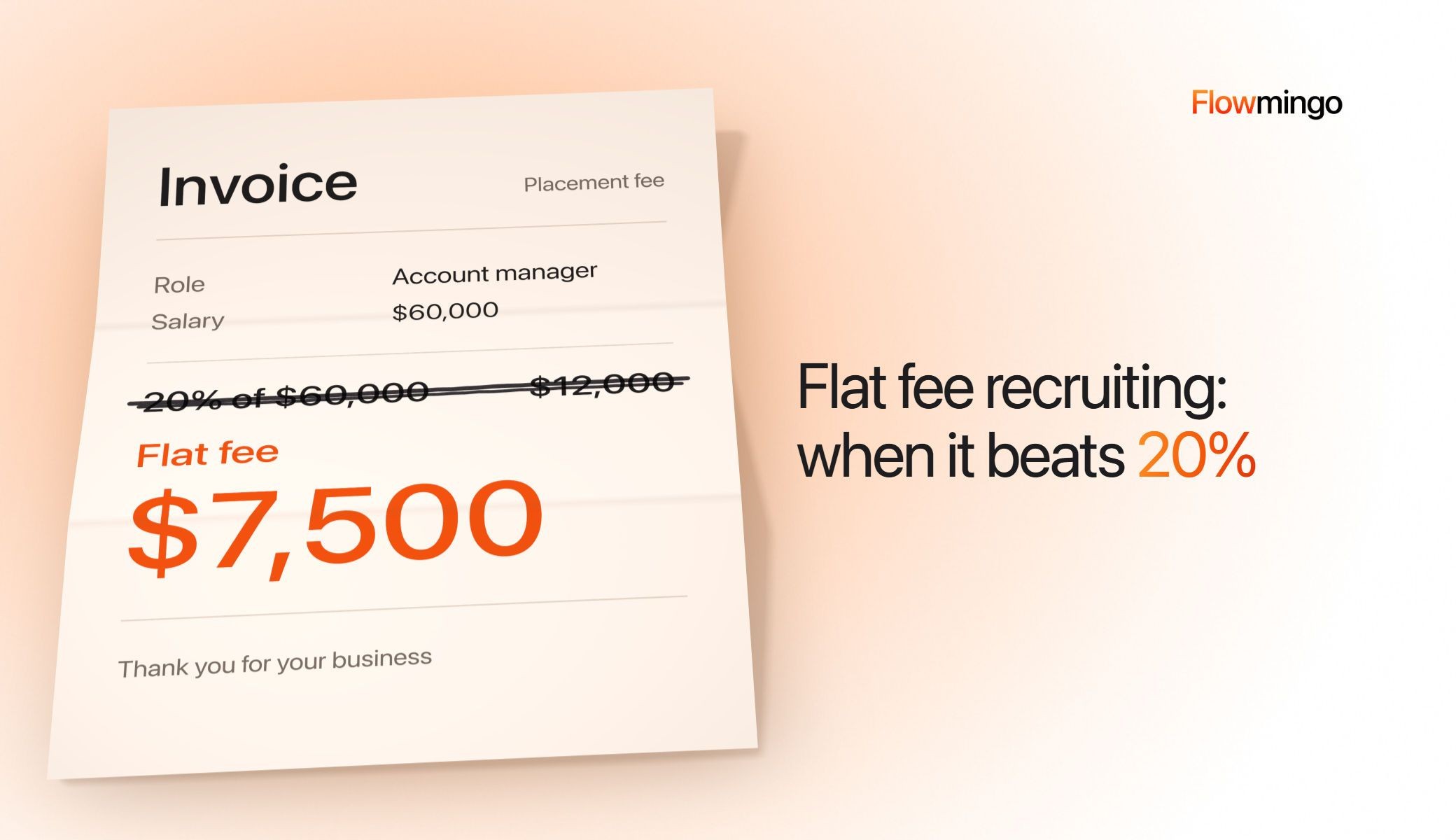
Flat fee recruiting is a pricing model in which the employer pays a recruiter 1 fixed price per role, agreed before the search starts. The price stays the same whatever salary the new hire earns.
If you run an agency, the term comes up when a client balks at a percentage fee on a senior hire. A flat fee recruitment agency trades the upside of high salaries for a price your client can plan around. You need to know where that trade pays.
Key takeaways
- What does a flat fee replace? A percentage fee. In a foundational 2016 SHRM article, contingency recruiters earned about 20% to 25% of first-year cash pay.
- When is a flat fee cheaper for the client? On higher salaries. Divide the flat fee by the percentage to find the break-even salary, and above it the flat fee costs less.
- What can the fee buy? It varies. Some firms run the whole search for 1 fee, while 1 UK provider sells job advertising alone from £350.
- Can the candidate be charged? Not in the UK, outside entertainment and modelling. The employer pays.
1. What is flat fee recruiting?
It sets the recruiter's price per role before work starts, instead of as a share of salary. For example, a $50,000 hire and a $120,000 hire carry the same fee.
Offers fall into 2 models. In a full-search flat fee, the recruiter sources, screens and arranges interviews: Reeve Jobs charges $7,500 for any salary, with no fee on hiring.
In a campaign flat fee, you buy set pieces of the work and run the rest yourself. 1 UK fixed-fee provider lists job advertising from £350, and managed support, such as shortlisting and interview scheduling, from £850.
It is not contingency recruiting, where the agency earns a percentage only when its candidate is hired. Retained search, at about 33% of first-year pay in a foundational 2016 SHRM article, is paid even if no one is hired. In the UK, the Employment Agencies Act 1973 also bars agencies from charging candidates for finding work, outside entertainment and modelling.
2. How does flat fee recruiting compare with a percentage fee?
A flat fee costs the client less once the salary passes a break-even point: the flat fee divided by the percentage. Below that salary, the percentage fee is cheaper.
For example, an agency quotes 1 client 3 roles at a $7,500 flat fee against its usual 20% contingency fee. The roles are a receptionist at $32,000, an account manager at $60,000 and an engineering lead at $110,000.
On contingency, the fees would be $6,400, $12,000 and $22,000, or $40,400 in all. The 3 flat fees total $22,500: $1,100 more on the receptionist, $4,500 less on the account manager and $14,500 less on the lead.
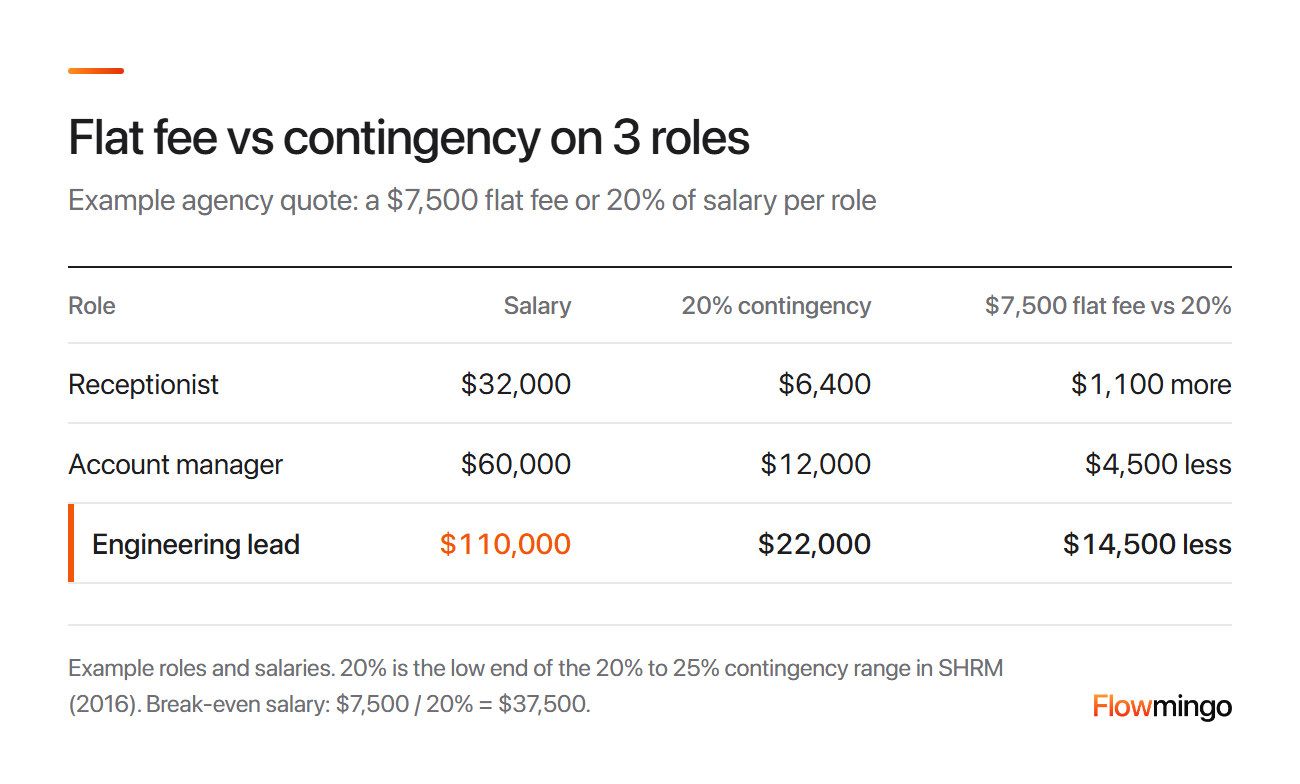
Flat fee vs contingency on 3 roles: the flat fee costs $1,100 more on the receptionist and $14,500 less on the engineering lead.
Here the break-even salary is $37,500, and at the 25% top of the SHRM range it drops to $30,000. So the agency kept contingency for the receptionist and quoted the flat fee for the 2 senior roles. The client saved $19,000, and the agency knew its fee on both roles before the search began.
3. How do you price a flat fee recruitment offer, step by step?
Price flat fee recruiting from the hours a role takes you, then write down the limits of what the fee buys. Each step below protects the margin that a percentage fee used to protect.
- Time 3 recent roles from brief to client-ready shortlist. Your hours are now the real cost, because a flat fee no longer rises with the salary.
- Set the fee from those hours plus your margin. Then test it against your percentage fee at the salaries your clients usually hire for.
- Work out your break-even salary. Divide the flat fee by your percentage, as the example did. Quote the percentage below that line, because there it is the cheaper offer.
- Write down what the fee buys. Name the shortlist size, the search rounds and the replacement terms. Reeve Jobs, for example, runs a second search at week 4 and replaces a hire who leaves within 30 days.
- Agree when you are paid. Up front, in stages or on the start date, because a fee paid only on hire leaves the risk of an unfilled role with you.
3.1 Which mistakes make a flat fee lose money?
The costliest mistake is an open-ended promise. If the fee covers the search until the role is filled, 1 hard role can eat the margin of 3 easy ones.
The second mistake is a flat fee on low salaries. Below the break-even point, contingency costs your client less, so the flat quote looks dear and you lose the role.
The third is a vague handover. A flat fee sells a result the client can check, so send every shortlist in the same client-ready format, with the evidence for each name. Our guide to recruitment process outsourcing covers the fee models used when a client hires at volume.
4. How do you run flat fee recruiting with Flowmingo?
Use Flowmingo for the first round on every flat-fee role, so each shortlist reaches the client in the same format with the evidence attached. The pricing, the brief and the final pick stay with you.
Before you start, have the hours from step 1 and the job description for each role. Run 1 role on your usual process and 1 with a structured first round, then compare the hours against your fee. This means you can see whether the flat fee from step 2 holds its margin.
How Flowmingo helps
Paste the job description and share 1 interview link with candidates. Every candidate comes back with the video, the transcript, a score for each skill and the reason behind it. Client links show names as initials and remove the email, phone and CV, so your client can't go around you. Sign up free to send client-ready shortlists in flat fee recruiting with Flowmingo.
5. Sources
Every fee, rule and price in this glossary entry links to its source below.
- Feffer, M. (2016, July 18). How to work effectively with an executive search firm. SHRM. SHRM
- Flat Fee Recruiter. (n.d.). Pricing. Retrieved 27 October 2026. Flat Fee Recruiter
- GOV.UK. (n.d.). Your rights as an agency worker: Fees. Retrieved 27 October 2026. GOV.UK
- Reeve Jobs. (n.d.). Retained flat fee recruiting. Retrieved 26 October 2026. Reeve Jobs
- UK Parliament. (1973). Employment Agencies Act 1973, section 6. legislation.gov.uk. legislation.gov.uk