
Your boss wants AI in recruitment this quarter. Of the first 10 search results we read on 4 Oct 2026, 8 come from organisations that sell something. That is AI in hiring in 2026: plenty of claims, few measured results.
You are not behind. SHRM's 2026 survey found 39% of organisations had implemented AI in HR, and 56% of HR functions did not formally measure its success.
Pick the wrong stage and the risk lands on you. In 1 lab audit, 3 AI models preferred white-associated names in 85.1% of 27 race tests. Pick the right stage and 1 preprint field trial of entry-level hiring found 12% more job offers, with people deciding.
Below, stage by stage, is where AI in recruitment has evidence and where it has none. The 3 moves: test the tool on your data, keep a person on every cut, tell candidates.
Key takeaways
- Where does AI belong in recruitment? At routine, checkable steps like sorting CVs, with a person on every cut and the final decision.
- Does AI in recruitment improve hiring? Not shown for quality of hire. 1 preprint trial of entry-level hiring found 12% more job offers from AI-led first interviews, with people deciding.
- Is AI screening biased? It can be: in 1 lab audit, 3 AI models preferred white-associated names in 85.1% of tests. Swap names to test yours.
- What do I owe candidates? Notice in several places, a bias audit in New York City and, in Colorado from 2027, human review on request (where commercially reasonable).
- Where should a small team start? With 1 stage and 3 numbers recorded first: screening hours, days to first interview and 6-month hire ratings.
1. Where should I use AI in recruitment, and where should a person still decide?
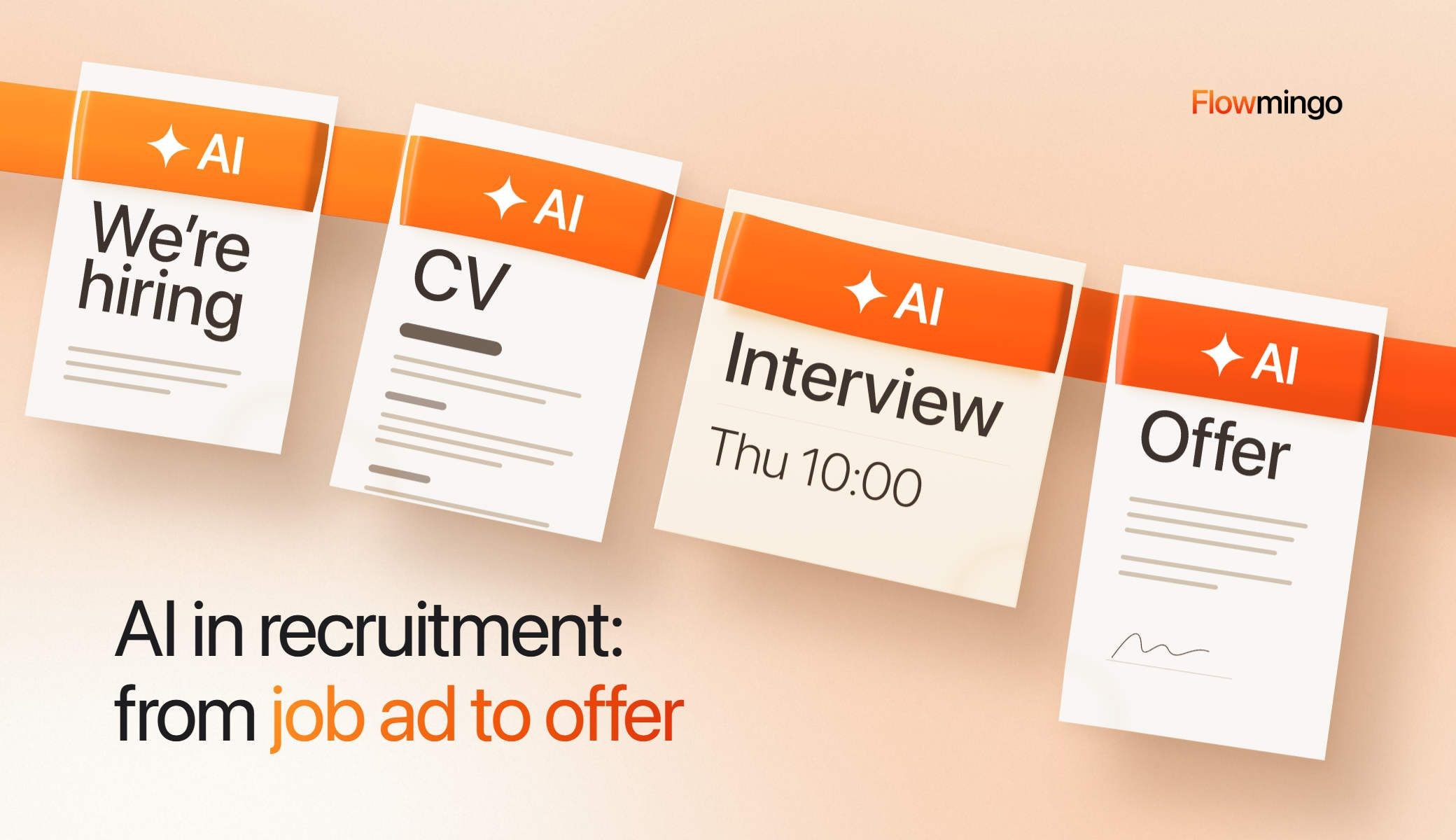
Use AI where the task is routine and you can check the result: sorting CVs, running a structured interview and scheduling. Keep a person on the final decision, because the 1 field trial that found better outcomes left every hiring decision with humans.
The table maps what independent research found at each stage.
| Stage | Where it goes wrong | Evidence found |
|---|---|---|
| Sourcing and ads | A neutral STEM ad reached over 20% more men than women in 191 countries | 1 field test (foundational) |
| CV screening | Preferred white-associated names in 85.1% of 27 tests; 22 models picked the first-listed CV 63.5% of the time (Rozado) | Lab audits of AI models; 1 firm study |
| Interviewing | Scoring studies are early, and both urge caution | 1 randomised field trial; 2 scoring studies |
| Scheduling | Unknown | No independent study found |
| Final decision | People copy a biased AI up to 90% in the lab; 71% of US adults oppose AI deciding | 1 lab study; 1 public survey (foundational) |
Sourcing happens before anyone screens a CV, so later checks never see its skew. In a foundational 2019 field test, a neutral STEM ad still reached more men than women (Lambrecht and Tucker).
This is our reading, not a finding. So test where evidence is thick, pilot where it is thin, and keep a person where you cannot check the tool.
*Evidence by hiring stage: CV screening is the most studied.
1.1 Will AI replace recruiters?
No study found measures replacement. TAFEP, Singapore's fair-employment body, says employers, not algorithms, remain accountable, so the job shifts toward reviewing, overruling and explaining (our reading). For example, you stop reading 200 CVs top to bottom and read the AI's reasons for the 20 lowest scores.
2. How many companies use AI in recruitment, and does it really save time or improve hires?
SHRM's surveys put AI use in HR at 39% to 43% of organisations, and LinkedIn found 11% integrating AI, so definitions explain the spread. Time saved is self-reported, 56% of HR functions do not formally measure results, and the best outcome evidence is 1 field trial.
Each row asks a different group a different question, so you cannot subtract one row from another.
| Survey | Who was asked | What counted | Result |
|---|---|---|---|
| SHRM Talent Trends 2025 | 2,040 US HR professionals | Organisation uses AI for HR tasks | 43%, up from 26% in 2024 |
| SHRM State of AI in HR 2026 | 1,900+ HR professionals | AI implemented in HR | 39%, with 7% more planning; 27% use it in recruiting |
| LinkedIn Future of Recruiting 2025 | 1,271 recruiting professionals, 23 countries | Generative AI in hiring | 11% integrating, 26% experimenting, 31% exploring, 32% not using |
SHRM's 43% and 39% are not a decline, because the 2 surveys used different wording and samples (SHRM 2025; SHRM 2026). In LinkedIn's 2025 report, a foundational late-2024 survey, 63% of recruiting professionals were not yet integrating or experimenting with generative AI. LinkedIn's newer Talent 2026 research (HR Dive) found 93% of surveyed recruiters planned to grow their AI use, so treat the 63% as dated.
Among LinkedIn's experimenters and integrators, the average saving is about 20% of the work week. In Greenhouse's survey, 50% of US recruiters say AI has improved hiring overall, mainly by saving time on screening and scheduling. Those are opinions: SHRM found only 16% of HR functions use ROI as a metric for their AI.
Flowmingo data · AI interviews finished 24 Jun to 20 Sep 2026 (41,572 at 860 companies; 37,201 with a report time, finished from 6 Jul) · recruiter invites sent 15 Jun to 13 Sep 2026 (52,078 at 866 companies)
- 15 seconds was the median time from a candidate finishing to the AI score being stored.
- About 4 minutes was the median time until the recruiter's report was set to appear, once the retake window closed.
- 24.8 hours was the median time from the invite to a finished interview, among applicants who finished within 14 days.
The 4 minutes is when the report is released, not opened, and the 24.8 hours starts at the send. This shows speed, not quality.
3. Does AI resume screening pick better candidates than my recruiters, or just reject faster?
Sometimes better, but only for a model built and tested on 1 firm's own data, not for AI screeners in general. At 1 Fortune 500 firm, 10% of recruiters' interview picks got hired, against an estimated 27% to 32% for the models' picks.
Li, Raymond and Bergman studied 88,666 applications at that firm, which rejects 95% of applicants at resume review. Both models trained on its own history, so you cannot buy this.
The design changed who got interviewed. The standard model behind the 32% cut the Black and Hispanic share of interviewees from 9.4% to 4.2%. The exploration model behind the 27% raised it to 24.3%.
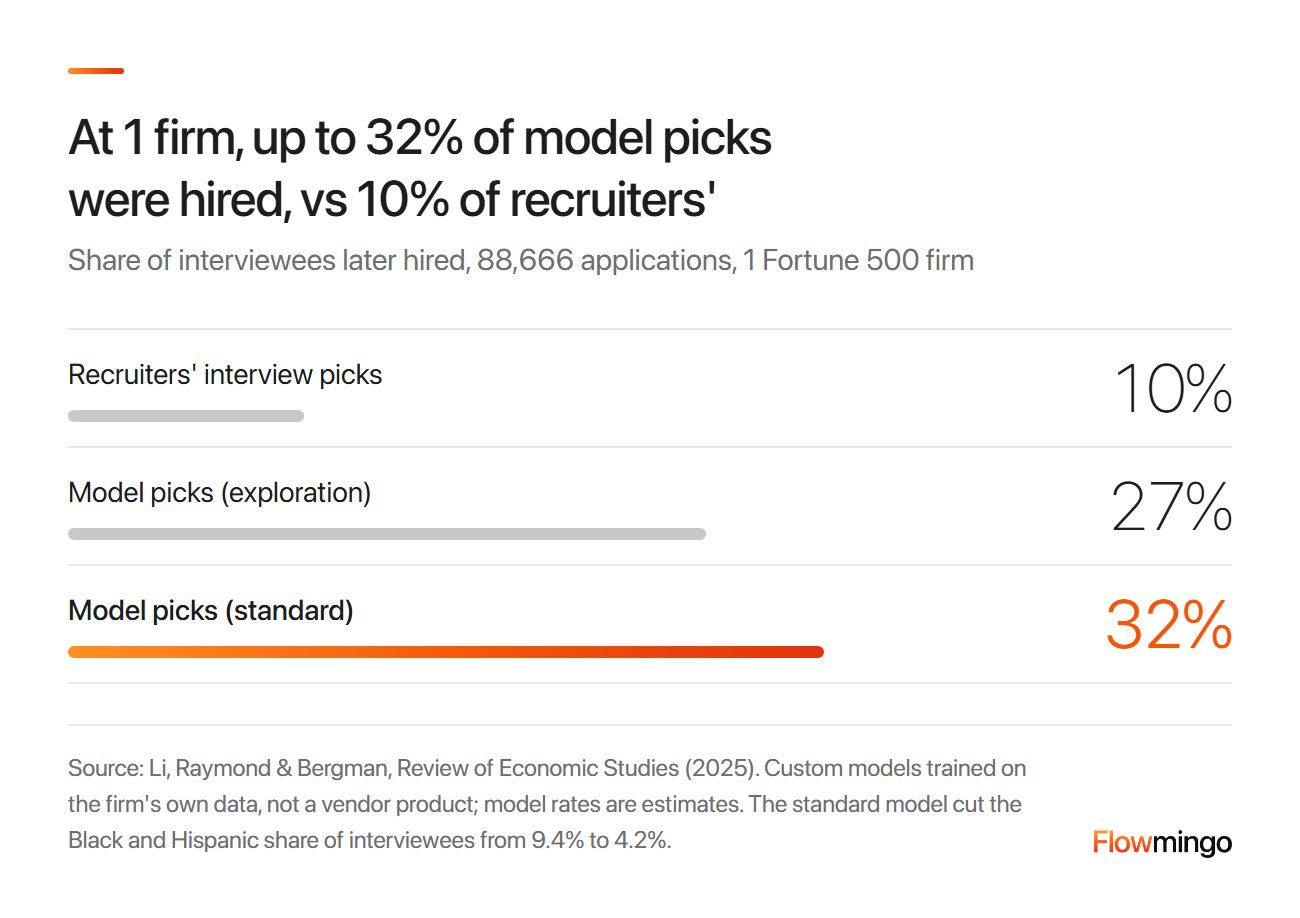
Recruiter vs model picks: at 1 Fortune 500 firm, 10% of recruiters' interview picks got hired, against an estimated 27% to 32% for 2 models.
A fast screen helps only if the rejected are the right people, so see candidate shortlisting.
3.1 Can I paste CVs into ChatGPT and ask for a shortlist?
Only as a first sort that a person checks. Hidden text in a CV can change the ranking: attack success passed 80% for some tricks in 1 test (Mu and colleagues).
- Paste plain text so hidden text shows, remove names and photos, and swap the order.
- Check where pasted CVs go, because the UK ICO found tools keeping candidate data indefinitely.
4. Do AI interview scores predict who will do the job well, or just who interviews well?
We found no independent study linking AI interview scores to job performance. The closest evidence is 1 field trial of 70,884 applications, where AI-led first interviews produced 12% more job offers and people made every hiring decision.
Jabarian and Henkel randomly assigned 67,056 eligible applications to an AI voice interviewer, a human recruiter or a free choice.
Among the 53,660 applications in the AI and human groups, offers were 9.73% with the AI and 8.70% with humans. Job starts and employment at 1 month each rose 18%.
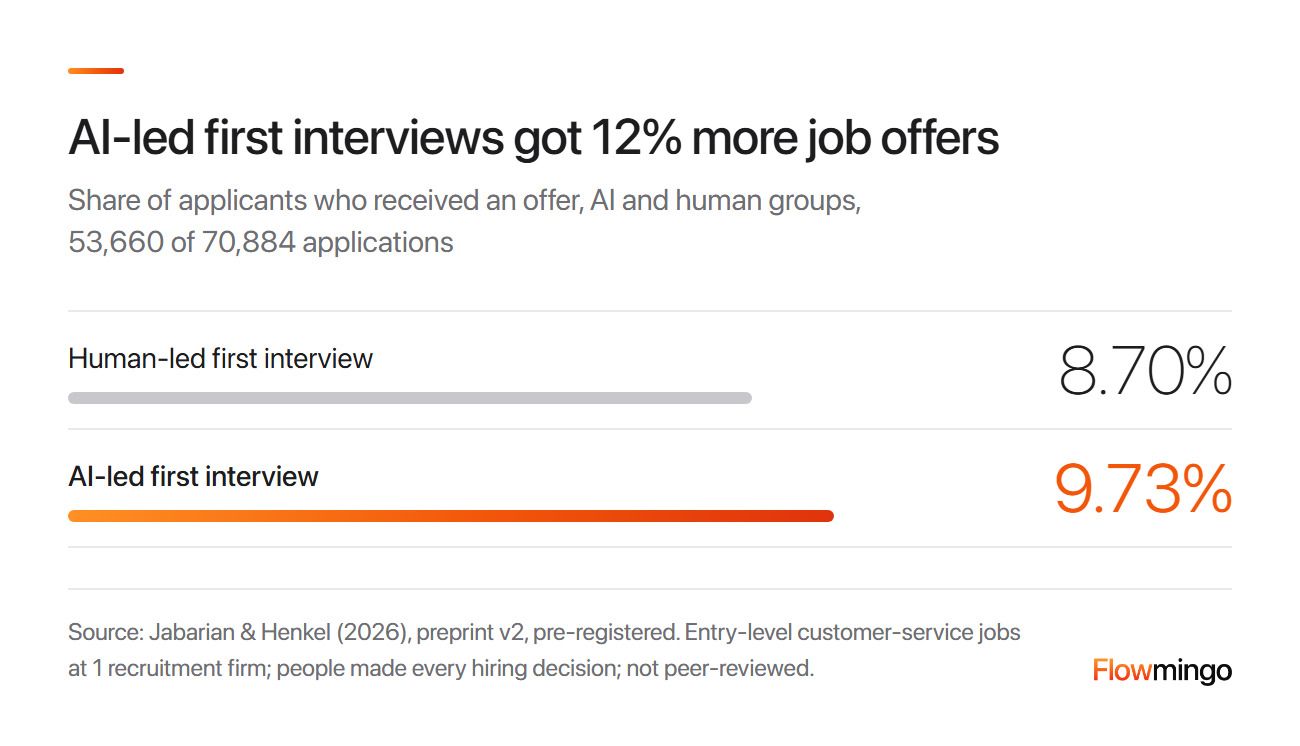
AI-led vs human-led first interview: 9.73% of applicants with an AI-led interview got an offer (3,904 of 40,103). It was 8.70% with a human recruiter (1,179 of 13,557), so AI-led got 12% more (preprint).
It is a preprint (version 2) from entry-level customer-service hiring at 1 Philippine recruitment firm, where recruiters knew each applicant's interview type. Treat it as a hint, because it compares interview types, not scores against performance.
Among hires with performance records, it found no significant productivity difference (handling time, satisfaction, quality scores). Recruiters weighted AI interview scores less than their own, leaning on language tests.
Of 2 peer-reviewed AI-scoring studies, Hickman and colleagues tested personality scores in 4 mock-interview samples (foundational, 2022), with no job-performance or adverse-impact analysis. Stockdale, Hickman and Liu (2026) found averaged AI models may score as well as 1 human rater. Both teams urged caution, the second for high-stakes use.
A foundational 2022 re-analysis found structured interviews predict job performance about twice as well as unstructured ones (Sackett and colleagues). They scored 0.42 against 0.19, where 0 means no link and 1 a perfect one.
That evidence covers human-run interviews, so AI's best job may be enforcing structure (our reading). Our structured interview and fair AI interview rubrics guides show how.
Flowmingo data · 41,342 AI interviews finished with a valid score · 819 companies · 6 Jul to 30 Sep 2026, a different window from section 2
- 6.4 out of 10 was the median score across all finished AI interviews.
- 7.3% of scores were 8 or more out of 10, and 0.64% were 9 or more.
- 2.1 to 8.3 was the range of company medians across 192 companies with 30 or more scored interviews.
These are AI scores against each company's own weighted criteria, not job performance, so a 7 at one company is not a 7 at another. Scoring changed on 6 Jul 2026, so only this window is comparable. Earlier guides quote 6.4% (pooled since July 2025) and 5.2% (16,057 interviews from invites sent 15 Jun to 13 Sep).
How Flowmingo helps
The AI Interviewer gives every applicant a structured, spoken interview in their own time, with a follow-up when an answer is thin. Flowmingo's scoring page says a 6.2 is not a 62% chance of success.
5. Is AI in recruitment biased, and how would I know if ours rejects good candidates?
Yes, it can. Test it with swapped names and a pass-rate check, because a vendor's label is not a test.
A foundational 2022 audit of human hiring found distinctively Black names got 2.1 percentage points fewer contacts at 108 large US employers (Kline and colleagues).
In a lab audit of 3 text-embedding models, white-associated names won 85.1% of 27 race tests (Wilson and Caliskan, October 2024).
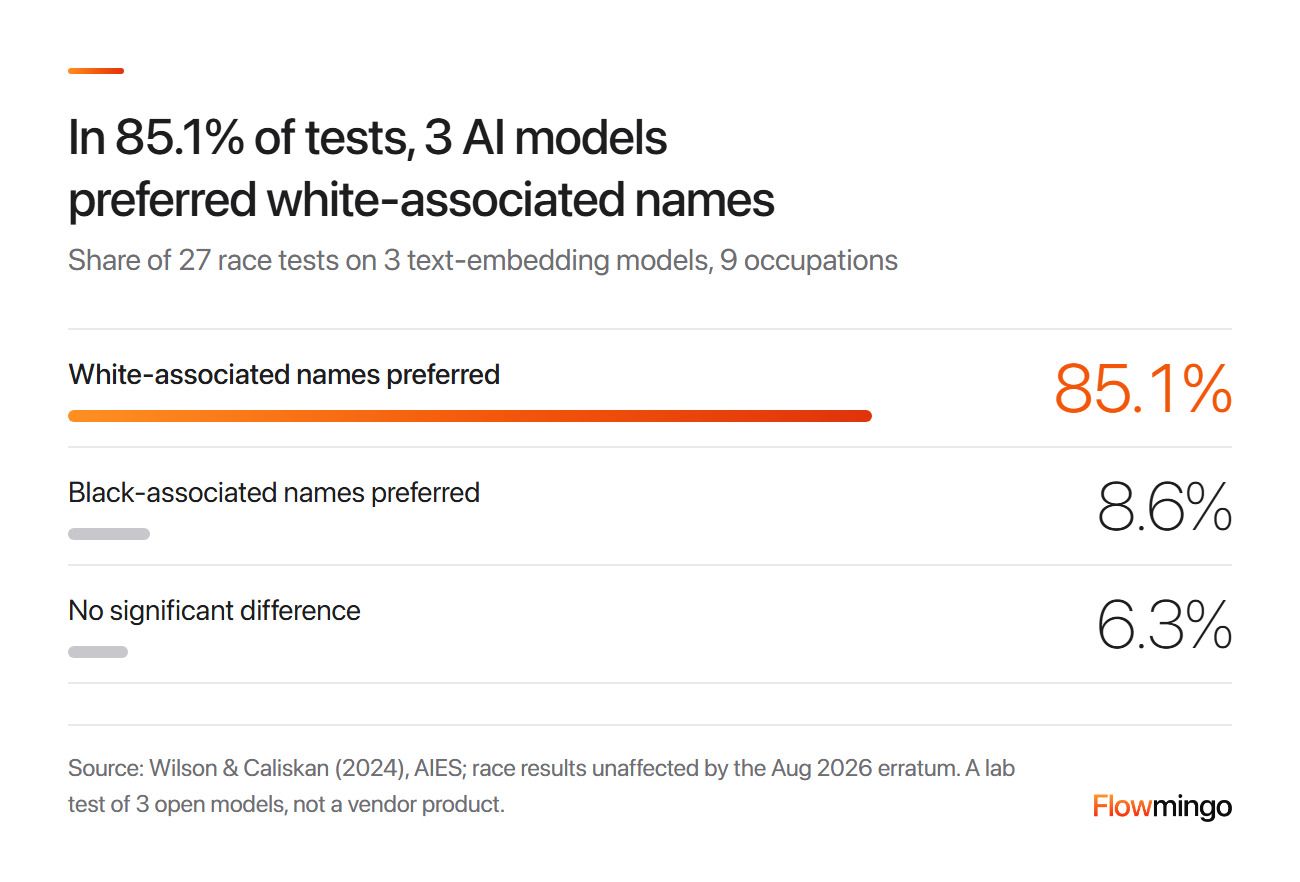
Name-swap audit: in an October 2024 audit of 3 AI models, white-associated names won 85.1% of 27 race tests. Black-associated names won 8.6%, and 6.3% showed no significant difference.
Run checks 1 to 3 every quarter and check 4 every week (our rule of thumb, not a study):
- Swap the names: copy 20 screened CVs, change only the name, and log any score or rank change.
- Swap the order: show 2 CVs in both orders, and if the first one wins twice, expect an order effect.
- Check pass rates by group and age: divide each group's advance rate by the highest group's and look closer under 80%.
- Read the bottom: note any of the 20 lowest-scored applicants you would have interviewed.
Run check 3 only where you may lawfully record group data. The EU and UK limit it, so ask counsel or your vendor to run it.
The 80% rule generally treats a selection rate under 80% of the highest group's as evidence of adverse impact (29 CFR 1607.4). It is a rule of thumb, not a safe harbour, and it does not name age. For example, if 30% of men and 20% of women advance, 20 divided by 30 is 0.67, under 0.8.
As of 4 October 2026 the rule is still in the eCFR. On 9 June 2026, the Justice Department's Office of Legal Counsel called the guidelines behind it an unconstitutional reading of Title VII. The EEOC plans to rescind them in November 2026.
Title VII's disparate-impact liability and private lawsuits remain, so keep the check as your own monitor.
6. Can AI make the final hiring decision, or must a person review every rejection?
No: a person makes the final decision and owns every cut the tool recommends, and TAFEP says AI should inform decisions, not make them. From 2027, Colorado gives rejected applicants a way to ask for human review, where commercially reasonable (SB26-189).
71% of 11,004 US adults opposed AI making the final hiring decision in a foundational December 2022 survey (Pew).
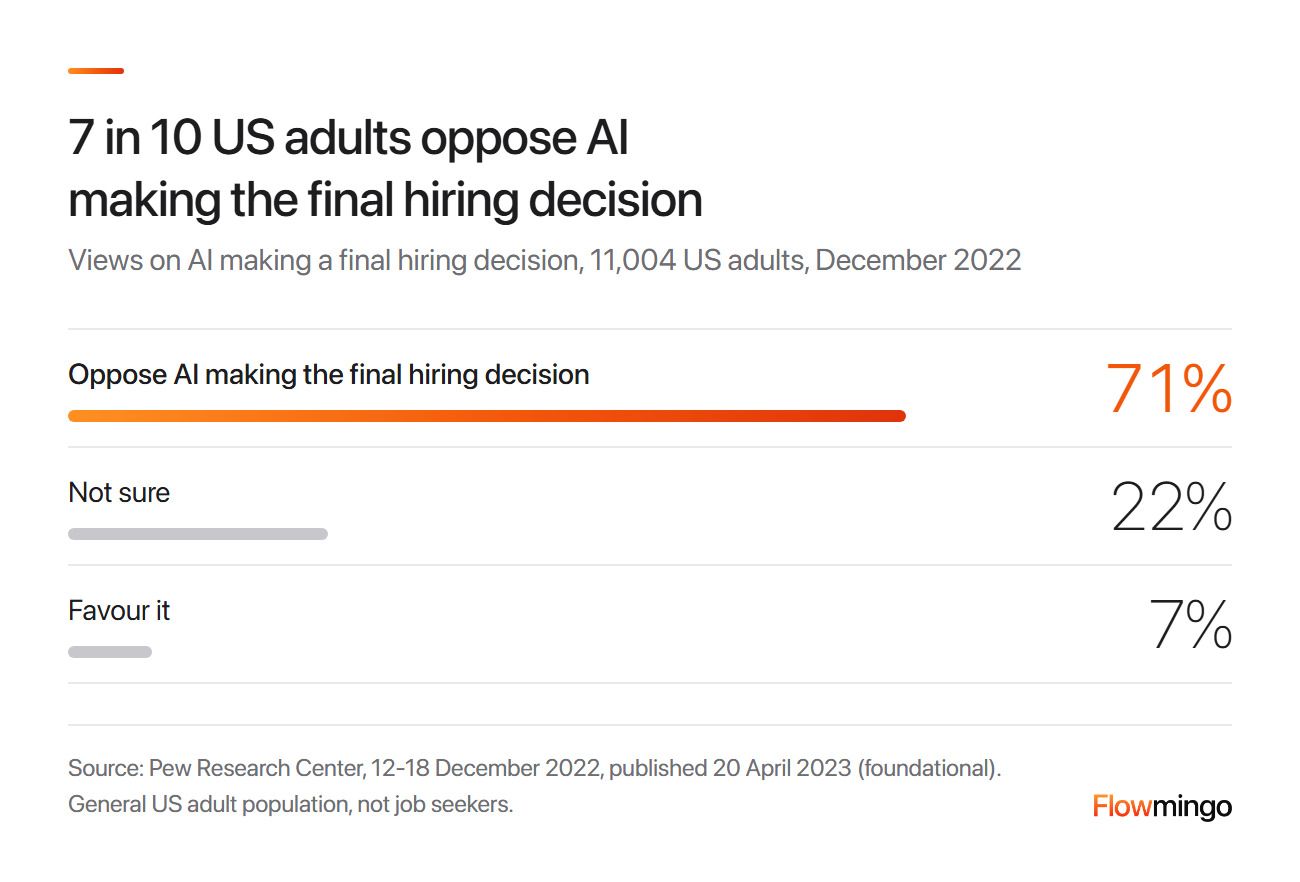
US views on AI deciding: 71% of 11,004 US adults opposed AI making the final hiring decision. 22% were not sure and 7% favoured it (foundational Pew survey, December 2022).
In a lab experiment with 528 participants, people followed a biased simulated AI up to 90% of the time (Wilson and colleagues). So a person in the loop is not a safeguard by default: audit the tool and let the reviewer overrule it (our reading).
Owning a cut does not mean reading every CV, because TAFEP asks for oversight and Colorado for review on request. The AI sorts, and a person sets each cut, reads the band just below it and samples the rest. For an AI interview, a person reads the report before anyone is rejected (practice advice, not legal advice).
6.1 Is it ethical to use AI in recruitment?
Ethical use means 3 checks you can verify: candidates know, a person decides, and you test the tool on your own data. For example, log overrides with reasons to prove a person decided, because lab participants copied a biased AI up to 90% of the time.
7. Do I have to tell candidates we use AI in recruitment, and will they walk away?
Tell them: New York City, Illinois, Colorado and Singapore's guidance all ask for notice or explanation, though some applicants will leave. In Greenhouse's 2026 survey, 38% of US job seekers walked away over AI interviews; in 1 trial, 5% of AI interviews ended in refusal.
Candidates already suspect AI: 52% believe it screens their application and only 26% trust it to evaluate them fairly (Gartner). Greenhouse's survey of 1,200 US job seekers also found 70% were never clearly told upfront that AI would evaluate them (both self-reported).
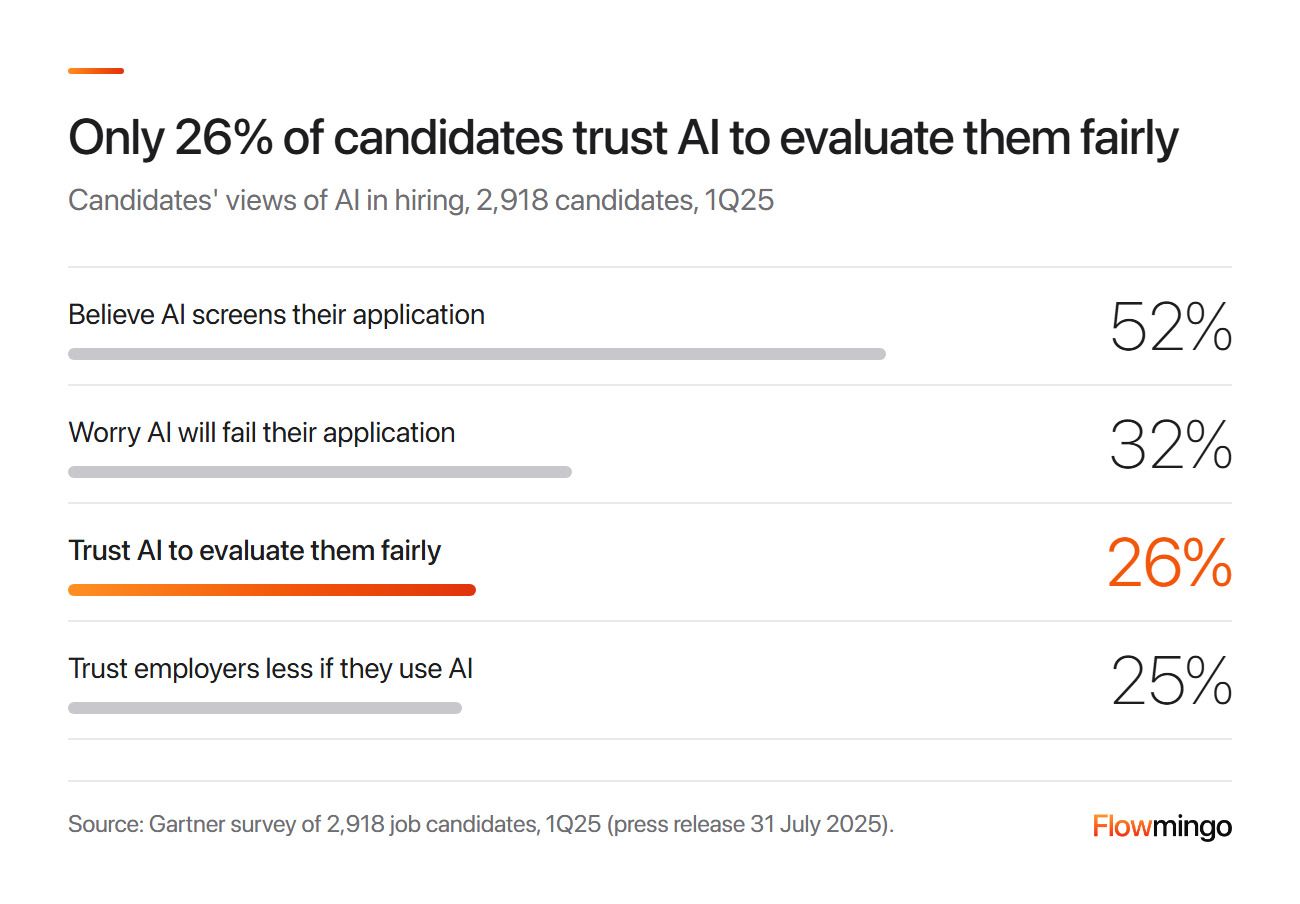
Candidate trust in AI hiring: of 2,918 candidates, 52% believe AI screens their application and 32% worry it will fail them. 26% trust it to evaluate them fairly and 25% trust employers less.
Attitude is not behaviour: in the same Philippine trial (Jabarian and Henkel), 78% of applicants chose the AI interviewer when given the choice. Those who chose it scored lower on language and analytical tests than those who chose a person. Applicants rated AI-led interviews less natural, and 7% ended in a technical failure, so the 78% is a hint, not a promise.
Flowmingo data · 52,078 AI interview invites sent by recruiters · 866 companies · 15 Jun to 13 Sep 2026
- 62.6% of invited applicants never opened the interview link within 14 days.
- 36.3% began the interview, and 30.9% finished it within 14 days.
- 85.1% of the applicants who began the interview finished it.
Behaviour, not cause. "Opened" means reaching the interview page and entering an email address. Flowmingo network invites are excluded.
Most of the loss happens before applicants open the link, and these data cannot tell AI aversion from a missed invite. So name the AI step in your notice and watch your open rate. AI interview completion rates has the full data.
Put a notice in the job ad and the invitation. Our interview invitation email and fair and compliant AI interview process guides cover the rest. Illustrative wording, not legal advice; promise only what you do:
We use an AI tool to interview every applicant on the same job-related topics and score answers against the job's criteria. [It scores what you say, not your face, accent or name.] A person on our team reviews the results and makes every hiring decision. To ask for a person to review your result, or another way to apply, email [name] at [email].
Delete the bracketed line unless your vendor confirms it. If the tool records video, add that and the retention period, because Illinois asks for consent first.
8. Which laws cover AI in recruitment for my company: EU, New York, Illinois, Colorado, Singapore?
It depends on where you hire: New York City and Illinois now, Colorado from 2027, the EU from 2 Dec 2027, plus Singapore's guidance. None bans AI in recruitment as such, but together they ask for notice, bias testing, human oversight and records.
This is general information, not legal advice, so check with counsel.
| Where | Rule and date | What it asks of you |
|---|---|---|
| EU | AI Act high-risk date moved to 2 Dec 2027 (Regulation 2026/1744); emotion-inference ban since 2 Feb 2025 | Human oversight, notice, logs 6+ months; fines up to EUR 15 million or 3%, or EUR 35 million or 7% for banned practices |
| New York City | Local Law 144, enforced since 5 Jul 2023 (foundational) | Bias audit within a year, public summary, notice 10 business days before use |
| Illinois | HB 3773 from 1 Jan 2026; AI Video Interview Act | Notice, no discriminatory effect; AI video analysis needs consent, deletion within 30 days on request |
| Colorado | SB26-189 from 1 Jan 2027 | Notice; explanation within 30 days of an adverse outcome; data correction; human review on request, where commercially reasonable; records 3 years |
| California | Civil Rights Council rules from 1 Oct 2025 | Covers automated decisions; records 4 years |
| US federal | Title VII, ADEA, ADA; the 80% rule, now under federal review (section 5) | Employer carries the risk; Mobley v. Workday is a claim against the vendor, preliminary certification 16 May 2025, no finding of discrimination, ongoing |
| Singapore | No AI-in-hiring statute found; Tripartite Guidelines now; Workplace Fairness Act aimed at end-2027 | AI informs, people decide; keep records; firms under 25 staff exempt at first |
In the EU, the date for recruitment AI moved to 2 December 2027 but the duties did not (Cooley). Guides written before July 2026 still show 2 August 2026, our inference from the dates. GDPR Article 22 separately restricts solely automated decisions.
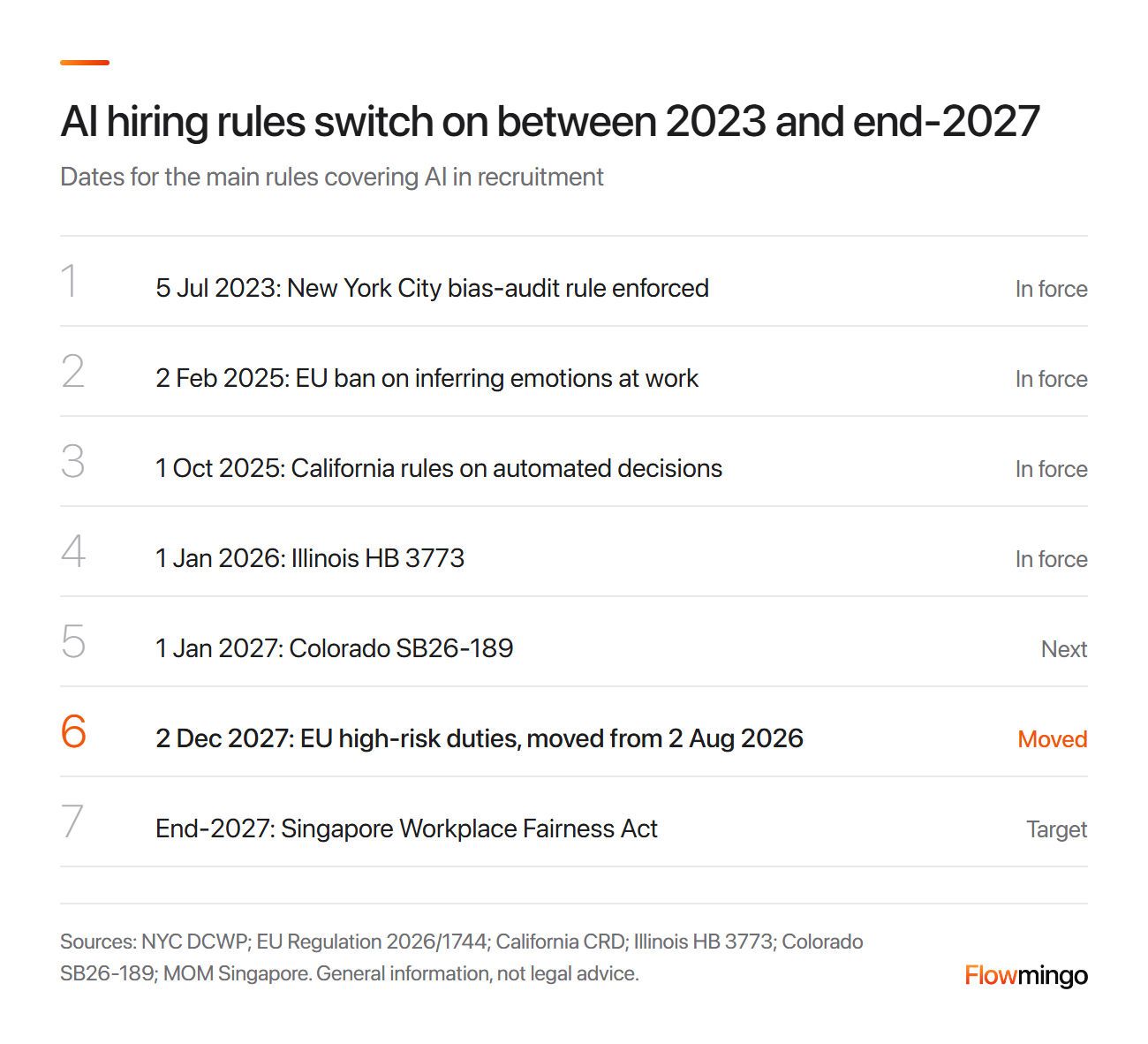
AI hiring rules by date: New York City since 5 Jul 2023, Illinois since 1 Jan 2026 and Colorado from 1 Jan 2027. EU high-risk duties start 2 Dec 2027, and Singapore's act is aimed at end-2027.
Low enforcement is not a defence, because the employer carries the risk. The State Comptroller found the city received only 2 complaints in 2 years. The city found 1 issue at 32 companies, where the auditors found at least 17 potential violations (Comptroller).
The laws add up to 3 habits:
- Tell candidates before use and keep a person on every decision and review request.
- Keep criteria, scores and reasons for at least 1 year in the US, longer once a charge is filed (29 CFR 1602.14).
- Ask your vendor for its bias audit if you hire in New York City.
9. What should I ask an AI recruiting vendor before I trust its scores?
Ask what the score is computed from, ask for pass rates by sex, race and age, and test the tool on your own past applicants. A vendor that cannot answer all 3 gives you no way to judge its scores.
The UK ICO audited AI recruitment tools, made nearly 300 recommendations and published 6 questions for buyers in November 2024 (ICO). It found tools guessing ethnicity from names. The table is a checklist built from those questions and this guide's studies.
| Ask the vendor | A weak answer sounds like |
|---|---|
| What is the score computed from? | "Our proprietary model" |
| Can you show pass rates by sex, race and age, or help us run them? | "We do not collect demographics" and no bias audit |
| Can we test it on our past applicants first? | No pilot, or a 12-month contract first |
| Can I see each score's reasons and overrule it? | A score with no reasons or override |
| Does it infer traits from names, photos, voice or video? | It infers traits or emotions |
| Where do CVs and recordings go, and for how long? | No retention limit |
In a journalist's test, a video-interview tool gave gibberish a 73% match (Schellmann, a foundational book from January 2024). So in the demo, read nonsense into the tool and see whether the score moves.
Insist on your own data, because the best CV result in section 3 came from models trained on 1 firm's history. Pilot on your past applicants.
Say you run the tool on 50 past applicants you already hired or rejected. If 5 of the 10 you rated highest score below its cut, it would have rejected half your best people. Run that test before you sign anything.
10. With 200+ applicants and no HR team, where does AI in recruitment help first?
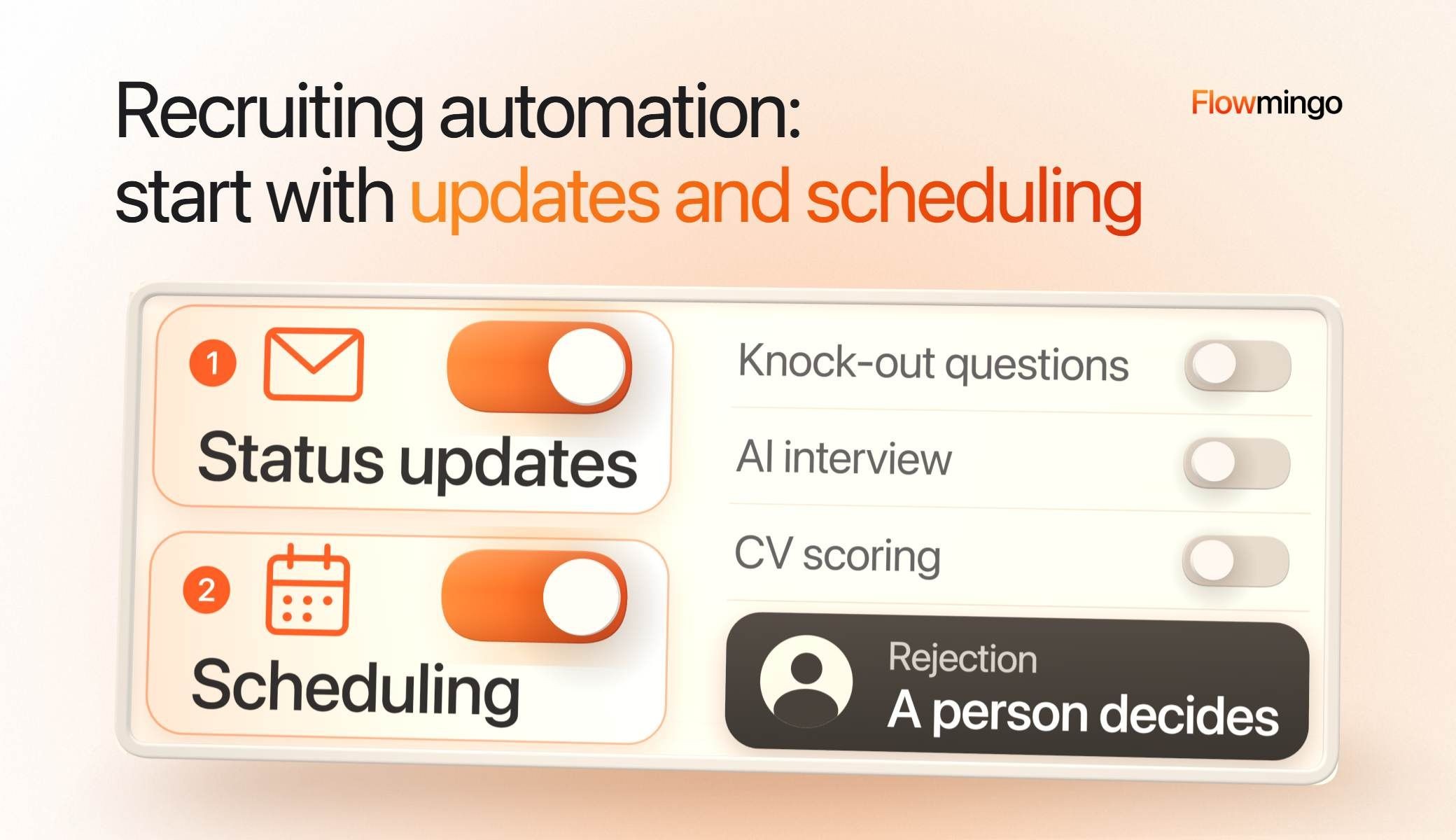
Start with 1 stage: scoring CVs against written criteria, or 1 structured first interview, with a person making every cut. Record 3 numbers first and review after 4 weeks.
The average job on Greenhouse's North American platform drew 244 applications in 2025. Recruiters per organisation fell 55.6% from 2022 to 2025 (Greenhouse). Choose 1 stage, because 4 tools at once hide which helped.
Before switching anything on, record these and the pass rate by group (section 5). Recruiting metrics shows how to calculate them:
- Hours your team spends screening 1 role.
- Days from application to first interview.
- How your last hires rated at 6 months, or the share still in role.
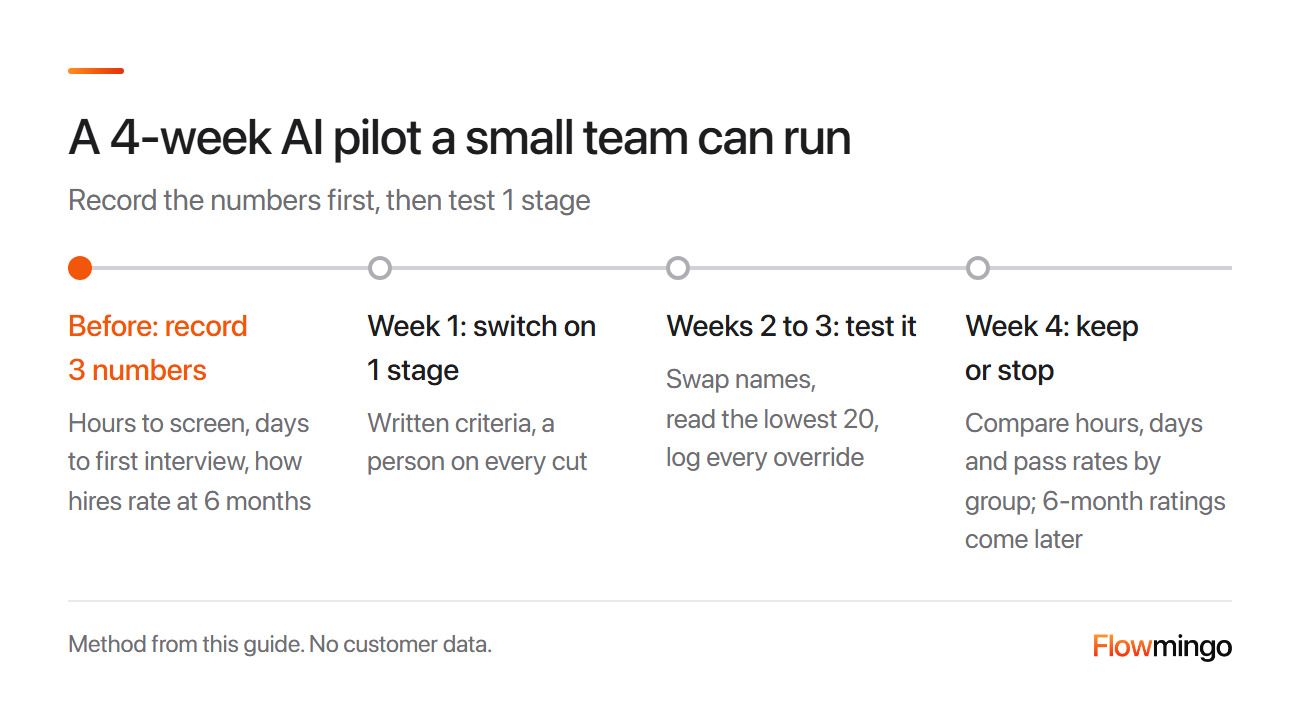
4-week AI pilot: record 3 numbers first, switch on 1 stage with a person on every cut, and test it. Then keep or stop at week 4 and check 6-month ratings later.
This pilot is a practice, not a study. Week 1 switches on 1 stage with written criteria, and weeks 2 to 3 swap names, read the 20 lowest-scored applicants and log every override. In week 4, compare numbers 1 and 2 and the pass rates, then keep or stop; number 3 waits until the hires reach 6 months.
Tell candidates, keep records and ask the vendor questions (sections 7 to 9) before you pay. The hiring process steps guide shows where each stage sits.
How Flowmingo helps
Flowmingo is an AI interviewer plus every other way to evaluate every candidate, for $0. CV Evaluation turns a job description into criteria you edit. It scores every CV 0 to 10 with 3 to 5 sentences of evidence, and filters nobody out automatically. The AI interview adds a spoken interview with your must-ask questions. Pilot 1 stage of AI in recruitment with Flowmingo.
11. Sources
Every study, law and survey here has a source below; Flowmingo figures come from its own platform data.
- California Civil Rights Department (2025). Civil Rights Council secures approval for regulations to protect against employment discrimination related to artificial intelligence. California Civil Rights Department.
- Colorado General Assembly (2026). SB26-189: Automated decision-making technology. Colorado General Assembly.
- Cooley (2026). Digital AI omnibus delays key deadlines, introduces new rules. Cooley LLP.
- Crowell & Moring (2024). Artificial intelligence in employment update: Illinois requires notice and prohibits discriminatory impact in use of AI. Crowell & Moring LLP.
- EU Artificial Intelligence Act website (n.d.). Annex III: High-risk AI systems referred to in Article 6(2); Article 26: Obligations of deployers of high-risk AI systems; Article 99: Penalties.
- European Union (2026). Regulation (EU) 2026/1744 amending Regulation (EU) 2024/1689 (Digital Omnibus on AI). Official Journal of the European Union.
- Ewen, L. (2026). Recruiters are increasing their AI usage as pressure to hire intensifies. HR Dive.
- FindLaw (n.d.). Illinois Artificial Intelligence Video Interview Act, 820 ILCS 42/5. FindLaw.
- Gartner (2025). Gartner survey shows just 26% of job applicants trust AI will fairly evaluate them. Gartner newsroom.
- Greenhouse (2025). An AI trust crisis: 70% of hiring managers trust AI to make faster and better hiring decisions. Greenhouse newsroom.
- Greenhouse (2026, May 1). 63% of job seekers have faced an AI interview. Most haven't had a good one yet. Greenhouse 2026 Candidate AI Interview Report.
- Greenhouse (2026). The Hire Standard: Greenhouse benchmark report, North America. Greenhouse.
- Hickman, L., Bosch, N., Ng, V., Saef, R., Tay, L., & Woo, S. E. (2022). Automated video interview personality assessments: Reliability, validity, and generalizability investigations. Journal of Applied Psychology.
- Holland & Knight (2025). Federal court allows collective action lawsuit over alleged AI age discrimination (Mobley v. Workday). Holland & Knight LLP.
- Information Commissioner's Office (2024). Thinking of using AI to assist recruitment? Our key data protection considerations. ICO.
- Information Commissioner's Office (2024). ICO intervention into AI recruitment tools leads to better data protection for job seekers. ICO.
- Intersoft Consulting (n.d.). Art. 22 GDPR: Automated individual decision-making, including profiling. GDPR-info.eu.
- Jabarian, B., & Henkel, L. (2026). Voice AI in firms: A natural field experiment on automated job interviews. arXiv preprint 2607.28222, version 2.
- Kline, P., Rose, E. K., & Walters, C. R. (2022). Systemic discrimination among large U.S. employers. The Quarterly Journal of Economics.
- Lambrecht, A., & Tucker, C. (2019). Algorithmic bias? An empirical study of apparent gender-based discrimination in the display of STEM career ads. Management Science.
- Li, D., Raymond, L., & Bergman, P. (2025). Hiring as exploration. The Review of Economic Studies.
- LinkedIn Talent Solutions (2025). Future of recruiting 2025. LinkedIn.
- Ministry of Manpower, Singapore (2025). Workplace Fairness (Dispute Resolution) Bill press release. MOM.
- Mu, H., Liu, J., Wan, K., Xing, R., Chen, X., Baldwin, T., & Che, W. (2025). AI security beyond core domains: Resume screening as a case study of adversarial vulnerabilities in specialized LLM applications. arXiv preprint.
- NYC Department of Consumer and Worker Protection (n.d., read 2026). Automated employment decision tools (AEDT). City of New York.
- Office of Legal Counsel, US Department of Justice (2026). Constitutionality of disparate-impact liability under Title VII. DOJ.
- Office of the New York State Comptroller (2025). Enforcement of Local Law 144: Automated employment decision tools. Report 2024-N-6.
- Pew Research Center (2023). AI in hiring and evaluating workers: What Americans think. Pew Research Center.
- Rozado, D. (2026). Gender and positional biases in LLM-based hiring decisions: Evidence from comparative CV/resume evaluations. PeerJ Computer Science, 12, e3628.
- Sackett, P. R., Zhang, C., Berry, C. M., & Lievens, F. (2022). Revisiting meta-analytic estimates of validity in personnel selection: Addressing systematic overcorrection for restriction of range. Journal of Applied Psychology.
- Schellmann, H. (2024). The algorithm: How AI decides who gets hired, monitored, promoted, and fired and why we need to fight back now. Hachette Books. Reviewed in Selinger, E. (2024). Keeping humans in the loop: On Hilke Schellmann's The Algorithm. Los Angeles Review of Books.
- SHRM (2025). 2025 Talent Trends: The role of AI in HR continues to expand. SHRM.
- SHRM (2026). State of AI in HR 2026: 5 critical insights for CHROs. SHRM.
- Stockdale, K., Hickman, L., & Liu, S. (2026). Scoring employment interviews with large language models: Evaluation design components, validity investigations, and best practice recommendations. Journal of Applied Psychology.
- Tripartite Alliance for Fair and Progressive Employment Practices (2025). Fair hiring first, AI second. TAFEP.
- U.S. Code of Federal Regulations (current text). 29 CFR 1602.14: Preservation of records made or kept. Legal Information Institute.
- U.S. Code of Federal Regulations (current text). 29 CFR 1607.4: Information on impact. Legal Information Institute.
- Wilson, K., & Caliskan, A. (2024). Gender, race, and intersectional bias in resume screening via language model retrieval. Proceedings of the AAAI/ACM Conference on AI, Ethics, and Society, 7. Erratum: arXiv v3.
- Wilson, K., Sim, M., Gueorguieva, A.-M., & Caliskan, A. (2025). No thoughts just AI: Biased LLM hiring recommendations alter human decision making and limit human autonomy. Proceedings of the AAAI/ACM Conference on AI, Ethics, and Society, 8.