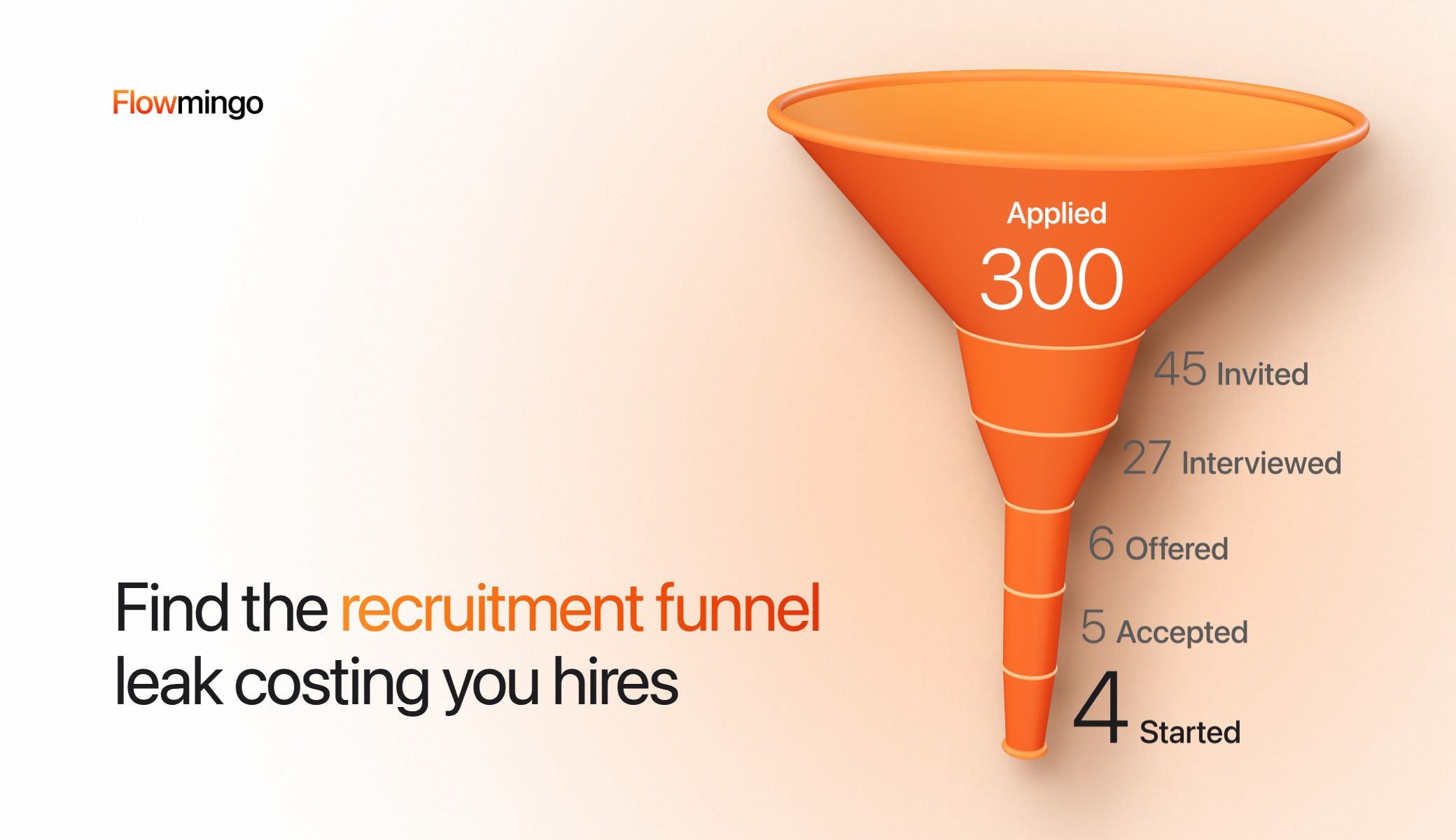

Your 1 open role has 300 applications, and every vendor tells you to buy recruiting automation without saying which step comes first.
The pile is the market, not you. Applications per hire have tripled since 2021 (Ashby), while recruiters per organisation fell 55.6% from 2022 to 2025 (Greenhouse). Of the top 10 results on recruiting workflow automation, 4 say to start with 1 bottleneck, and none ranks the steps by risk.
Switch on the wrong step first and you lose people you never see. In 1 foundational Harvard Business School and Accenture survey, 88% of employers said exact-match filters screen out qualified high-skill candidates.
This guide ranks 6 steps by risk and shows the hours each returns. Start with 2 steps that decide nothing about a person, size the saving with your own numbers, and know which rejections a person must make.
Key takeaways
- What should I automate first in hiring? Status updates and scheduling. They decide nothing about a person and return 26.1 of 91.6 net hours a quarter.
- How many hours does recruiting automation save? About 92 net hours a quarter at 300 applicants a role and 5 hires, after 23 hours of review.
- Can the software reject candidates for me? Our rule: only through a yes/no rule on a written requirement, such as the right to work. The ICO treats a score that auto-rejects as automated decision-making, so a named person signs off every other rejection.
- Did the EU dates for hiring tools move? Yes, from 2 August 2026 to 2 December 2027.
- How would I know the tool is rejecting good people? Our rule of thumb: read 20 of the lowest-scored files per role each week. If you would have interviewed more than 2, fix the criteria.
1. Hiring alone with 200 applicants a role, which recruiting automation do I switch on first?
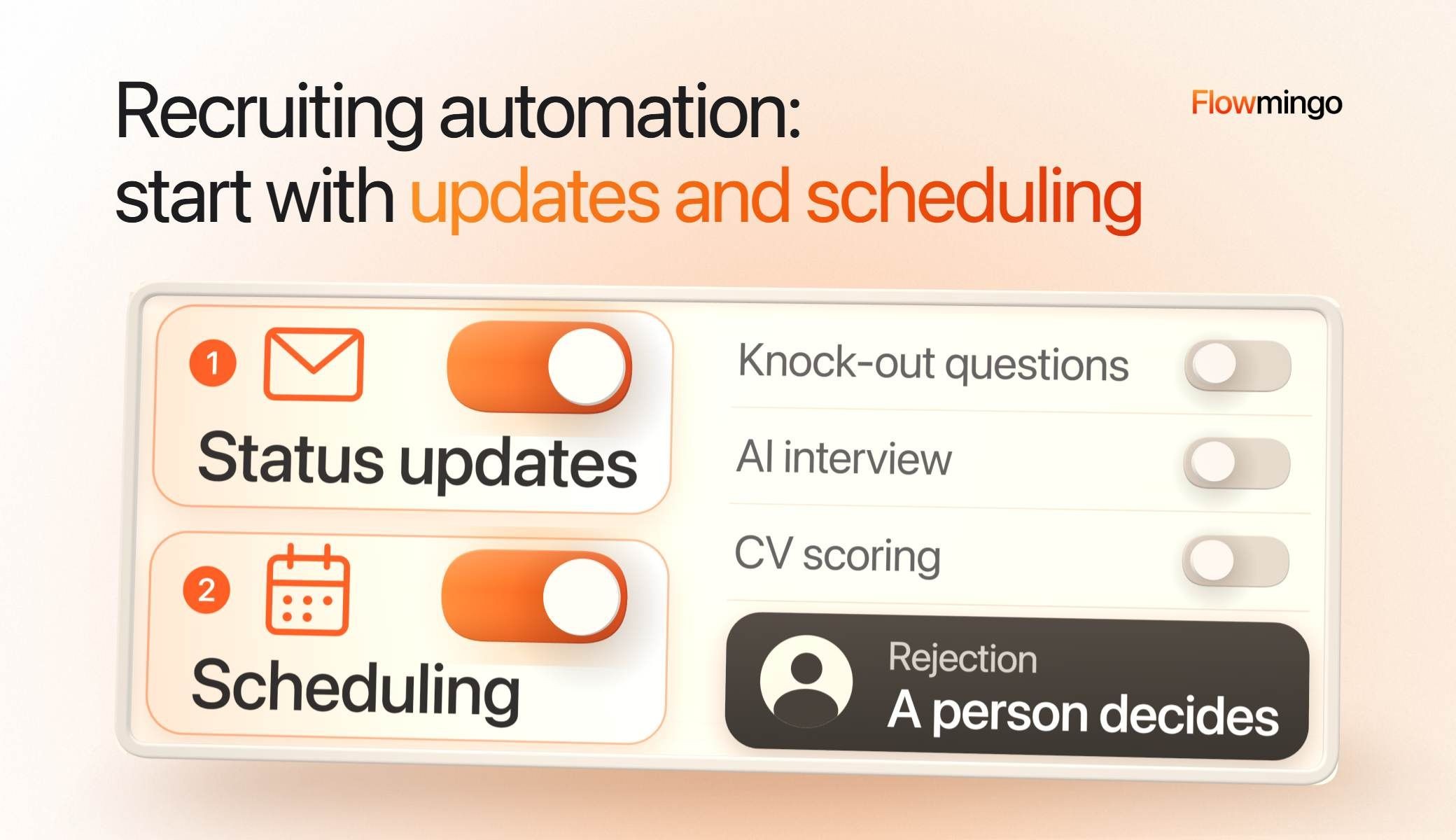
Switch on the 2 steps that decide nothing about a person first: status updates, then scheduling. Add steps that score people later, and keep rejections under a named person's sign-off.
Recruiting automation is software that does a hiring task so a person need not repeat it: an update, a booking, a question, a score. Ashby puts the average at more than 300 applications per hire, and Greenhouse counts 244 per job in 2025. So 200 to 300 applicants a role is ordinary.
We ordered the 6 steps by how little each decides about a person, then by how easily its output is checked. A yes/no rule can be read and tested but a score cannot, so step 3 precedes step 4.
Hours do not set the order, because CV scoring returns the most (40.0 net hours) and comes fifth. The order is our judgment.
Colorado's SB 26-189 excludes tools that only summarize, organize, translate, draft, route or present information for human review, per Proskauer. In our reading, that covers status and scheduling.
| Step | Main risk | A person still |
|---|---|---|
| 1 Status updates | Hollow or false updates | Writes templates and dates |
| 2 Scheduling and reminders | Wrong time zone, reminders to declined people | Handles exceptions |
| 3 Knock-out questions | A proxy rule rejects good people | Owns the list, samples declines |
| 4 AI interview | Candidate trust; high-risk in the EU | Reads every report |
| 5 CV scoring | Silent filtering, name and order bias | Reads 60 CVs a role, signs off the cut |
| 6 Rejection | GDPR Article 22, Colorado, ICO tests | Decides and writes the reason |
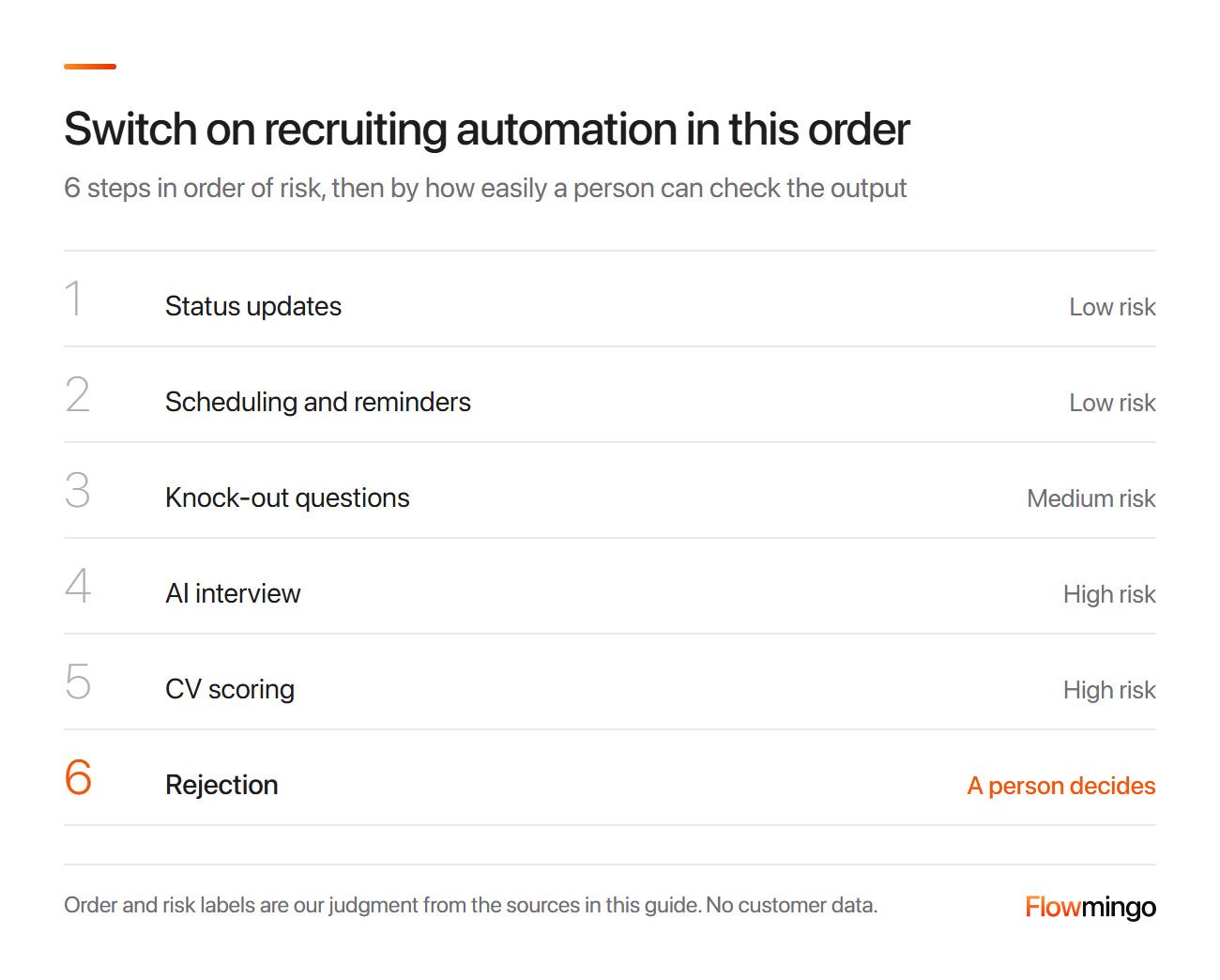
Automation ladder: steps 1 and 2 carry low risk, step 3 medium, steps 4 and 5 high, and step 6, rejection, stays with a person.
A recruitment chatbot is no separate step: it sits at step 1 for status, 3 for knock-outs and 4 or 5 for scoring.
2. How many hours does recruiting automation save at 300 applicants a role, 5 hires a quarter?
About 91.6 net hours a quarter in our worked example: 114.8 hours removed, minus 23.2 hours of review that stays.
Say you make 5 hires a quarter from 5 roles of 300 applicants, as Ashby's average implies. That is 1,500 applicants and about 114 interviews, since Greenhouse counts 22.7 interviews per job.
The steps do not overlap: the 100 AI interviews in step 4 need no booking, so step 2 counts only the 14 live ones.
We assume 20 candidates a role get a 15-minute AI interview, the middle of the 10 to 20 minutes Jabarian and Henkel report for humans. The review column samples 12 messages and 24 declined files a role, and rebooks 1 interview in 10.
| Step | By hand today (assumed) | Units a quarter | Gross hours | Review that stays | Net hours |
|---|---|---|---|---|---|
| Status updates | 1 minute per applicant | 1,500 | 25.0 | 1.0 (60 messages, 1 minute) | 24.0 |
| Scheduling and reminders | 10 minutes per interview | 14 (114 minus 100) | 2.3 | 0.2 (1 in 10 rebooked, 10 minutes) | 2.1 |
| Knock-out questions | 0.5 minute per applicant | 1,500 | 12.5 | 2.0 (120 declined files, 1 minute) | 10.5 |
| AI interview | 15 minutes per call | 100 | 25.0 | 10.0 (100 reports, 6 minutes) | 15.0 |
| CV scoring | 2 minutes per CV | 1,500 | 50.0 | 10.0 (60 CVs a role, 5 roles, 2 minutes) | 40.0 |
| Total | 114.8 | 23.2 | 91.6 |
CV scoring removes 50.0 hours of first reads, and the 10.0 hours a person spends on 60 CVs a role make that safer. The 2 safest steps return 26.1 net hours, 28.5% of the total.
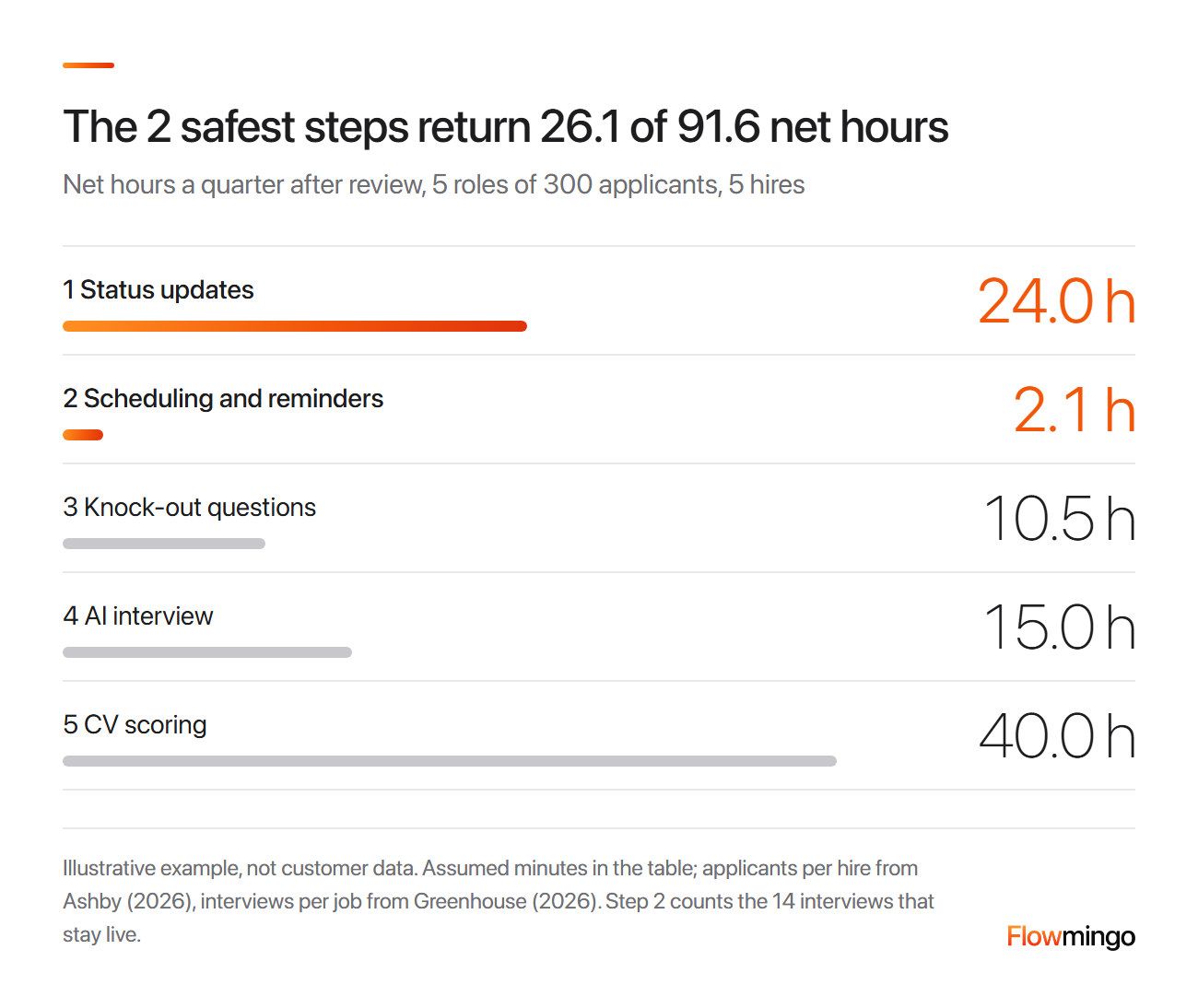
Net hours by step: 24.0, 2.1, 10.5, 15.0 and 40.0 hours a quarter add to 91.6. Status updates plus scheduling return 26.1 (illustrative example, not customer data).
The weekly audit in section 8 adds about 13.3 hours: 20 files a week at 2 minutes each, for 5 roles open about 4 weeks. That makes a cautious net about 78.
3. Can I safely automate status updates and scheduling, or will candidates feel ghosted by a bot?
Yes, these 2 are the safest steps of recruiting automation, because they decide nothing about a person. Keep every message true: a bot that promises a reply it cannot keep feels like ghosting.
The complaint is silence. In the 2025 CandE benchmark, 31% of North American candidates had not heard back 1-2 months after applying. Complaints about AI or automated screening were among the top 3 negative themes, yet every top-10 winner used some AI.
A mail merge or ATS auto-email can send the first 2 messages, and a booking link covers scheduling. Send the acknowledgement within 1 hour.
Subject: We got your application for [Role] at [Company]
Hi [First name], thanks for applying for [Role]. We will tell you by [date, within 7 days] whether you move on. To ask for an adjustment, reply to this email.
[Name], [Company]
Subject: Still deciding on [Role]: update by [new date]
Hi [First name], we promised an answer about [Role] by [date] and are not there yet. We will write by [new date, within 7 days].
[Name], [Company]
Each message follows 4 rules:
- Promise a yes or no within 1 week, our rule. Talent Board's foundational benchmark is 1 to 2 weeks at most (ERE).
- Sign with a name and a reply address a person reads, because 33% of rejected candidates in the 2025 CandE benchmark got a do-not-reply email.
- Send "no news yet" on the date you promised, because a status that never changes reads as silence.
- Never remind someone you have declined, because it shows the system lost track.
Flowmingo data · 52,078 AI interview invites sent by recruiters · 866 companies · 15 Jun to 13 Sep 2026
- 30.9% of invited applicants finished the AI interview within 14 days, and 14.9% finished within 24 hours.
- 24.8 hours was the median time from the invite to a finished AI interview, among the 16,071 who finished.
- 22.2% of those 16,071 finishers came in after the first automatic reminder, sent at a median of 48 hours.
Matched Talent invites excluded. Only finishers have a time. Reminders go to invitees who had not opened the link, so this shows timing, not cause.
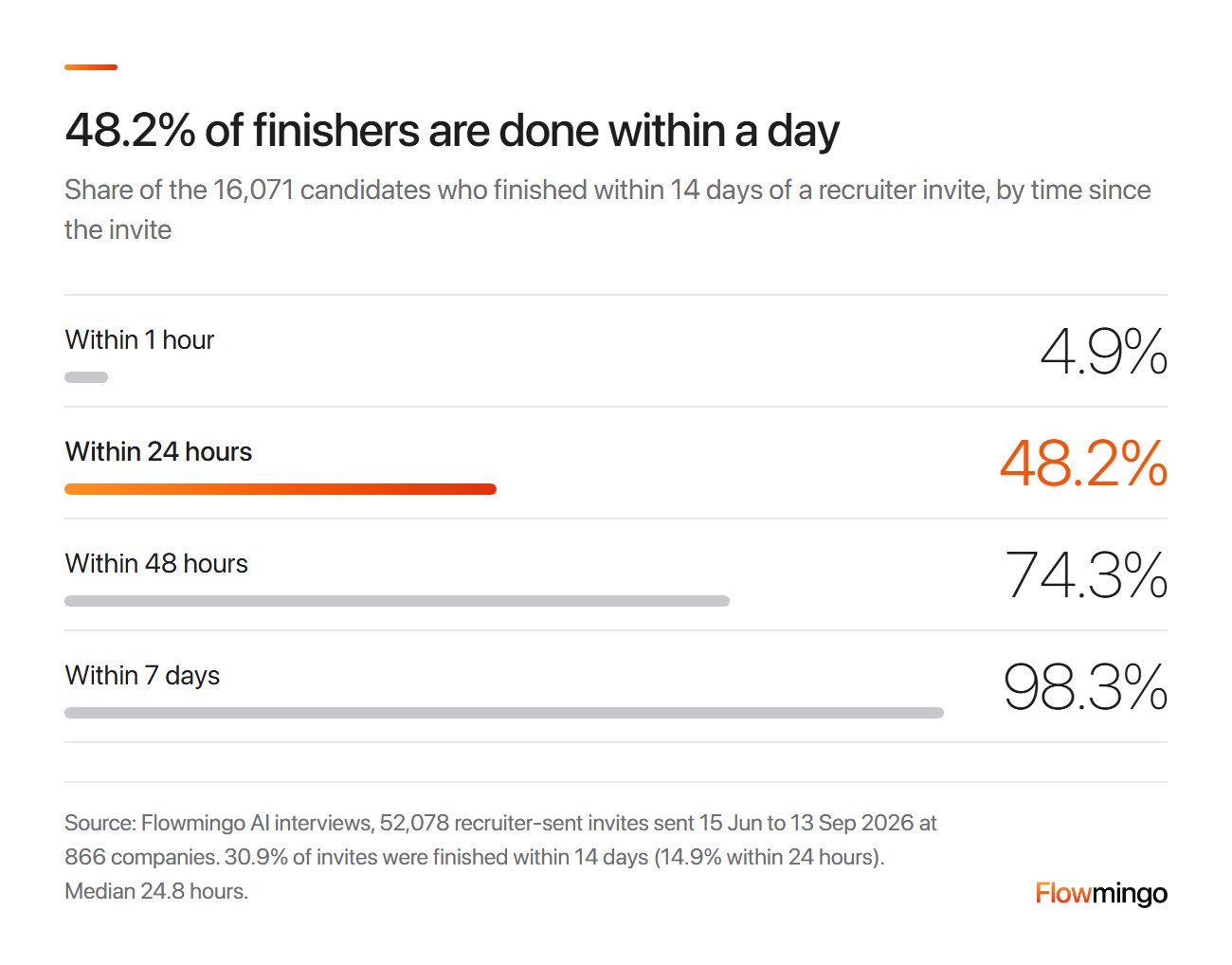
Invite finish curve: of 16,071 finishers within 14 days of a recruiter invite, 4.9% finished within 1 hour and 48.2% within 24 hours. 74.3% finished within 48 hours and 98.3% within 7 days.
Only 14.9% of invited applicants finish within a day, and 22.2% of finishers came in after the first reminder. For a self-paced interview, remind on day 2 and day 5, unless your tool already does. For a live slot, use the day-before reminder in our interview invitation guide.
4. Can knock-out questions cut my pile without rejecting good candidates?
Yes, if each knock-out is a yes/no check on a written requirement the job truly needs. Rules built on proxies, such as gaps or degrees, reject good people unseen.
This is the 1 step where an automatic no is defensible in the UK. The ICO says a yes/no knock-out on a written requirement, such as the right to work, is not automated decision-making. A fit score that auto-rejects below a pass mark is.
The trap is the proxy. In the same foundational Harvard Business School and Accenture study, 48% of employers that filter middle-skill candidates used an employment gap over 6 months. In a foundational case, iTutorGroup paid $365,000 over software alleged to reject applicants by age (EEOC).
Test every rule on 20 past applicants before it goes live, then re-read 24 declined files per role, 8% of 300.
| Rule | Keep? | Why |
|---|---|---|
| Right to work or a required licence | Keep | A written legal requirement |
| Shifts or pay range printed in the posting | Keep | Printed, so yes or no; never ask pay history |
| Employment gap over 6 months | Remove | A proxy, used by 48% |
| Degree the law does not require | Remove | A proxy, so score the skill instead |
| Age or birth date | Remove | Direct age screening |
| Graduation year | Remove | An age proxy, so ask for skills instead |
Send the decline within 3 to 5 days of applying, the pace that 60% of the 2025 CandE top-10 winners kept. State the reason, say no score applied and offer a route to a person. Our rejection email templates have the tiers.
Subject: [Role] at [Company]: our decision
Hi [First name], thank you for applying for [Role]. This role needs [requirement], and your answer says you do not have it. This decision came from that answer alone, with no CV score. If we misread it, reply and a person will look again.
[Name], [Company]
5. Will good candidates walk away, or stop trusting us, if an AI runs the first interview?
Some will, so say plainly that it is an AI and what it does with the answers. In 1 large field test, candidates interviewed by an AI got more offers, and 78% chose it when given the choice.
The trust gap is real, because in a 1Q25 Gartner survey only 26% of 2,918 candidates trusted AI to evaluate them fairly. In Greenhouse's 2026 survey of US job seekers, 38% had walked away over an AI interview and 44% wanted to be told upfront.
The field test is a preprint by Jabarian and Henkel at 1 Philippine recruitment firm hiring for entry-level customer-service jobs. Of 67,056 randomised applications, 53,660 went to an AI or a human interviewer. Offers were 9.73% with the AI against 8.70%, and humans made every hiring decision.
Applicants rated the AI interviews as less natural, and those who chose the AI scored lower on language and analytical tests.
In a foundational 2022 review of human-run interviews, the same questions on a written rubric predicted performance better than loose chats.
Put this notice in your interview invite, with the consent tick-box Illinois requires before AI analyses a video interview.
This interview is run by an AI. It asks every applicant the same questions, with a follow-up when an answer is thin, and scores the answers against the role's criteria. [Our recruiters and the hiring manager] can see your recording, and we keep it for [period]. A person reads the report and decides. For an adjustment or a person, reply to this email.
[ ] I agree to take part in this AI-run interview.
Flowmingo data · 41,126 completed AI interviews · 856 companies · interviews started 24 Jun to 19 Sep 2026
- 60.6% of completed AI interviews were finished outside Monday to Friday 9:00 to 17:00 in the candidate's local time.
- 34.4% finished on weekday evenings from 17:00 to midnight, and 17.6% at weekends.
Local time is estimated from the candidate's connection, and 9 to 5 on weekdays is assumed. About 61% of applicants are in India and Nigeria, and this shows timing, not preference.
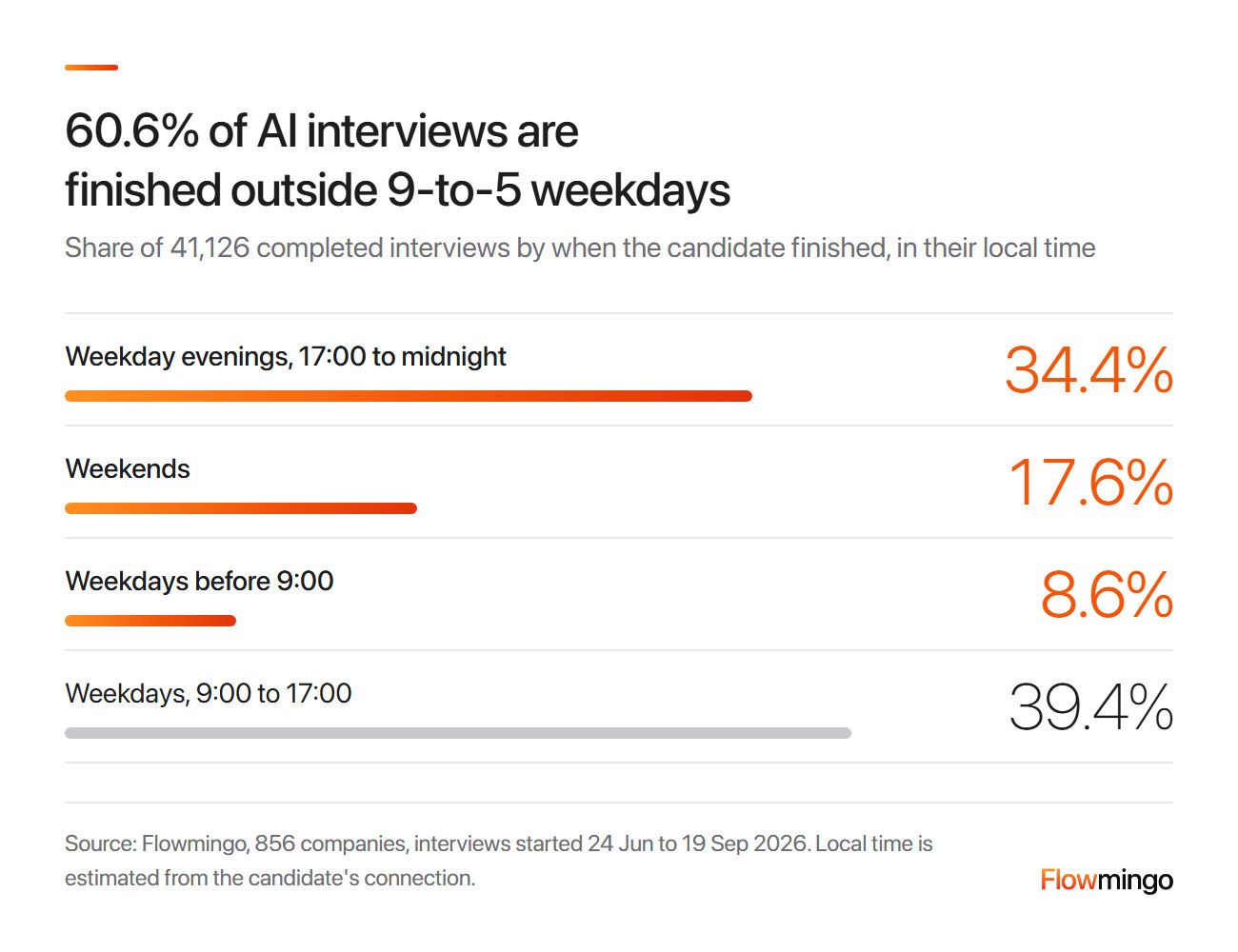
Out-of-hours finishes: of 41,126 completed AI interviews, 34.4% finished on weekday evenings, 17.6% at weekends and 8.6% before 9:00 on weekdays. So 39.4% finished in a 9-to-5 weekday.
So 6 in 10 candidates finished outside a weekday 9-to-5 in their own time zone.
How Flowmingo helps
With the AI interviewer you send 1 link, and each applicant interviews in their own time. You get the recording, transcript and a score out of 10 with a reason per criterion, and who moves forward is always your call.
6. Should software score and rank my CVs, or is that where automation goes wrong?
Use scores to order the pile, and let a named person sign off the cut after reading samples above and below it.
Scoring has 2 documented failures:
- Names: in a resume audit of embedding models, White-associated names won 85.1% of the race comparisons, though the result depends on the names used.
- Order: 22 AI models picked the first-listed of 2 equally qualified CVs 63.5% of the time.
A human screen is not a safe baseline either. At 1 Fortune 500 firm, 10% of the people recruiters chose to interview got the job, against an estimated 27% to 32% for models.
Yet the standard model cut the Black and Hispanic share of interviewees from 9.4% to 4.2%. An exploration model raised it to 24.3%, so design decides who gets cut.
The owner of the cut signs the declines below the line only after reading the band under it and 20 random CVs. If more than 2 of those 20 are people you would interview, read the next 20 first.
The ICO treats ranking and then rejecting without considering every application as automated decision-making. So reading 60 of 300 does not make the other 240 declines human decisions.
In the EU, have a person look at each file before a decline (section 7.1). In the UK, automated declines are allowed with safeguards: say a score was used and offer a person.
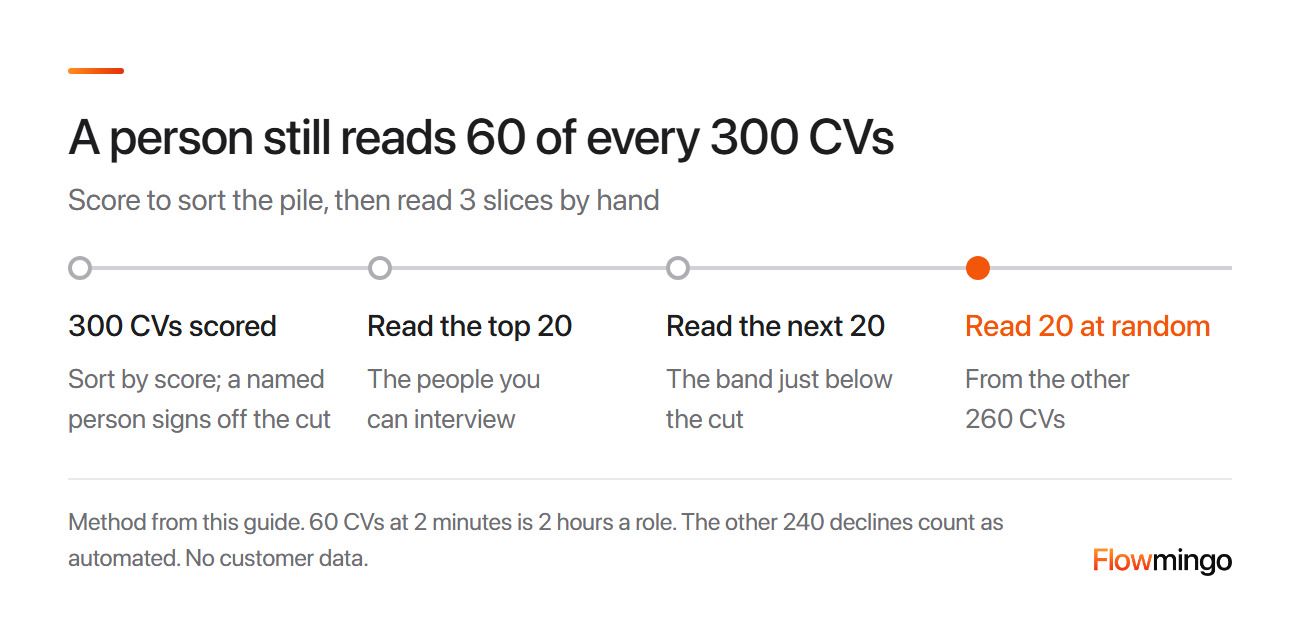
Sort, then a person signs off the cut: read the top 20, the next 20 and 20 at random from the other 260. That is 60 of 300 CVs, and the 240 unread declines count as automated.
Shuffle the order before any AI comparison and run it twice, swapped, because the first-listed CV wins more often. Our candidate shortlisting guide has the full method.
How Flowmingo helps
CV Evaluation turns a pasted job description into criteria you edit and rate by importance, and scores every CV out of 10 with written evidence. A Must Have changes the weight only, so you decide who moves forward.
7. Does a person need to read every rejection, or can recruiting automation auto-reject low scorers?
Our rule: auto-reject only on a yes/no rule for a written requirement. Every other rejection needs a named person who has read the evidence, or goes out as an automated decision with a route to a person.
It has 5 clauses:
- The only automatic no is a written knock-out applied to everyone, owned by a person.
- A named person with authority to overturn it makes or signs off every other rejection (Article 26 and Article 14, from 2 December 2027). Unread declines count as automated (section 7.1).
- Form a view before the AI's pick, because in a 2025 experiment 528 people followed a deliberately biased AI up to 90% of the time.
- Every rejection carries a plain reason and a route to a person.
- Keep logs for at least 6 months in the EU, at least 4 years in California and, per law-firm summaries, 3 years in Colorado.
7.1 Can I auto-reject in the EU or UK without a person looking, or does GDPR Article 22 ban it?
In the EU, not on a score alone: Article 22(1) gives people the right not to face a significant decision based solely on automated processing. In the UK you can with safeguards since 5 February 2026, but the ICO still treats a fit score that auto-rejects as automated decision-making.
Recital 71 names e-recruiting without human intervention as an example. In the foundational SCHUFA ruling, a credit case, the Court of Justice treated a score as the decision when users rely on it heavily.
8. How would I know recruiting automation is silently rejecting good people, and what breaks first?
Look at the pile you never see, because a silent rule hides there. Sample the lowest scores and declines every week, and compare outcomes by group.
In our judgment proxy rules break first, then scoring and order bias, then candidates gaming the tool. In Greenhouse's 2025 survey of 1,200 US job seekers, 41% admit using prompt injections.
In June 2025 2 researchers got into McHire, Paradox.ai's recruitment chatbot for McDonald's franchisees, with the default login 123456 (Carroll and Curry). They said personal data on more than 64 million applicants, estimated from record numbering, was reachable.
Run these 5 checks on our rule-of-thumb cadences:
- Weekly, about 40 minutes a role: read 20 of the lowest-scored or declined files.
- Weekly: count actions a person reopens or corrects within 48 hours.
- Monthly: compare the tool's top 20 with your own on 10 CVs.
- Quarterly: divide each group's selection rate by the top group's, where lawful to collect. Treat under 80%, a long-standing US rule of thumb, as your own monitor. On 9 June 2026 the Justice Department's Office of Legal Counsel said the guidelines behind it rest on an unconstitutional reading of Title VII.
- Quarterly: re-run 5 CVs with names hidden and order swapped.
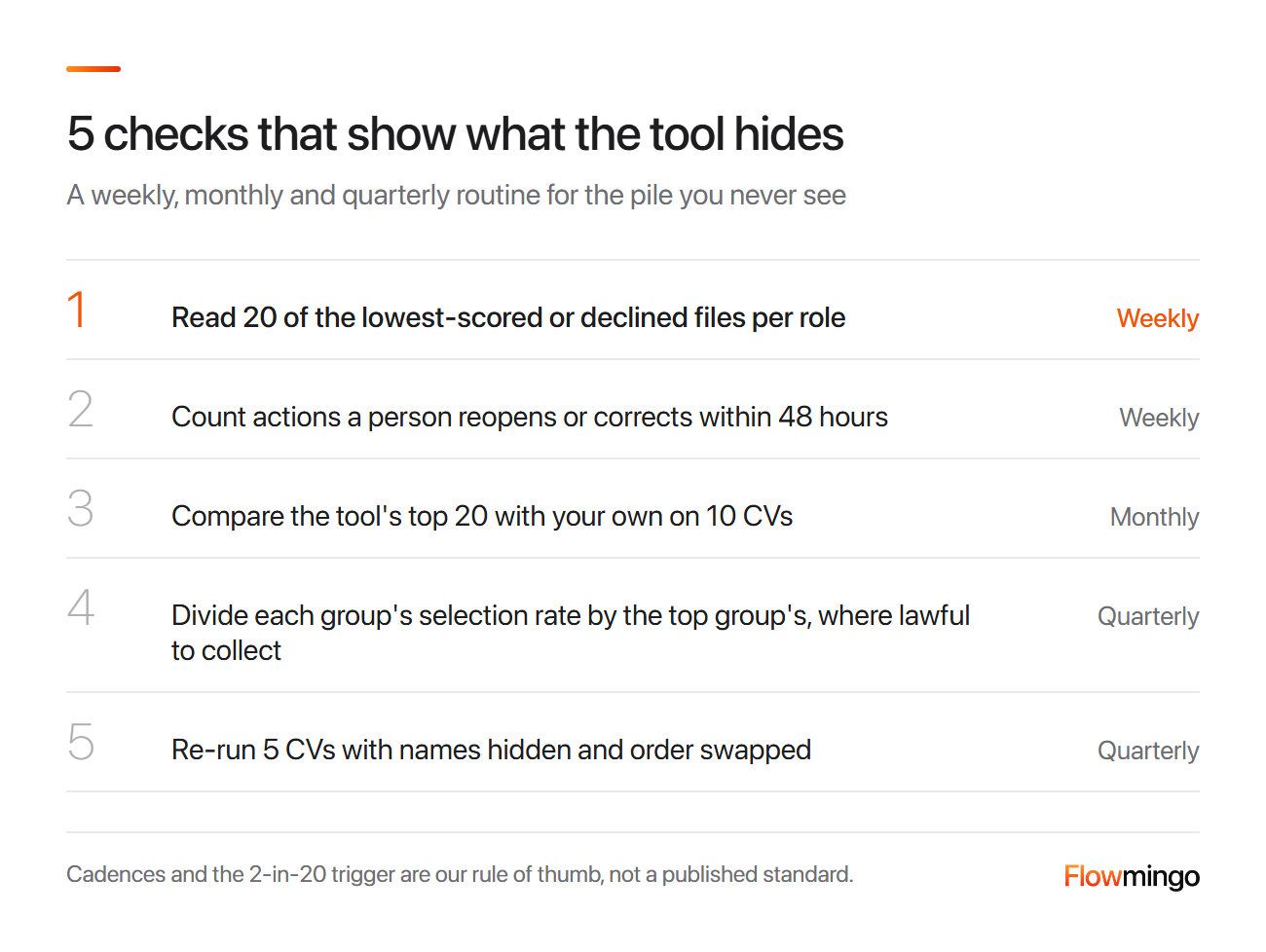
Weekly audit: 5 checks, 2 weekly, 1 monthly and 2 quarterly. They run from reading 20 low-scored files to re-running 5 CVs with names hidden and order swapped.
If more than 2 of the 20 would have earned an interview, fix the criteria, our rule of thumb.
9. Is my screening tool high-risk under the EU AI Act, and what are the new dates?
If the AI in your recruiting automation filters CVs, scores or ranks candidates or evaluates them in an interview, yes. The duties for employers moved from 2 August 2026 to 2 December 2027.
Annex III point 4(a) lists AI that analyses and filters applications and evaluates candidates as high-risk, and names no scheduling or status messages. Regulation (EU) 2026/1744 moved the date, in force since 27 July 2026 (EUR-Lex, Steptoe).
| Date | What starts |
|---|---|
| 2 Feb 2025 | The Article 5 bans, including reading emotions in hiring |
| 2 Aug 2026 | Article 50(1), a provider duty: AI that talks to people tells them it is an AI |
| 2 Dec 2027 | Annex III duties for employers using hiring AI: oversight, logs of at least 6 months, notice |
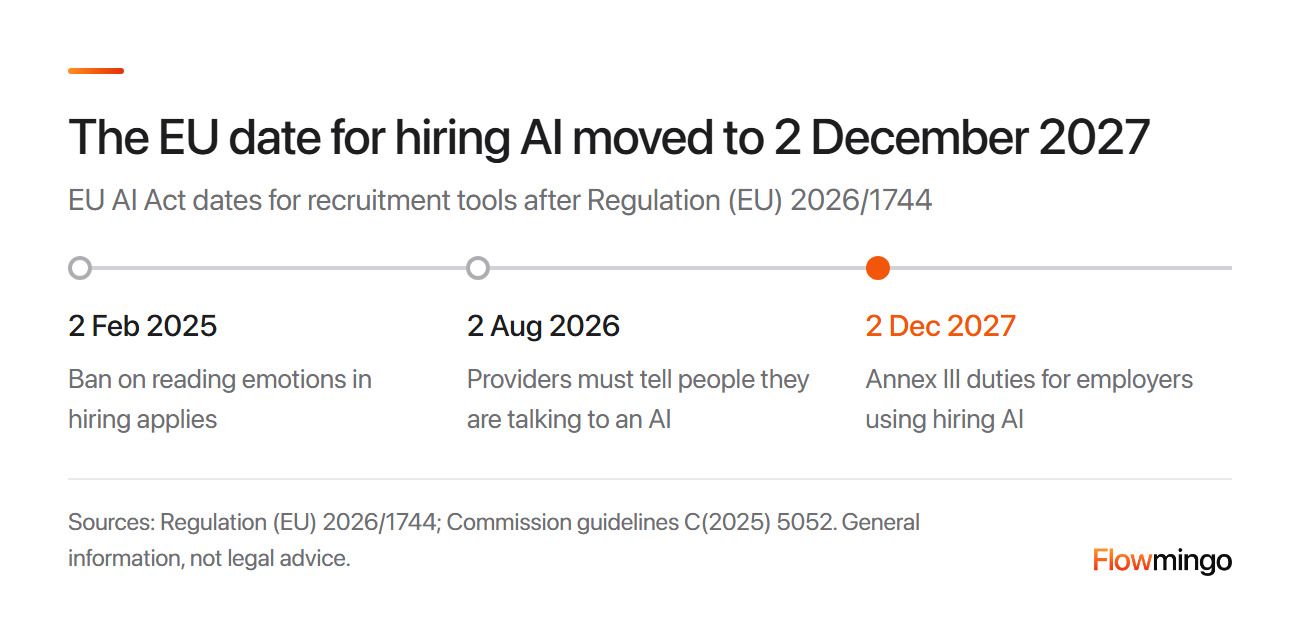
EU dates for hiring AI: the ban on reading emotions applies since 2 Feb 2025. Employer duties for hiring tools start 2 Dec 2027.
The emotions ban and Article 50(1) did not move.
We found no small-business exemption for deployers in Article 26, only a lower fine for SMEs. This means a team using a high-risk tool has about 14 months to be ready.
Fines for breaking employer duties reach EUR 15,000,000 or 3% of worldwide turnover, whichever is higher, and the lower amount for SMEs. The ban on inferring emotions in hiring, from the face, voice or gestures, can cost up to EUR 35,000,000 or 7%.
Scoring the words of an answer against a rubric is different from reading the face or voice. Vendor question 3 in section 10.1 asks which. General information, not legal advice.
10. Do NYC, Illinois, Colorado or California rules reach a 15-person company, and who is liable?
Assume they can: NYC's foundational FAQ sets no size threshold, and a law firm reads Colorado's law as hard to avoid for web-hiring employers. The employer is ultimately responsible, and the vendor can face claims too.
| Where | Rule and start date | What you owe |
|---|---|---|
| NYC | Local Law 144 (foundational), enforced 5 Jul 2023 | For NYC-office jobs: independent audit for bias within a year, public summary, notice to NYC residents 10 business days before |
| Illinois | HB 3773, 1 Jan 2026; AI Video Interview Act | No discriminatory AI or zip code proxy; notice. For AI video analysis: tell the applicant, explain what it checks, get consent, delete a video within 30 days of a request |
| California | Civil Rights Council, 1 Oct 2025 | Vendors count as your agent; keep automated-decision data at least 4 years |
| Colorado | SB 26-189, 1 Jan 2027 | Notice; plain description within 30 days of an adverse decision; human review on request where commercially reasonable |
General information, not legal advice: we found no small-employer exemption in Colorado's law.
10.1 If my vendor's tool discriminates, am I liable, and what should I ask before I sign?
Yes, you can be, because California treats a vendor that screens for you as your agent. In the Mobley case, a court let claims proceed against Workday, which shows vendors face claims, not that you are cleared. Ask these 7 questions before you sign:
- How do you classify the tool under EU Annex III?
- Can you share an independent audit for bias from the past year?
- Does it score the words or the voice?
- Where is candidate data stored, and how do I delete it?
- How do you test security, given McHire?
- Can I export the reason and log for each decision?
- Who tells candidates it is an AI?
10.2 I run a 15-person company with no HR: what is the minimum I should do this month?
Do these 4 things, our minimum and not a legal standard:
- List every tool that scores, ranks or screens, and switch off automatic rejection except yes/no knock-outs.
- Add 1 line to postings saying AI helps sort applications, if true.
- Name the person who signs off rejections, and treat unread declines as automated.
- Keep applications, scores and reasons for the periods in section 7, and check outcomes by group each quarter.
How Flowmingo helps
Flowmingo is a free AI interviewer for recruiters, and every hiring decision stays with your team. When you reach step 4, try Flowmingo for the AI interview step of your recruiting automation.
11. Sources
Every study, law and survey in this guide links to a source below; Flowmingo figures come from Flowmingo's own platform data.
- Ashby (2026, May 7). New data from Ashby reveals surge in applications, rising selectivity, and shifting recruiter workloads. PR Newswire.
- California Civil Rights Department (2025, June 30). Civil Rights Council secures approval for regulations to protect against employment discrimination related to artificial intelligence. State of California.
- Carroll, I., & Curry, S. (2025). Would you like an IDOR with that? Leaking 64 million McDonald's job applications. ian.sh.
- Civil Rights Litigation Clearinghouse (2026). Mobley v. Workday, Inc., No. 3:23-cv-00770 (N.D. Cal.). Clearinghouse.
- Colorado General Assembly (2026). SB26-189: Automated decision-making technology. Colorado General Assembly.
- Court of Justice of the European Union (2023, December 7). Press release No 186/23: Judgment in Case C-634/21, SCHUFA Holding (Scoring). CJEU.
- Equal Employment Opportunity Commission (2023, September 11). iTutorGroup to pay $365,000 to settle EEOC discriminatory hiring suit. EEOC.
- European Commission (2025). Guidelines on prohibited artificial intelligence practices established by Regulation (EU) 2024/1689 (AI Act), C(2025) 5052 final. European Commission.
- European Union (2026). Regulation (EU) 2026/1744 amending Regulation (EU) 2024/1689, the Digital Omnibus on AI. Official Journal of the European Union.
- EU Artificial Intelligence Act (n.d.). Annex III: High-risk AI systems. Future of Life Institute.
- EU Artificial Intelligence Act (n.d.). Article 14: Human oversight. Future of Life Institute.
- EU Artificial Intelligence Act (n.d.). Article 26: Obligations of deployers of high-risk AI systems. Future of Life Institute.
- EU Artificial Intelligence Act (n.d.). Article 50: Transparency obligations. Future of Life Institute.
- EU Artificial Intelligence Act (n.d.). Article 99: Penalties. Future of Life Institute.
- Fuller, J., Raman, M., Sage-Gavin, E., & Hines, K. (2021). Hidden workers: Untapped talent. Harvard Business School and Accenture (archived copy; the original page now returns 404).
- Gartner (2025, July 31). Gartner survey shows just 26% of job applicants trust AI will fairly evaluate them. Gartner newsroom.
- Greenhouse (2025, November 19). An AI trust crisis: 70% of hiring managers trust AI to make faster and better hiring decisions, only 8% of job seekers call it fair. Greenhouse newsroom.
- Greenhouse (2026, March). The Hire Standard: Greenhouse benchmark report, North America. Greenhouse.
- Greenhouse (2026, May 1). 63% of job seekers have faced an AI interview. Most haven't had a good one yet. Greenhouse 2026 Candidate AI Interview Report.
- Grossman, K. (2025, January 23). 12 key takeaways from the 2024 Candidate Experience Benchmark Research. ERE.
- Illinois General Assembly (2019). Artificial Intelligence Video Interview Act, 820 ILCS 42. Illinois Compiled Statutes.
- Information Commissioner's Office (2026). Recruitment Rewired: Introduction, key findings and use cases. ICO.
- Information Commissioner's Office (n.d., read 2026). Recruitment Rewired: Understanding how meaningful human involvement applies, use cases. ICO.
- Intersoft Consulting (n.d.). Art. 22 GDPR: Automated individual decision-making, including profiling. GDPR-info.eu.
- Intersoft Consulting (n.d.). Recital 71: Profiling. GDPR-info.eu.
- Jabarian, B., & Henkel, L. (2026). Voice AI in firms: A natural field experiment on automated job interviews (arXiv:2607.28222v2). Preprint.
- Li, D., Raymond, L., & Bergman, P. (2025). Hiring as exploration. The Review of Economic Studies (author version).
- NYC Department of Consumer and Worker Protection (2023, June 29). Automated employment decision tools (AEDT): Frequently asked questions. City of New York.
- Office of Legal Counsel, US Department of Justice (2026, June 9). Constitutionality of disparate-impact liability under Title VII. DOJ.
- Ogletree Deakins (2026, June). Illinois postpones proposed regulations on AI in employment. National Law Review.
- Proskauer Rose LLP (2026, May 26). Colorado's AI law gets major rewrite: What now for employers?. National Law Review.
- Rozado, D. (2026). Gender and positional biases in LLM-based hiring decisions: Evidence from comparative CV/resume evaluations. PeerJ Computer Science, 12, e3628.
- Sackett, P. R., Zhang, C., Berry, C. M., & Lievens, F. (2022). Revisiting meta-analytic estimates of validity in personnel selection: Addressing systematic overcorrection for restriction of range. Journal of Applied Psychology.
- Steptoe (2026, July 30). EU AI Act amendments enter into force. Steptoe blog.
- Survale (2025). 2025 Candidate Experience (CandE) benchmark research: Key statistics. Talent Board benchmark, via Survale.
- Wilson, K., & Caliskan, A. (2024). Gender, race, and intersectional bias in resume screening via language model retrieval. AAAI/ACM Conference on AI, Ethics, and Society, 7. Race results only: the authors' August 2026 erratum says a code bug inverted the gender-only results.
- Wilson, K., Sim, M., Gueorguieva, A., & Caliskan, A. (2025). No thoughts just AI: Biased LLM hiring recommendations alter human decision making and limit human autonomy. Proceedings of the AAAI/ACM Conference on AI, Ethics, and Society, 8(3).