
You need 3 graduates by next September, and you have no campus recruiter, no travel budget and no ATS. That is campus recruitment for most small teams. The graduate hiring benchmarks you can find come mostly from surveys where more than half of employers have over 5,000 staff (NACE).
Employers in the Institute of Student Employers' 2025 UK survey, mostly large graduate programmes, averaged 140 applications per graduate vacancy. And 61% reported candidates using AI in interviews without permission, so add 1 same-task step for everyone, not just a read of the pile.
Miss the calendar and the students you want may sign elsewhere. Cut on GPA and you filter on a signal that explains about 4% of job performance. Set a 48-hour deadline and you run into school offer rules.
This guide gives you a dated calendar, a GPA-free way to score 500 applicants, and a plan for offers and interns.
Key takeaways
- When should campus recruitment start? About 3 months before the fair. Vanderbilt opens spring interview requests on 12 October, so start now.
- Can a campus recruitment ad ask for recent graduates only? Avoid it: the US calls it an age-law violation, the UK likely indirect age discrimination, and Singapore says avoid age.
- How do I screen 500 near-identical applications without a GPA cutoff? Score each on 4 to 6 written criteria, then give everyone who passes the same task or interview. Grades explain only about 4% of performance.
- How long should graduates get to accept an offer? 1 to 2 weeks is common. About 3 in 4 offers were accepted and about 7% of those fell through, so send about 29 offers for 20 starters.
- How many interns should I convert to full-time hires? NACE's latest survey found 63.1% became full-time hires, so keeping 3 of 5 is typical.
1. When should campus recruitment start, and what does a fall and spring calendar look like?
Start about 3 months before the fair you want, and try not to hire for a job that starts more than 12 months away. That limit is NACE advice, not a rule.
Stony Brook, Vanderbilt and NUS each run a fall season (roughly August to December) and a spring season (roughly January to April). The main fall fairs below have passed by 7 Oct 2026, so this month's job is spring. We have no UK calendar, so confirm dates with the school.
| When | What the schools publish | Your move |
|---|---|---|
| 12 Jun to 10 Dec 2026 | Fall: NUS Career Fest registration 12 Jun to 10 Jul for 23 Sep. Stony Brook 6 fairs, 26 Aug to 2 Oct. Vanderbilt season to 10 Dec, main fair 22-24 Sep, law fair 13 Oct, finance fair 14 Oct | Main fall fairs are over. Already interviewing? Close offers before each school's season ends |
| 12 Oct 2026 to 26 Apr 2027 | Spring: Vanderbilt opens interview requests 12 Oct, season 11 Jan to 26 Apr, fair 26-27 Jan. Stony Brook 5 fairs, 27 Jan (general) to 24 Mar (volunteer) | Now: email 2 career offices and request interview days, then run the fair and offers |
With only 2 schools, "about 3 months" is a pattern, not a rule. NUS closed registration 11 weeks before its fair, and Vanderbilt opens spring requests 13 weeks before classes.
Here is the spring back-plan, our arithmetic on NACE's 2025 average of 27.3 days from first interview to offer or rejection. A 26 Jan fair with first interviews on 27 Jan (our assumption) puts offers about 23 Feb. A 14-day deadline, inside NACE's 1 to 2 weeks, puts answers due about 9 Mar, 42 days after the fair.
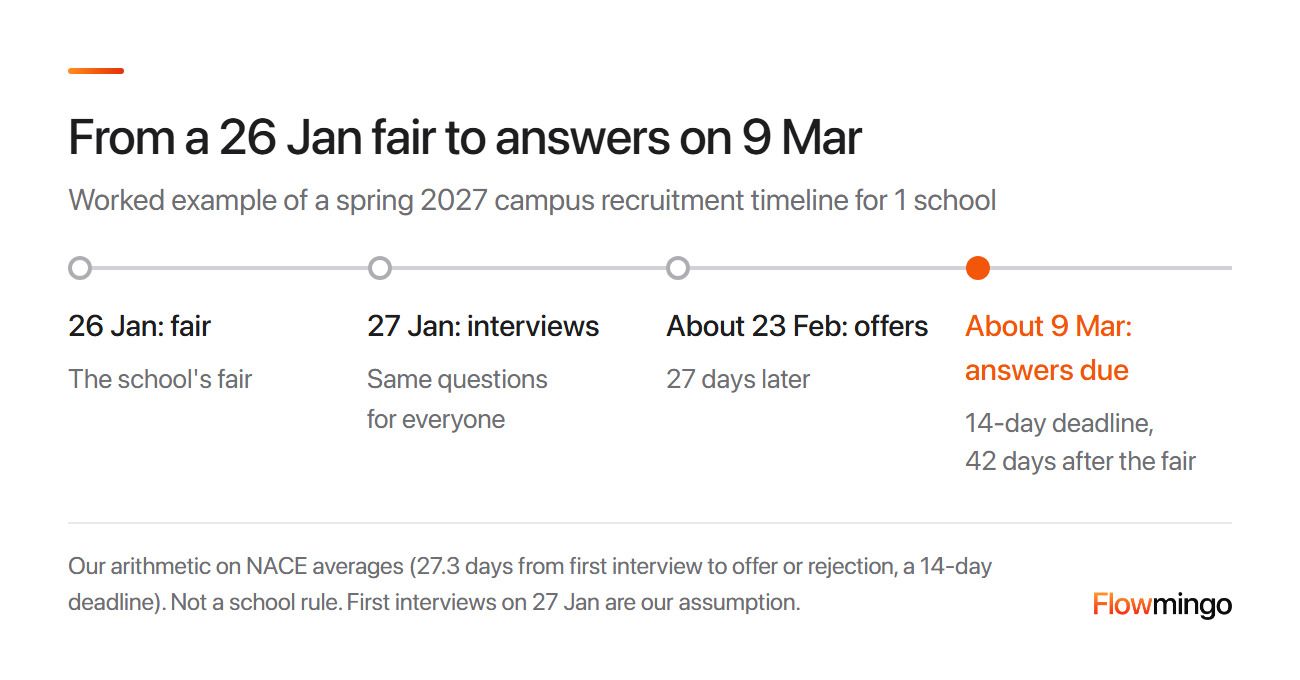
Worked timeline: a 26 Jan fair and first interviews on 27 Jan, with the same questions for everyone. Offers come about 23 Feb and answers are due about 9 Mar, 42 days after the fair (our arithmetic).
Our hiring process steps guide says to offer within 1 week of the final interview, because faster offers won more acceptances. So count from your last interview: 23 Feb assumes it is 16 Feb, and a last interview on 3 Feb means offers about 10 Feb.
2. We're a 50-person company with no recruiter. How does campus recruitment work on a small budget?
Pick 2 schools, email each career office, then run 1 virtual talk, 1 set of same-question interviews and 1 offer window. A small team needs no travel budget and no ATS for that.
For example, here is a 4-week campus hiring plan (our plan, not a study):
- Week 1: pick 2 schools by programme fit, and ask each career office for its rules, dates and fees.
- Week 2: write 4 to 6 criteria and a posting with no age words and an adjustment line.
- Week 3: open applications with that line on the page, and run 1 virtual talk or class slot.
- Week 4: run same-question interviews with the line in every invitation, then send offers with a 1 to 2 week deadline.
That line can read: "If you need extra time or a different format, email [name] before [date]."
These are 4 working weeks, not 4 in a row. Week 1 starts about 3 months before the fair, and weeks 2 and 3 fit between. Week 4 starts the fair and interviews, and offers follow the last interview (section 1).
For the 26-27 Jan fair, week 1 is late October, so email the career offices this month.
3. How do I choose schools for campus recruitment when I can only visit 3 or 4?
Choose schools by whether their programmes teach the skills the job needs and whether you can show up there, not by rank. Start with 2 schools, add up to 2 more once the first cycle shows yield, and drop any that give you no applicants.
Score each school 1 point per yes. For example, the table scores 2 schools for an operations analyst role (illustrative):
| Criterion | School A | School B |
|---|---|---|
| Programme fit (a course teaching the job's 3 skills) | A data analysis course | None |
| Access (dates, fees and rules published) | Dates and fees published | Dates and fees published |
| Reach (can you visit in person?) | 1 hour away | 2 hours by train |
| Yield (past applicants and hires from here, and how they scored) | 4 of your last 20 graduate applicants | None |
| Score | 4 of 4 | 2 of 4 |
Prestige is the easy shortcut, but the research we cite covers elite firms only. Rivera's foundational 2012 paper, based on 120 interviews at elite US banks, consulting firms and law firms, found shared culture often outweighed concern about productivity. So a prestige list can let fit stand in for skill.
Grades in job-like courses link to job performance more closely than grades overall, per a December 2024 study (section 7 has the numbers). So at pass 3 (section 6), ask for 2 grades from courses like the job, from an official transcript, as evidence and not a cutoff.
Our judgement, not a study: choose schools by their courses, not their name, and keep your reasons (section 5).
4. Are on-campus fairs worth the cost for 3 hires, or should campus recruitment be mostly virtual?
Spend on in-person events only at the 2 schools you picked, and use virtual sessions for the rest. In NACE's 2025 internship survey of 247 organisations, over 2 in 3 rated in-person fairs effective and under 1 in 5 rated virtual ones effective.
Virtual is rated lower but costs far less, so money decides the rest of your campus recruitment plan. The table shows Handshake's estimates, which come from a vendor and give no sample size.
| Cost | Virtual event | In-person event |
|---|---|---|
| People time | $456 | $3,491 |
| Travel | None | $3,017 to $5,046 |
| All costs combined | As little as $1,000 | $10,000 or more |
Most of the gap is people time, $456 virtual against $3,491 in person, plus travel of $3,017 to $5,046. The school sets its own price too: NUS Career Fest starts at $1,100 excluding 9% GST, and its page shows no currency.
After your first event, measure cost per interview: the total event cost divided by the interviews it produced. For example, a $1,000 virtual event that produces 10 interviews costs $100 each, and a $10,000 in-person fair needs 100 interviews to match.
Handshake advises going in person where competition is high or past events drew the most RSVPs, and virtual where it keeps costs low.
5. Can a campus recruitment ad ask for recent graduates only in the US, UK and Singapore?
Avoid it: US rules name "recent college graduate" as an ad term that violates the age law. UK guidance calls it likely indirect age discrimination, and Singapore's guidelines say to avoid age in ads.
This is general information, not legal advice, so check with counsel.
| Where | Rule | Your move |
|---|---|---|
| US, age | 29 CFR 1625.4(a) names "young", "college student" and "recent college graduate" as age-law violations unless an exception applies | Describe skills, not age |
| US, selection | 29 CFR 1607.16(Q): educational requirements are selection procedures | Write the job reason |
| US, adverse impact | 29 CFR 1607.4(D): a pass rate under 80% of the top group's is generally regarded as evidence of adverse impact (race, sex or ethnicity) | Run the 80% check per school or GPA cut |
| US, disability | 29 CFR 1630.11 and 1630.14: tests must reflect the skill, and medical questions wait for an offer | Tell every candidate how to ask for an adjustment |
| UK, disability | Acas: reasonable adjustments at any stage. Equality Act s.60: no health questions before an offer, except to arrange adjustments | Name 1 adjustment contact |
| UK | Acas: a "recent graduate" ad is likely indirect age discrimination. Equality Act ss.19 and 39 | Be ready to justify requirements |
| Singapore | TAFEP Guidelines: avoid age as a criterion | Keep age words out, and keep interview, assessment and offer records at least 1 year (TAFEP) |
The US age law covers ages 40 and over at employers with 20 or more staff (29 USC 630(b)). Singapore's Workplace Fairness Act is passed, not in force, expected by end-2027. Firms under 25 staff are exempt at first (MOM).
These US rules (1978 to 2007) and the 2010 Equality Act are foundational. Acas says "likely" because section 19 allows a proportionate requirement.
As of 4 October 2026 the 80% rule is still in the eCFR. The Justice Department's Office of Legal Counsel said on 9 June 2026 that the guidelines behind it rest on an unconstitutional reading of Title VII. The EEOC's agenda lists rescinding them in November 2026.
Title VII's disparate-impact liability and private lawsuits remain, so keep the check as a rule of thumb, not a safe harbour. With small numbers a gap can be chance.
5.1 Can I hire only from certain schools or degrees?
Nothing we checked bans it, but a school list needs a job reason. It is a selection procedure in the US (29 CFR 1607.16(Q)). In the UK, a requirement that disadvantages a protected group must be a proportionate means (Equality Act s.19).
The Singapore guidelines we read cover age, not school lists. Keep pass rates by group, for example with the US 80% rule.
6. I have 500 near-identical graduate applications and thin CVs. How do I screen them fairly?
Score every campus recruitment applicant on 4 to 6 written, job-related criteria, then give everyone who clears the cut the same short task or interview.
The figure shows 3 passes, starting with hard facts (see our pre-screening interview questions), and the task email repeats the adjustment line.
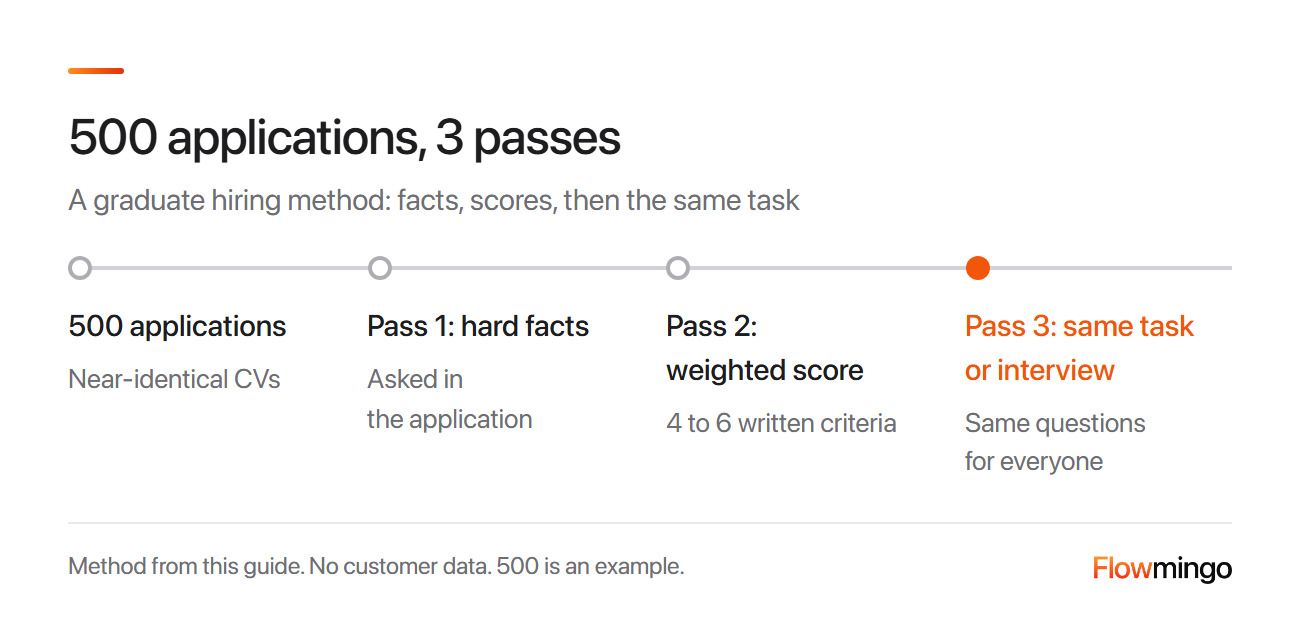
Screening in 3 passes: hard facts, weighted scores, then the same task or interview for everyone who clears the cut (method, no data).
Write the criteria before you read a CV, because reading bends them (Uhlmann and Cohen, in lab studies, foundational 2005). Add the scores with a fixed formula, which a foundational 2013 review found predicts performance more than 50% better than an expert's judgement.
Here is a worksheet for a graduate operations analyst (illustrative, not customer data):
| Criterion (weight) | Thin-CV evidence | Score 8 to 10 | Score 3 to 5 |
|---|---|---|---|
| Start date and location (pass or fail) | A direct answer | Yes | -- |
| Data handling (Must Have, 4) | A course project, course grades or a part-time task | Names the data, tool and finding | Lists a course, no result |
| Written communication (Very Important, 3) | A report or 3-sentence answer | Clear, ordered, with an example | Correct but generic |
| Ownership (Important, 2) | A society role or project they ran | Names what they owned and the result | Took part, no clear role |
| Learning new tools (Good to Have, 1) | A tool they taught themselves | Names the tool and what they built | Says "quick learner" |
A criterion with no evidence scores 3, never skipped. Weighted score = (4 x data + 3 x writing + 2 x ownership + 1 x learning) / 10. Scores of 8, 5, 4 and 3 (no evidence on learning) give 5.8.
The 4-3-2-1 weights and the 3 for no evidence are our convention, not a study. Scoring 500 CVs by hand at 3 minutes each takes 25 hours (an assumption, not data), before any interview. Set the cut from your interview hours, not a fixed bar such as 8, which can leave no list (candidate shortlisting).
If an AI tool ranks the pile, change only the names on 20 screened CVs and log any rank change. In October 2024, 3 text-embedding models preferred white-associated names in 85.1% of 27 tests (Wilson and Caliskan).
How Flowmingo helps
CV Evaluation turns a job description into criteria you edit and rate, then scores every CV from 0 to 10 on each. A criterion with no evidence counts as 3, and nobody is filtered out automatically.
7. We screen on GPA. Does it predict job performance, or should campus recruitment drop the cutoff?
Skip the hard GPA cutoff in campus recruitment. Across 114 samples, grades explain only about 4% of the differences in job performance, and they say nothing about who quits.
That comes from a December 2024 meta-analysis, a study that pools many studies, by Van Iddekinge and colleagues. On a scale where 0 is no link and 1 a perfect one, the average was 0.21 for job performance. For quitting it was -0.02 across 20 samples, and squaring 0.21 gives 0.044, so grades explain about 4% (our arithmetic).
Grades in major-specific or job-like courses reach the 0.30s and 0.40s, which means the relevant course beats a blanket GPA. In NACE's Job Outlook 2026, 42% of employers use GPA as a screening tool, down from 73% in 2019 (foundational).
Screen on evidence of the work itself instead. Sackett and colleagues' foundational 2022 analysis scored structured interviews 0.42, job knowledge tests 0.40, work samples 0.33 and cognitive ability tests 0.31. They come from different studies and corrections, so read them as a rough ranking.
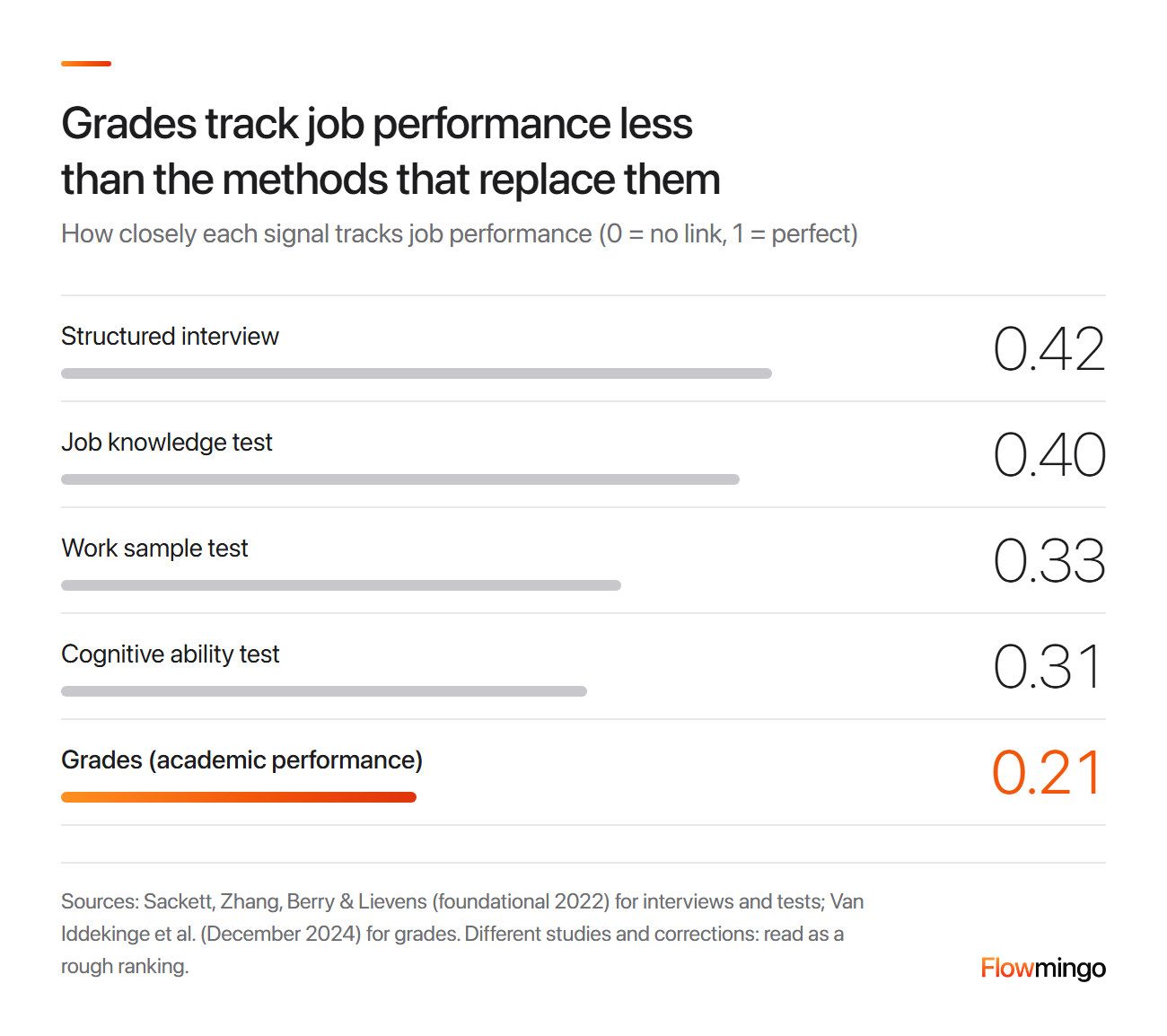
Grades against other methods: structured interviews (0.42) and job knowledge tests (0.40) track later performance more closely than grades (0.21).
That gives 3 moves. Score coursework or project evidence on written anchors (section 6), give everyone a short work sample, and ask the same structured interview questions (section 8).
8. How do I interview 300 graduates with the same questions and compare them fairly?
Ask every graduate the same questions, score each answer on a written 1 to 5 scorecard, and have interviewers score alone before comparing. Structured interviews rank first among common selection methods (section 7), though question quality matters.
Unstructured chats often fail because interviewers rate the same people differently.
The interview has its own 1 to 5 scale. A thin CV may lack evidence through no fault of the graduate, so the CV pass gives 3. An interview question asks for evidence, so none scores 1.
Here is a kit for a graduate operations analyst (illustrative, not customer data):
| Question | Skill | A 5 looks like | A 3 looks like | A 1 looks like |
|---|---|---|---|---|
| Describe a time you learned a tool fast. What changed? | Learning speed | Names tool, steps, checkable result | Describes the project, thin on how | No example |
| A spreadsheet of 200 orders has 12 wrong prices. How would you find them and tell the team? | Data handling | Sets a check order, confirms the fix, plans a message | Finds the errors, no plan to confirm or share | Cannot say where to start |
| Tell me about a group project that went off track. What did you do? | Ownership | Names own action and outcome | Describes the problem and the group's action | Blames others, no action of own |
Set the spreadsheet as the 20-minute short task from sections 6 and 7, and score its 3-sentence team note for written communication.
For the first question, "I learned Python in 3 weeks for my dissertation and cut the run from 2 hours to 4 minutes" scores 5, and "I am a fast learner" scores 1.
At 30 minutes each, 300 live interviews are 150 hours, about 4 working weeks (an assumption, not data). Give candidates 7 days to finish an AI interview, as our interview invitation email templates guide advises, and put the adjustment line in the invitation.
Flowmingo data · AI interviews begun (opened) 1 Jul 2025 to 27 Sep 2026 · 19,440 interviews in projects titled graduate, intern, campus, early career or trainee · 227 companies (company-level rates use the 50 companies with 20 or more interviews); invitations sent 1 Jul 2025 to 7 Sep 2026 · 14,109 invitations · 131 companies
- 84.5% of the AI interviews begun at the typical company's graduate, intern and trainee projects were finished, against 84.0% at other companies.
- About 36% of everyone invited to the typical company's graduate, intern or trainee projects finished the interview within 14 days, against 30% at other companies.
Projects are grouped by title words, so early-career hiring under other titles sits in the comparison group. Begun means the candidate opened the interview, and about 6 in 10 unfinished ones show only 1 message. These are associations, not causes, and say nothing about candidate quality.
So graduate interviews were finished about as often as others at the typical company. The 14-day figure counts everyone invited, including people who never opened the link. In March to May 2026 both groups were at about 35%, so do not plan on a graduate advantage.
We left out invitations sent from a job post, because we cannot match them to an interview, and other unmatched invitations understate both groups. We also cannot tell where graduate invitees came from.
The 2 largest programmes make up 45% of these interviews and 60% of these invitations. The company figures count each company once, so those programmes weigh no more than any other company.
How Flowmingo helps
With the AI Interviewer, you send 1 link and each graduate does a structured, spoken interview in their own time. Follow-ups depend on the answer, so only the base interview and criteria are shared. You get the recording, the transcript and a report scoring each criterion 0 to 10, and you decide who moves forward. Name your adjustment contact in the invitation you write. On Free, the latest 300 videos stay for 30 days.
9. How long should graduates get to accept, and how many accepted offers still fall through?
Give graduates 1 to 2 weeks to answer, which NACE's guidance calls common, and plan for about 3 in 4 to accept. About 1 in 14 accepted offers fell through in foundational 2024 data, so send about 29 offers to start 20 graduates.
NACE adds that less can be undue pressure. Duke asks employers to keep year-ahead offers open to 31 Aug, and return offers to 2 Nov or 2 weeks, whichever is later. It also prohibits exploding offers, for example a bonus for accepting within 24-48 hours.
Both rows are 1 survey of graduate offers, not a trend.
| Measure | Figure | Survey |
|---|---|---|
| Offers accepted | 75% | NACE 2024 report, Class of 2023, 235 employers (foundational) |
| Accepted full-time offers that fell through | About 7% (10% for internships) | Same report |
Offers needed equal starters divided by (accepted x not reneged), so 20 / (0.75 x 0.93) = 28.7, or about 29 offers (our arithmetic). Gartner's 48% for late 2025 asks candidates about their latest offer, so it is not an employer's acceptance rate.
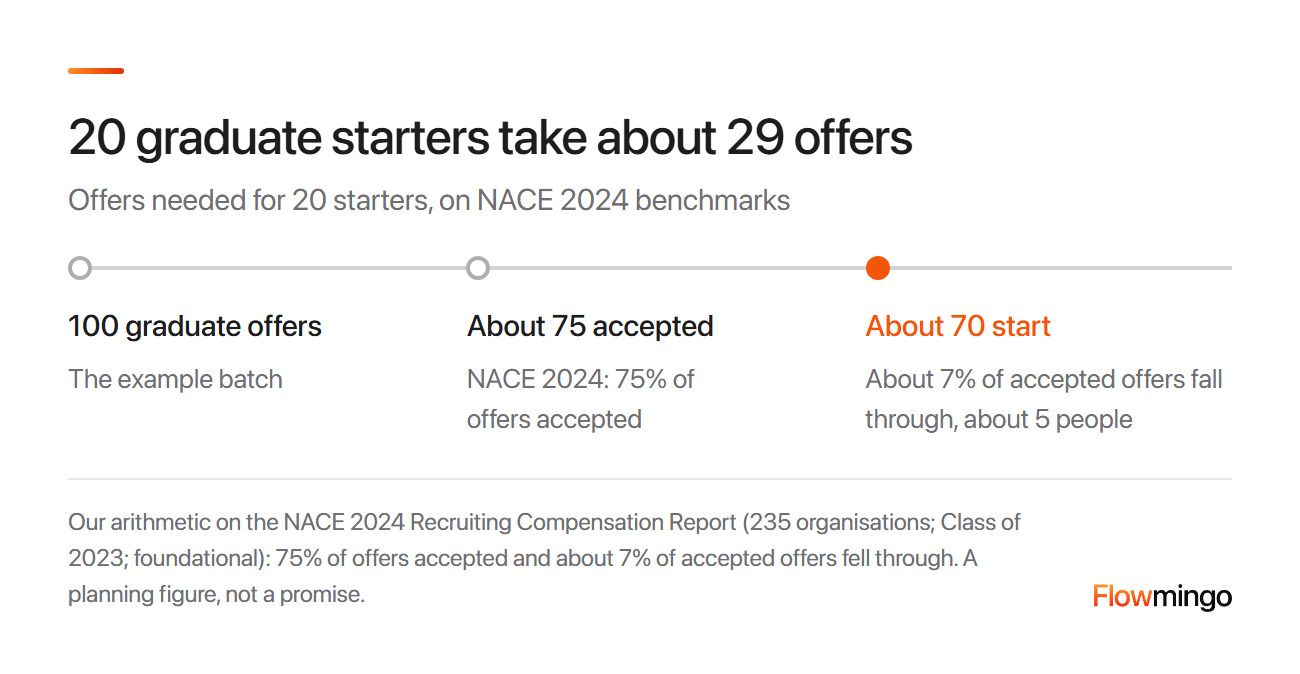
Offers for 20 starters: of 100 graduate offers about 75 are accepted and about 70 start, so 20 starters need about 29 offers (our arithmetic).
NACE's 2025 article says students accepted at a greater rate but also that reneges rose for full-time positions, and it prints neither percentage. Treat 29 as a planning figure and recheck after your first round. For the 3 graduates in the opening, 3 / (0.75 x 0.93) is 4.3, so send 5 offers.
10. How many of our interns should we convert to full-time hires, and what rate is normal?
NACE's latest survey of 284 organisations puts the average at 63.1% of interns hired full time, so keeping 3 of 5 is typical. Size the intern class to the jobs you actually have.
That 63.1% is for 2024-25 interns, the highest in 5 years, and NACE calls it "a steep climb of nearly 13%" from 2023-24. Conversion means the share of the intern class that became full-time hires, for example 3 of 5 interns. It depends on offers made and offers accepted.
Acceptance reached 88.3%, so about 23 return offers keep 20 interns (20 / 0.883 = 22.7, our arithmetic). Say you hire 5 interns this year. At 63.1%, about 3 convert, and keeping 2 of 5 is 40% (our arithmetic), below the average, so ask what changed.
NACE warns that hiring more interns than you can integrate sets the programme up to fail. Write the return-offer rule before the internship starts, so every intern is judged on the same evidence. Use the intake's weighted criteria plus the manager's end-of-internship rating, so a return offer never rests on 1 person's liking.
How Flowmingo helps
Flowmingo is a free AI interviewer for recruiters. Results, scores and transcripts stay on every plan, so you can compare each intake's scores with its end-of-internship ratings. Your next round of campus recruitment then starts from what worked with Flowmingo.
11. Sources
Every study, law and survey in this guide links to a source below; Flowmingo figures come from Flowmingo's own platform data.
- Acas (n.d.). Following discrimination law: Recruitment. Acas.
- Acas (n.d.). Types of age discrimination. Acas.
- Duke University Career Hub (2026). Recruiting guidelines and expectations for employers. Duke University.
- Equality Act 2010, sections 19, 39 and 60 (2010). Equality Act 2010, section 19, section 39 and section 60. legislation.gov.uk.
- Gartner (2026, June 18). Gartner HR research finds 48% of candidates accepted job offers in 4Q25. Gartner.
- Handshake (n.d.). Going back on campus? Here's how much it really costs. Handshake.
- Institute of Student Employers (2025). 5 trends you need to know from ISE's Recruitment Survey 2025. Institute of Student Employers.
- Kuncel, N. R., Klieger, D. M., Connelly, B. S., & Ones, D. S. (2013). Mechanical versus clinical data combination in selection and admissions decisions: A meta-analysis. Journal of Applied Psychology, 98(6), 1060-1072.
- Ministry of Manpower, Singapore (2024). Fact sheet on Workplace Fairness Bill first reading. MOM.
- National Association of Colleges and Employers (2024). As employers push out time from interview to offer, student response time holds steady. NACE.
- National Association of Colleges and Employers (2025). In-person activities more effective than virtual ones for recruiting interns. NACE.
- National Association of Colleges and Employers (2025). Employers continue to recruit in fall but adjust timing of offers. NACE.
- National Association of Colleges and Employers (2025). Employers make more offers as student acceptance rate rises, response time shortens. NACE.
- National Association of Colleges and Employers (2026). Advisory opinion: Setting reasonable deadlines for job offers. NACE.
- National Association of Colleges and Employers (2026). Skills-based hiring grows, but college students don't fully understand it. NACE.
- National Association of Colleges and Employers (2026). Intern conversion rate hits highest mark in five years. NACE.
- National University of Singapore, Centre for Future-ready Graduates (2026). Career fairs and recruitment talks. NUS. Read through a Wayback capture on 4 October 2026.
- Office of Legal Counsel, US Department of Justice (2026, June 9). Constitutionality of disparate-impact liability under Title VII. DOJ.
- Rivera, L. A. (2012). Hiring as cultural matching: The case of elite professional service firms. American Sociological Review, 77(6), 999-1022.
- Sackett, P. R., Zhang, C., Berry, C. M., & Lievens, F. (2022). Revisiting meta-analytic estimates of validity in personnel selection: Addressing systematic overcorrection for restriction of range. Journal of Applied Psychology, 107(11), 2040-2068.
- Singapore Statutes Online (2026). Workplace Fairness Act 2025, status uncommenced as at 4 October 2026. Singapore Attorney-General's Chambers.
- Stony Brook University Career Center (2026). Recruitment events. Stony Brook University. Read on 4 October 2026.
- Tripartite Alliance for Fair and Progressive Employment Practices (n.d.). Tripartite guidelines on fair employment practices: Job advertisements. TAFEP.
- Tripartite Alliance for Fair and Progressive Employment Practices (2026, May 18). Fair recruitment practices for employers in Singapore: Preparing for the Workplace Fairness Act. TAFEP.
- U.S. Code of Federal Regulations (1978). 29 CFR 1607.4, information on impact, and 29 CFR 1607.16, definitions. Legal Information Institute and eCFR.
- U.S. Code of Federal Regulations (2007). 29 CFR 1625.4, help wanted notices or advertisements, 29 U.S. Code 630, definitions and 29 U.S. Code 631, age limits. Legal Information Institute.
- U.S. Code of Federal Regulations (1991). 29 CFR 1630.11, administration of tests and 29 CFR 1630.14, medical examinations and inquiries. Legal Information Institute.
- Uhlmann, E. L., & Cohen, G. L. (2005). Constructed criteria: Redefining merit to justify discrimination. Psychological Science, 16(6), 474-480. Summarised by Yale News.
- Vanderbilt University Career Center (2026). Recruiting calendar. Vanderbilt University. Read on 4 October 2026.
- Van Iddekinge, C. H., Arnold, J. D., Krivacek, S., Frieder, R. E., & Roth, P. L. (2024). Making the grade? A meta-analysis of academic performance as a predictor of work performance and turnover. Journal of Applied Psychology, 109(12), 1972-1993.
- Wilson, K., & Caliskan, A. (2024). Gender, race, and intersectional bias in resume screening via language model retrieval. Proceedings of the AAAI/ACM Conference on AI, Ethics, and Society, 7, 1578-1590. Erratum: arXiv v3.