
Your 2026 budget meeting wants a shortlist of AI recruiting tools, and every vendor deck says its AI runs the whole funnel. You have 1 slide to name the 3 worth a pilot.
Of 12 AI hiring tools we read on 5 November 2026, 4 show no price and only 3 have a bias audit you can open.
Where New York City's audit rule covers a scoring tool, the employer, not the vendor, must ensure its audit exists. Under the foundational 2021 Local Law 144, fines reach $1,500 a violation, each day counted separately.
The fix takes 3 moves: judge every tool on 5 points, start where your hours go, and pilot 1 role for 2 weeks. We make Flowmingo, so it is 1 entry of 12, judged on the same points.
Key takeaways
- What should we compare AI recruiting tools on? 5 points: the AI's stage, evidence per score, dated price, 1 real limit and a readable audit.
- How many of these tools show a bias audit? 3 of 12 have a report you can open, and 2 of those used simulated or test candidates for some or all groups.
- Who is liable if a vendor's AI screens someone out unfairly? You stay liable, and the vendor may be too: a June 2026 US ruling says Workday can be directly liable, before any merits ruling.
- Do AI scores at different stages agree? Rarely at the top: in 457 of our projects, the top AI interview score had the top AI CV score in 12.5%.
- How fast do candidates finish an AI interview? Finishers are quick: 84.8% of 22,372 were done within 72 hours of the invite, not counting non-starters.
1. We must shortlist AI recruiting tools for the 2026 budget: what should we compare?
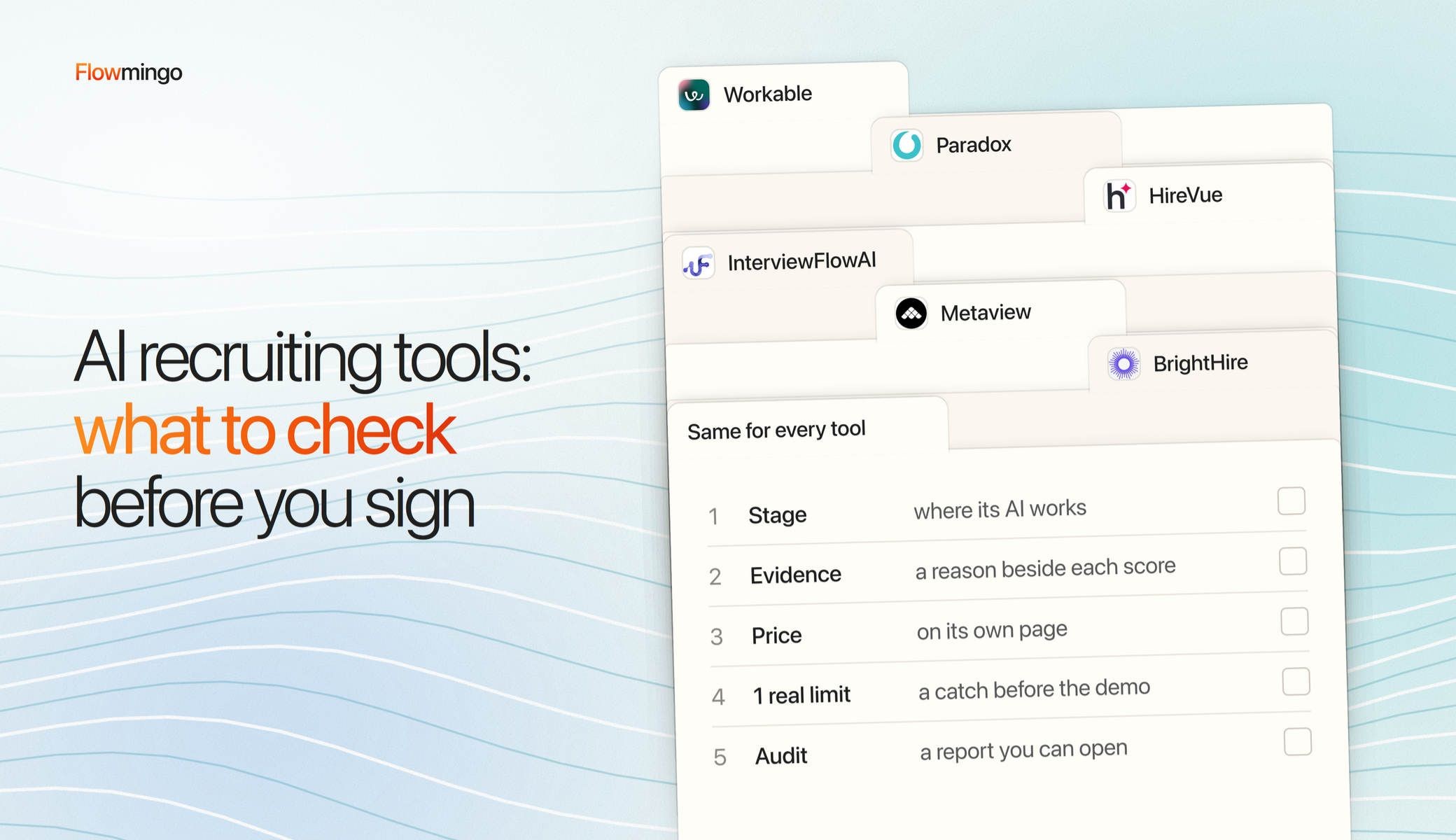
Compare 5 things: the AI's stage, the evidence beside each score, the dated price, 1 real limit and a bias audit you can read.
Criteria come first because 3 of the 4 "best tools" lists on Google's page 1 come from vendors ranking themselves first (Metaview, Spott, Zapier).
- Stage. Scoring applicants can need an NYC audit, but sourcing does not (DCWP FAQ, foundational).
- Evidence. A score nobody can explain is worthless, so we want its reason (r/managers).
- Price. Prices change, so we quote each vendor's own page in USD, read 5 November 2026.
- 1 real limit. We name 1 catch from the vendor's pages, so you see it before the demo.
- Audit. A claimed audit is not a report, so we look for 1 you can read.
This list of the best AI recruiting tools follows the order a candidate meets them, with all-stage platforms last. Within a stage, a report you can open ranks first, then a claimed audit, then none mentioned, then a stated none. Ties go alphabetically, and a vendor's audit of another product counts (Metaview).
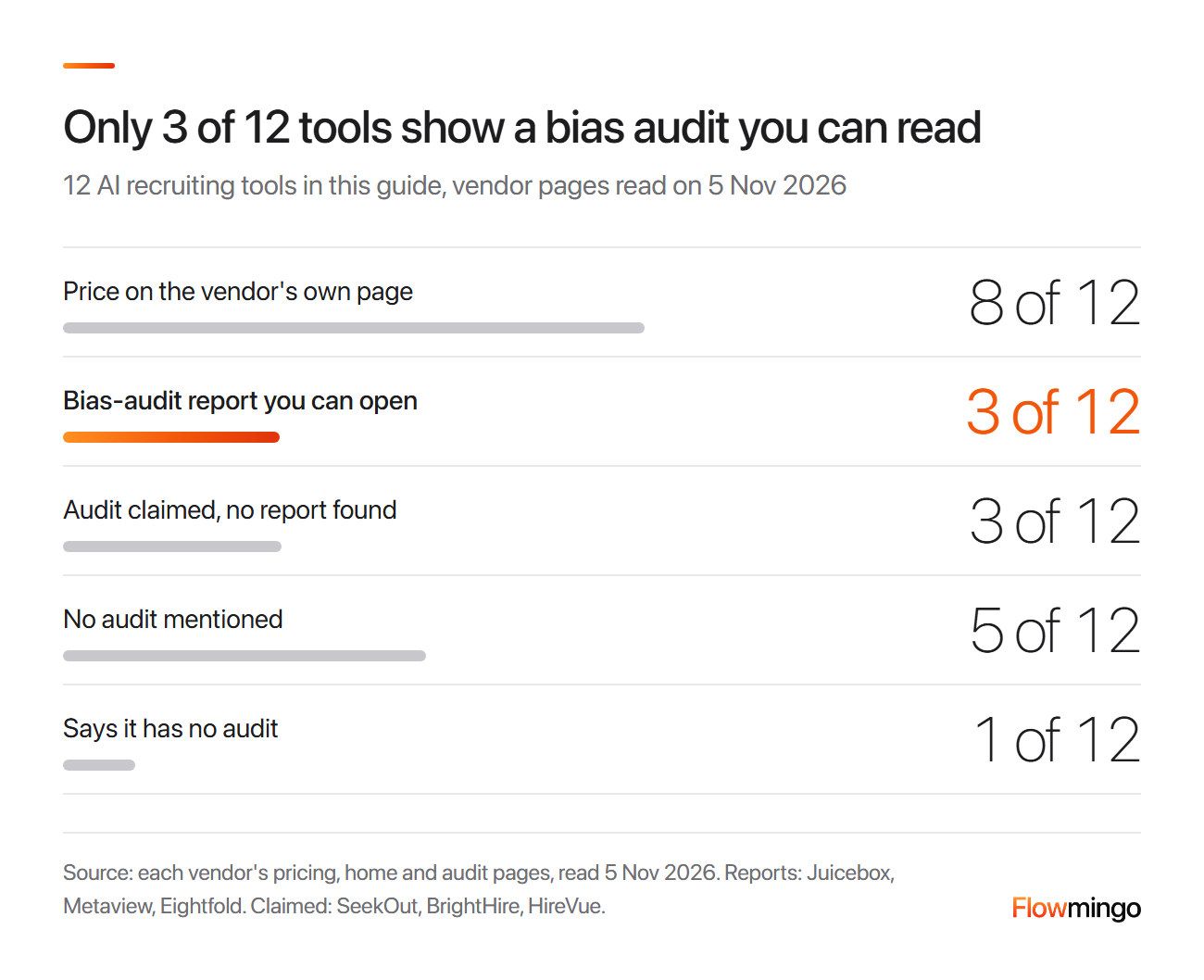
Price and audit check: of 12 tools read on 5 November 2026, 8 show a price. Only Juicebox, Metaview and Eightfold have an audit report you can open, while SeekOut, BrightHire and HireVue claim one but link none.
5 tools mention no audit, and Flowmingo says it has none.
1. Juicebox
Best for: agencies filling hard roles through outbound.
- Stage and evidence: Sourcing. It ranks 800M profiles from 30+ sources against your brief, and its sample card marks each criterion a match or not.
- Price: Free plan, then $99 a seat a month billed yearly, or $119 monthly.
- Real limit: Agents that email once a person signs off on the copy cost $199 each a month extra.
- Audit: A public Warden AI dashboard audits its Autopilot ranking monthly, latest 6 August 2026.
2. SeekOut
Best for: TA teams wanting sourcing and applicant scoring from 1 vendor.
- Stage and evidence: Sourcing and applicant scoring over 1B+ profiles plus your ATS. It promises reasoning tied to your criteria, so ask to see it on 5 of your own applicants.
- Price: $149 a month paid yearly, or $179 monthly, after 14 days of access.
- Real limit: 500 contact credits and 1,000 exports a month, and team tiers are quote-only.
- Audit: It claims "Regular third-party bias audits (latest: Nov 2025)" but its homepage links no report.
3. Pin
Best for: solo recruiters and founders who do their own outreach.
- Stage and evidence: Sourcing. It matches 850M+ profiles and drafts outreach, and its sample card gives each criterion a yes or maybe with a 1-line reason.
- Price: Free plan with 5 contact credits a week, then Solo at $100 a user a month.
- Real limit: Solo is "not available on monthly billing", so you commit for a year.
- Audit: Its home and pricing pages mention no bias audit.
4. Manatal
Best for: agencies and small teams wanting a cheap per-seat ATS.
- Stage and evidence: CV matching inside an ATS. Its AI summaries show "how candidates match your requirements", and a separate AI interviewer grades videos.
- Price: $15 a user a month on yearly plans, or $19 monthly.
- Real limit: The entry plan caps an account at 15 jobs and 10,000 candidates.
- Audit: It promises "an objective evaluation, free from unconscious bias" but links no audit.
5. Workable
Best for: small companies wanting 1 ATS with per-candidate AI screening.
- Stage and evidence: CV screening. Its Screening Agent checks each applicant against your "ideal candidate profile", and the pricing page shows no sample result.
- Price: ATS from $299 a month for 1 to 20 employees, then 1 credit per screened candidate, $0.095 to $0.12 after 3,000 free credits.
- Real limit: Credits expire 1 year after purchase with no refund.
- Audit: The pricing page mentions no bias audit.
6. Paradox (Workday)
Best for: frontline, high-volume employers, especially on Workday, which bought Paradox on 1 October 2025.
- Its assistant, Olivia, texts applicants, asks screening questions and books interviews, and its pages show no sample score or reason.
- Price: Not published: its pricing link opens the homepage.
- Real limit: Its standard terms renew yearly unless you give 30 days' notice, with rises of up to 5% a year.
- Audit: None found on its pages, and our Paradox recruiting guide covers its contract.
7. HireVue
Best for: large employers running video interviews at scale.
- Stage and evidence: AI interview. It scores only the transcribed words against expert ratings, and its explainability statement rules out facial expressions and tone.
- Price: Not published, and free for candidates.
- Real limit: A third party, Rev.ai, transcribes speech before scoring, so add it to your data review.
- Audit: It hired DCI Consulting for NYC audits in 2023 (foundational), and employers have posted reports, but its own pages link none (Gerchick et al.).
8. InterviewFlowAI
Best for: small teams that want to pay per interview.
- Stage and evidence: AI interview. It runs voice or video interviews in "16 supported languages", with ranked shortlists "backed by verbatim transcript quotes", competency scores and recordings.
- Price: $59 a month for 20 interviews, down to about $0.83 each on a yearly Growth plan.
- Real limit: Extra interviews cost $3 each on that Pilot plan.
- Audit: Its headline promises "no bias", but neither page links an audit.
9. Flowmingo
Best for: high-volume, entry to mid-level roles, not a senior hire's final round.
- Stage and evidence: AI interview. It drafts 1 to 30 questions from your job description and rates each criterion 0 to 10 with written reasons.
- Price: Free plan with unlimited AI interviews, then Starter at $49 a month.
- Real limit: Free keeps the latest 300 videos, for 30 days each, allows 3 report downloads in total and caps interviews at 20 minutes. Candidates see Flowmingo's brand beside yours.
- Audit: Its AI ethics page says it has not commissioned a third-party bias audit.
10. Metaview
Best for: teams whose hours go into interview write-ups.
- Stage and evidence: Interview notes and CV screening. Its Notetaker summarises interviews, and Application Review screens inbound applications. Its pricing page says every AI decision "includes candidate-level rationale".
- Price: Notes free for 25 calls a month, then $60 a user a month.
- Real limit: AI screening is billed apart from the notes seat: Application Review Pro is $150 a month for 500 reviews.
- Audit: Its auditor, Warden AI, publishes a report on Application Review only, run on test profiles.
11. BrightHire (Zoom)
Best for: mid-size and large teams wanting consistent notes and scorecards.
- Stage and evidence: Interview notes and AI first rounds. It records and summarises interviews, auto-fills scorecards, and says Screen and Inbound cite evidence for each score. Zoom announced buying it on 13 November 2025.
- Price: Not published: every product leads to a demo.
- Real limit: Its 3 products are priced on 3 bases (applicant volume, interview volume, company size), so ask for 1 quote covering all you buy.
- Audit: It says auditors test its AI yearly but links no report, and candidates can opt out of recording.
12. Eightfold
Best for: enterprises hiring at volume on 1 AI hiring platform.
- Stage and evidence: Every stage, as 1 platform. It matches people to roles from "1.6 billion career trajectories" and says its AI "never decides". Its AI Interviewer page promises "data-rich intelligence summaries" but shows no sample reason per score.
- Price: Not published, only "Request demo".
- Real limit: Race results in its public audit come from simulated interviews, not real applicants.
- Audit: BABL AI audited its AI interviewer on 29 June 2026, with every ratio above 0.80.
2. Which AI recruiting tools find passive candidates, and are $99 to $179 sourcing seats worth it?
Juicebox, SeekOut and Pin rank people who never applied, for $99 to $179 a seat a month. That is worth 1 seat on a hard role that needs outbound, judged by replies rather than profiles.
A bigger database does not fill a role on its own, because the bottleneck sits after the search. A corporate recruiter with 15+ years says the hard part is getting the right people to reply without spamming them (r/recruiting).
Check what your tier costs, too. A recruitment-tech poster puts sourcing seats at $500 to $800 a month (r/recruiting).
In the foundational 2024 agency thread on Google's first page, a reply says most AI sourcing feels like ordinary search (r/recruiting). Others report LinkedIn restricting their accounts after a browser-extension sourcing tool, though nobody has confirmed a lawsuit (r/recruiting).
So ask each vendor where its profile data comes from and whether it automates any LinkedIn action. For example, pilot 1 seat on 1 role for 2 weeks, billed monthly where offered, because Pin's Solo locks you in for a year. Count replies and interviews booked, not profiles found.
3. Our ATS smart match burned us: do AI recruiting tools actually read a CV?
Some read the CV and some match keywords, and the reason beside each score tells you which. Ask for the criterion, the CV line it used, and a re-score when you change the criteria.
A keyword filter shows a match count, while a reading tool gives a reason per criterion. A freelance recruiter who tested tools for months found much "AI" review was keyword matching in a new interface (r/recruiting).
Names can move scores too. In a foundational 2024 study, 3 CV-matching models preferred White-associated names in 85.1% of race tests (Wilson and Caliskan). The CVs differed only by name, so send 5 such pairs before you buy.
Our own scores show 2 stages rarely agree at the top, so 1 stage should not decide alone.
Flowmingo data · 457 hiring projects at 214 companies, AI scores from 9 Jul to 4 Nov 2026
- 12.5% of projects gave the top AI interview score to the candidate who also had the top AI CV score.
- 5.7% is what chance alone would give for that same match.
- 56.5% of projects saw the top interviewer's AI CV score fall outside the top 20% of the group, against 78.5% by chance.
Candidates with both scores in a project, ties counted, on current weighted scoring, unlike older figures. AI scores, not job performance, from an already selected group.
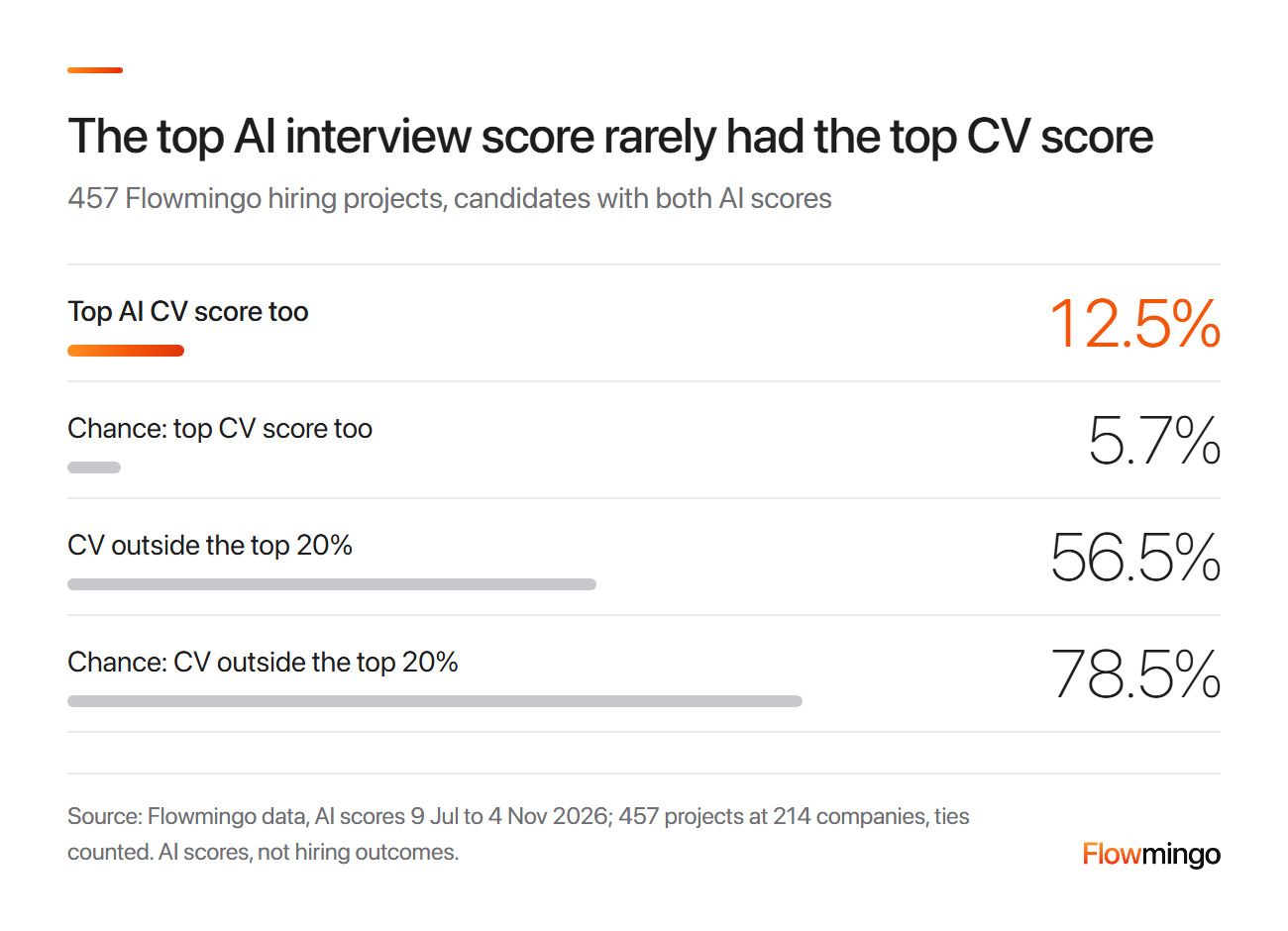
CV score vs interview score: the top AI interview score matched the top AI CV score in 12.5% of 457 projects, against 5.7% by chance. It sat outside the CV top 20% in 56.5%, against 78.5% by chance.
Among candidates who had both scores, a top-20% CV cut would have dropped the top AI interview scorer in 56.5% of projects. Chance alone gives 78.5%, so the CV score carries some signal, just not enough to cut on alone. Our guide to AI CV screening software shows how to test that on your roles.
4. Hiring at volume: will good candidates finish an AI interview, and which tools should we test?
Many never start: of 52,078 applicants invited to a Flowmingo AI interview, 36.3% began within 14 days, and 85.1% of those finished. Those who finish are quick, so track your own start rate.
Test HireVue for video at scale, InterviewFlowAI to pay per interview, or Eightfold for a published audit. Flowmingo fits high-volume entry to mid-level roles on a free plan. Teams on BrightHire or Manatal can try the AI interviewer they already pay for.
Candidates still need convincing: only 26% trust AI to evaluate them fairly (Gartner). A Fortune 500 recruiter says about half of candidates take it (r/recruiting).
Flowmingo data · AI interview invites and finishers, 2 published cuts
- 36.3% of 52,078 applicants invited 15 Jun to 13 Sep 2026 began the AI interview within 14 days.
- 85.1% of applicants who began the AI interview finished it within the 14 days.
- 84.8% of 22,372 invited candidates who finished did so within 72 hours of the invite.
Starts as in our recruitment funnel guide. Speed counts finishers only, interviews created 15 Apr to 6 Oct 2026 (Apollo Technical).
Nearly half of finishers were done within a day, almost all within a week.
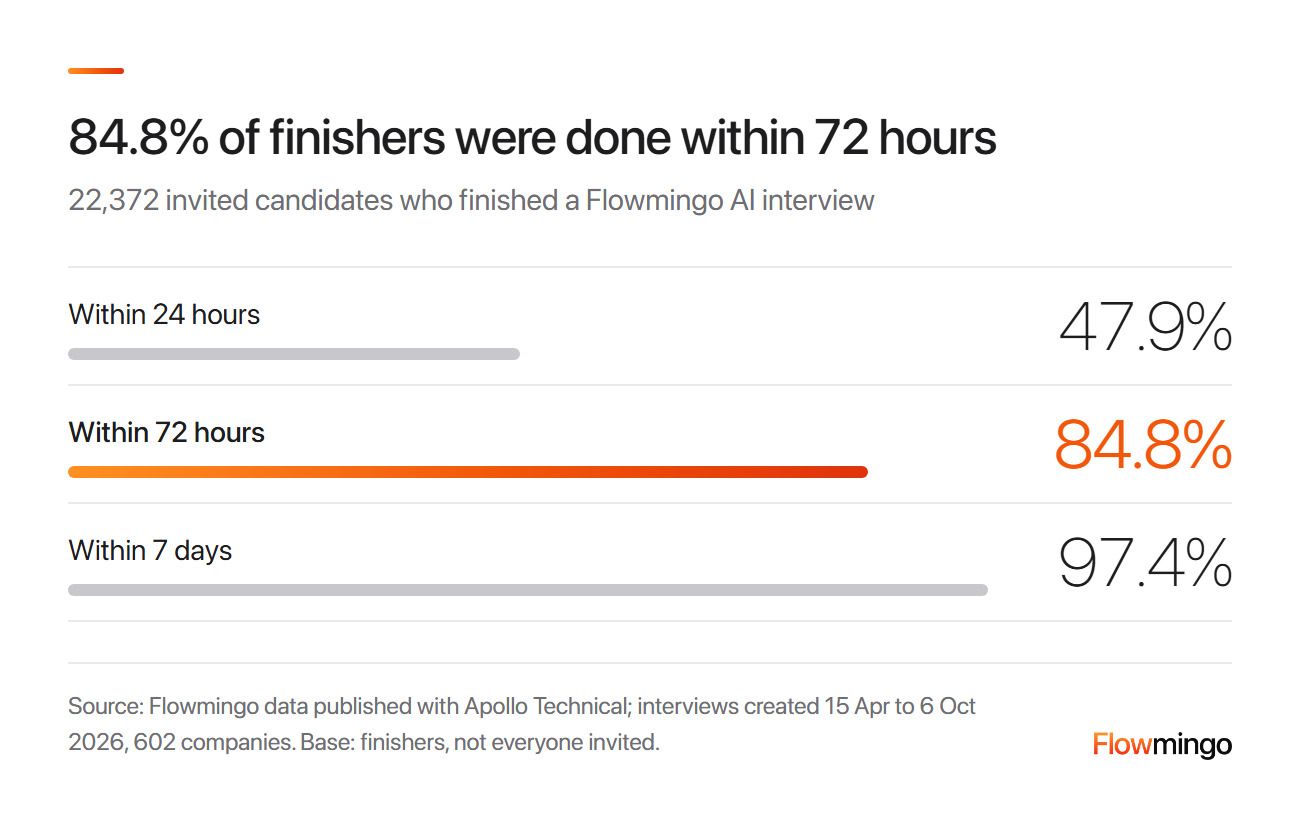
Invite to finish: of 22,372 invited candidates who finished an AI interview with us, 47.9% did so within 24 hours. 84.8% finished within 72 hours and 97.4% within 7 days.
In a foundational 2024 book, a journalist's German-only answers earned a competent rating for English (Schellmann). So send 1 off-topic and 1 wrong-language answer in your trial, and the score must drop or carry a flag.
Ask whether face, tone or emotion counts, because the EU has banned emotion recognition from biometric data at work since 2 February 2025. Lewis Silkin reads the Commission's draft guidelines as covering job candidates.
5. Is it safe to let an AI notetaker record interviews, and what must candidates hear?
Yes, if candidates hear about it before the call, can say no, and the recording stays with your hiring records. Treat any auto-filled score like any other AI score.
In the foundational 2024 agency thread, recruiters named note-takers most, and a BrightHire user asks consent first: "90% are fine with it". Another team puts notice and an opt-out in the confirmation email and keeps recordings only in the ATS (r/recruiting).
Check accuracy too, because a read.ai user said the notes did not resemble the call. For example, compare 5 summaries with their recordings in your first week.
If summaries feed a decision, they are hiring records, and California wants automated-decision data kept at least 4 years (CRD). So ask each vendor who sets retention and who can export. Illinois HB 3773 has required notice of AI use since 1 January 2026 (Crowell & Moring, foundational).
Adapt this notice for the confirmation email, as an illustration, not legal advice.
Recording notice for the interview confirmation email
We record and transcribe this interview with an AI notetaker. Only the hiring team and our notetaker vendor can access it, kept for [your retention period][, and our contract bars the vendor from training its AI on it]. A person, not the AI, decides who moves forward. Reply "no recording" and we will take notes by hand instead, with no effect on your application.
Keep the bracketed line only if your contract says it. Where NYC's audit rule covers a scoring notetaker, send it 10 business days ahead.
6. Why won't most AI recruiting tools publish a price, and what should we budget per role?
Quote-only vendors price by volume, company size or the tools they replace, so they want a demo first. Budget per role instead: on published plans, $0 to about $150 a month per stage for 200 applicants, before any ATS fee or credit bundle.
1 vendor not on this list, hireEZ, says it no longer publishes a seat price because it "stopped reflecting what we actually do" (hireEZ).
AI recruitment tools that publish a price follow 3 models. Per seat suits a few recruiters on hard roles, per use suits volume hiring, and a per-account plan costs the same at any volume.
Here is our list-price arithmetic for 1 role with 200 applicants, not customer data.
| Stage | Tool and plan | Cost at list price |
|---|---|---|
| Sourcing, 1 seat | Juicebox Starter | $99 a month, billed yearly |
| CV screening, 200 | Workable Screening Agent | Inside 3,000 free credits, then bundles from $600 for 5,000 ($0.12 each), on an ATS from $299 |
| AI interviews, 50 | InterviewFlowAI Pilot, per interview | $59 plus 30 extra at $3 = $149 |
| AI interviews, 50 | Flowmingo Free, per account | $0, latest 300 videos kept 30 days |
| Chat, video, platforms | Paradox, HireVue, BrightHire, Eightfold | No list price: quote only |
Prices also climb after signing: a client of 5+ years says a sourcing vendor's price rose many times over (r/recruiting). Paradox caps renewal rises at 5% a year, so ask every vendor for a cap in writing.
Then pilot for 2 weeks, tracking time to shortlist, start and finish rates, pass-through and hiring-manager agreement with the AI's top 5. Our AI interview cost per candidate guide shows the maths at volume.
7. If AI recruiting tools screen out candidates unfairly, who is liable: the vendor or us?
You stay liable, and the vendor may be too, because buying AI hiring software does not hand over your legal duty. In a foundational July 2024 ruling, a US court let Mobley v Workday proceed on the theory that Workday acted as the employers' agent.
This is general information, not legal advice. In June 2026 the court ruled Workday can be directly liable under California law for its own conduct (Duane Morris). A class-certification hearing is set for 9 March 2027, with no ruling on the merits.
Under Title VII and the foundational 1978 guidelines, a group selected at under 80% of the top group's rate signals adverse impact (29 CFR 1607.4). On 9 June 2026 the Justice Department's Office of Legal Counsel called them an unconstitutional reading of Title VII. The EEOC's agenda lists rescinding them in November 2026.
Keep the 4/5 check as your own monitor, since NYC audits still report impact ratios.
A proposed class action alleges Eightfold scored applicants 0 to 5 on data they never supplied, which Eightfold denies (SIA).
NYC's audit duty follows the score, not the search: sourcing sits outside it, while CV and interview scores can bring audit and notice duties. Illinois' notice and anti-discrimination rule also covers AI in recruitment (National Law Review).
Give notice before chat knockouts and recorded notes, and keep a person on the decision. In the EU, AI interviews must not read emotion.
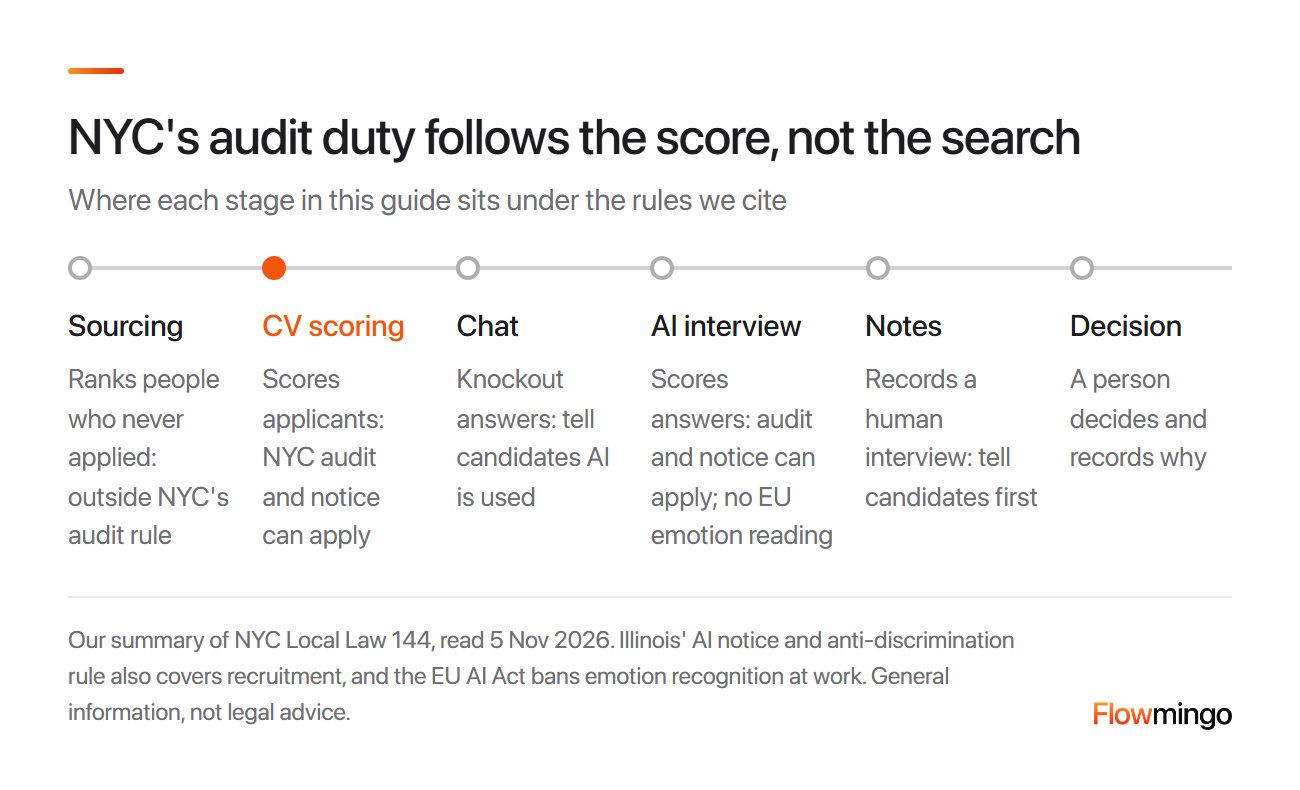
NYC audit duty by stage: sourcing people who never applied sits outside NYC's audit rule. Scoring can bring audit and notice duties, EU AI interviews must not read emotion, chat and notes need notice first, and a person decides.
Put 7 lines in the contract.
- Roles: who controls candidate data, since the UK regulator found some vendors pushing compliance onto recruiters (ICO, foundational).
- Indemnity: who pays if a score is challenged, though Colorado voids discrimination indemnities from 1 January 2027 (Goodwin).
- Data sources: every source a score uses beyond the application.
- Training: whether your applicants' data trains the vendor's models.
- Records: export of scores, transcripts and recordings for your strictest location's retention period.
- Audit: a report from the last 12 months, its data type and a yearly re-run.
- Exit: the export window after you leave and a cap on renewal rises.
Paradox's standard terms let it train its AI on de-identified account data and delete your data 30 days after you leave.
8. Does the vendor's bias audit cover our AI recruiting tools, or do we need our own?
In NYC, the audit rule can apply when a tool scores applicants. Then you must make sure a bias audit from the last 12 months exists, even one the vendor paid for.
Where it applies, also warn candidates 10 business days before use. The foundational DCWP FAQ says the vendor "is not responsible" and employers are "ultimately responsible".
State auditors found at least 17 potential violations in 32 companies' audits, where the city found 1 (NY State Comptroller). DLA Piper expects stricter enforcement.
A published audit is only a start. Gerchick et al. read 116 public NYC audits up to early November 2024. 53% had at least 1 impact ratio below 0.8, a flag to check, not proof of discrimination, and 16% used test data.
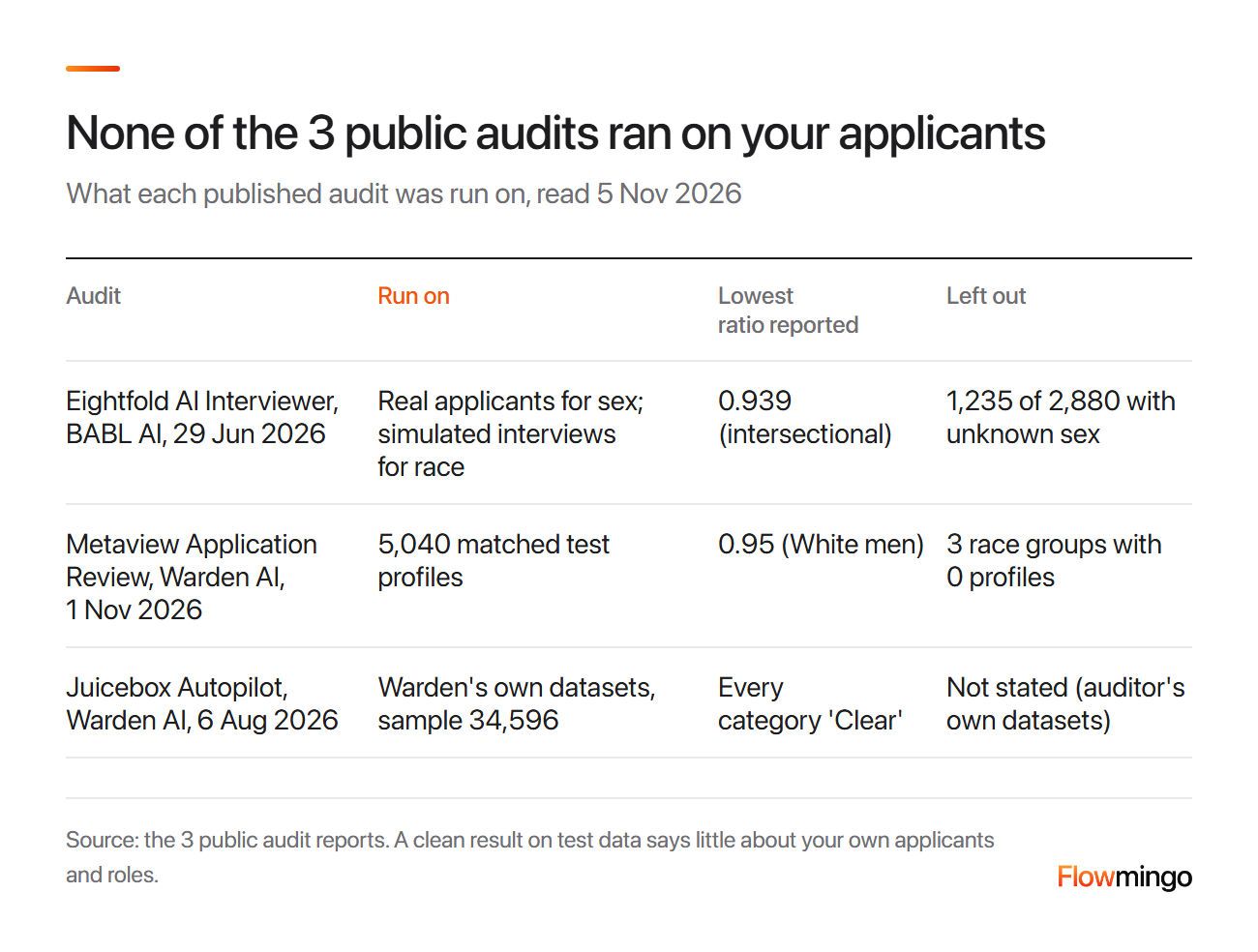
Public audits compared: Eightfold, Metaview and Juicebox each have a public bias audit. Each ran on a different pool: real applicants for sex plus simulated interviews for race, matched test profiles, or the auditor's own data.
The 3 public audits raise no flag on their own tests. Eightfold's lowest intersectional ratio was 0.939, on simulated interviews, and its sex results left out 1,235 of 2,880 real applicants with unknown sex.
Metaview's 1 November 2026 report found a lowest of 0.95 on 5,040 test profiles, with 0 in 3 race groups. Juicebox's ran on a Warden sample of 34,596, every category Clear.
So run your own check each quarter, because none ran on your applicants, and have a person re-review a random sample (r/managers). Say 60 of 100 men but only 40 of 100 women pass a stage. Divide 40% by 60% and you get 67%, under 80%.
How Flowmingo helps
Flowmingo has not commissioned a third-party bias audit, so where NYC's rule applies, you arrange your own. Each AI Interviewer score shows written reasons per criterion beside the recording and transcript, and your team can override it. CSV export for a 4/5 check starts on the Growth plan.
Run 1 role through 2 tools for 2 weeks, then judge Flowmingo on the same 5 points as the other AI recruiting tools.
9. Sources
We read every vendor price and quote on the vendor's own page on 5 November 2026. Flowmingo figures are our own data.
- Apollo Technical (2026). AI interview statistics. Apollo Technical.
- BABL AI for Eightfold AI (2026). AI Interviewer bias audit results. Eightfold AI.
- BrightHire (n.d., read 2026). Pricing. BrightHire.
- California Civil Rights Department (2025). Civil Rights Council secures approval for regulations to protect against employment discrimination related to artificial intelligence. CRD.
- Colvin, J. L., Francis, S. R. D., Ochs, D., & Zagger, Z. V. (2026, June 4). Illinois postpones proposed regulations on AI in employment. National Law Review.
- CourtListener (2026). Mobley v. Workday, Inc., No. 3:23-cv-00770. Docket.
- Crowell & Moring (2024). Artificial intelligence in employment update: Illinois requires notice and prohibits discriminatory impact in use of AI. Crowell & Moring.
- DLA Piper (2026). Critical audit of NYC AI hiring law signals increased risk for employers. DLA Piper.
- Eightfold AI (n.d., read 2026). AI Interviewer. Eightfold AI.
- Eightfold AI (n.d., read 2026). Talent intelligence, human-led. Eightfold AI.
- Flowmingo (n.d., read 2026). AI ethics. Flowmingo.
- Flowmingo (n.d., read 2026). Pricing. Flowmingo.
- Gartner (2025). Gartner survey shows just 26% of job applicants trust AI will fairly evaluate them. Gartner.
- Gerchick, M. K., Encarnación, R., Tanigawa-Lau, C., Armstrong, L., Gutiérrez, A., & Metaxa, D. (2025). Auditing the audits: Lessons for algorithmic accountability from Local Law 144's bias audits. FAccT 2025, ACM.
- Goodwin (2026). Colorado enacts law repealing and replacing landmark Colorado AI Act. Goodwin.
- hireEZ (n.d., read 2026). Pricing. hireEZ.
- HireVue (2026). Explainability statement. HireVue.
- HireVue (n.d., read 2026). Pricing. HireVue.
- HireVue (2023). HireVue engages external auditor DCI Consulting Group for external bias audit of algorithms. Press release.
- Information Commissioner's Office (2024). AI tools in recruitment: Audit outcomes report. ICO.
- InterviewFlowAI (n.d., read 2026). AI interview software for candidate screening via phone and video. InterviewFlowAI.
- InterviewFlowAI (n.d., read 2026). Pricing. InterviewFlowAI.
- Juicebox (n.d., read 2026). Pricing. Juicebox.
- Lewis Silkin (2025). Understanding the EU AI Act's prohibited practices: Key workplace and advertising. Lewis Silkin.
- Maatman, G. L., Jr., Brown, A. D., & Underwood, E. G. (2026). California federal court grants in part and denies in part Workday's motion to dismiss in Mobley v. Workday. Duane Morris.
- Manatal (n.d., read 2026). AI Interviewer. Manatal.
- Manatal (n.d., read 2026). Pricing. Manatal.
- Metaview (n.d., read 2026). Pricing. Metaview.
- Metaview (n.d., read 2026). AI hiring tools. Metaview.
- New York City Council (2021). Local Law 144 of 2021: Automated employment decision tools, §§ 20-870 to 20-874. Intro.nyc.
- New York City Department of Consumer and Worker Protection (2023). Automated employment decision tools: Frequently asked questions. DCWP.
- Office of Information and Regulatory Affairs (2026). Unified agenda: EEOC, RIN 3046-AB43. Reginfo.gov, archived 19 October 2026.
- Office of Legal Counsel, US Department of Justice (2026, June 9). Constitutionality of disparate-impact liability under Title VII. DOJ.
- Office of the New York State Comptroller (2025). Enforcement of Local Law 144: Automated employment decision tools. Report 2024-N-6.
- Paradox (n.d., read 2026). Paradox homepage. Paradox.
- Paradox (2026). Terms of service. Paradox.
- Pin (n.d., read 2026). Pricing. Pin.
- Schellmann, H. (2024). The algorithm. Hachette, reviewed by Publishers Weekly.
- SeekOut (n.d., read 2026). Pricing. SeekOut.
- Spott (2026). Best AI recruiting tools 2026. Spott.
- Staffing Industry Analysts (2026). Lawsuit targeting AI dives into job seeker data. SIA.
- U.S. Equal Employment Opportunity Commission et al. (1978). Uniform guidelines on employee selection procedures, 29 CFR 1607.4. Legal Information Institute.
- Warden AI (2026). AI assurance dashboard: Juicebox Autopilot. Warden AI.
- Warden AI (2026, November 1). NYC Local Law 144 bias audit report: Metaview Application Review. Warden AI.
- Wilson, K., & Caliskan, A. (2024). Gender, race, and intersectional bias in resume screening via language model retrieval. AIES 2024.
- Workable (n.d., read 2026). Pricing. Workable.
- Workday (2025). Workday completes acquisition of Paradox. Workday.
- Zapier (n.d., read 2026). AI recruiting tools. Zapier.
- Zoom (2025). Zoom acquires BrightHire. Zoom.