
You have 12 screening calls to book and 3 days of emails behind you. That is interview scheduling now, and it takes longer than the interviews themselves.
It is not your calendar skills. A hire now takes about 20 interviews in Gem's 2026 benchmarks, and each one needs a slot that suits several people. Most interview scheduling software only books those slots faster.
TA leaders say recruiters spend 38% of their time on it (HR Dive). An interview starts a median of about 6 days after you ask for availability (Ashby). Book it under 24 hours ahead, and more than 1 in 4 candidates (28.0%) did not turn up in Talview's vendor data (Talview).
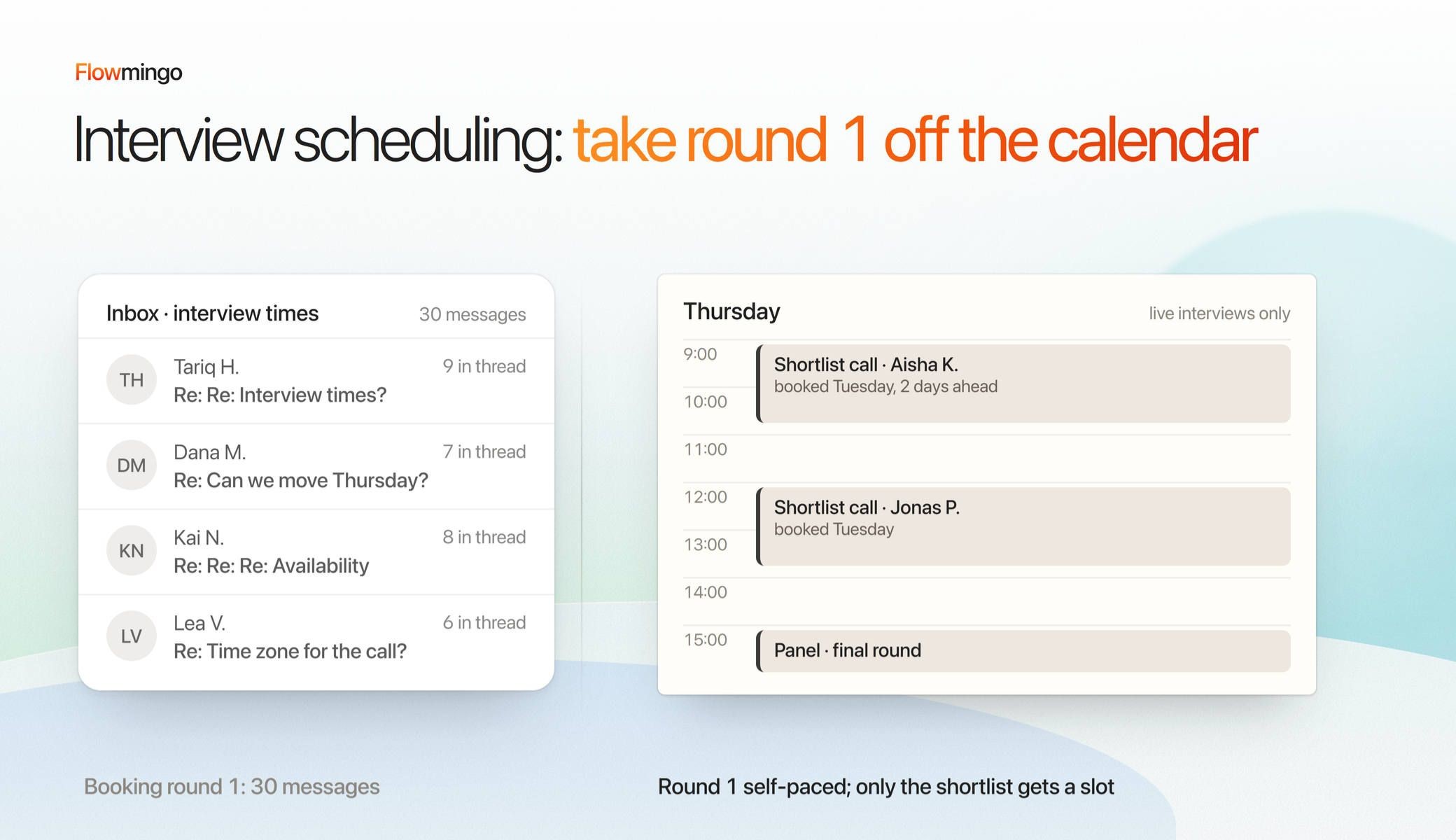
This guide fixes it in 3 moves. Take round 1 off the calendar with a self-paced structured interview, and book live slots only for the shortlist, 1 to 3 days ahead. Then hold a fixed weekly block for panels.
Key takeaways
- How much time does interview scheduling really cost? About 15 hours of a recruiter's week, on TA leaders' estimate (our arithmetic), or 39 booking messages per hire in our example.
- Which interview rounds need a live slot? The shortlist conversation, the final and any panel. Round 1 can run in the candidate's own time.
- How fast do candidates finish a self-paced first round? Half of the finishers in Flowmingo's data were done within 26.3 hours of the invite, and 97.4% within 7 days.
- How far ahead should I book a live interview? 1 to 3 days. In Talview's data, 91.6% showed up when booked 24 to 48 hours ahead, against 72.0% under 24 hours.
- Why are panel interviews so hard to book? Everyone must be free at once, and in Ashby's data only 34% of panels were scheduled within 1 day.
1. How many recruiter hours does interview scheduling really cost us per hire?
TA leaders say recruiters spend 38% of their time on interview scheduling, about 15 hours of a 40-hour week (our arithmetic). For 1 hire in the worked example below, that is 39 booking messages and 5 live screening hours.
That figure comes from GoodTime's survey of 500+ US talent acquisition leaders at companies with 1,000+ employees, run in November 2025. It is self-reported and vendor-run, so read it as a signal, not a stopwatch.
Most of the wait appears to sit on your side (our reading of Ashby's data). In Ashby's October 2024 report, 50% of candidates gave their availability within 24 hours, yet the interview started a median of about 6 days later. Recruiters were associated with 70% of the interview schedules created, which means the person who should talk to candidates does the calendar work.
Email makes it slower. In a foundational 2019 Cronofy survey of 272 agency recruiters, 60% needed 3 or more emails or calls per interview. 41% took 3 or more days.
It also costs you candidates. In Talent Board's December 2024 report, "my time was disrespected" led the withdrawal reasons in North America (31%). Withdrawing candidates are under 1% of respondents, so treat it as a warning, not a headcount.
Say you hire for 1 role with 10 screening calls, 3 finalists and a panel of 3. The worksheet prices both ways, with assumptions marked.
| Step | Booked by email | Self-paced round 1 |
|---|---|---|
| Round 1 booking messages | 30 (10 x 3 emails, assumption) | 0 |
| Live screening | 5 hours (10 x 30 minutes, assumption) | About 1 hour 40 minutes of review (10 x 10 minutes, assumption) |
| Finalist booking messages | 9 (3 x 3 emails, assumption) | 3 (1 of held times each) |
| Panel hours | 9 (3 finalists x 3 interviewers x 1 hour) | 9 |
| Total for 1 hire, before the panel | 39 messages, 5 live hours | 3 messages, about 1 hour 40 minutes of review |
The panel row does not move, because those hours are real conversations. The savings sit in round 1 and in booking finalists.
2. Which interview rounds really need a live calendar slot, and which can go?
Keep live slots for the rounds where both sides must talk: the shortlist conversation, the final and any panel. Round 1 screening can run on the same structured questions without a calendar slot.
Hiring now uses more interviews: Gem's 2026 benchmarks count about 20 per hire, and about 36 for technical roles. Every round you remove saves interview scheduling across the whole pool.
Extra rounds also add little. In a foundational account, Laszlo Bock wrote that 4 interviews predicted Google's hire decision with 86% confidence. That measures agreement with the decision, not job performance, so use 4 as a ceiling.
What makes a round useful is structure: the same questions and scoring for everyone. A foundational 2022 review by Sackett and colleagues ranked the structured interview first. It tested structure, not live versus recorded delivery, so a self-paced round 1 is our reasoning, not its finding.
| Round | Needs a live slot | Why | Booking rule |
|---|---|---|---|
| Knockout questions | No | Facts, not conversation | In the application |
| Round 1 screening | No | Same questions for all, reviewed later | Self-paced link, closes at 7 days |
| Shortlist conversation | Yes | Questions both ways, and you probe what the recording raised | 1 to 3 days ahead |
| Panel or final | Yes | Several deciders, plus selling the role | Fixed weekly panel block |
For example, a sales hire might keep 3 live slots: the shortlist call, a role play and a final panel. Everything before that collects answers, and answers do not need a meeting.
In the flow below, only the live round and the final or panel take a slot.
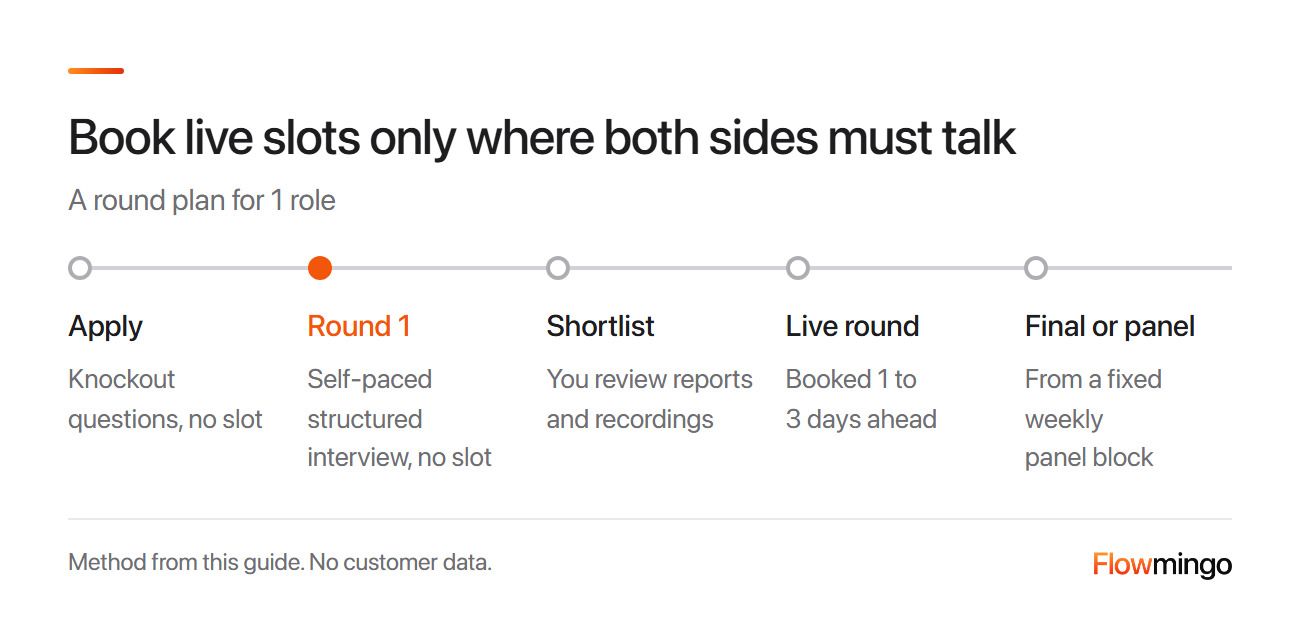
Round plan for 1 role: only the live round and the final or panel need a slot. Round 1 runs on the same structured questions without one.
3. Can a self-paced first round replace interview scheduling for screening calls?
Yes, for screening. Each applicant answers the same structured questions from 1 link in their own time, and you book live slots only for the shortlist.
Take the 12 screening calls from the start. With a self-paced round in an AI interview tool for recruiters, those 12 booking threads become 0, because nobody has to agree a time. Interview scheduling then starts at the shortlist of perhaps 3 or 4 people.
Flowmingo data · 14,171 applicants who finished an AI interview · 490 companies · invites 24 Jun to 6 Sep 2026
- 26.3 hours was the median time from invite to finish for applicants who completed the AI interview.
- 71.1% of the applicants who finished the AI interview were done within 48 hours of the invite.
The clock starts when the recruiter created the invite, and 11.7% of invites were set to send later, which stretches their times. Our invitation guide counted only invites recruiters sent themselves (15 Jun to 13 Sep 2026) and found 48.2% within 24 hours, 74.3% within 48 hours and 98.3% within 7 days.
That speed comes with a risk. In a field experiment with 3,000+ applicants, asynchronous interviews cut application continuation by over 50%, most of all for women. It is a working paper from 1 employer, but the drop is large enough to plan for.
Candidates also resent badly run rounds of both kinds. In foundational Talent Board data reported by SHRM, recorded video interviews and hiring-manager phone screens drew the most complaints of wasted time.
In our practice, a few habits reduce the risk. Keep round 1 short, say who reviews it, say a person decides, and say when candidates will hear back. Put knockouts first with pre-screening interview questions, so only eligible people spend time on it.
How Flowmingo helps
Flowmingo's AI Interviewer is 1 link with nothing to book, and each applicant starts when it suits them, on a laptop or a phone. The AI asks each question out loud and follows up when an answer is thin or drifts off topic. You get the recording, the transcript and a report scored against your criteria.
4. Round 1 links are out: when do I book live slots for the shortlist?
Start booking the shortlist after 48 hours, when most finishers are in, and close round 1 at 7 days. By then, about 97% of the people who finish within 30 days have done so.
Flowmingo data · 60,225 applicants invited to an AI interview · 847 companies · invites 24 Jun to 6 Sep 2026
- 23.5% of invited applicants finished the AI interview within 30 days of the invite.
- 22.9% of invited applicants had finished within 7 days, about 97% of everyone who finished.
Counts every invite. Our hiring process steps guide counted only invites recruiters sent themselves, 1 per person, and found 30.9% finished within 14 days. Completion depends on sourcing: 44.0% of 8,781 applicants with a CV uploaded into a hiring project finished within 14 days. From a recruiter's own list, it was 18.9% of 40,884 (invites 24 Jun to 7 Sep 2026). This is not a no-show rate, which counts only people who booked a slot.
Our invitation guide counted 16,071 finishers from 15 Jun to 13 Sep and found 98.3% within 7 days. This sample also counts the 11.7% of invites set to send later, which stretches the clock. Both point to the same 7-day window.
Review reports daily from day 2 and book each shortlisted person as soon as they qualify. Waiting for the whole batch rebuilds the delay you just removed.
For example, send the link on Monday. On Wednesday, book the first 2 or 3 strong candidates for Thursday or Friday, and close round 1 the next Monday. Send reminders on Wednesday (day 2) and Saturday (day 5) to anyone who has not started, as in our invitation guide.
Deadline and reminder wording lives in our interview invitation email templates. In the chart below, the bars climb fast in the first 2 days and flatten after day 7.
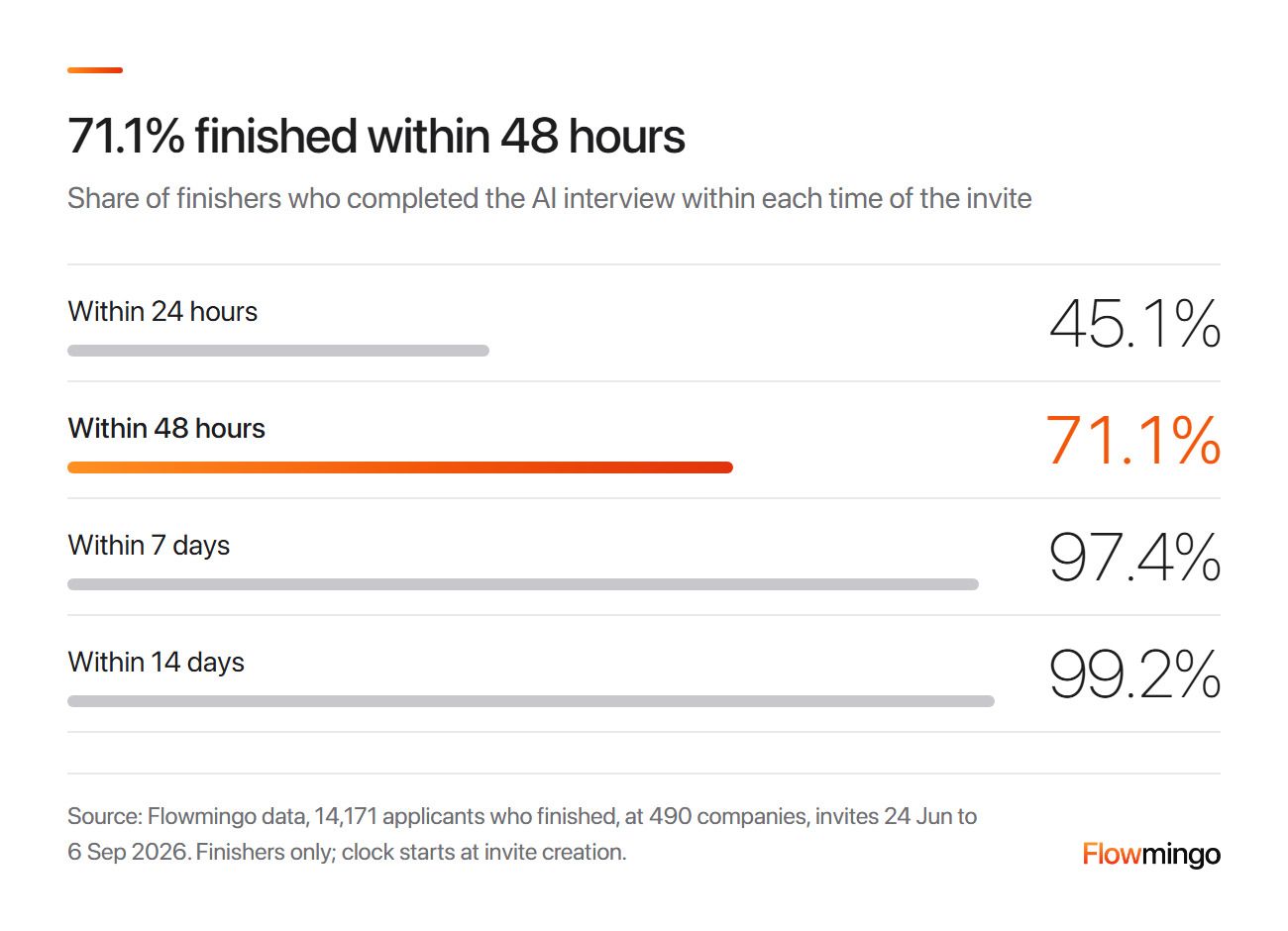
Finish times for a self-paced AI interview: of applicants who finished, 45.1% did so within 24 hours and 71.1% within 48 hours. 97.4% finished within 7 days, and 99.2% within 14 days.
How Flowmingo helps
Flowmingo holds each AI interview report for 2 hours, while the candidate can re-record an answer, then scores it, usually within a few minutes. To see reports as soon as candidates finish, tick "Do not allow candidates to retake interview" or sponsor the session.
Connect your ATS (20+, including Greenhouse, Lever and Workday), and anyone who reaches your chosen stage gets the AI interview. Most ATSs get the score back.
5. How do I book shortlist interviews without endless email back and forth?
Stop asking for availability, and offer the times yourself in 1 message. Hold 1 to 3 times for a few finalists, or send a booking link when you have 20 or more people to book.
Offering times cuts the reply loop, because the candidate answers once. In Ashby's data, 72% of single interviews booked through a direct link got scheduled within 1 day, against 54% without one.
The 2 figures start the clock at different points, at the request for availability with a link and at the candidate's reply without one. So read the gap as a direction, not an exact lift.
Get the slots from the hiring manager first, as a standing weekly block. For example, 2 blocks of 2 hours give you 4 slots of 1 hour to offer each week.
Spread finalists over 2 or 3 days, not 1 afternoon. In a foundational study of over 9,000 MBA admission interviews, Simonsohn and Gino found scores dropped after a run of strong applicants that day.
The table leaves out tool names and prices, which change.
| Approach | Best for | Breaks down at | Round 1 slots |
|---|---|---|---|
| Manual email | 1 or 2 interviews a month | More than a few candidates | Yes |
| Booking link | 1-to-1 rounds, small teams | Panels | Yes |
| ATS scheduler | Teams already in an ATS | Interviewers outside the ATS | Yes |
| AI scheduling assistant | High volume, many locations | Cost, and every round stays live | Yes |
| Self-paced round 1, then held times or a link | Any volume, any time zone | Candidates who want live contact (offer it) | No |
AI interview scheduling tools sit in row 4, yet only 17% of employers used conversational AI to schedule in the 2025 CandE benchmark. The chart adds panels, the slowest of the 3.
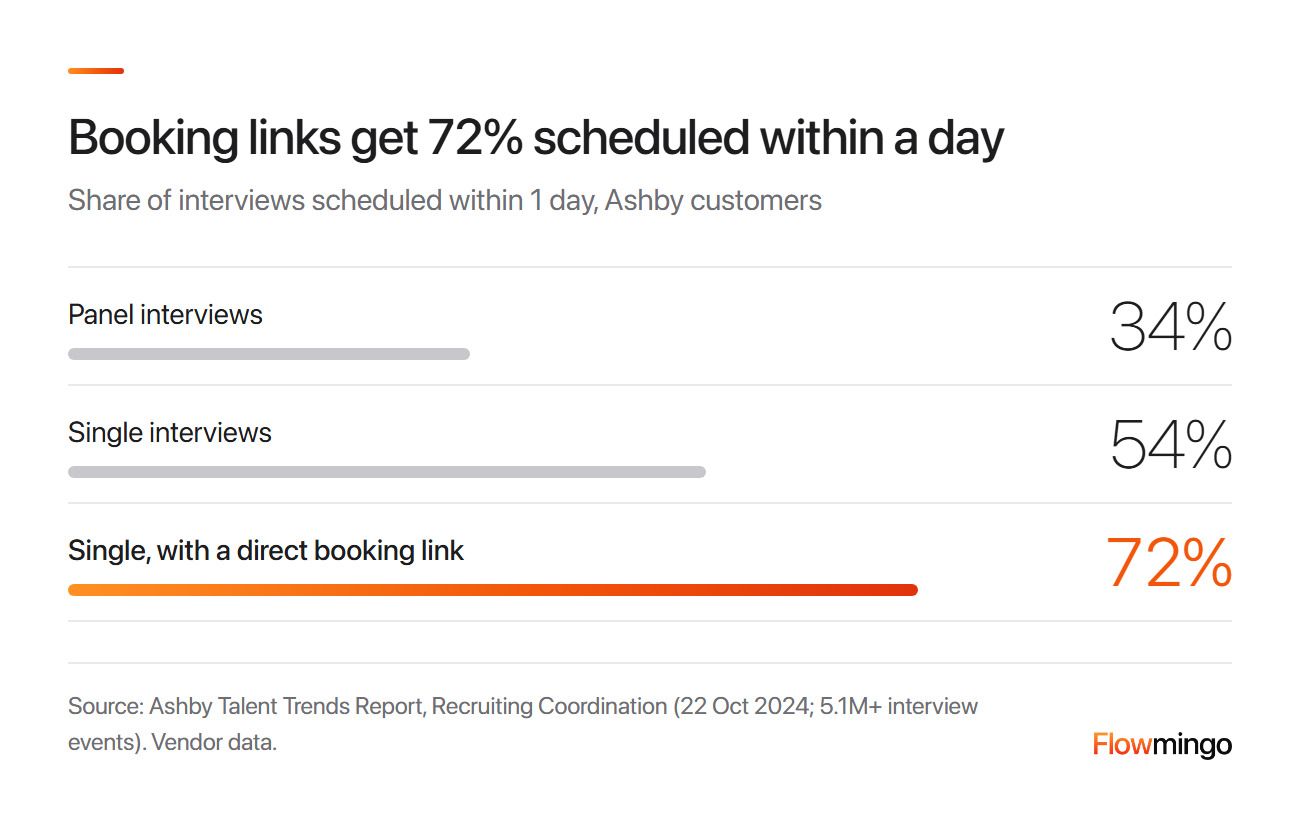
Scheduling speed in Ashby's data: 34% of panel interviews and 54% of single interviews got scheduled within 1 day. With a direct booking link, 72% of single interviews got scheduled within 1 day of the availability request.
5.1 Is free interview scheduling software enough for a small team?
Yes, for 1-to-1 rounds if you hire a few people a quarter.
A 3-person team hiring 4 people a quarter, with a 4-person shortlist per role, books about 16 live calls, and a free link covers that.
Free links break at panels, because a basic link shows 1 calendar. Pay for a recruiting scheduler when panels or volume break your links, and double bookings are the usual sign.
6. Panel interview scheduling: how do I book 4 interviewers who never share a slot?
Stop hunting for a slot all 4 share. Hold a fixed weekly panel block, cut the panel to the people who must decide, and collect written scores from anyone who cannot attend.
Panels are where interview scheduling stalls, as the Ashby chart shows, because 1 late reply holds up the rest.
An illustrative model, not data, shows why. Take a 40-hour week of 1-hour slots, with each interviewer free half the time.
Then 1 interviewer has about 20 free slots, and 2 interviewers share 10. 3 interviewers share 5, and 4 interviewers share only 2 or 3, before you add the candidate.
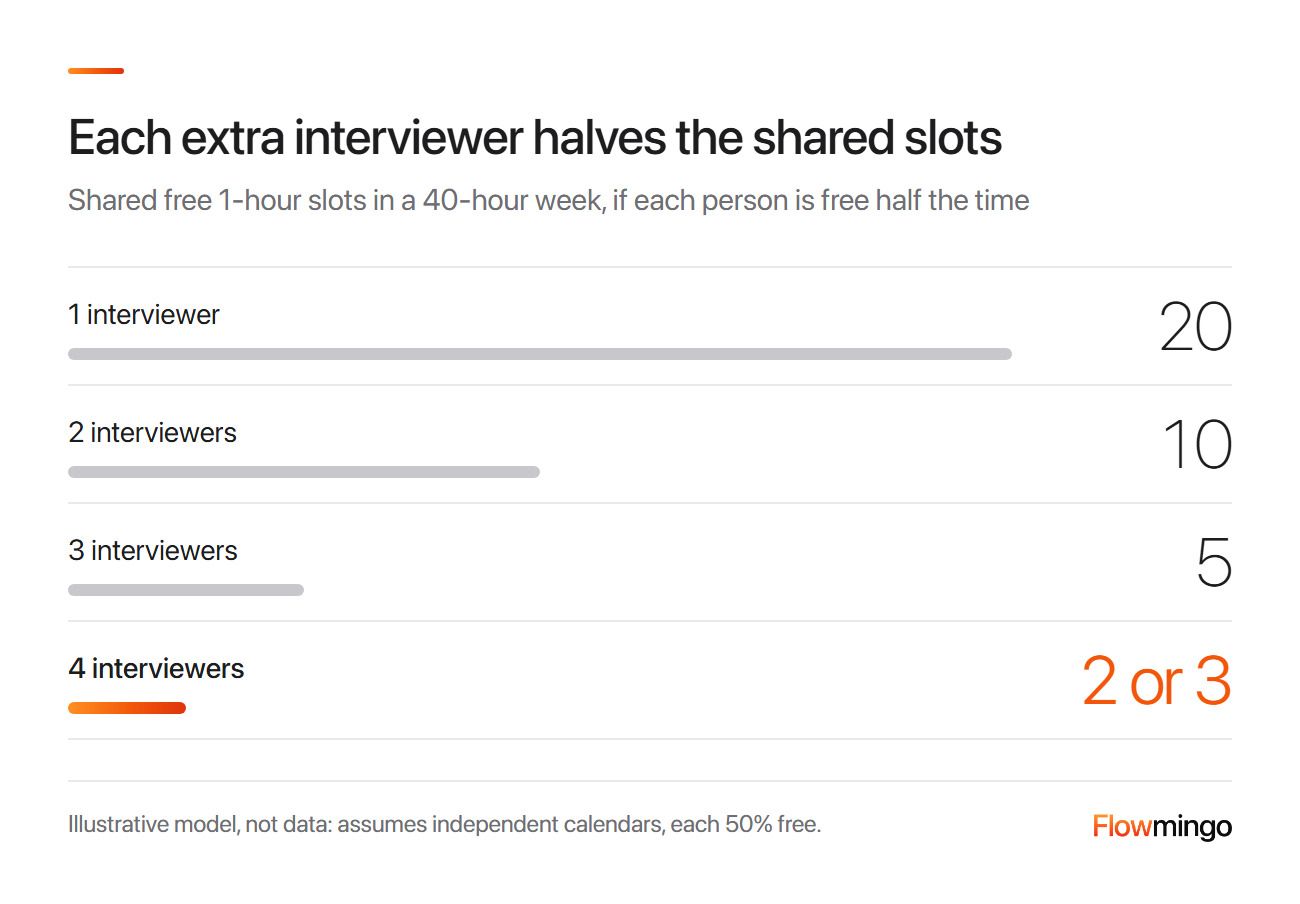
Panel slot model: if each person is free half of a 40-hour week, 1 interviewer has 20 free slots. 2 share 10, 3 share 5 and 4 share 2 or 3.
Book the panel block 4 to 6 weeks ahead as a recurring hold, with 1 backup interviewer per seat. A standing block works because the time exists before any candidate does. That fixes the common case of interviewers on site who reply 1 or 2 days late.
An interviewer who cannot attend can score in writing on the same interview scorecard. They can watch a recording of the live interview only if the candidate agreed, as section 10 explains.
How Flowmingo helps
For round 1, every panellist sees the same AI interview recording and report through a shared link.
7. How far ahead should I book interviews so candidates actually show up?
Book live interviews 1 to 3 days ahead. In Talview's data on about 80,000 interviews with a known lead time, 91.6% to 91.9% of candidates showed up at that lead time.
Talview analysed 93,783 interviews booked through its own scheduler, so this is vendor data without a stated period. It is a correlation across bookings, not a trial. Under 24 hours ahead, only 72.0% showed up, and beyond 72 hours, 88.3% did.
That is 28.0% against 8.4% no-shows, about 3.3 times more for bookings under 24 hours (our arithmetic). For 10 finalist calls, it means about 3 empty slots against about 1 at 1 to 2 days ahead (rounded). Each empty slot is an interviewer hour you already blocked.
Waiting longer is no fix either, because people drift away. In healthcare appointments, the closest analogue, a foundational review of 105 studies named long lead time and past no-shows as the most common drivers.
This no-show playbook is our practice, not a study.
- Book 1 to 3 days ahead, never the same day unless the candidate asks.
- Confirm in 1 message, in the candidate's time zone, with a way to reschedule.
- Send a reminder the day before and a text 4 hours before.
- At 10 minutes late, send 1 message and call.
- After a no-show, offer 1 new time within 24 hours.
- After a second no-show, close the application kindly.
- Track no-shows by lead time each month.
The chart shows a deep dip under 24 hours, a plateau at 24 to 72 hours and a small fall after that.
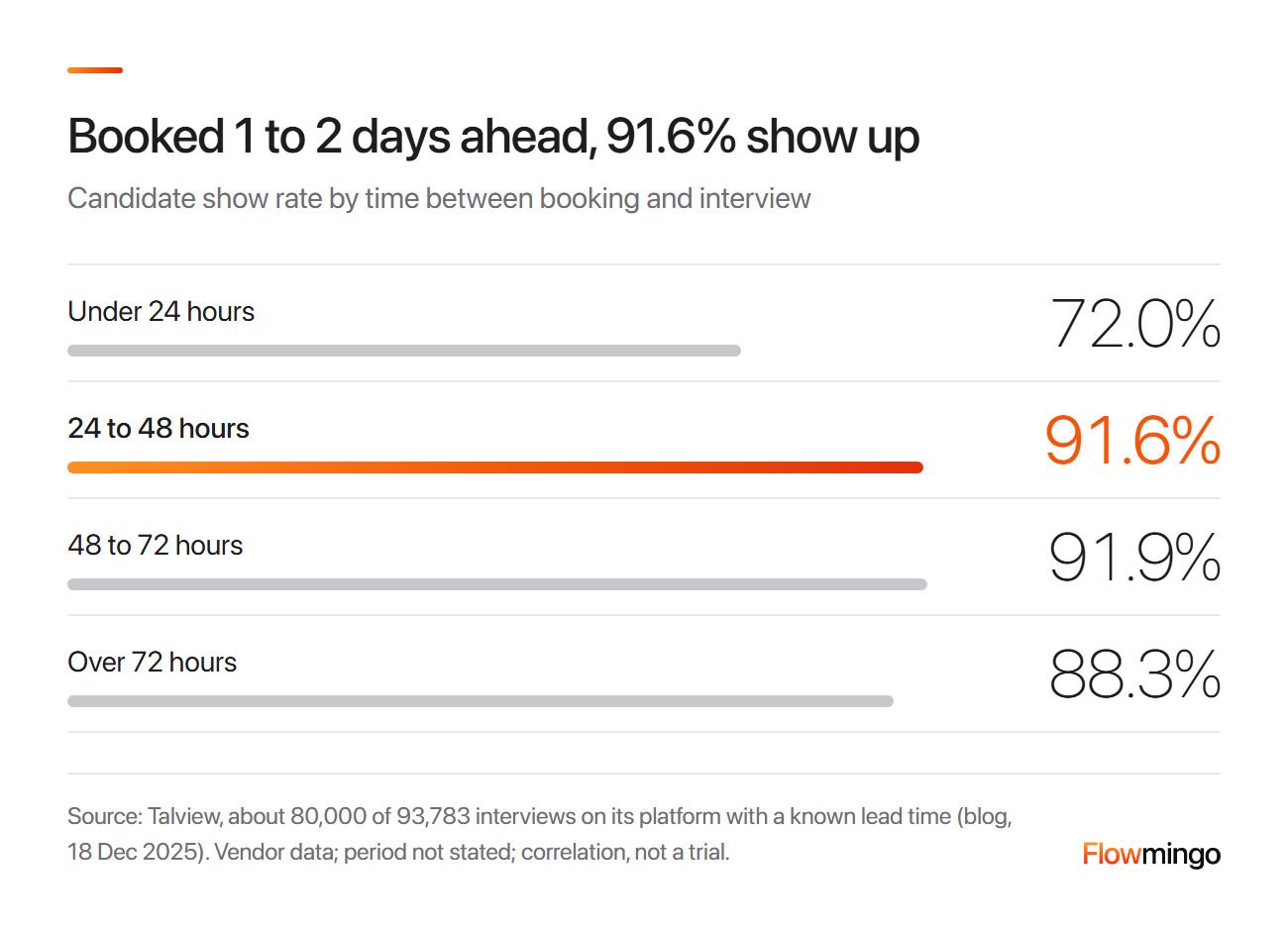
Show rate by lead time in Talview's data: 72.0% of candidates showed up under 24 hours ahead and 91.6% at 24 to 48 hours. It was 91.9% at 48 to 72 hours and 88.3% over 72 hours.
7.1 What do I do when a candidate doesn't show?
Offer 1 new time within 24 hours, then close kindly if they miss it too. Template 9.3 in our interview invitation email templates gives the no-show wording.
A recruiter on r/recruiting describes candidates who book their own slot, reschedule and miss again. A single new time stops that loop.
For a screening round, offer the self-paced link instead, so you lose no calendar time.
8. Interview scheduling across time zones: how do I stop giving candidates the 6am slot?
Take round 1 off the clock, then offer live slots in the candidate's working day and take the early or late slot yourself. Free to choose, candidates started 6 in 10 of our completed AI interviews outside weekday 9 to 5, most in India and Nigeria (card below).
In Microsoft's Work Trend Index, nearly a third of meetings now span several time zones, up 35% since 2021. So a 9-to-5 slot list from 1 office already strains a third of meetings.
Flowmingo data · 48,512 completed AI interviews · 931 companies · finished 24 Jun to 5 Oct 2026
- 6 in 10 completed AI interviews started outside weekday 9 to 5 in the candidate's own time zone.
- 31.7% of completed AI interviews started on a weekday from 17:00, local time.
- 18.0% of completed AI interviews started at the weekend.
- 93% as many interviews started per hour between 17:00 and 22:59 as per office hour.
Most of these candidates were in India and Nigeria time zones, so this is not a global average. It shows when candidates chose to interview, not that they could not attend in the day. Time zone is the device setting, not a verified location, and the weekend is taken as Saturday and Sunday.
Candidates pick their own hour in round 1, so a self-paced round removes the time-zone problem where interview scheduling is heaviest.
For live rounds, our practice has 3 rules. Show slots in the candidate's time zone, and offer every finalist the same range. When the overlap is early or late, take the awkward hour on your side, not the candidate's.
Say you hire in Singapore and your finalist is in London. Take the 17:00 Singapore slot yourself, which is 09:00 in London in winter and 10:00 in summer.
The chart picks out the weekday evening band, almost a third of starts, while the office band is under half.
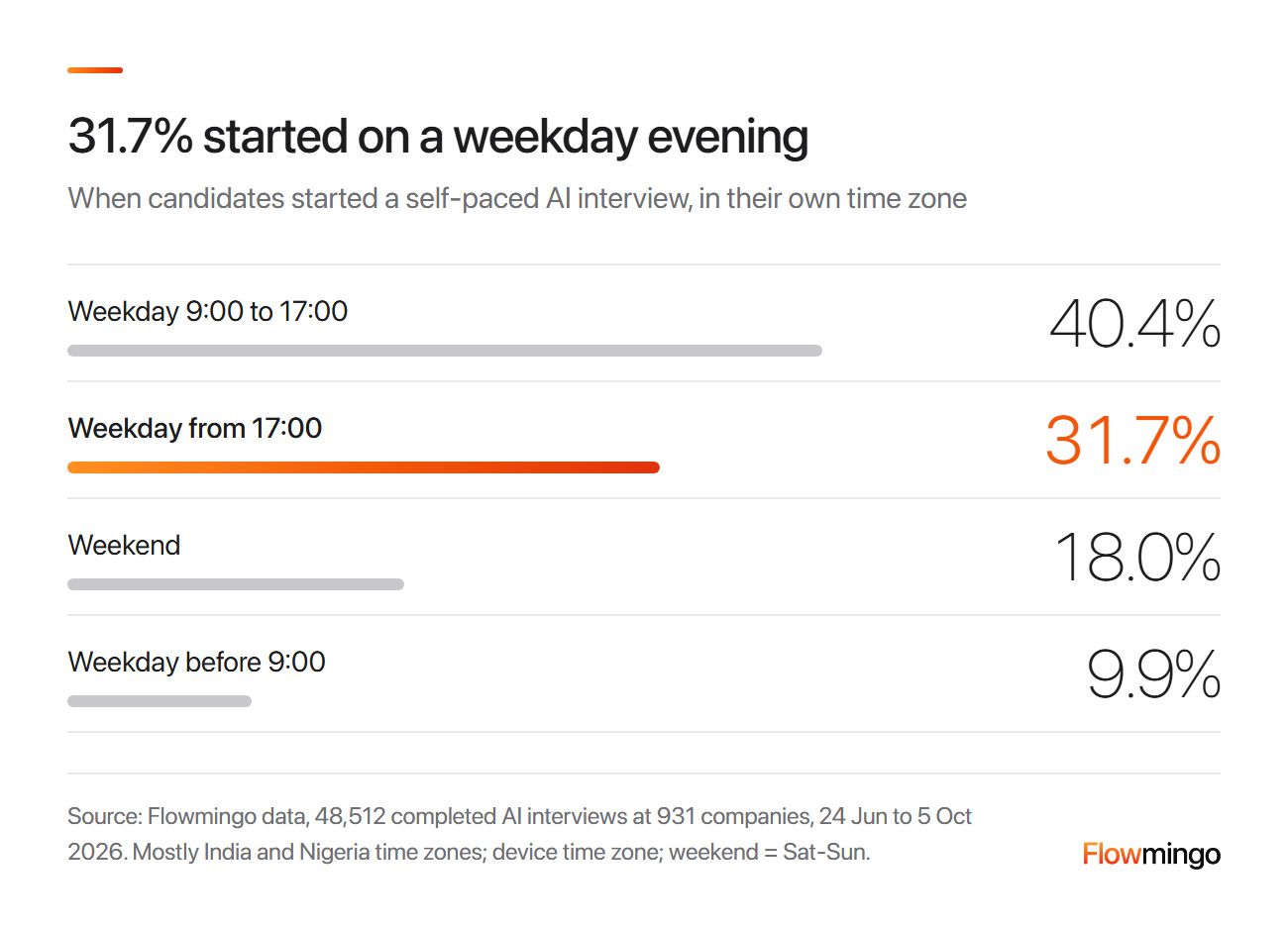
When candidates start a self-paced AI interview: 40.4% on a weekday from 9:00 to 17:00 and 31.7% from 17:00. 18.0% started at the weekend and 9.9% on a weekday before 9:00.
9. A candidate asks for an adjustment to the time or format: what must I do?
For a disability-related request, US law (the ADA) requires a reasonable change of time, length or format unless it causes undue hardship. UK law requires reasonable adjustments, so make it easy to ask, and say yes to other reasonable requests where you can.
The duty covers the hiring process, not just the job. The foundational EEOC guidance, still current, says you may tell applicants what the process involves and ask whether they need an accommodation. It gives a blunt example: cancelling a deaf applicant's interview after an interpreter request violated the ADA.
In the UK, GOV.UK lets employers ask whether interviewers need to make reasonable adjustments in a selection process. Ask about the interview format, not a diagnosis.
Applied to scheduling, that means extra time, a later slot, a phone call instead of video, an interpreter or a break. Our practice is to decide within 1 working day and never count the request against the candidate.
For example, if a candidate asks for extra time on a timed round, give it, note it and score the answers like everyone else's.
Paste the first line into every invite, and the second into any invite for a recorded step, live or self-paced. Add the third when AI scores the answers, and check local law, because these are a template, not legal advice.
Adjustments: If you need a change to the time, length or format of this interview, or any other adjustment, contact [name] at [email] or [phone]. We will reply within 1 working day.
Recording: This [interview] is recorded so [who] can review it. We keep the recording for [period] and delete it within 30 days if you ask. Reply "I agree" to confirm before you start, or ask [name] for a format without recording.
If AI scores answers: An AI tool scores your answers against [criteria], and a person makes every decision. Your "I agree" covers it.
How Flowmingo helps
You set the AI interview length: up to 20 minutes on Free, 30 on Starter and 60 on Growth. A shorter or longer interview is 1 adjustment you can offer.
10. Do I need consent to record interviews, live or self-paced?
Tell candidates before any recording starts, say why and how long you keep it, and get consent where the law asks for it. If AI analyses the video in Illinois, notice, an explanation and consent come first.
A summary of the AI Video Interview Act, a foundational Illinois law in force since 2020, says employers must explain how the AI works. They must say what it evaluates, get consent first and delete videos within 30 days of a request.
In the UK, the ICO's draft guidance says it is not usually necessary to video every interview. So record only when you have a reason, and consider a data protection impact assessment.
In the EU, the foundational AI Act's Annex III lists AI that evaluates candidates as high-risk, with duties on documentation and human oversight.
Recording laws for live calls differ by place, because some require everyone's consent. Use the consent line from section 9 before every recorded step, live or self-paced, and set a deletion date. This is not legal advice.
Those are the 3 moves for lighter interview scheduling: round 1 off the calendar, live slots 1 to 3 days ahead, a weekly panel block.
How Flowmingo helps
On Free, Flowmingo keeps the latest 300 AI interview videos for 30 days. Older videos are hidden, and upgrading within the recovery period brings them back; after that they may no longer be available. Results, scores and transcripts stay on every plan, including Free.
To run round 1 without a single booking, try Flowmingo for your interview scheduling.
11. Sources
Every study, law and survey in this guide links to a source below, and Flowmingo figures come from Flowmingo's own platform.
- Ashby (2024, October 22). Talent trends report: Recruiting coordination. Ashby.
- Avery, M., Ip, E., Leibbrandt, A., & Vecci, J. (2026). A brave new world of hiring: A natural field experiment on how asynchronous interviews and AI assessment reshape recruitment (CESifo Working Paper No. 12573). CESifo.
- Cronofy (2019). Cronofy and JobAdder interview scheduling survey 2019 results. Cronofy.
- Dantas, L. F., Fleck, J. L., Cyrino Oliveira, F. L., & Hamacher, S. (2018). No-shows in appointment scheduling: A systematic literature review. Health Policy, 122(4), 412-421.
- European Union (2024). Artificial Intelligence Act, Annex III: High-risk AI systems. artificialintelligenceact.eu.
- Ewen, L. (2026, January 27). Companies miss hiring goals as AI reshapes recruiting. HR Dive.
- Gem (2025). 2026 recruiting benchmarks: Year-over-year insights and industry trends. Gem.
- GOV.UK (n.d., read 2026). Disability rights: Employment. GOV.UK.
- Holistic AI (2023, June 12). Illinois Artificial Intelligence Video Interview Act. Holistic AI.
- Information Commissioner's Office (n.d., read 2026). Shortlisting, testing, and interviewing candidates [Draft guidance]. ICO.
- Knowledge at Wharton (2016, February 26). Open-sourcing Google's HR secrets. Knowledge at Wharton.
- Maurer, R. (2024, April 9). Candidate experience: Talent Board research. SHRM.
- Microsoft (2025, June 17). Breaking down the infinite workday. Work Trend Index special report.
- r/recruiting (2025). No-call/no-show is now the norm [Online forum post]. Reddit.
- Sackett, P. R., Zhang, C., Berry, C. M., & Lievens, F. (2022). Revisiting meta-analytic estimates of validity in personnel selection: Addressing systematic overcorrection for restriction of range. Journal of Applied Psychology, 107(11), 2040-2068.
- Simonsohn, U., & Gino, F. (2013). Daily horizons: Evidence of narrow bracketing in judgment from 10 years of M.B.A. admissions interviews. Psychological Science, 24(2), 219-224.
- Survale (2026, July 21). 2025 candidate experience (CandE) benchmark research: Key statistics. Survale.
- Talent Board & ERE Media (2024, December). The business impact of candidate experience: 2024 CandE benchmark research. ERE Media.
- Talview (2025, December 18). Interview no-shows drop 3x with 24-72 hour scheduling. Talview.
- U.S. Equal Employment Opportunity Commission (2002, October 17). Enforcement guidance: Reasonable accommodation and undue hardship under the Americans with Disabilities Act. EEOC.