
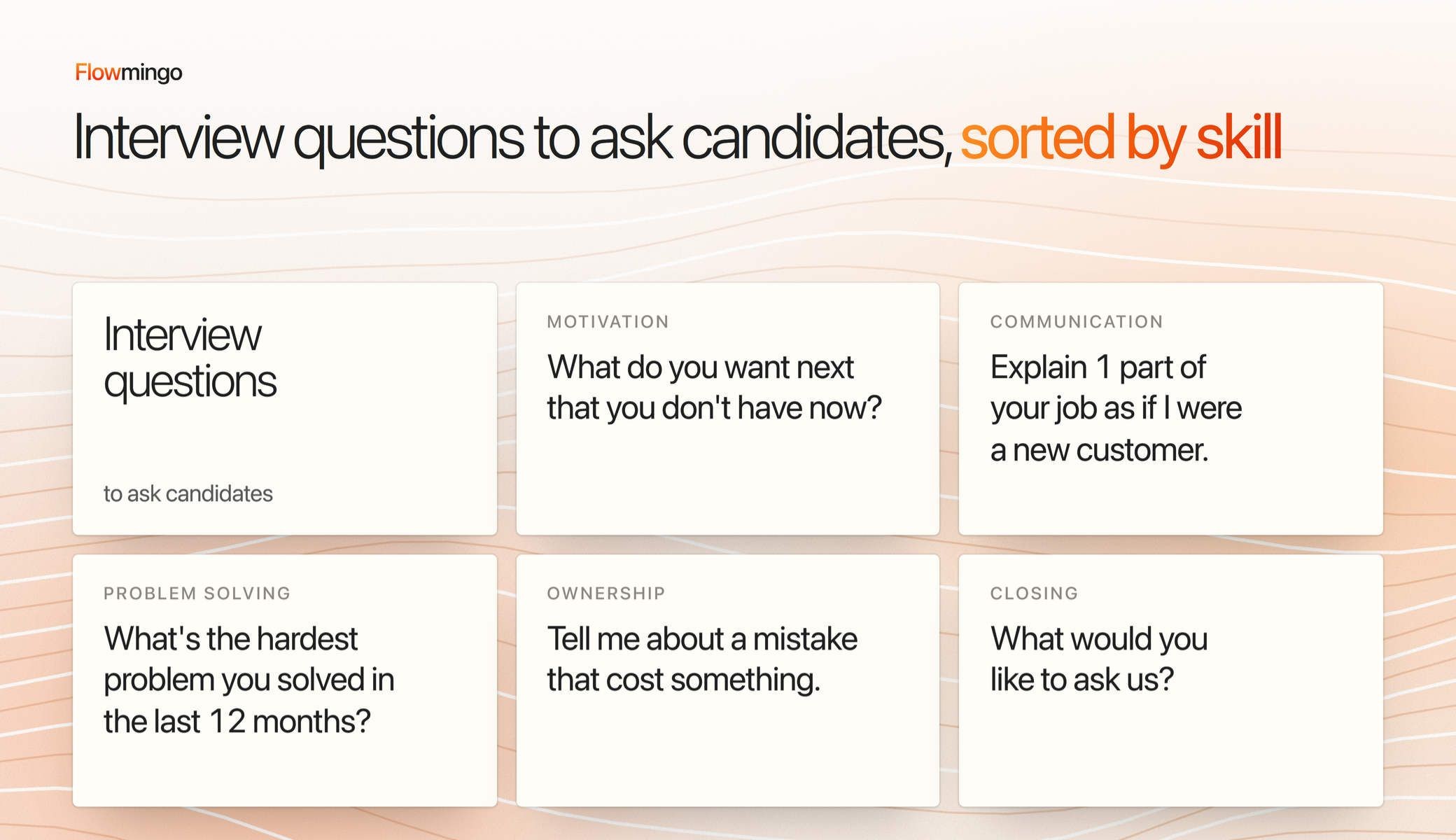
6 interviews on Thursday, and the question list you inherited was written years ago. Here are interview questions to ask candidates, sorted by skill, with what a strong and a weak answer sound like.
Most lists of the best interview questions to ask candidates stop at the question, with no score scale, so your panel scores on feel.
Feel costs you hires and invites legal risk.
This bank fixes that in 3 moves: 6 skills with follow-ups, a 30- or 45-minute plan and a 1 to 5 scale. It lists what never to ask in the US, Great Britain and Singapore.
Key takeaways
- Which questions tell you who will do the job well? Past-behaviour questions on 4 to 6 skills, asked the same way each time. A large review ranked structured interviews first.
- How many questions fit in a 45-minute interview? About 6, each with 2 follow-ups, plus 8 minutes for the candidate's questions. Plan 4 for 30 minutes and split a bigger bank across rounds.
- What does a strong answer sound like? It names what they did, with a number you can check. In Flowmingo AI interviews, answers under 30 seconds scored a median 4 out of 10.
- Which questions should interviewers never ask? Age, marriage or children, pregnancy, religion, race, nationality, or health before an offer. In 1 survey, 54% of US candidates had faced one.
- Do these questions still work if candidates use ChatGPT? Yes, if follow-ups ask for numbers, names and a second example that you then check. Ask 1 more before scoring an answer under 30 seconds.
1. Which interview questions to ask candidates tell you who will actually do the job well?
Ask past-behaviour questions on 4 to 6 skills the job needs, worded the same way for every candidate. Write the follow-ups and a strong answer in advance.
Sackett and colleagues' foundational 2022 re-analysis (SIOP) ranked structured interviews first among single hiring methods. The figure scores each method from 0, no link with later performance, to 1, a perfect link. Structured interviews lead at 0.42, ahead of job knowledge tests at 0.40.
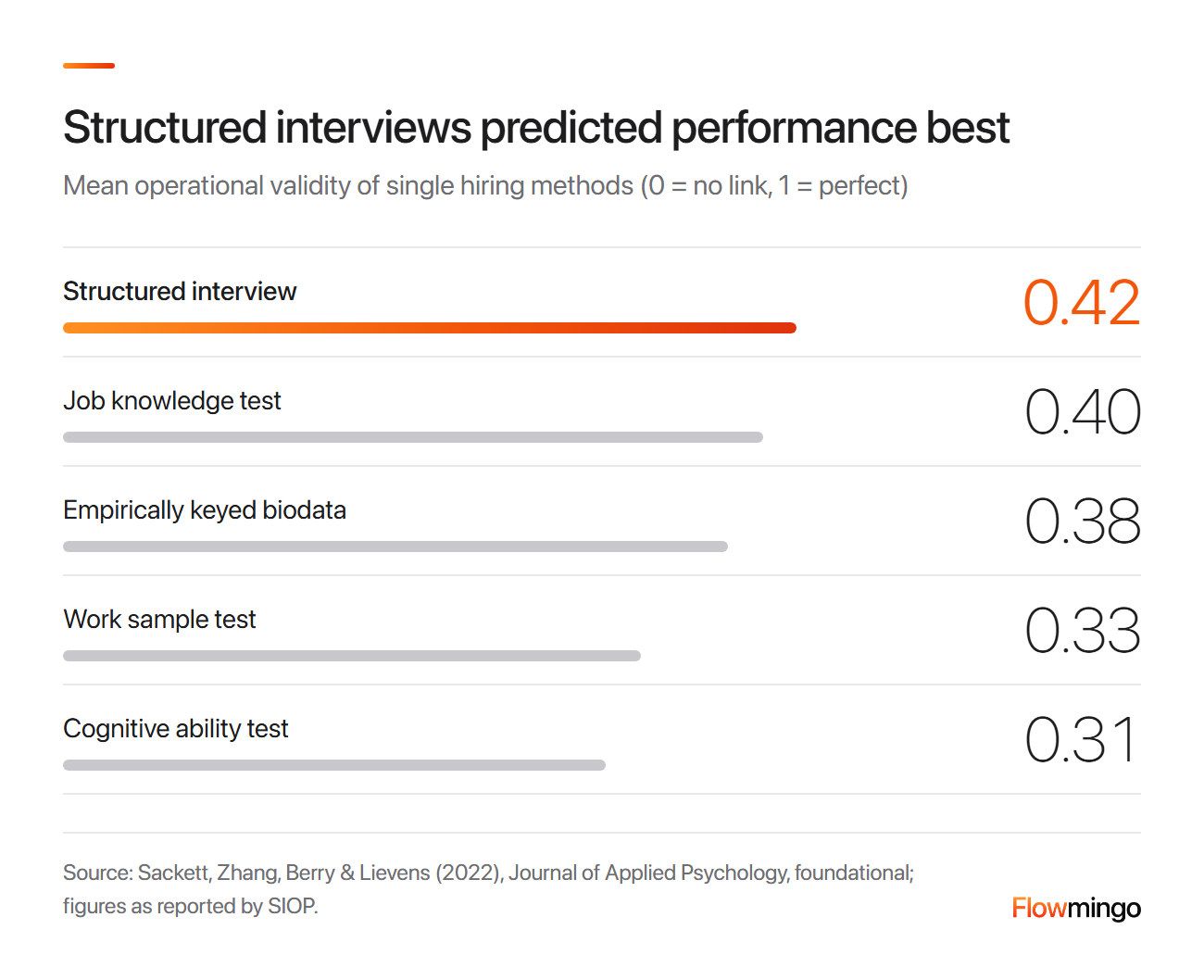
Hiring methods ranked: structured interviews 0.42, job knowledge 0.40, keyed biodata 0.38, work samples 0.33 and cognitive ability 0.31, in a foundational 2022 re-analysis.
Take the 4 to 6 skills in your job description that matter most, the range OPM suggests. Sections 2 to 6 cover 6: problem solving, ownership, teamwork, communication, motivation and a role skill.
For example, "Tell me about a problem you solved" invites a highlight reel. Asking for "the hardest one in the last 12 months" gets 1 story you can check.
Drop brainteasers: Google found they have little if any power to predict performance. Its foundational internal research also found pre-made questions, guides and rubrics saved 40 minutes per interview on average.
Ask every main question the same way, and mark the 3 or 4 you never drop if time runs short. The card shows how often our sets carry the mark.
Flowmingo data · 6,358 AI interview sets · 2,217 companies · 9 Apr 2025 to 6 Oct 2026
- 23.4% of questions in these sets carried a 'Must Ask' mark, so the AI interviewer always asks them.
- 43.9% of the AI interview sets held at least 1 question marked 'Must Ask'.
The AI may skip other questions an applicant already covered. Its draft can add the mark itself.
2. What interview questions to ask candidates about problem solving show real reasoning, not a rehearsed story?
Ask for the hardest real problem they solved recently, then probe what they ruled out and how they knew it worked. Strong answers show their own steps and a result they checked.
Past events work better because a real story has details you can test. In Taylor and Small's foundational 2002 meta-analysis, past-behaviour questions predicted slightly better than "what would you do" questions.
The gap was 0.31 against 0.25 before statistical corrections, as our structured interview guide reports. The figure splits it by job: 0.40 against 0.26 in lower-complexity jobs, and 0.31 against 0.23 in higher-complexity ones.
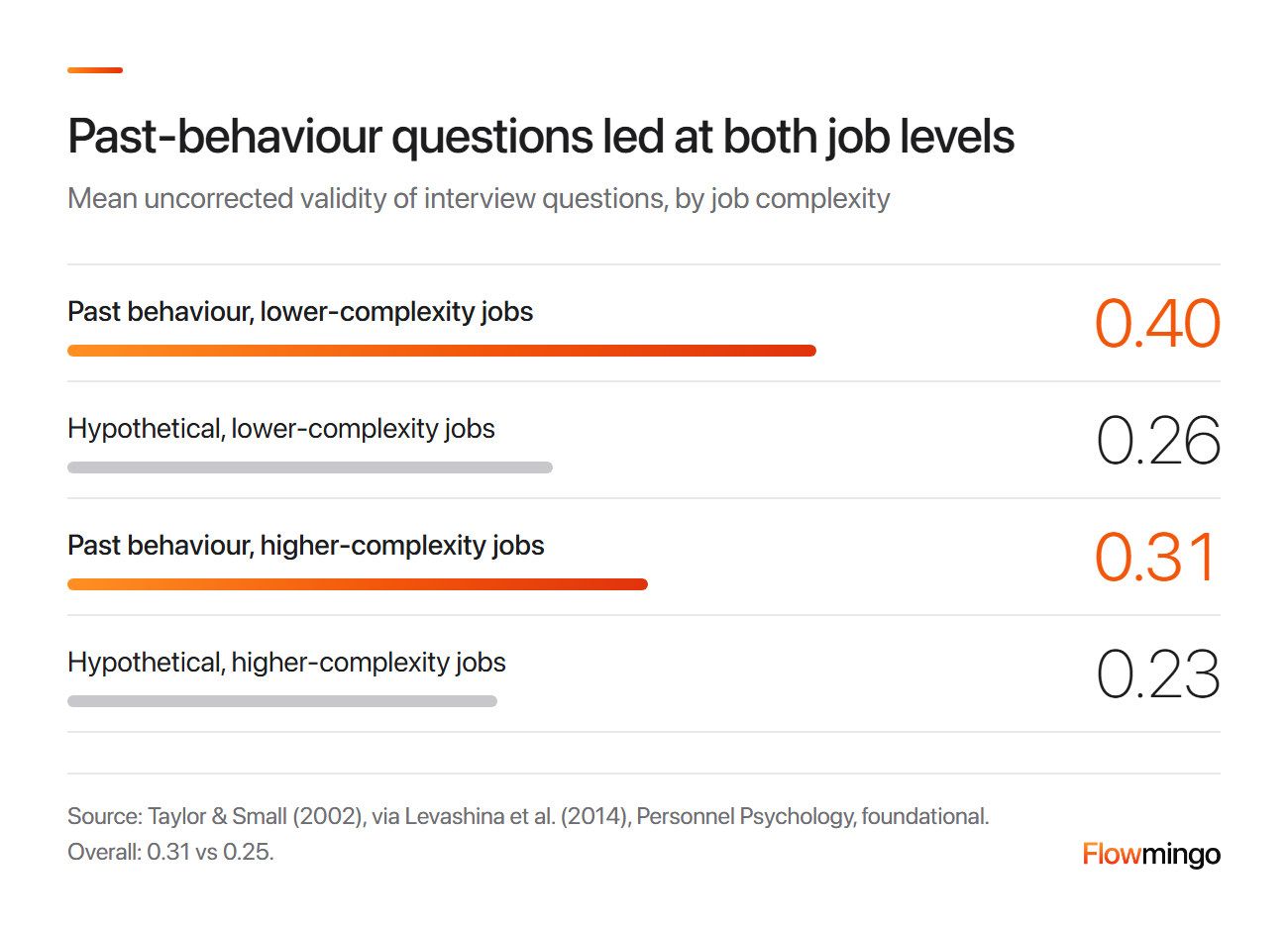
Past vs hypothetical questions: past behaviour led in lower-complexity jobs (0.40 vs 0.26) and higher-complexity jobs (0.31 vs 0.23), in foundational research.
The foundational review by Levashina and colleagues says hypotheticals mostly measure job knowledge and reasoning, and recommends both types. So use 1 for graduates or career changers with little track record, as in row 3 below.
The card shows the same candidate scoring the same on both kinds.
Flowmingo data · about 3,200 AI interviews with both kinds of question · about 200 companies · 28 Apr to 6 Oct 2026
- 0 out of 10 was the median gap between the same candidate's scores on past-example and hypothetical questions.
AI scores against each company's criteria, not hiring outcomes or job performance. Question type is our own keyword classification.
| Question | Planned follow-ups | Strong answer | Weak answer |
|---|---|---|---|
| "Tell me about the hardest problem you solved in the last 12 months." | What did you rule out? How did you know it worked? | A number, 2 options weighed, a checked result | A process, no result, "we" throughout |
| "Tell me about the last time the data and your instinct disagreed." | What did you do? Were you right? | Names the data, the call and the outcome | Only stories where they were right |
| For little track record: "Sales fell 20% last week. What do you check first?" | Why that order? What would change your mind? | Asks questions, orders checks by likelihood | 1 guess, buzzwords |
Skip abstract questions and use a real problem from their last job. In an r/managers thread on go-to questions, 2 replies warned against a bare "how do you solve a problem". It rewards quick thinking, not real problem solving.
3. How do I find out in an interview whether someone takes ownership?
Ask about a recent mistake that cost something, a problem nobody asked them to fix, and the deadline they nearly missed this year. Strong answers say "I", name the cause and show what changed afterwards.
Ownership shows in what happens after the mistake, so your follow-ups matter more than the opening question. Write them in advance, as OPM's guide advises. It also says to ask for clarification when a candidate says "we did", for example: "You said we. What did you do yourself?"
For example, a candidate says the team missed a launch date. Ask who told the client, and when. "I called them that afternoon with a new date" is ownership, and "we kept everyone informed" is not.
Expect some polish. In 4 foundational studies of 467 people, candidates promoted themselves more on "tell me about a time" questions than on hypotheticals (Levashina and colleagues). The effect was modest, but it is why strong answers reward specifics, not confidence.
| Question | Planned follow-ups | Strong answer | Weak answer |
|---|---|---|---|
| "Tell me about a mistake you made at work in the last 2 years that cost something." | Who did you tell, and when? What changed? | Real cost, own share, a fix that stopped a repeat | Trivial, blames others, "I'm a perfectionist" |
| "Tell me about the last time you fixed a problem nobody asked you to fix." | How did you find it? Who did you check with? | Spotted it, checked scope, finished it | Waited, or told nobody |
| "Tell me about the deadline you came closest to missing this year." | When did you see the risk? What did you do first? | Flagged it early, renegotiated | Last-minute heroics |
Still, 1 weak answer should not sink a candidate. Score it, then test the same theme with your reference check questions.
4. What interview questions to ask candidates about teamwork and communication separate strong answers from weak ones?
Ask about their hardest recent disagreement with a colleague and the hardest news they had to deliver. Strong answers describe the other person fairly and quote what they actually said.
These skills need care because charm can pass for them. In LinkedIn's foundational 2019 survey of 5,164 talent professionals and hiring managers, 89% said bad hires typically lack soft skills (LinkedIn).
Yet in that foundational survey, 57% struggled to assess soft skills, and 68% judged them mainly by social cues in the interview. That is where interview bias gets in, because a confident voice feels like communication skill.
So listen for the other side of the story. "She wanted more data first, and she had a point about the cost" is a strong answer. A weak one turns the colleague into a villain, so the strong answers below ask for quotes, not adjectives.
The last row is a small work sample of communication itself. The candidate explains 1 part of their job to you as a new customer, in 2 minutes. Score plain words, structure and whether they check you followed.
| Question | Planned follow-ups | Strong answer | Weak answer |
|---|---|---|---|
| "Tell me about the most difficult disagreement you had with a colleague in the last 12 months." | What was their view? How did it end? | States their view fairly, a resolution or trade-off | Colleague as villain, no ending |
| "Tell me about the hardest news you had to deliver in your current job." | What exactly did you say? How did they react? | Quotes the message and the reaction | Avoided it, or hid behind email |
| Live: "Explain 1 part of your job as if I were a new customer, in 2 minutes." | What would you leave out? What would you add for an expert? | Plain words, an example, checks you followed | Jargon, runs over |
5. How do I test motivation and fit without it turning into a gut-feel question?
Ask which tasks make time fly and which make it crawl, then compare the answer with the real job. Replace "culture fit" with 2 or 3 written behaviours the team needs.
Fit questions drift into gut feel because nobody writes down what a good answer is. Singapore's TAFEP guidance gives the fix: "Create a list of interview questions that are directly related to the selection criteria".
The time-fly question comes from a practising manager in the same r/managers thread. It works because you can score it: list the job's daily tasks first, then score the overlap with what the candidate enjoys.
For example, a support candidate says time flies when they fix a tricky customer issue and crawls in long meetings. If your role is mostly live tickets, that is a strong match.
Cut hobbies and animal or superpower questions. None ties to the job, and each invites the social-cue judgements from section 4.
"Why are you leaving?" adds little, because it invites a rehearsed answer. If you keep it, score only whether the reason matches what this job offers.
| Question | Planned follow-ups | Strong answer | Weak answer |
|---|---|---|---|
| "Which tasks in your last job made time fly, and which made it crawl?" | How much of your week was each? Why do those tasks drain you? | Time-fly tasks match this job's daily work | Time-crawl tasks are most of this job |
| "What do you want next that you don't have now?" | Why now? What have you done about it? | Specific, and this job offers it | Only title, pay or "growth" |
| "Our team writes everything down. Tell me about a time you worked that way, or the opposite way." | What did you like? What frustrated you? | A concrete, honest example | "I'm flexible", no example |
6. Which interview questions to ask candidates for sales, service or manager roles show real skill?
Ask for numbers they owned, then add a short live task from the real job: a pitch, a refund role-play or an underperformance story. Doing the task beats describing it.
A task earns its place because it tests the work itself. In the Sackett re-analysis from section 1, work sample tests (0.33) and job knowledge tests (0.40) both predicted performance, close behind structured interviews.
A 5-minute slice of the job gives a bit of both. It also catches the hire who talks well and works badly, a cost 1 founder put plainly on r/smallbusiness: "Wasted $3k on a sales hire who couldn't pitch".
For sales, ask about results, never past pay or commission (section 8 explains why).
For managers, ask for people decisions with an outcome and a date. "I spoke to her in week 1 and set 3 goals" is an answer, while "I'd support them" is a plan.
Keep knockout facts such as shifts, licences and location in your pre-screening interview questions, so interview time goes on skill. Each row carries its own follow-ups, since a refund role-play needs different probes from a pitch.
| Role | Question or task | Planned follow-ups | Strong answer | Weak answer |
|---|---|---|---|---|
| Sales | "What target did you carry last year, and what did you close?" | How much did you source yourself? Which deal did you lose, and why? | Numbers, and how they got them | "Above target", no number |
| Sales, live | 5-minute pitch of what they sell now, with 1 objection | What did you ask before pitching? How would you handle a second objection? | Asks questions first | A feature monologue |
| Service, live | Role-play a refund the policy does not allow | What if they ask for a manager? What would you log afterwards? | Says no clearly, offers an alternative | Promises what policy forbids |
| Manager | "Tell me about someone on your team who was underperforming in the last 12 months." | When did you first raise it? What had changed, and by when? | Early talk, clear goals, a dated outcome | Waited months, or left it to HR |
7. How many questions fit in a 30 or 45 minute interview?
Plan 4 main questions for 30 minutes and 6 for 45, each with 2 planned follow-ups. Leave 5 to 8 minutes at the end for the candidate's questions.
That is about 5 minutes per question, our rule, not a study's. Live interviews run longer, so treat the card's times as the floor.
Our structured interview guide plans about 12 questions, and the interview scorecard template asks 2 per skill. Split a bank that size across rounds or interviewers, as 7.1 shows.
Flowmingo data · about 1 million answer turns · about 91,000 asynchronous AI interviews · about 2,050 companies · 9 Apr 2025 to 6 Oct 2026
- About 72 seconds was the median time a candidate spent on each question, counting follow-ups.
- 18.4% of answer turns lasted under 30 seconds in these interviews.
Asynchronous AI interviews, not live ones.
18.4% ran under 30 seconds, the thin answers section 10 deals with, and most ran 30 seconds to 2 minutes.
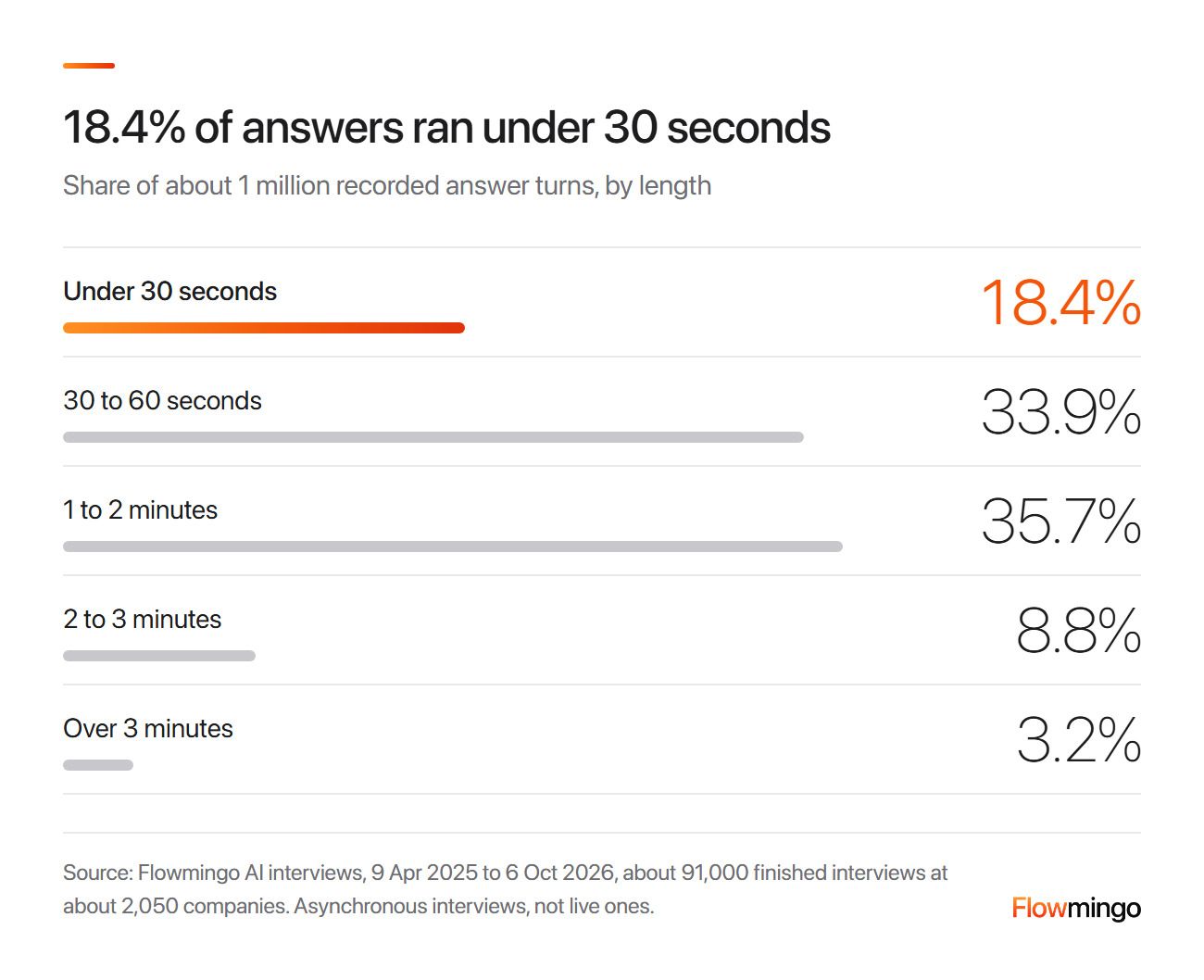
Answer turn length: 18.4% of answers ran under 30 seconds. 33.9% ran 30 to 60 seconds, 35.7% 1 to 2 minutes, 8.8% 2 to 3 minutes and 3.2% over 3.
| Block | 30 minutes | 45 minutes |
|---|---|---|
| Welcome and format, not scored | 2 | 3 |
| Main questions, about 5 minutes each | 4 questions, 20 | 6 questions, 30 |
| Candidate's own questions | 5 | 8 |
| Close and next steps | 3 | 4 |
| Total | 30 | 45 |
In a foundational 2016 study of 163 mock interviews with accounting students, a good first impression inflated scores, especially on the first few questions (BPS).
So buffer, as the authors suggest, with a few easy unscored questions in the welcome, such as why they applied. Then ask the key skill early, so time never cuts it.
7.1 What should I ask in a second interview that the first round did not cover?
Split the skills across interviewers instead of repeating them. Round 2 covers what round 1 missed, probes its weakest scores and adds section 6's live task.
For example, round 1 scored ownership 3 and teamwork 4 out of 5. So round 2 asks the deadline question from section 3 and skips teamwork.
Google found 4 interviews predicted its hire decision with 86% confidence, each extra one adding less than 1% (re:Work). That foundational figure measures the decision, not performance.
8. Which interview questions are illegal or risky to ask in the US, UK and Singapore?
Never ask about age, marriage or children, pregnancy, religion, race or nationality, or health before an offer. Ask about expected pay, not current salary.
This is general information, not legal advice.
In Greenhouse's foundational 2024 candidate experience report, 54% of 1,200 US job seekers faced a discriminatory question, most often about age, race or gender (Fortune).
US federal law protects race, color, religion, sex including pregnancy, national origin, age 40 or older, disability and genetic information (EEOC). It bars disability questions before an offer, and the EEOC says marriage or children questions may count as evidence of intent.
In England, Wales and Scotland, section 60 of the foundational Equality Act 2010 bars health questions before an offer. Its 5 narrow exceptions include adjustments for the interview itself.
Singapore's Workplace Fairness Act is expected to take effect by the end of 2027. A Ministry of Manpower fact sheet lists the traits it protects, such as age, nationality and caregiving. At first, firms with fewer than 25 employees are exempt.
| Don't ask | Ask instead | Why |
|---|---|---|
| "How old are you?" | Nothing: ask about the experience the job needs | US protects age 40+; TAFEP |
| "Are you married? Do you plan to have children?" | "The role travels 1 week a month. Is that workable?" | EEOC; TAFEP |
| "Do you have any health conditions?" | "Do you need any adjustments for this interview?" | US; Equality Act s60 |
| "Where are you from?" | "Do you have the right to work here?" | US; Singapore's Act |
| "What do you earn now?" | "The range is [X to Y]. Does that work for you?" | California Labor Code 432.3 |
8.1 Can I ask a candidate what they earn now, or about their salary history?
Not in California. Labor Code 432.3 bars seeking salary history and using it to set pay.
You may ask what pay the candidate expects. Share your range first, because an old salary reflects someone else's budget.
If a candidate volunteers past pay, California lets you consider it. Other US states and cities have similar bans, so check yours.
9. How do I score answers so 2 interviewers rate the same answer the same way?
Write a 1 to 5 scale for every question, with an anchor, a written example answer, at each point. Have each interviewer score alone before the debrief.
Taylor and Small found validity of 0.35 for interviews scored with anchored rating scales, against 0.26 without them. That covers 19 foundational past-behaviour studies, summarised by Levashina and colleagues.
Those studies differed in other ways, so the gap is a strong hint, not proof. Interviewer agreement rose from 0.73 to 0.77.
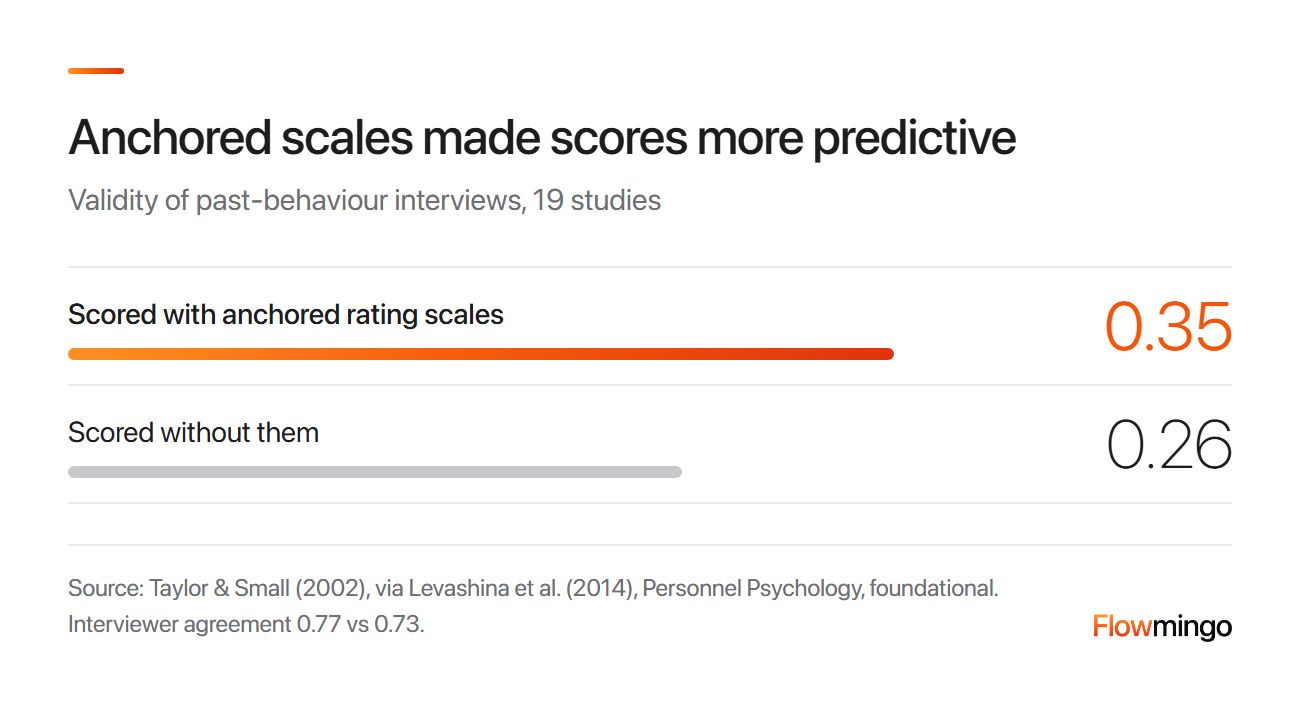
Anchored rating scales: past-behaviour interviews scored with them reached 0.35, against 0.26 without them, across 19 foundational studies.
Anchor every point if you can, as below, and at least 1, 3 and 5, as the interview scorecard template does. In 1 foundational study in that review, a fully anchored scale resisted disability bias better than 1 anchored only at its ends.
Here is a worked scale for section 3's mistake question:
| Score | What the answer sounds like |
|---|---|
| 5 | A real cost with a number, own share, told people that day, changed a process |
| 4 | Clear ownership, fixed it, a small later change |
| 3 | Owns it, cost vague, nothing changed after |
| 2 | A minor or shared mistake told as "we" |
| 1 | No real mistake, blames others, or "I'm a perfectionist" |
In Kahneman's foundational army interview, the overall rating, made last, was the most predictive one.
Its value came from the 6 trait scores made before it: "Trying to be reliable had made them valid," he wrote. So give your overall view last, never first. Then let the total decide, but any must-have below 3 means no hire, and write down every override, as our interview scorecard template advises.
Plan the probes too, because the Levashina review proposes planned follow-ups over unlimited probing or none.
How Flowmingo helps
Paste your job description into the AI Interviewer, and AI drafts the questions and scoring criteria. You edit both and mark the must-ask ones. Each criterion gets a 0 to 10 rating with a written reason, as our scoring page shows, and the AI rejects nobody automatically.
10. Do my interview questions still work if candidates answer with ChatGPT?
Yes, if the follow-ups ask for numbers, names, the moment it went wrong and a second example, and you check the claims that matter. A script can invent specifics too, and follow-ups raised faking in 1 foundational study our pre-screening guide cites, so score checkable specifics, not polish.
A remote manager's r/managers post about candidates running interview questions through AI during live calls drew 288 comments.
Strengths, weaknesses and "why are you leaving" are the easiest questions to script. So the bank asks about specific past events, because they resisted faking better than hypotheticals in that study. These follow-ups surface claims to verify:
- "What was the number before and after?"
- "Who else was involved, and what did they think?"
- "What was the moment it nearly went wrong?"
- "Give me a second example from a different job."
- "You said we. What did you do yourself?"
- A 5-minute live task from the real job.
The card below shows thin answers scoring low, levelling off once an answer passes about 1 minute.
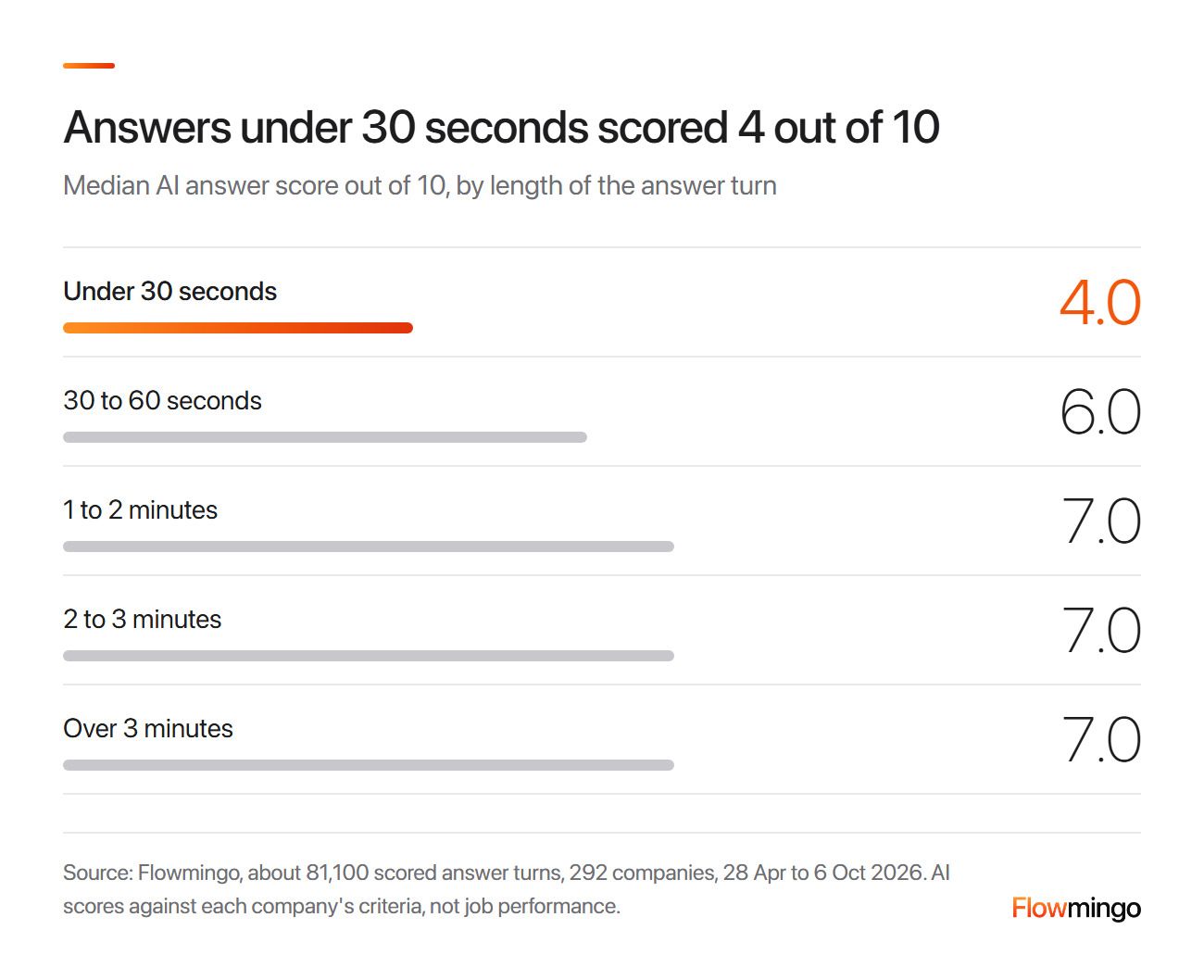
Median AI score by answer length: 4.0 out of 10 under 30 seconds and 6.0 at 30 to 60 seconds. Answers from 1 minute up scored 7.0.
Flowmingo data · about 81,100 scored answer turns · 292 companies · 28 Apr to 6 Oct 2026
- 4.0 out of 10 was the median AI score for answer turns under 30 seconds.
- 6.0 out of 10 was the median AI score for turns of 30 to 60 seconds.
- 7.0 out of 10 was the median for turns of 1 minute or longer.
An association, not a cause. AI scores against each company's criteria, not job performance.
When an answer runs under 30 seconds, ask 1 follow-up before scoring it. Longer is not better in itself, but specific examples take time.
How Flowmingo helps
Add the questions above to your AI interview and mark the core ones must-ask. Each applicant answers out loud, on camera, in their own time. The AI listens to each answer and asks a follow-up when one is thin or off topic, and the score reflects the whole exchange. You get back the recording, the transcript and a report scored against your criteria. Try Flowmingo with your own interview questions to ask candidates.
11. Sources
Every research number in this guide links to a source below. The data cards are Flowmingo's own platform data, and numbers in the examples are illustrative.
- California Legislature (current text). Labor Code section 432.3. California Legislative Information.
- Google re:Work (n.d.). Guide: Use structured interviewing. Avoid brainteasers. Retrieved via the Wayback Machine.
- Google re:Work (n.d.). Guide: Use structured interviewing. Read Google's internal research. Retrieved via the Wayback Machine.
- Greenhouse (2024). 2024 Greenhouse candidate experience report. Greenhouse.
- Kahneman, D. (2002). Daniel Kahneman: Biographical. The Nobel Prize.
- Levashina, J., Hartwell, C. J., Morgeson, F. P., & Campion, M. A. (2014). The structured employment interview: Narrative and quantitative review of the research literature. Personnel Psychology, 67(1), 241-293.
- Levashina, J., & Campion, M. A. (2007). Measuring faking in the employment interview: Development and validation of an interview faking behavior scale. Journal of Applied Psychology, 92(6), 1638-1656.
- LinkedIn Talent Solutions (2019). Global talent trends 2019. LinkedIn.
- Ministry of Manpower (2024). Fact sheet on Workplace Fairness Bill (first reading). MOM.
- O'Shea, P. G., & Fox Luscombe, A. (n.d.). Is cognitive ability the best predictor of job performance? New research says it's time to think again. The Industrial-Organizational Psychologist, SIOP.
- Reddit r/managers (2026, March 27). What is your go-to question you ask to candidates to get a read on their character? Reddit.
- Reddit r/managers (2025, October 16). No more remote interviews [Online forum post]. Reddit.
- Reddit r/smallbusiness (2025, September 13). As a founder doing my own hiring: How do I screen for actual skills without HR experience? [Online forum post]. Reddit.
- Sackett, P. R., Zhang, C., Berry, C. M., & Lievens, F. (2022). Revisiting meta-analytic estimates of validity in personnel selection: Addressing systematic overcorrection for restriction of range. Journal of Applied Psychology, 107(11), 2040-2068.
- Shaper, S. (2017, April 4). How many interviews does it take to hire a Googler? Google re:Work, retrieved via the Wayback Machine.
- Swider, B. W., Barrick, M. R., & Harris, T. B. (2016). Initial impressions: What they are, what they are not, and how they influence structured interview outcomes. Journal of Applied Psychology, 101(5), 625-638. Summary: BPS Research Digest.
- Taylor, P. J., & Small, B. (2002). Asking applicants what they would do versus what they did do: A meta-analytic comparison of situational and past behaviour employment interview questions. Journal of Occupational and Organizational Psychology, 75(3), 277-294.
- Thier, J. (2024, May 2). Job candidates are getting "ghosted" and "love bombed": Here's the "rot at the core of recruiting," according to a top hiring platform CEO. Fortune.
- Tripartite Alliance for Fair and Progressive Employment Practices (2026). Fair recruitment practices for employers in Singapore: Preparing for the Workplace Fairness Act. TAFEP.
- Tripartite Alliance for Fair and Progressive Employment Practices (n.d., read 2026). Conducting job interviews. TAFEP.
- UK Parliament (2010). Equality Act 2010, section 60. legislation.gov.uk.
- U.S. Equal Employment Opportunity Commission (n.d.). Pre-employment inquiries and marital status or number of children. EEOC.
- U.S. Equal Employment Opportunity Commission (n.d.). Prohibited employment policies/practices. EEOC.
- U.S. Office of Personnel Management (n.d.). Structured interviews: A practical guide. OPM.