
Full-cycle recruiting is a hiring model in which 1 recruiter owns every stage of a hire. The work runs from the intake meeting and sourcing through screening, interviews and the offer to the onboarding handover.
You meet the term in job ads that ask for "full-cycle experience", and in agencies that sell end-to-end recruitment to clients. It means 1 name answers for the role, so every delay and every drop-off lands on your desk.
Key takeaways
- What does full-cycle recruiting cover? Every stage of 1 hire, usually 6: intake, sourcing, screening, interviews, offer and handover.
- Is end-to-end recruitment the same thing? Yes. End-to-end and full life cycle recruiting are other names for the same model.
- Where does it work? On small teams. In SHRM's 2025 data, recruiters at firms under 100 staff carried a median 6 requisitions a year, against 60 at firms of 5,000+.
- Where does it slow down? At scheduling. In a foundational 2019 survey, 60% of agency recruiters needed 3 or more emails or calls per interview.
1. What is full-cycle recruiting?
Full-cycle recruiting means 1 person carries a role from the approved requisition to the new hire's first day. The hiring manager still interviews and decides, but the recruiter runs every step around that decision.
Most guides count 6 stages: intake, sourcing, screening, interviews, the offer and the handover to onboarding. Pin's guide calls 6 the standard and notes that some frameworks split onboarding in 2 to count 7. The count matters less than the single owner.
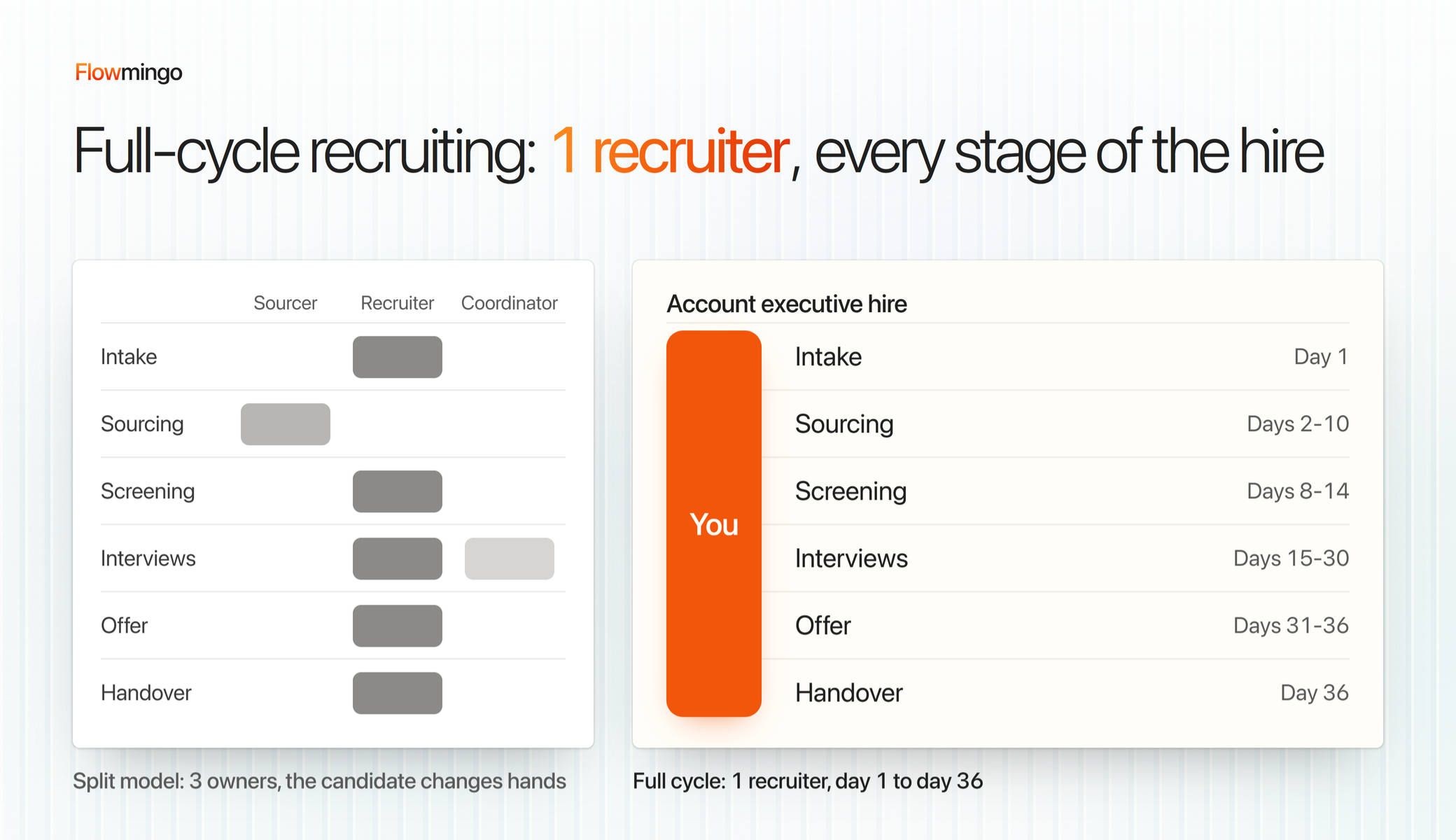
It is not the split, or segmented, model. In Greenhouse's description, a sourcer finds candidates, a recruiter screens and interviews, and a coordinator books the interviews.
Greenhouse calls full cycle a natural fit for a team of 1 recruiter, and load shows why. In SHRM's 2025 benchmarking, recruiters at firms under 100 staff carried a median 6 requisitions a year, and those at firms of 5,000+ carried 60. This means 1 recruiter at a small firm can hold every stage of every role in their head, which gets hard at 60.
2. What does full-cycle recruiting entail on 1 hire?
On 1 hire, the model is a chain of 6 handoffs that 1 person makes alone. Here is 1 hire worked through with illustrative numbers, from the open requisition to the handover.
Say you are the only recruiter at a 180-person software firm, and the sales director needs an account executive. The requisition opens on day 0. You hold a 30-minute intake on day 1 and agree the must-haves, the interview panel and the pay range.
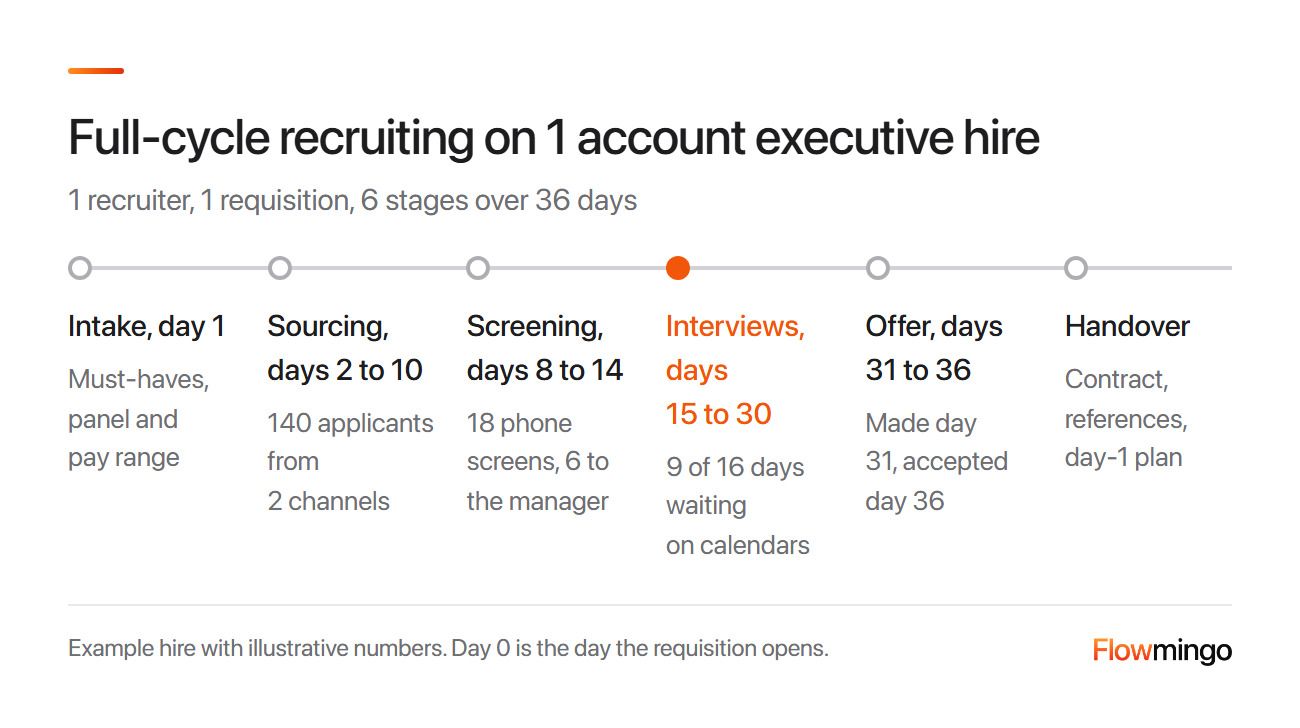
Full-cycle recruiting on 1 account executive hire: 6 stages from intake on day 1 to an accepted offer on day 36. The interview stage took 16 days, and 9 of them went on waiting for calendars.
Sourcing ran from day 2 to day 10, and the post and your direct messages brought 140 applicants. Screening overlapped from day 8 to day 14, with 18 phone screens, and 6 people went to the hiring manager.
Interviews took days 15 to 30. You made the offer on day 31 and the candidate accepted on day 36. Then you handed the manager the contract, the references and a day-1 plan.
That is 36 days to fill, under SHRM's 2026 median of 39 days for non-executive roles. Because you owned every stage, you could see that calendars, not candidates, slowed the hire most. So at the next intake, you book the panel's interview slots before sourcing starts.
3. What are the stages of the full-cycle recruiting process?
The process has 6 stages, and each one sets up the next. Run them in this order, with the reason for each in mind, so nothing waits on a handoff that never comes.
- Intake. Meet the hiring manager for 30 minutes on the approved requisition, and agree the must-haves, panel, pay range and dates. It goes faster when a job analysis has already named the critical skills.
- Sourcing. Post the role and message people directly in the same week. 2 channels keep 1 slow channel from stalling the role.
- Screening. Check every applicant against the must-haves only, and write 1 line on each decision. Our guide to the recruitment funnel shows how to read the pass rate at each stage.
- Interviews. Book the panel's slots at intake, not after the shortlist. In a foundational 2019 Cronofy survey of 272 agency recruiters, 60% needed 3 or more emails or calls to book 1 interview.
- Offer. Agree the offer range at intake, so you can make the offer within days of the final interview. A finalist who waits a week has time to say yes elsewhere.
- Handover. Send the manager the contract, the references and a day-1 plan, then close the requisition. The new hire then meets a team that expects them.
3.1 When does full-cycle recruiting stop working?
It stops working when 1 recruiter holds more roles than they can track by name. The first signs are slow candidate updates, interviews booked late and decisions with no notes behind them.
The load is rising at the top end. SHRM's 2026 benchmarking, from over 4,600 organisations, found a 67% rise in median requisitions per recruiter at extra-large organisations. Each hour lost to calendars has a price, since US HR specialists, recruiters included, earned a median $36.51 an hour in May 2025 (BLS).
You don't have to drop the single owner: keep 1 recruiter accountable for each hire. Move the work that takes hours but little judgement, such as booking calendars or asking everyone the same first-round questions. Our hiring process guide shows the full sequence a team can share.
4. How do you run full-cycle recruiting with Flowmingo?
You stay the single owner, and the first interview round runs without a calendar. Every applicant answers the same questions in their own time, and you read the results in 1 board.
Before you start, have the intake answers ready: the must-haves, the pay range and the panel. They become the job description you paste and the stages you set on the board. For example, the account executive role could use 5 stages: applied, first-round interview, manager interview, final and offer.
How Flowmingo helps
Paste the job description from your intake, and Flowmingo drafts 1 to 30 interview questions you review, then you share 1 link. Applicants take the interview in their own time, and you get the recording, the transcript and a scored report. Every result lands on 1 profile, in 1 board with stages you define, and the decision stays with your team. Sign up free to run full-cycle recruiting on Flowmingo.
5. Sources
Every benchmark and survey in this glossary entry links to its source below.
- Cronofy. (2019). Cronofy and JobAdder interview scheduling survey 2019 results. Cronofy
- Greenhouse. (2026, May 26). Full cycle recruiting: What it is and how to get it right. Greenhouse
- Pin. (2026, April 25). Full cycle recruiting: Every step from sourcing to offer in 2026. Pin
- SHRM. (2025). 2025 recruiting executives benchmarking: Insights to maximize recruitment. SHRM
- SHRM. (2026). Recruiting benchmarking. Retrieved 26 October 2026. SHRM
- U.S. Bureau of Labor Statistics. (2026). Human resources specialists. Occupational Outlook Handbook. BLS