
Candidate ranking is putting a role's candidates in order by their scores on the same criteria, so the top of the list becomes the shortlist. It compares people with each other, while scoring rates each person alone.
You rank candidates whenever more qualified people reach you than you have interview slots. A hiring manager asks for your top 6. The order you send has to hold up when they ask why number 7 missed out.
Key takeaways
- How is ranking different from scoring? Scoring rates each candidate on fixed criteria. Ranking puts those scores in order and draws the shortlist line.
- Can you rank on interview impressions? Barely. If 1 candidate simply interviewed better than another, the chance they're truly the better one is only 56% to 61%.
- Where should the shortlist line go? At a real gap in the scores, not at a fixed count. In the example below, a 0.1 gap is a tie and a 0.6 gap is the line.
- Is there a formal model? Yes. The US Interior Department's toolkit sets out 2: the Rule of Many ranks people by score, and category rating sorts them into bands such as 85 to 100.
1. What is candidate ranking in recruitment?
Candidate ranking is the step that turns a set of scores into an order, and the order into a shortlist. It comes after screening and scoring, and before interviews or a client submission.
It includes 3 decisions: the order, the line, and what happens to ties. Singapore's TAFEP handbook asks employers to rank candidates by how well they meet the criteria set in advance.
It is not scoring, which rates each candidate on fixed criteria one at a time. This means a ranking is only as fair as the scores under it. The phrase is also formal in US federal hiring, where the Interior Department's toolkit lists the candidate ranking options agencies may use.
Kahneman and colleagues' book Noise shows why impressions make a weak order, in a foundational 2021 finding. If 1 candidate simply interviewed better than another, the chance they're truly the better one is only 56% to 61% (NPR). A ranking needs scores against criteria, not a feeling about who shone.
2. What does candidate ranking look like on a real shortlist?
On a real shortlist, ranking is a sorted list with 1 line across it. The hard part is where the line goes, because a fixed count can split 2 people who are effectively tied.
Here is 1 shortlist worked through with example scores.
Say you hire an inside sales representative, and 40 candidates pass the CV screen. For example, each is scored 0 to 10 on 4 weighted criteria, and the hiring manager has 6 interview slots.
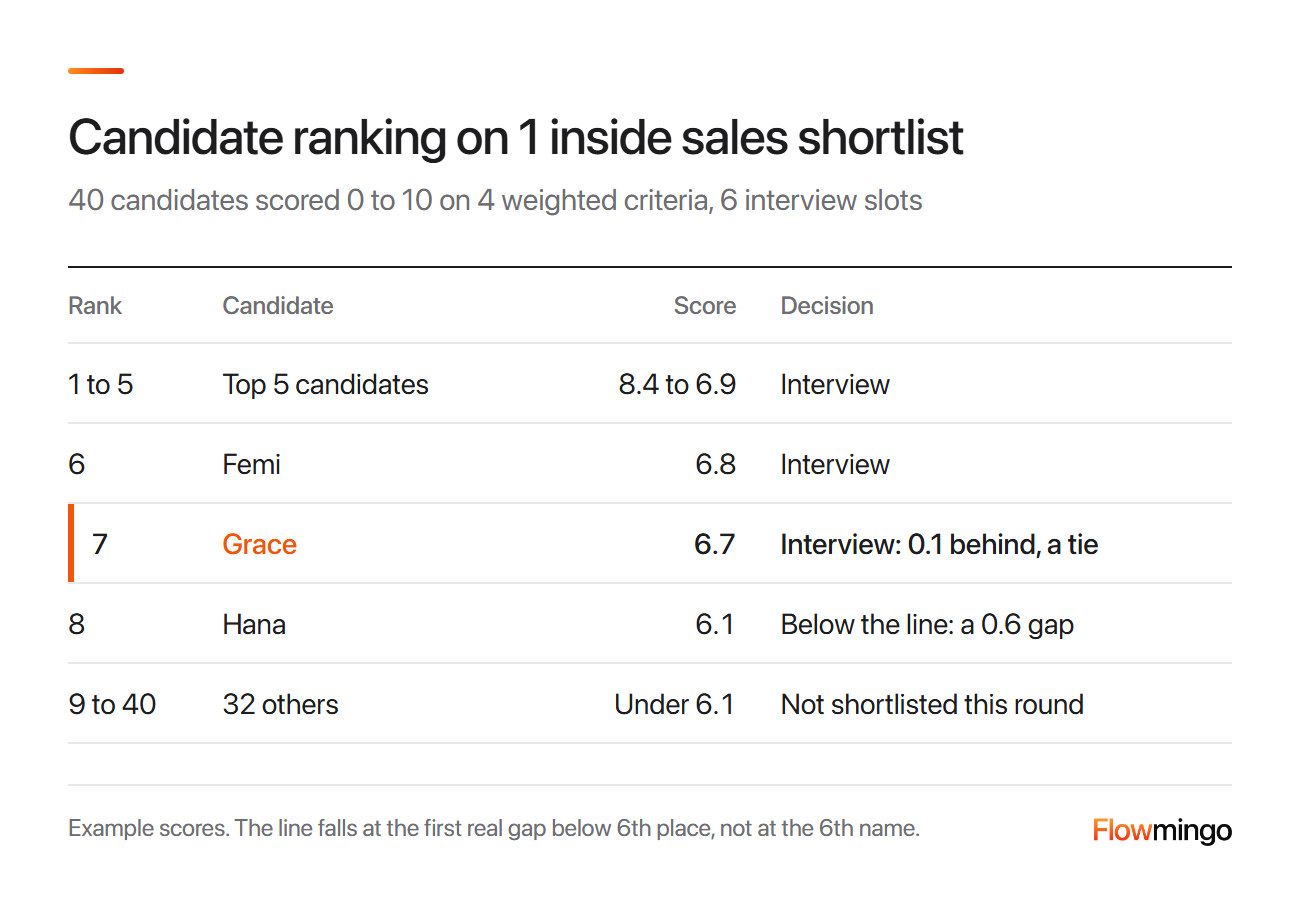
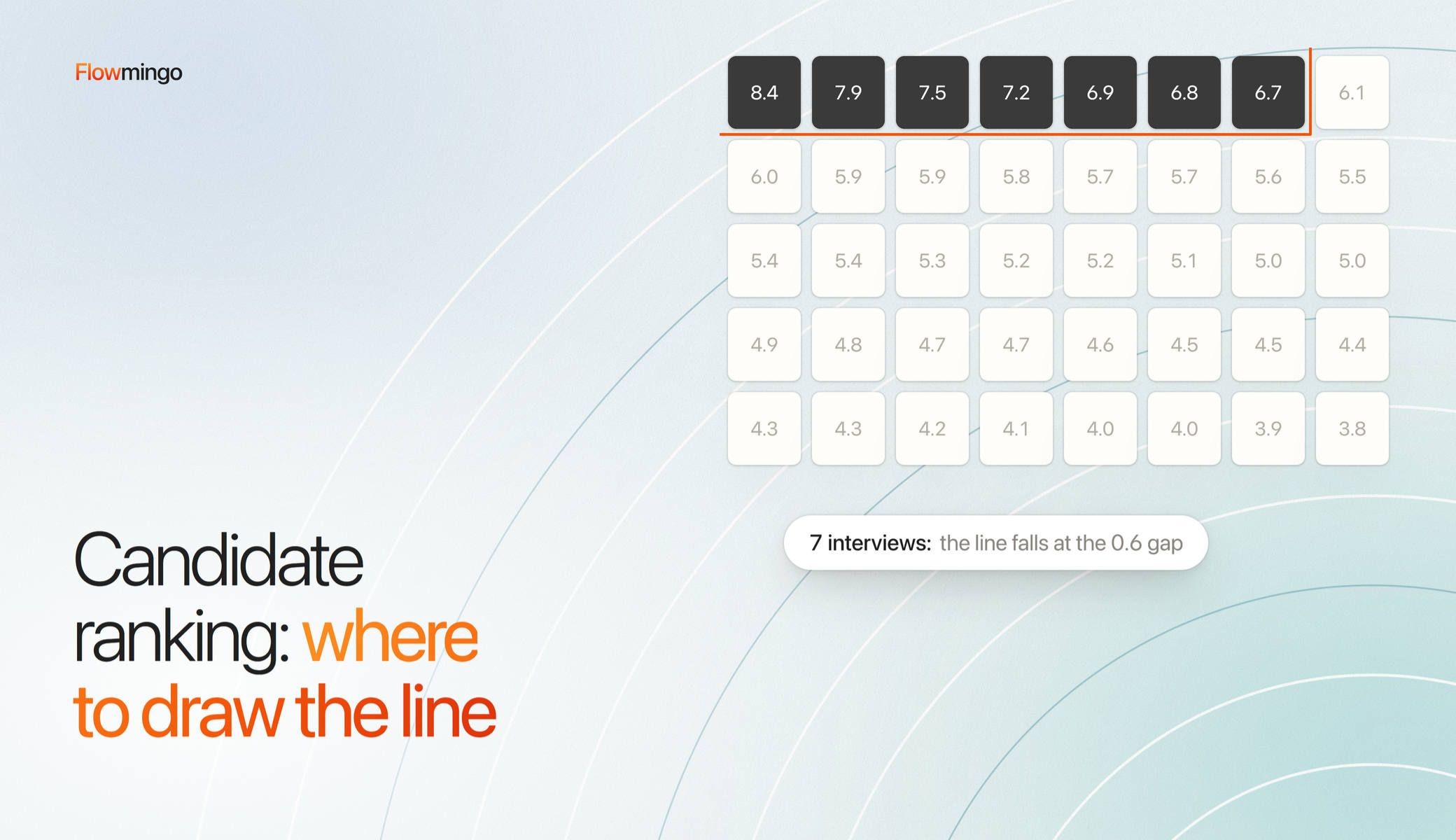
Candidate ranking on 1 inside sales shortlist: ranks 1 to 5 score 8.4 to 6.9. Femi and Grace sit 0.1 apart, and the first real gap is 0.6.
Ranks 1 to 5, the top 5 candidates, score from 8.4 down to 6.9 and get an interview. Femi is 6th on 6.8 and Grace 7th on 6.7. A strict count of 6 would cut Grace over 0.1, a gap too small to tell 2 people apart.
Hana, 8th on 6.1, sits 0.6 below Grace, the first real gap below 6th place. So you draw the line between Grace and Hana and ask the manager for 1 extra slot: 7 interviews. The 32 others, ranks 9 to 40 and all under 6.1, are not shortlisted this round.
3. How do you rank candidates so the order holds up?
Fix the criteria and the weights before you sort, then draw the line at a gap and write down why. An order built that way survives the hiring manager's questions.
- Score everyone on the same criteria first. Ranking only sorts scores, so it can't repair scores built on different questions.
- Set the weights before you see a name. If weights change after the scores are in, nobody can tell whether the job or a favourite moved them.
- Agree a tie margin in advance. For example, treat scores within 0.2 of each other as equal, as Femi and Grace were.
- Draw the line at the first real gap, not at a count. Asking for 1 more slot or 1 fewer is easier than defending a 0.1 cut.
- Write 1 line on why each person sits above the line. Our guide to candidate shortlisting shows how to turn those lines into the list you send.
3.1 Should you rank candidates in order or in bands?
Use an order when your scores clearly separate people, and bands when they don't. US federal hiring offers both, and the Interior Department's toolkit sets them side by side.
The Rule of Many, published on 8 September 2025, ranks candidates by number on their assessment scores. Managers then select from an agency-set range of top-ranked candidates. The toolkit asks for an assessment that clearly separates them.
Category rating, set out in section 3319 of title 5 of the US Code, sorts candidates into at least 2 quality bands instead. With 2 bands, Best Qualified covers 85 to 100 and Qualified 70 to 84. The manager then selects from the top band.
4. How do you run candidate ranking with Flowmingo?
Score every candidate on the same weighted requirements, sort by the overall score, and read the reasons at the line before you send the list. The tool does the sorting, and your team owns the line.
Before you start, get the must-haves and their weights signed off by the hiring manager. Agree the tie margin too, because a rank list without one invites an argument over 0.1.
Then look hardest at the 2 or 3 people on either side of the line. That is where the reasons matter most, as Femi, Grace and Hana showed.
How Flowmingo helps
Flowmingo's CV evaluation scores every résumé against the must-haves you set and hands back a ranked shortlist with the reasoning attached. Each requirement is rated 0 to 10 and weighted by its importance, and every hiring decision stays with your team. Sign up free and check the reasons at your line before you settle your candidate ranking on Flowmingo.
5. Sources
Every book, handbook and government page cited in this glossary entry links to its source below.
- Kahneman, D., Sibony, O., & Sunstein, C. R. (2021). Noise: A flaw in human judgment, ch. 24, as quoted by NPR Planet Money. Little, Brown Spark. NPR
- Tripartite Alliance for Fair and Progressive Employment Practices. (2025, November). Fair recruitment and selection handbook. TAFEP. TAFEP
- U.S. Department of the Interior, Interior Business Center. (n.d.). Candidate ranking options. IBC Customer Central. Retrieved 26 October 2026. IBC