
The average job drew 244 applications in 2025, and the reading lands on a few people like you. Your recruitment tools decide whether the strongest of those 244 gets a real look, or stays buried in a pile nobody reaches.
That is up from 116 in 2022, while recruiting teams shrank 56% (Greenhouse). Vendors sell hiring tools for every stage.
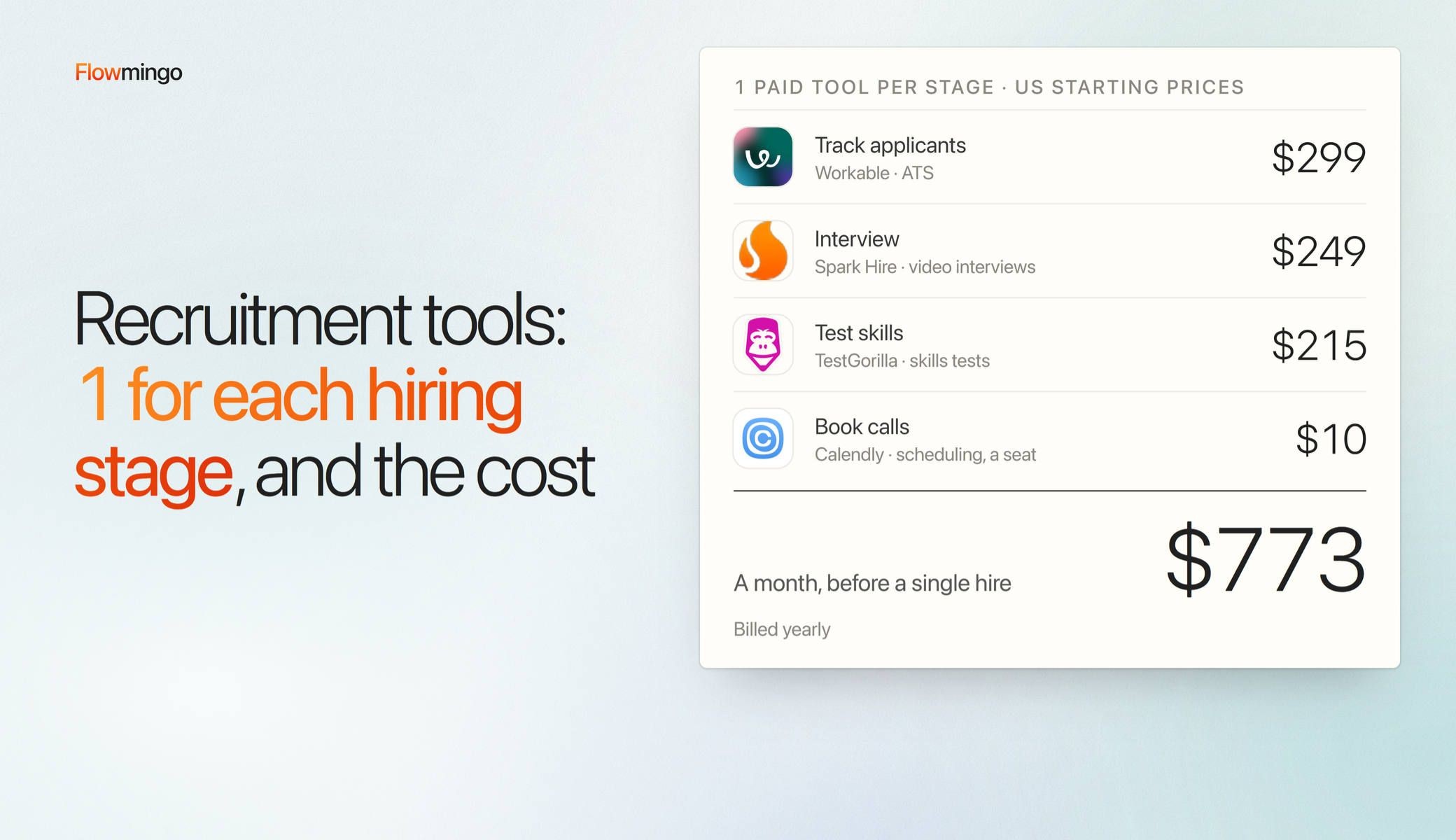
Buy 1 paid tool per stage from Workable, Spark Hire, TestGorilla and Calendly, and you pay about $773 a month before a single hire.
So build the stack in 3 moves. Put the deal-breakers in the form, give everyone who passes 1 structured interview in their own time, and keep every result on 1 record.
Key takeaways
- Which recruitment tools do I need first? Screening questions, a CV score and 1 structured interview for everyone above your line. About 3 in 10 of 1,020 Flowmingo projects combined assessment types, counting invites.
- Should an AI interview replace my phone screen? For volume and entry to mid-level roles, yes: 60.6% of completed Flowmingo AI interviews finished outside a weekday 9-to-5.
- What does a stack cost? Workable, Spark Hire, TestGorilla and Calendly cost about $773 a month, 64% of SHRM's median cost per hire at 1 hire a month. Free plans cover most stages.
1. With 200+ applicants and no recruiter, which recruitment tools do I need, stage by stage?
You need 1 tool per stage, and 4 stages carry the load: screening questions, a CV score, 1 structured interview and a tracker. A skills test and a final-round scheduler come after.
Each stage answers a different question, so 2 recruitment tools at the same stage waste money and a missing stage leaves a blind spot. A CV shows what someone claims, an interview how they think, and a test what they can do.
Say 240 people apply for 1 operations coordinator role at your 40-person logistics firm (illustrative). Knockouts remove people who can't work the 07:00 shift, and the CV score sorts the rest.
Everyone above your line gets the same interview link, and you review each report. The skills test waits for the last 4 or so, because it costs them the most time.
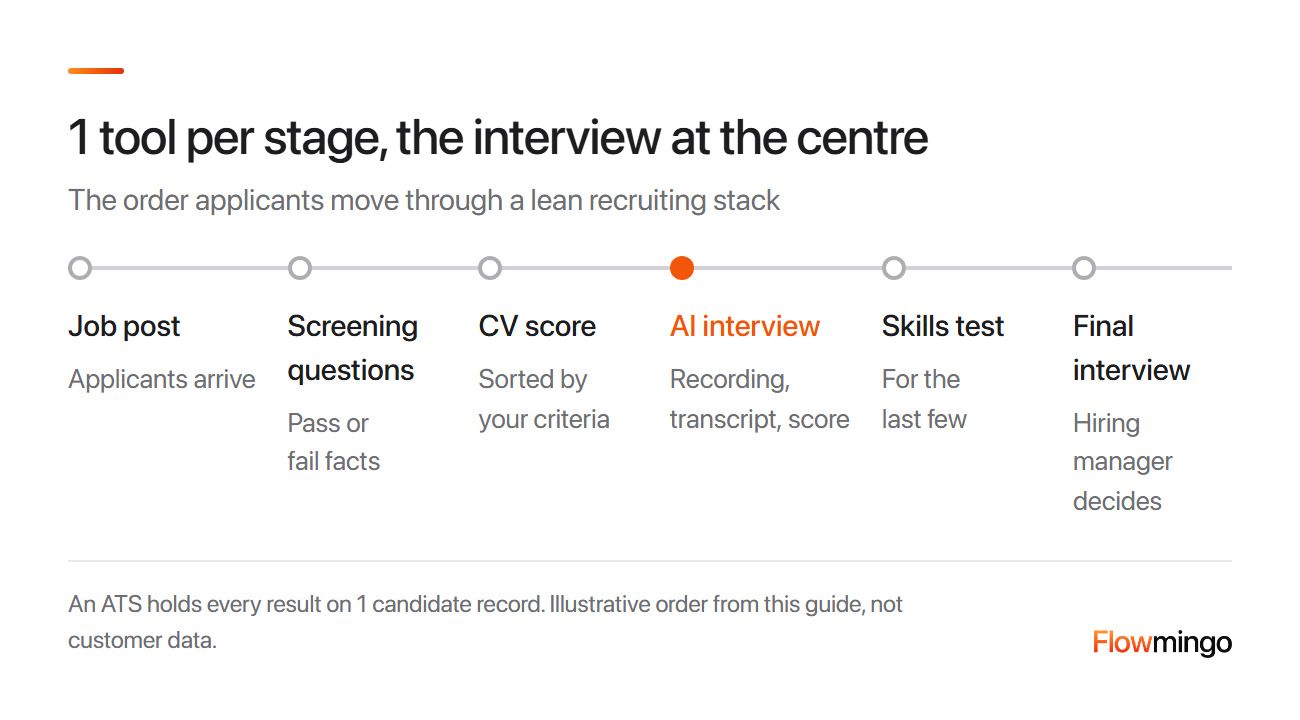
Stack by stage: a job post brings applicants, screening questions check pass or fail facts, and a CV score sorts them. The AI interview returns a recording, transcript and score before the skills test and the final interview.
In our data, 70.6% of 1,020 projects used a single assessment type, and 4.5% a skill test alone.
Flowmingo data · 1,020 hiring projects that assessed at least 1 real applicant · 490 companies · 42,365 candidates · projects created 20 Jul to 28 Aug 2026
- 35.6% used CV evaluation and no other assessment.
- 30.5% used the AI interview and no other assessment.
- 2.2% paired a test (a skill test or showcase) with the AI interview or CV evaluation.
An AI interview counts here once its invite was sent, and CV evaluation runs when a CV is added, so the CV share partly reflects attached CVs. Counting completed results, our AI hiring platform guide found 46.8% of 3,042 projects (July to September 2026) used 2 or more types.
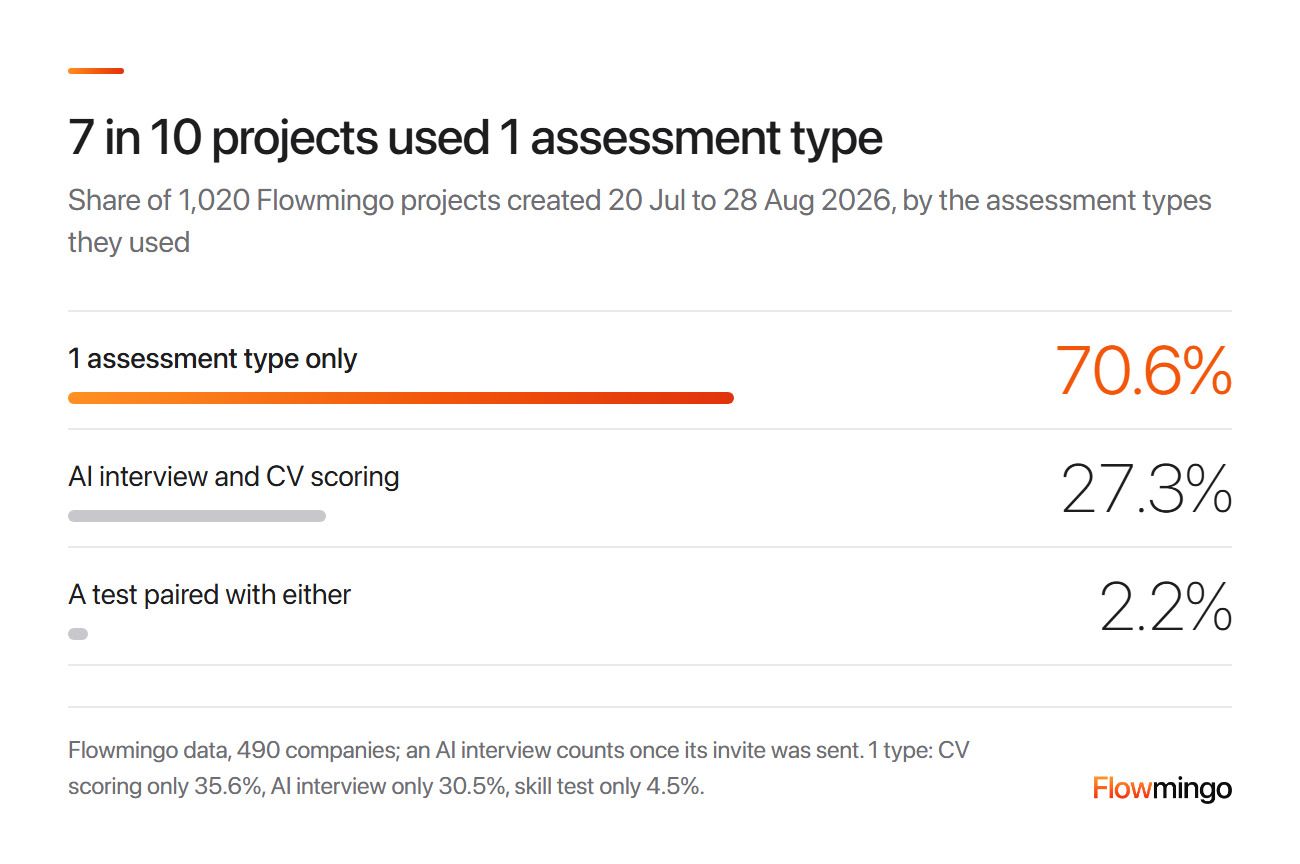
Assessment mix: of 1,020 projects (20 Jul to 28 Aug 2026), 70.6% ran 1 type and 27.3% paired the AI interview with CV scoring. Just 2.2% paired a test with either.
So by this count the CV or the interview judged alone in most projects. Section 4 shows how often they disagree. Our hiring process steps guide gives each stage a day budget.
2. Should an AI interviewer replace my phone screen, and what do I get back?
For volume, shift and entry to mid-level roles, yes, because the AI interviewer gives everyone the same questions in their own time. Keep live calls for small senior searches and the final round.
You read a recording, transcript and scored report per applicant instead of booking calls. At an assumed 20 minutes a call, phoning 244 applicants takes about 81 hours.
A foundational 2022 re-analysis found that structured interviews, run by people, predicted performance more than twice as well as unstructured ones (Sackett and colleagues). So the AI's job is to hold everyone to the same questions (our reading).
Jabarian and Henkel's preprint, the only randomised field trial we found, assigned 67,056 of 70,884 entry-level applications at random. AI-led first interviews produced 12% more offers (9.73% against 8.70%), and people made every hiring decision.
2.1 What should the invite say about the AI interview?
Say there is an AI step, and offer a person on request. In Greenhouse's 2026 survey, 38% of US job seekers had quit a hiring process over an AI interview. 46% wanted a human option.
For example, an invite could say:
The first step is a 20-minute AI interview, scored against this job's criteria, that you can take any time before Friday. A person on our team reviews every answer before any decision.
Reply to speak to a person instead. If you need more time, another format or any other adjustment, contact [name] at [email].
Flowmingo data · 41,126 completed AI interviews · 856 companies · interviews started 24 Jun to 19 Sep 2026
- 60.6% of completed AI interviews were finished outside Monday to Friday 9:00 to 17:00 in the candidate's local time.
Local time is estimated from the candidate's connection, and 9 to 5 on weekdays is assumed. About 61% of applicants are in India and Nigeria, and this shows timing, not preference.
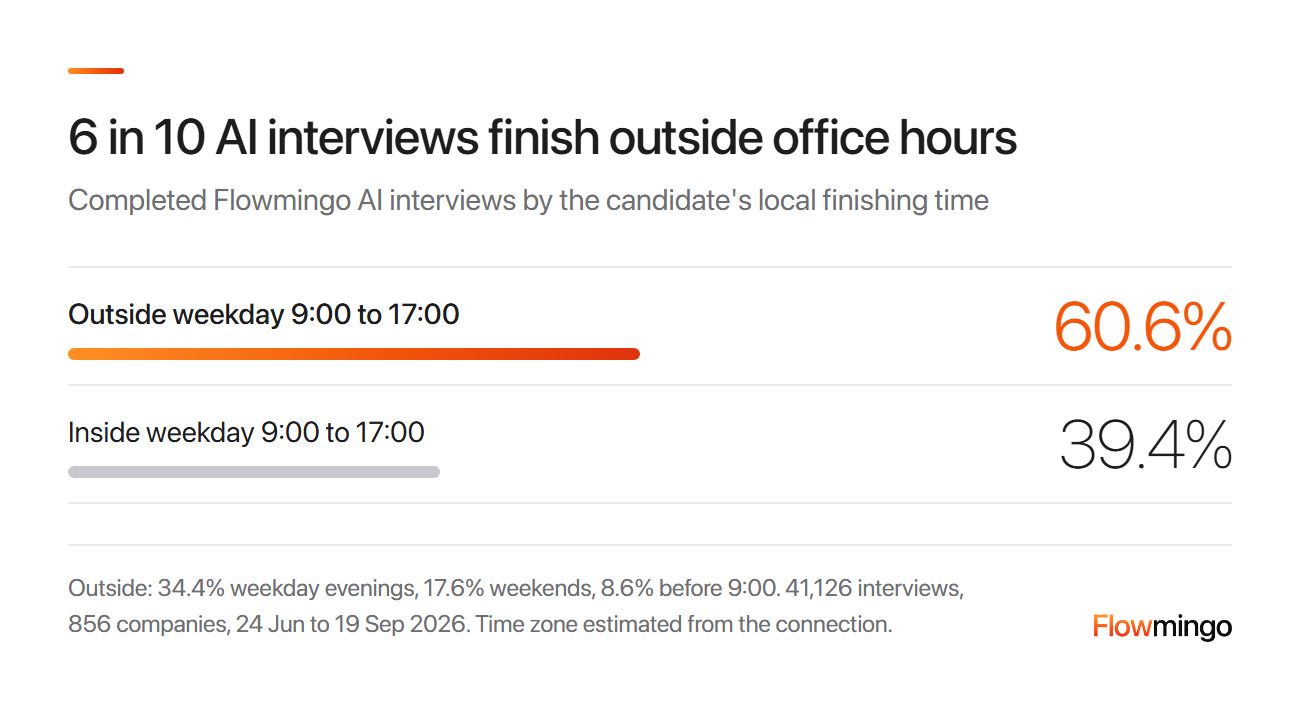
Own-time finishes: 60.6% of 41,126 completed AI interviews finished outside weekday 9:00 to 17:00, and 39.4% inside it. Outside means 34.4% on weekday evenings, 17.6% at weekends and 8.6% before 9:00.
So put the interview first among your recruitment tools: no calendar stands between you and the applicant.
How Flowmingo helps
Paste your job description and the AI Interviewer drafts 1 to 30 questions you can edit, then follows up on incomplete answers. You get the recording, the transcript and a 0 to 10 rating per criterion with reasons, and it rejects nobody automatically.
3. Which candidate screening questions should my recruitment tools ask before anyone reads a CV?
Ask 2 or 3 pass-or-fail facts the job can't flex on: the shift, the site, a licence, the pay range or the right to work.
Knockouts cost nothing to run, because candidates answer them, but 1 bad rule silently removes good applicants.
A common bad rule is a minimum of years. In a foundational review of 81 samples, past experience told employers almost nothing about performance (Van Iddekinge and colleagues). Ask what someone did, not for how long.
US rules treat the form as a test: the Uniform Guidelines count even "informal or casual interviews and unscored application forms" as selection procedures (29 CFR 1607).
Say 60% of 1 group passes your knockouts and 42% of another. 42 divided by 60 is 70%, under the 80% line agencies generally treat as evidence of adverse impact. On 4 Nov 2026 the rule was in the eCFR but under federal review, so keep it as your own monitor.
Pick 2 or 3 of these 5 knockouts.
| Knockout question | Passes if |
|---|---|
| Can you work [days and hours]? | Yes |
| Can you work on site in [city] [N] days a week? | Yes |
| Are you authorised to work in [country]? | Yes, where it is lawful to ask |
| The range is [X to Y]. Does that work for you? | Yes |
| Do you hold a current [licence]? | Yes, if the job requires 1 |
Ask about the right to work, never citizenship, because the job needs the first and not a passport. Our pre-screening interview questions guide adds the scored questions and the ones the law bans.
4. Can CV screening software rank 200 CVs without burying good candidates?
Yes, if it scores every CV against your written criteria, shows its reasons and filters nobody out on its own. Use the score to sort, then read the band just below your line by hand.
In a foundational 2021 Harvard Business School and Accenture survey of 2,275 executives, over 90% of software users let it rank applicants first. Yet 88% believed it vetted out qualified high-skills candidates who missed the job description's exact criteria, and 94% for middle-skills roles.
Keyword rules fail on wording. For example, a filter for "account management" drops a CV that says "kept 40 client accounts", while a criterion score sees the match.
Adding up criterion scores also beats a gut read. In a foundational 2013 review, a fixed formula predicted performance more than 50% better than experts' overall view (Kuncel and colleagues).
If a chatbot ranks your CVs, watch the order. Rozado gave 22 AI models pairs of equally qualified CVs, and the first-listed CV won 63.5% of the time.
Flowmingo data · 34,114 candidates · 745 projects · 379 companies · Jul 2025 to Sep 2026
- 19.2% of 532 projects: the top interview score and the top CV score went to the same candidate.
Both are Flowmingo AI scores, not job performance, and interviewed candidates are a selected group. This shows a different ranking, not which is right.
So sort by CV score, but send the interview to everyone above a modest line, not just the top few. Our candidate shortlisting guide shows how to set that line.
How Flowmingo helps
CV Evaluation scores every CV out of 10 against weighted criteria from your job description, with the evidence for each score and no per-CV charge.
5. Which talent assessment tools predict job performance, and which only look scientific?
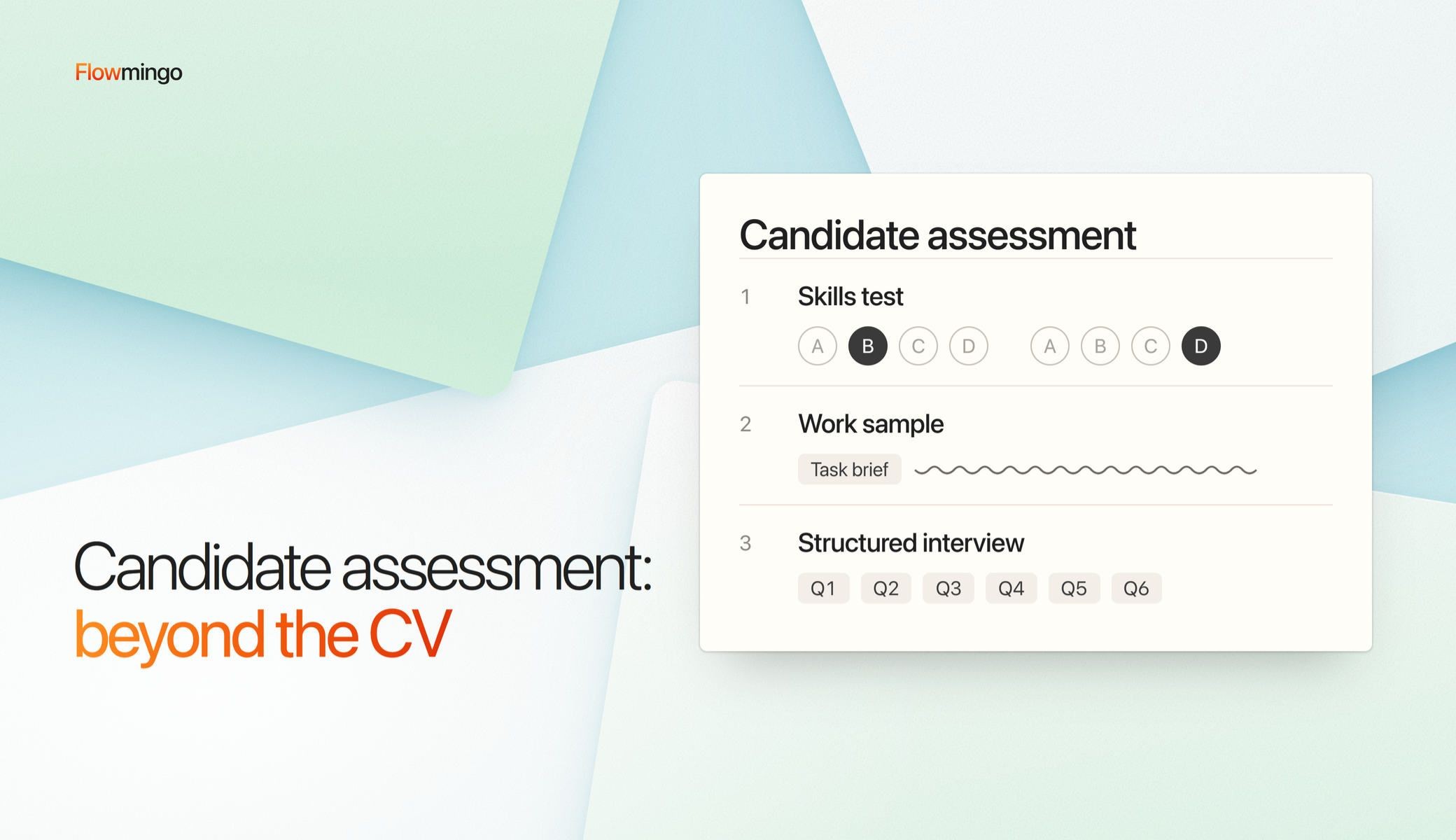
Tests of the job itself predict best: job knowledge tests rank just behind structured interviews, and work samples close behind, in a foundational 2022 re-analysis. A test that can't show a link to the job is a risk, however polished its report.
In an r/recruiting thread with 136 comments, a recruiter questioned a CEO's new personality test, a ranking exercise ending in a 10-page report. Ask any vendor for evidence that its scores predict performance in jobs like yours.
The research gives you a ranking to hold any of your recruitment tools to. Sackett and colleagues put structured interviews at 0.42 and job knowledge tests at 0.40, on a scale where 1 is a perfect link.
Work sample tests came in at 0.33, cognitive ability tests at 0.31 and unstructured interviews at 0.19. Experience in a relevant job scored 0.07, close to nothing (Van Iddekinge and colleagues).
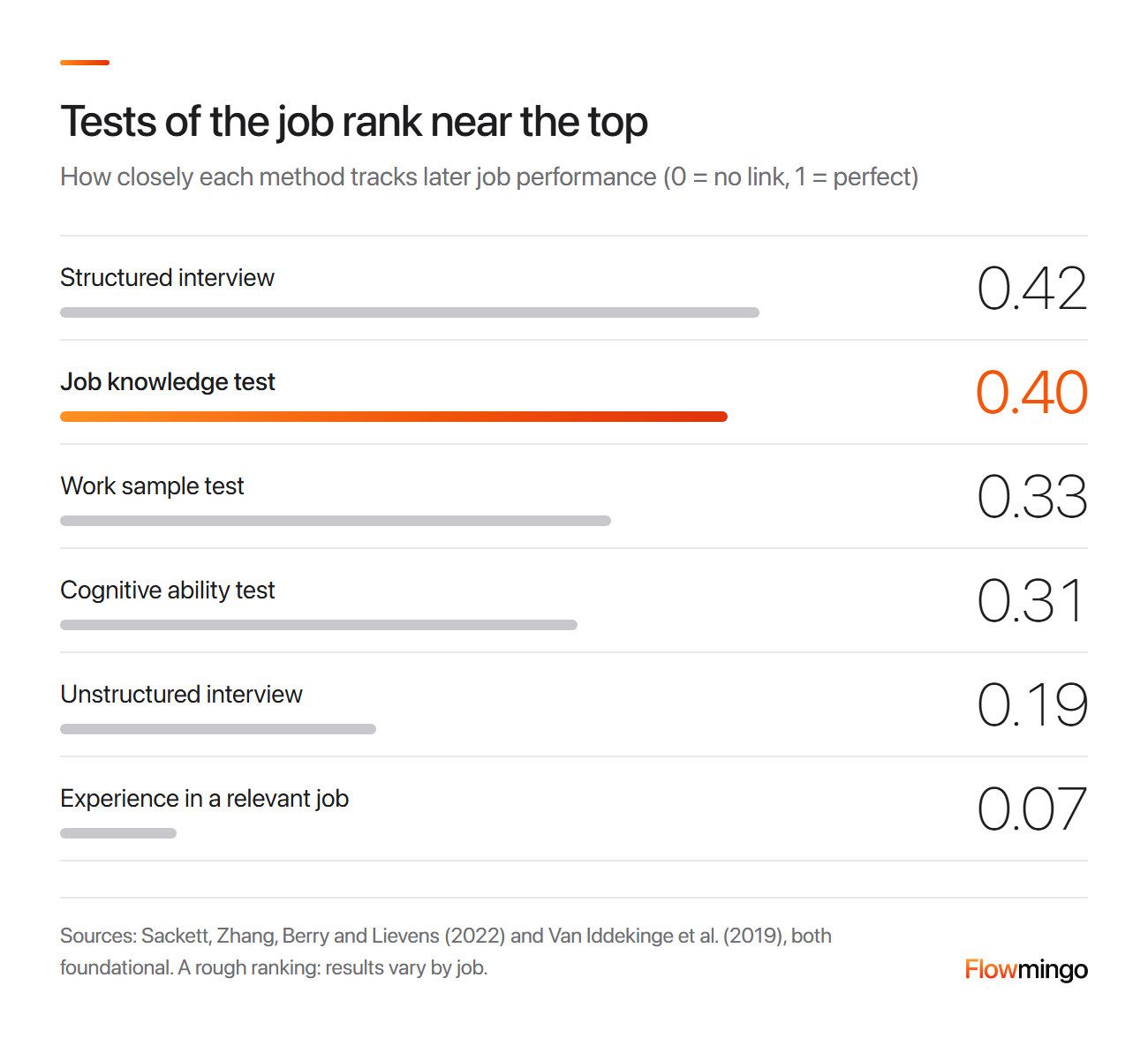
What predicts performance: structured interviews (0.42) and job knowledge tests (0.40) lead, and experience in a relevant job trails at 0.07.
Put the test after the first interview, for the 4 or so people left.
For example, a support hire could answer 3 real customer emails in 30 minutes, scored on accuracy, tone and next step. Our skills based hiring guide shows how to build one.
Flowmingo data · 293 skill-test attempts · 287 candidates · 38 companies · started 25 Aug to 30 Sep 2026
- 77.5% of attempts (227) got through to the end of the test.
- 12.9 minutes was the median time those 227 attempts took from the first timed question to submitting.
Multiple-choice skill tests scored automatically, mostly with 20 or 30 minute limits, not work samples. Attempts, not people, and the 12.9 minutes counts finished attempts only.
How Flowmingo helps
Tests are auto-scored multiple-choice skills tests beside the interview and CV score. Role-Play scores how a candidate handles an AI character, and Showcase records tasks you set for your team to rate.
6. Do I need an ATS, or can a spreadsheet hold my hiring for now?
A spreadsheet can hold 1 role with a few dozen applicants. Move to an applicant tracking system (ATS) once roles overlap, or once you must show why you turned each person down.
Records are the reason. US employers must keep hiring records for at least 1 year (29 CFR 1602.14). California's AI rules ask for 4 years of automated-decision data, and Colorado's for 3 years from 2027.
A spreadsheet loses that trail once 2 people edit it, because nobody can see who moved whom, when or why. An ATS keeps the stage, the score and the note on each candidate's record.
Buy for the team you have, not the one in the demo. An in-house recruiter at a 120-person company swapped a "dying spreadsheet system" for the top-rated enterprise ATS on a 12-month contract. 4 months in, it was overbuilt for their 35 to 40 hires a year (r/recruiting).
If you already have an ATS, ask how other recruitment tools write their results back into it: a native integration, an API or webhooks. A CSV you upload by hand is a workaround that breaks the record the law asks you to keep.
How Flowmingo helps
Free includes a full applicant tracker with stages, notes, ratings and unlimited team members. Our ATS integrations page listed setup guides for 21 ATSs on 4 Nov 2026, including Greenhouse, Lever and Workday. At the stage you pick, Flowmingo sends the AI interview or role-play and writes the score back, on every plan.
7. Which recruitment tools should a small team shortlist, and what do they cost?
Shortlist 1 tool per stage, in the order applicants meet them, and pay only where a free plan fails. Workable, Spark Hire, TestGorilla and Calendly cost about $773 a month at yearly-billed US prices, with 1 scheduling seat.
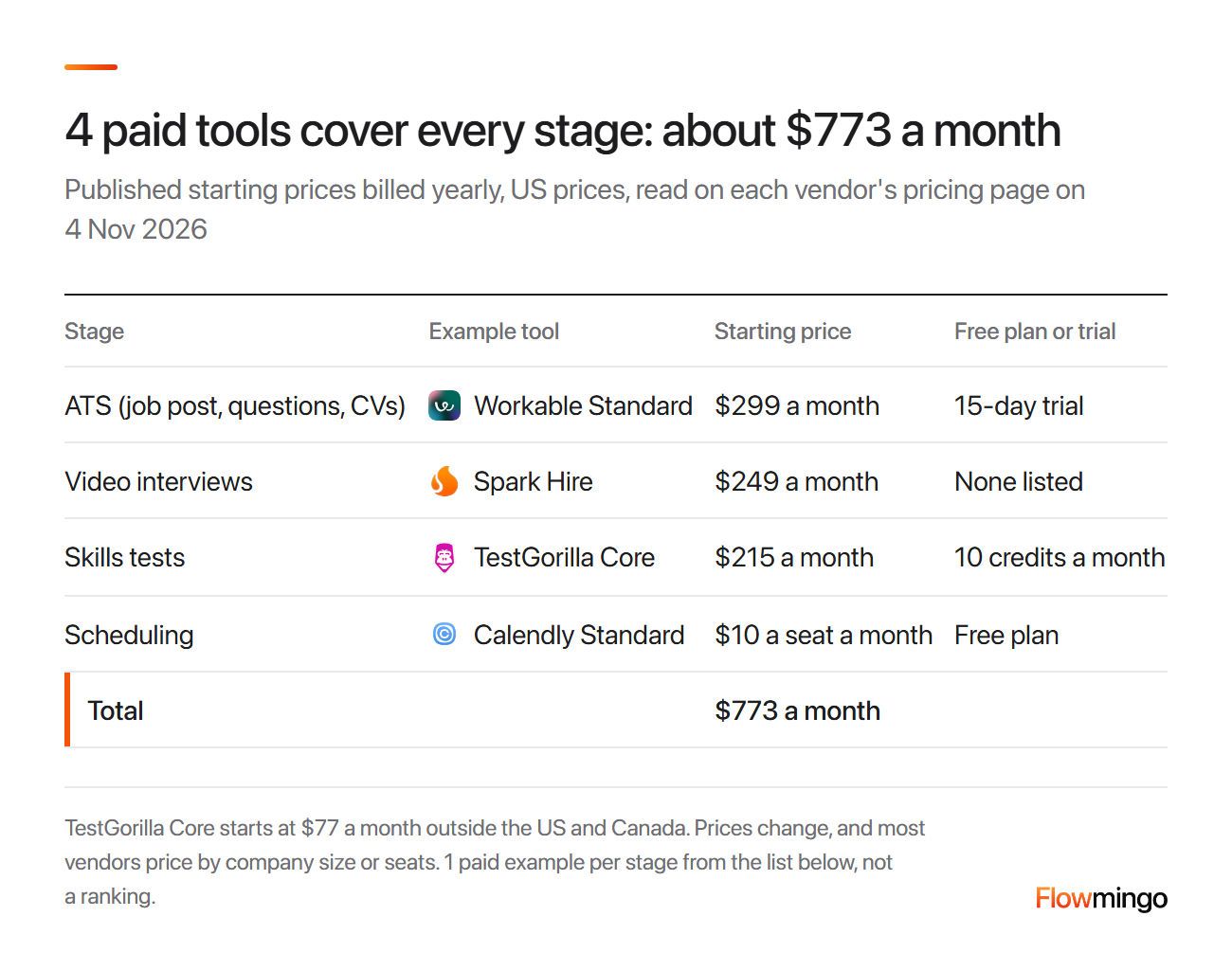
Stack prices: Workable Standard $299, Spark Hire $249 and TestGorilla Core $215 a month, plus Calendly Standard at $10 a seat. US prices billed yearly, read 4 Nov 2026.
Workable's ATS also posts the job to 200+ boards, runs custom application forms, parses CVs and books interviews, so 4 vendors cover every stage. For 1 hire a month, this means they equal 64% of SHRM's 2025 median cost per hire, $1,200 for non-executive roles (SHRM).
Workable alone, with its video ($109) and assessment ($59) add-ons, does the same jobs for about $467 a month, no Calendly.
Pick 1 ATS from 7.1, 7.2, 7.7 or 7.8, and the rest add 1 stage each. Prices and limits come from each vendor's page, read 4 Nov 2026.
7.1 Breezy HR: an ATS built around screening questions
Best for knockout questions on every application: this ATS posts jobs to 50+ boards, and questionnaires qualify applicants.
- Price: $157 a month billed yearly, or $189 monthly, with unlimited users (Breezy HR).
- Limit: AI evaluation costs extra credits, from $30 per 100,000, and the page lists no free plan.
7.2 Manatal: an ATS that ranks CVs
Best for ranking a pile of CVs. This ATS parses each one and scores candidates against the job with AI.
- Price: $15 per user a month billed yearly, or $19 monthly (Manatal).
- Limit: the Professional plan stops at 15 jobs and 10,000 candidates.
7.3 Flowmingo: the first interview
Best for interviewing everyone above your CV line without booking calls. Interview, CV score, tests and tracker share 1 record.
- Price: $0 on Free, with no per-candidate charge. Flowmingo Pro costs $49, $99 or $399 a month, or $42, $84 or $339 billed annually.
- Limit: Free keeps the latest 300 videos for 30 days, caps interviews at 20 minutes and gives 3 PDF or DOCX reports in total. Pro adds storage, branding, downloads and longer assessments, not more screening.
7.4 Spark Hire: one-way and live video interviews
Best for recorded video answers your team reviews: unlimited one-way and live interviews, with 40+ ATS integrations.
- Price: $249 a month billed yearly, or $299 monthly (Spark Hire).
- Limit: the monthly plan covers up to 5 jobs and 5 users, and the page lists no free plan.
7.5 TestGorilla: skills tests
Best for testing the last few candidates on the core task, from 350+ skills tests on Core.
- Price: $215 a month billed yearly in the US and Canada, $77 elsewhere, beside a free plan of 10 credits a month (TestGorilla).
- Limit: Core has no AI interviews. Plus, from $520 a month, adds the full AI interview library, custom tests and ATS and API integrations.
7.6 Calendly: scheduling the final interview
Best for booking the final round: candidates pick a slot your calendars show as free.
- Price: $10 a seat a month billed yearly, next to a free plan (Calendly).
- Limit: Free allows 1 event type and 1 calendar connection, and every host needs a seat. Check first whether your ATS books interviews: Workable's does.
7.7 Workable: the applicant tracking system
Best for a company of up to 20 employees. Standard bundles sourcing, unlimited active jobs and reports.
- Price: $299 a month billed yearly for 1 to 20 employees, with a 15-day trial (Workable).
- Limit: video interviews ($109 a month) and assessments ($59 a month) are paid add-ons.
7.8 Zoho Recruit: an ATS on a budget
Best for hiring 1 role at a time on no budget. Standard adds job boards, assessments and a pipeline.
- Price: $0 on Free, or $25 a recruiter a month billed yearly on Standard (Zoho Recruit).
- Limit: Free allows 1 active job per recruiter licence and no add-ons, and video interviews cost $12 per job opening.
8. How many recruitment tools can I add before candidates drop out?
Count the candidate's minutes, not your recruitment tools. Before anyone speaks to a person, keep it to 1 short form and 1 interview of 15 to 20 minutes.
Then test only the few who remain, because a test costs the most time.
In a foundational 2024 study of 27,809 applicants at 33 companies in 11 countries, Tilston and colleagues linked more interview questions to worse reactions. Applicants over 31 minded most.
The bigger loss comes earlier, before the first step starts.
Flowmingo data · 52,078 AI interview invites sent by recruiters · 866 companies · 15 Jun to 13 Sep 2026
- 62.6% of invited applicants never opened the interview link within 14 days.
- 36.3% began the interview, and 30.9% finished it within 14 days.
- 85.1% of the applicants who began the interview finished it.
Behaviour, not cause. "Opened" means reaching the interview page and entering an email address. Flowmingo network invites are excluded.
85.1% of those who start finish, so the loss sits before the link. A clear invite that names the step, its length and the deadline does more than cutting 1 question. Our interview invitation email templates show how to write it.
Tools pile up on your side too. A recruiter on r/recruiting listed 11 tools they switch between daily, from LinkedIn and the ATS to Calendly and Sheets.
In another thread, 3 people who weren't in the ATS booked phone screens, likely through a link a candidate shared. Our rule of thumb: if a tool can't write its result onto the candidate's record, it will cost you time later.
9. What must I tell candidates when hiring tools score them?
Tell them that software helps assess them, what it looks at and that a person decides, and offer a human route on request. New York City and Illinois require parts of this now, and Colorado from 2027.
Silence costs you candidates as well as legal risk. In Greenhouse's 2026 survey, 70% of candidates said nobody had clearly told them upfront that AI would evaluate them, and 44% wanted that disclosure.
| Where | Rule and start | What it asks of you |
|---|---|---|
| New York City | Local Law 144, since 5 Jul 2023 | An independent audit for bias within a year before use, a public summary, notice 10 business days ahead |
| Illinois | AI Video Interview Act, since 1 Jan 2020 | Notice, an explanation of what the AI evaluates and consent; delete videos within 30 days on request |
| Illinois | HB 3773, from 1 Jan 2026 | Notice, no discriminatory effect, no zip code as a proxy |
| Colorado | SB26-189 from 1 Jan 2027 | Notice; explanation within 30 days of an adverse outcome; human review on request, where commercially reasonable |
| California | Civil Rights Council rules from 1 Oct 2025 | Covers automated decisions; records 4 years |
| EU | Regulation 2026/1744: high-risk duties from 2 Dec 2027 | Human oversight, notice, logs |
| Singapore | Workplace Fairness Act, aimed at end-2027 | No decisions on protected traits |
The vendor does not carry this risk for you. In Mobley v. Workday, a court preliminarily certified a nationwide age claim against a screening vendor on 16 May 2025, with no finding of discrimination yet.
Put a short notice in the job ad and the invite, and promise only what you do, for example like this.
We use a 20-minute AI interview to ask every applicant the same job-related questions. It scores what you say, from a transcript, against [the 3 to 5 criteria for this job], with written reasons. A person on our team reviews every result and makes each hiring decision.
Reply to speak to a person instead. If you need more time, another format or any other adjustment, contact [name] at [email].
Flowmingo's scoring page shows how each requirement is rated and weighted, so you can name what the score uses. In Illinois, also get consent before a video interview and delete videos within 30 days on request.
This is general information, not legal advice, so check with counsel where you hire. Our AI in recruitment guide covers each law in more depth.
10. How do I test recruitment tools on 1 role before I commit?
Run 1 live role through the tool's trial or free plan, with your own criteria, before you sign anything.
Recruiters in an r/recruiting thread describe tools that "do the demo use case really well and then fall apart". So use the trial to run these 5 checks:
- Real role: the vendor runs 1 of your live roles, not their script.
- Reasons: read why the 10 lowest scorers scored low.
- Nonsense: give a video tool a nonsense answer and watch the score. In a journalist's test, 1 gave gibberish a 73% match (Schellmann, a foundational book from January 2024).
- Pass rates: divide each group's pass rate by the highest group's, and look closer under 80%.
- Exit: export your data before you sign, and check the API is in your plan.
Say you run 30 past applicants through the tool. If it scores 3 of your 6 hires below its line, it would have cut half of them.
The right recruitment tools are the few that cover each stage once, give every applicant the same questions and keep every result on 1 record. Start with the first interview, add the rest only where a stage fails, and test each on 1 real role.
How Flowmingo helps
Flowmingo is a free AI hiring platform, led by its AI Interviewer, with CV scoring, tests and an applicant tracker on 1 record. Run your next role through Flowmingo and keep the recruitment tools that pass your test.
11. Sources
Every study, law, survey and price in this guide links to a source below; Flowmingo figures come from Flowmingo's own platform data.
- Breezy HR (n.d., read 4 Nov 2026). Pricing. Breezy HR.
- Calendly (n.d., read 4 Nov 2026). Pricing. Calendly.
- California Civil Rights Department (2025). Civil Rights Council secures approval for regulations to protect against employment discrimination related to artificial intelligence. State of California.
- Colorado General Assembly (2026). SB26-189: Automated decision-making technology. Colorado General Assembly.
- Crowell & Moring (2024). Artificial intelligence in employment update: Illinois requires notice and prohibits discriminatory impact in use of AI. Crowell & Moring LLP.
- European Union (2026). Regulation (EU) 2026/1744 amending Regulation (EU) 2024/1689 (Digital Omnibus on AI). Official Journal of the European Union.
- Fuller, J. B., Raman, M., Sage-Gavin, E., & Hines, K. (2021). Hidden workers: Untapped talent. Harvard Business School Project on Managing the Future of Work and Accenture.
- Greenhouse (2026). The Hire Standard: Greenhouse benchmark report, North America. Greenhouse.
- Greenhouse (2026, May 1). 63% of job seekers have faced an AI interview. Most haven't had a good one yet. Greenhouse 2026 Candidate AI Interview Report.
- Holland & Knight (2025). Federal court allows collective action lawsuit over alleged AI age discrimination (Mobley v. Workday). Holland & Knight LLP.
- Illinois General Assembly (2020). Artificial Intelligence Video Interview Act, 820 ILCS 42. ETO AGORA copy.
- Jabarian, B., & Henkel, L. (2026). Voice AI in firms: A natural field experiment on automated job interviews. arXiv preprint 2607.28222, version 2.
- Kuncel, N. R., Klieger, D. M., Connelly, B. S., & Ones, D. S. (2013). Mechanical versus clinical data combination in selection and admissions decisions: A meta-analysis. Journal of Applied Psychology.
- Manatal (n.d., read 4 Nov 2026). Pricing and features. Manatal.
- Ministry of Manpower, Singapore (2025). Workplace Fairness (Dispute Resolution) Bill press release. MOM.
- NYC Department of Consumer and Worker Protection (n.d., read 2026). Automated employment decision tools (AEDT). City of New York.
- Rozado, D. (2026). Gender and positional biases in LLM-based hiring decisions: Evidence from comparative CV/resume evaluations. PeerJ Computer Science, 12, e3628.
- Sackett, P. R., Zhang, C., Berry, C. M., & Lievens, F. (2022). Revisiting meta-analytic estimates of validity in personnel selection: Addressing systematic overcorrection for restriction of range. Journal of Applied Psychology.
- Schellmann, H. (2024). The algorithm: How AI decides who gets hired, monitored, promoted, and fired and why we need to fight back now. Hachette Books. Reviewed in Selinger, E. (2024). Keeping humans in the loop: On Hilke Schellmann's The Algorithm. Los Angeles Review of Books.
- SHRM (2025). 2025 recruiting benchmarking report. SHRM.
- Spark Hire (n.d., read 4 Nov 2026). Pricing. Spark Hire.
- TestGorilla (n.d., read 4 Nov 2026). Pricing. TestGorilla.
- Tilston, O., Krings, F., Roulin, N., Bourdage, J. S., & Fetzer, M. (2024). Reactions to asynchronous video interviews: The role of design decisions and applicant age and gender. Human Resource Management.
- U.S. Code of Federal Regulations (current text). 29 CFR Part 1607: Uniform guidelines on employee selection procedures. eCFR.
- U.S. Code of Federal Regulations (current text). 29 CFR 1602.14: Preservation of records made or kept. Legal Information Institute.
- Van Iddekinge, C. H., Arnold, J. D., Frieder, R. E., & Roth, P. L. (2019). A meta-analysis of the criterion-related validity of prehire work experience. Personnel Psychology.
- Workable (n.d., read 4 Nov 2026). Pricing. Workable.
- Zoho Recruit (n.d., read 4 Nov 2026). Zoho Recruit corporate pricing. Zoho.