
Your last finalist interviewed 2 weeks ago, and you are looking at candidate evaluation software because 2 scorecards are still blank. Your top pick has just asked for an update while you compare candidate evaluation tools.
The delay is rarely your judgement. Scorecards wait on busy interviewers, the debrief waits for a free slot, and the offer waits for approval. Job seekers tracked by Huntr report about 12 days from interview to offer, twice the wait to get the interview.
That wait costs you people. In Metaview's 2026 survey of 505 recruiting leaders and hiring managers, 67% of teams said they lose qualified candidates to faster rivals every month.
Here is how to decide faster without lowering the bar. Score on fixed weighted criteria with evidence, compare finalists side by side, and prove it with 6 numbers.
Key takeaways
- Where do the 2 weeks after the last interview go? Mostly to waiting on scorecards, a debrief slot and offer approval. Job seekers report about 12 days from interview to offer.
- Will deciding faster mean worse hires? Not in the study that checked: across 3,012 candidates at 1 company, faster offers won more acceptances without worse performance or retention.
- What should candidate evaluation software do that an ATS scorecard does not? Total scores by a fixed rule, which predicted performance more than 50% better than experts' judgement, and link each score to its evidence.
- Why compare finalists side by side? In lab experiments, evaluators judging side by side were 46 percentage points more likely to pick the stronger performer.
- How do I know the software worked? Compare decision time, offer acceptance and 90-day retention with your last 3 similar hires.
1. Our decisions take 2 weeks after the last interview. Where can candidate evaluation software save time?
Most of the 2 weeks is waiting on scorecards, a debrief slot and an approval, not deciding. Candidate evaluation software saves time only where it shortens 1 of those waits.
Job seekers logged 139,927 applications with Huntr in early 2026. Getting a first interview took about 6 days, and getting from interview to offer took about 12.
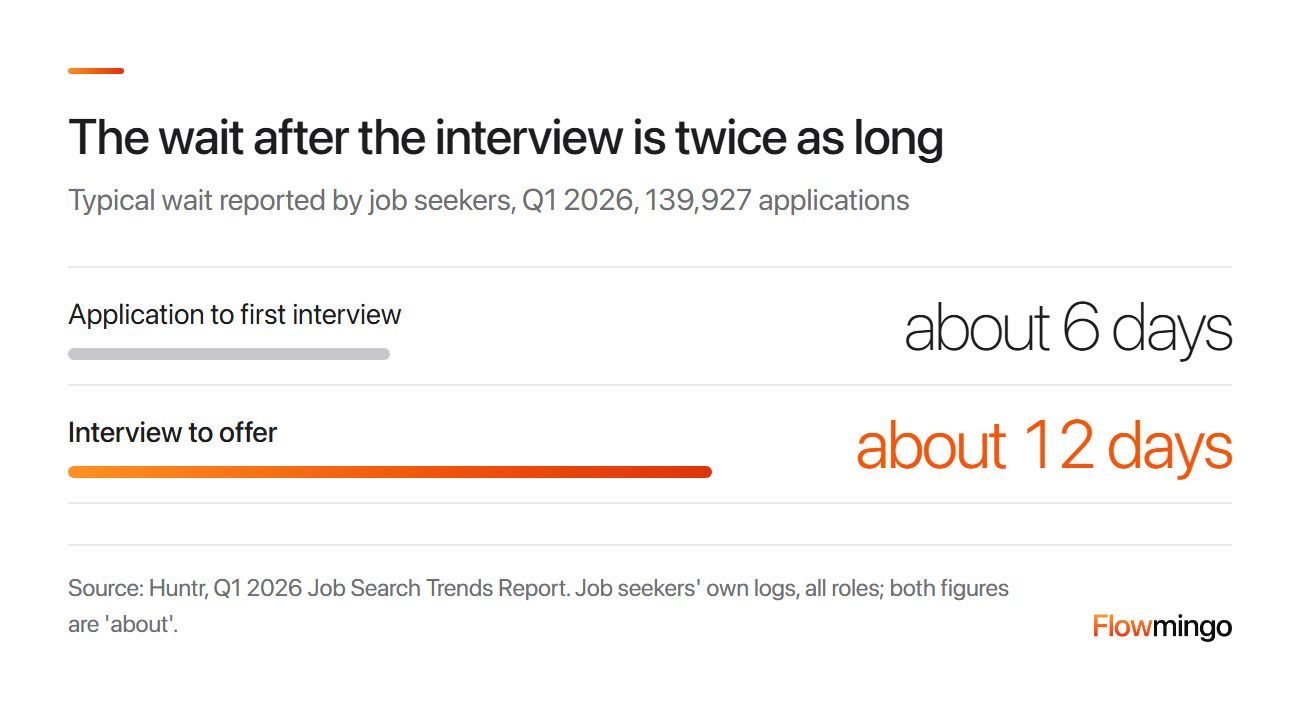
Where the weeks go: about 12 days from interview to offer, against about 6 days from application to a first interview (Huntr, Q1 2026).
Huntr does not say which interview it counts from. That means the 12 days can include later rounds.
A foundational 2019 Gartner study found a 33-day lag from interview to offer, up 84% from 2010 to 2018 (HR Dive). Gartner's 33 days and Huntr's 12 come from different data and years, but both put the slow step after the interview.
The table splits the 2 weeks into 4 waits (illustrative, not customer data).
| Wait | What software can do | Your team fixes | Deadline |
|---|---|---|---|
| Scores | Scores AI rounds itself, shows who has not scored | Scoring inside the interview slot | 24 hours |
| Debrief slot | Puts all evidence on 1 record | Debrief booked with the final interview | Decision 1 working day after the final |
| Arguing from memory | Hides scores until each is in | Discuss only criteria where scores split, such as a 2 against a 5 on a 1 to 5 scale | In the debrief |
| Approval | Gives the approver a ranked summary | Approver and salary band agreed early | Next step in 3 working days, offer in 1 week |
An in-house recruiter on r/recruiting saw offer approval alone take 5 business days. That is 1 team's number, not a study.
Software can shorten the scoring and the arguing. The debrief slot and the approval are calendar decisions only your team can make, so start with the waits, not the scoring.
2. How fast must we make an offer after the final interview before our top candidate walks?
Tell your finalist the next step within 3 working days, and send the offer within 1 week of the final interview. In a foundational survey, 23% said they would lose interest after 1 week without news, and another 46% within 2 weeks.
That matters because silence reads as indecision. In Robert Half's foundational 2016 survey of over 1,000 US office workers, 32% said a long process made them doubt the employer's other decisions.
The 2 groups do not overlap, so together that is 69% within 2 weeks, by our sum. The survey asked about the first interview, so treat it as a rule of thumb for every round.
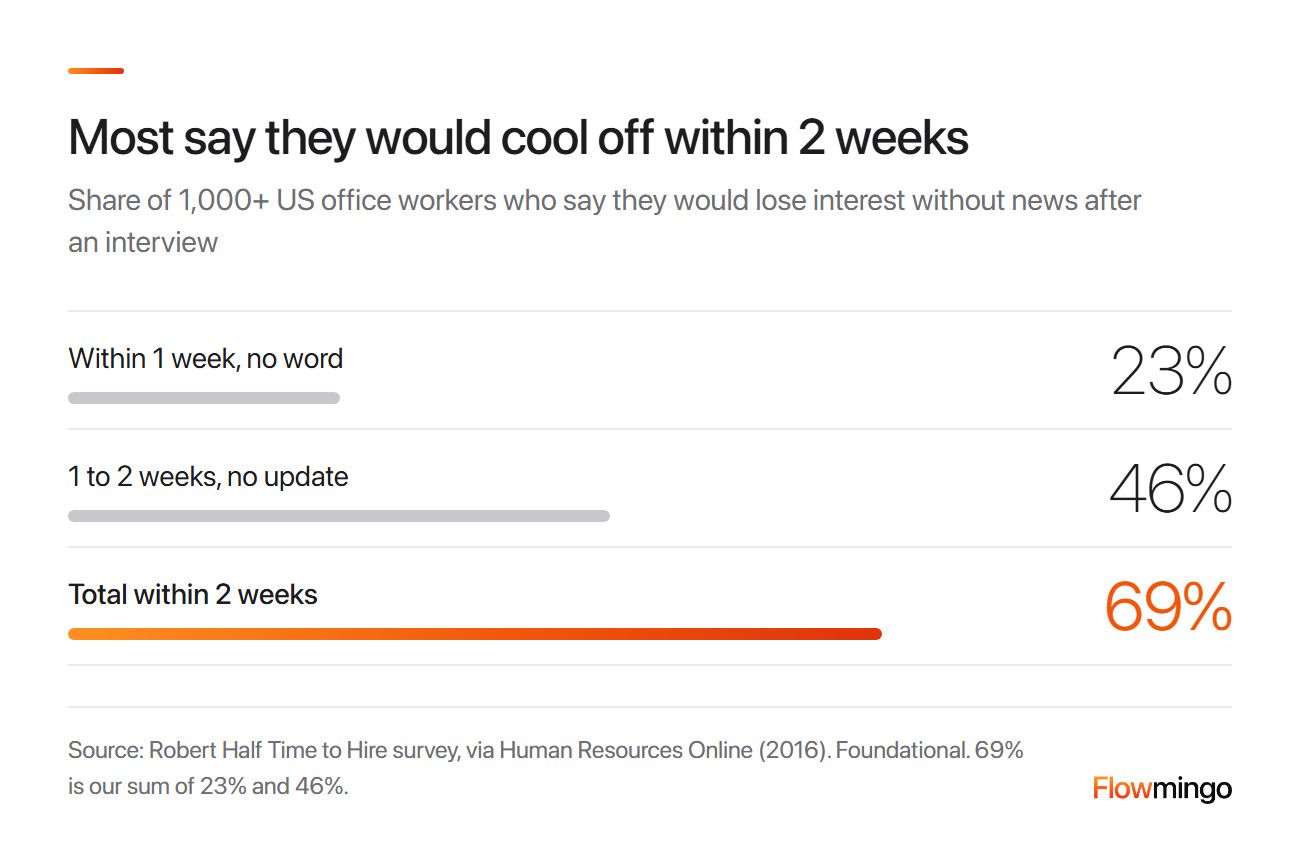
Office workers cooling off: 23% would lose interest with no word in 1 week, and another 46% after 1 to 2 weeks, 69% in total.
Speed need not mean worse hires. In a foundational 2010 study of 3,012 candidates, Becker and colleagues found faster offers won more acceptances. Later performance and retention did not drop.
So hold the panel to 2 deadlines: scores within 24 hours of each interview, and a decision within 1 working day of the final. The 1-day decision and both candidate deadlines follow our hiring process steps guide. All 4 are our recommendation, not 1 study's finding.
3. What should candidate evaluation software do that our ATS scorecards don't, when interviewers skip them?
An ATS scorecard stores opinions, while candidate evaluation software should produce evidence you can compare. That means fixed weighted criteria, described score levels, scores locked before the debrief and scores nobody chases.
A hiring-team lead on r/humanresources said interviewers write essays or "good vibes", and templates and calibration moved only about 20% of them.
Independent scores matter because 1 impression is weak evidence. If all you know is that 1 candidate interviewed better, the chance they really are better is about 56% to 61%.
That figure comes from the foundational 2021 book Noise (quoted by SBAM). So in a demo, check that the tool hides each interviewer's scores until everyone has submitted.
In a foundational 2013 meta-analysis, Kuncel and colleagues found a fixed formula predicted performance more than 50% better than experts' judgement.
Section 8 turns these needs into 12 checks for candidate evaluation tools. For the form and questions, see our interview scorecard template and structured interview guide.
In automated rounds, the scoring itself takes seconds, as the card below shows, while human rounds still need the 24-hour deadline.
Flowmingo data · 43,592 finished AI interviews · 851 companies · 14 Jul to 13 Oct 2026
- 16 seconds was the median time from a candidate's last answer to Flowmingo's scored AI evaluation, and 97.8% were ready within 1 minute.
This measures the AI's written, scored evaluation: criteria scores, overall score, strengths, gaps and recommendation. It does not measure when the video recording finishes processing, which has no timestamp. If an interview is re-evaluated later, only the latest scoring time is kept, which can only lengthen these times.
4. I was handed a 6.7 out of 10. How do I check the evidence behind it?
Click from the score to what the candidate said, answered or wrote: every criterion score should open its evidence. A score with no visible evidence is an opinion you cannot check.
In a 2025 experiment, 528 people screening for 16 jobs followed a simulated AI's racial preference in up to 90% of cases (Wilson and colleagues). The study tested no fix, so reading the evidence is our advice.
Here is the 6.7 behind the question, for a Customer Support Team Lead (illustrative, not customer data).
| Criterion (weight) | Score | Evidence | Probe |
|---|---|---|---|
| Coaching, Must Have (4) | 8 | "I sat in on 5 calls, then we role-played the 2 hardest" | An agent who stalls |
| Escalations, Very Important (3) | 6 | Steps, no outcome | 1 result |
| Support metrics, Important (2) | 7 | Named backlog targets | None |
| Help-desk tool, Good To Have (1) | 3, could not evaluate | Never mentioned | Final round |
| Weighted overall | 6.7 | (8x4 + 6x3 + 7x2 + 3x1) / 10 |
Run 3 checks:
- Each quote answers the criterion it sits under.
- Every score without evidence is marked: here the help-desk 3 is a default for never mentioned, not a judgement.
- A decent overall does not hide a weak Must Have.
A low, flagged default beats a 0, which punishes a question nobody asked, and beats skipping the row, which rewards a dodge.
Hoffman, Kahn and Li studied 15 firms hiring low-skilled service workers in foundational 2018 research. Managers who overrode a job test more often hired people who left sooner. That's why overrides are fine only with a written reason.
How Flowmingo helps
After each AI interview, you get the recording, the transcript and a report rating each criterion from 0 to 10 with written reasons. A requirement it could not evaluate counts as 3.0, and How we score explains why a 6.2 is not a 62% chance of success. Nobody is rejected automatically. Highlighted quotes must be exact transcript phrases, and your team can check any score against the recording and override it.
5. How do I compare finalists side by side when different people interviewed them?
Put every finalist on 1 screen with the same criteria as rows, each cell showing a score, its evidence and who gave it. Then compare criterion by criterion, using only criteria every panel scored.
In foundational 2016 experiments by Bohnet and colleagues, people picked candidates by past task scores. Judged 1 at a time, the stronger performer got picked 62% of the time and the weaker 52%, only 10 points apart.
Side by side, evaluators were 46 percentage points more likely to pick the stronger performer, and the gender gap disappeared. The study used task scores, not interviews, so applying it here is our inference.
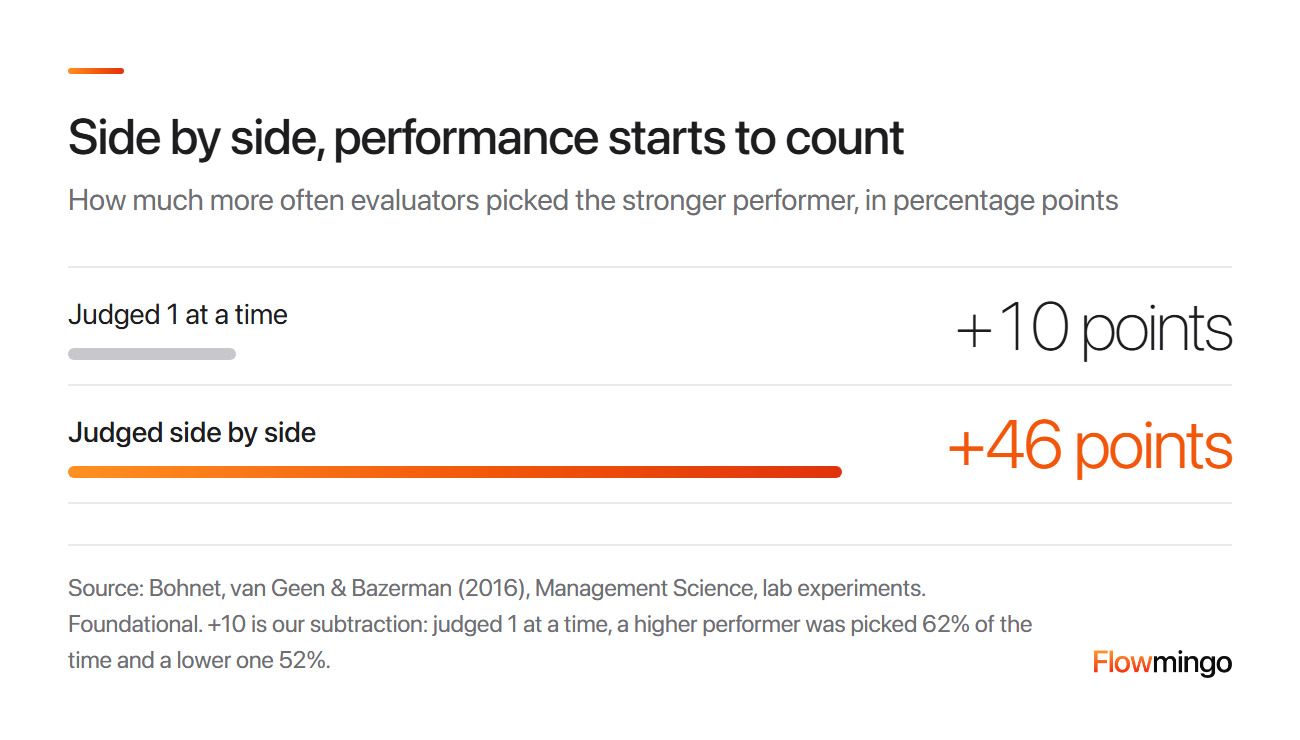
Side-by-side effect: evaluators picked the stronger performer 46 percentage points more often side by side, against 10 points when judged 1 at a time.
That's why the view must show 4 things:
- The same criteria and weights for every finalist.
- Each interviewer's score kept separate and named, behind the average.
- A missing score flagged, never counted as 0.
- The evidence 1 click away.
Here are 3 finalists for 1 role, each cell averaging the panel's scores (illustrative, not customer data).
| Criterion (weight) | A | B | C |
|---|---|---|---|
| Interviewers | Jo, Sam | Jo, Lee (Lee missing) | Sam, Lee |
| Coaching (4) | 8: role-plays | 6: a template | 7: call reviews |
| Escalations (3) | 6: no outcome | 8: kept the account | 5: passed it on |
| Metrics (2) | 7: knew targets | 9: built the dashboard | 6: no trends |
| Help-desk tool (1) | Not mentioned: 3 | 9: admin on it | 6: similar tool |
| Weighted /10 | 6.7 | 7.5 | 6.1 |
| Scores in before the debrief | 2 of 2 | 1 of 2 | 2 of 2 |
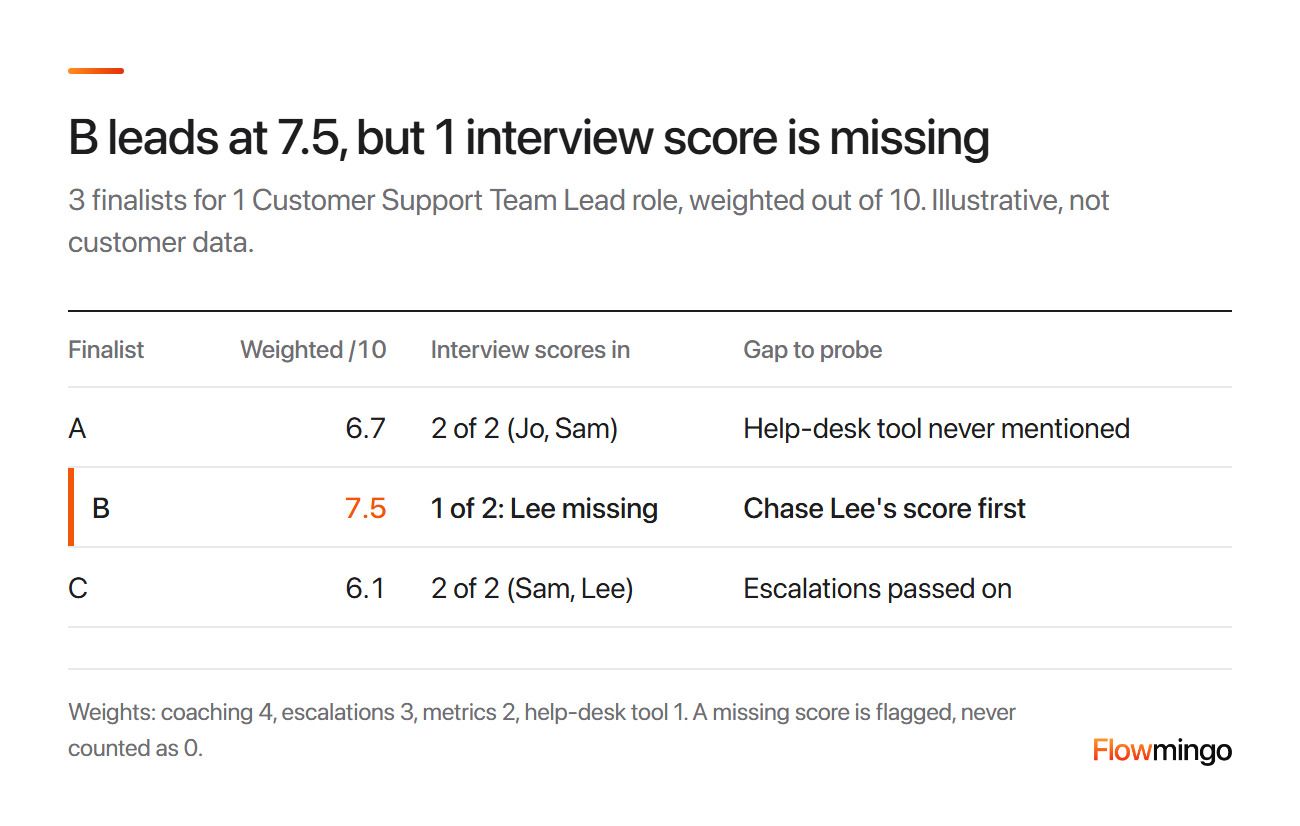
Finalists side by side: B leads at 7.5 out of 10 with Lee's score still missing. A has 6.7 with the help-desk tool never mentioned, and C has 6.1 after passing escalations on.
Jo saw A and B, and Sam saw A and C, so a shared interviewer anchors each comparison. B leads, but chase Lee's missing score before the debrief.
A shared interviewer also exposes a lenient panel, so calibrate your interviewers, as Google's re:Work guide advises alongside its scoring rubrics.
6. How do I combine CV, test and interview scores so no single score swamps the rest?
Rescale every score to 0 to 10, fix the weights before results arrive, and weight the evidence with the best track record most. Adding raw numbers lets a 0 to 100 test drown a 0 to 10 interview.
Weights: CV x1, test x2 and structured interview x3 (illustrative, not customer data).
| Candidate | CV /10 | Test % | Interview /10 | Raw sum (wrong) | Test /10 | Weighted /10 |
|---|---|---|---|---|---|---|
| A | 8.0 | 60% | 6.5 | 74.5 | 6.0 | 6.6 |
| B | 6.0 | 85% | 7.5 | 98.5 | 8.5 | 7.6 |
| C | 9.0 | 95% | 5.0 | 109.0 | 9.5 | 7.2 |
Added raw, C wins on the test alone despite the weakest interview: C, B, A. Weighted, it is B, C, A: for C, (9.0 + 2 x 9.5 + 3 x 5.0) / 6 = 7.2.
A foundational 2022 re-analysis by Sackett and colleagues scored structured interviews 0.42 and job knowledge tests 0.40, where 0 means no link. That's why the interview gets the top weight here, with the test close behind.
Across 3 tests in 1 data set, applicant scores barely moved after ChatGPT's release (Dabdoub and Pool, 2026). That does not rule out individual cheating, but test results still count as evidence.
Flowmingo data · 139,578 candidate-job pairs · applications 1 Jul to 29 Sep 2026 · active assessments only
- About 1 in 7 evaluated candidate-job pairs (14.6%) were judged with more than 1 method in that job.
Most of this is a funnel, not a choice of more methods. In jobs with a CV evaluation attached, every applicant's CV is scored, and recruiters then send a smaller group to the AI interview. A job can only show more than 1 method if the recruiter attached more than 1 assessment. The screening questions inside an AI interview are not counted as separate methods.
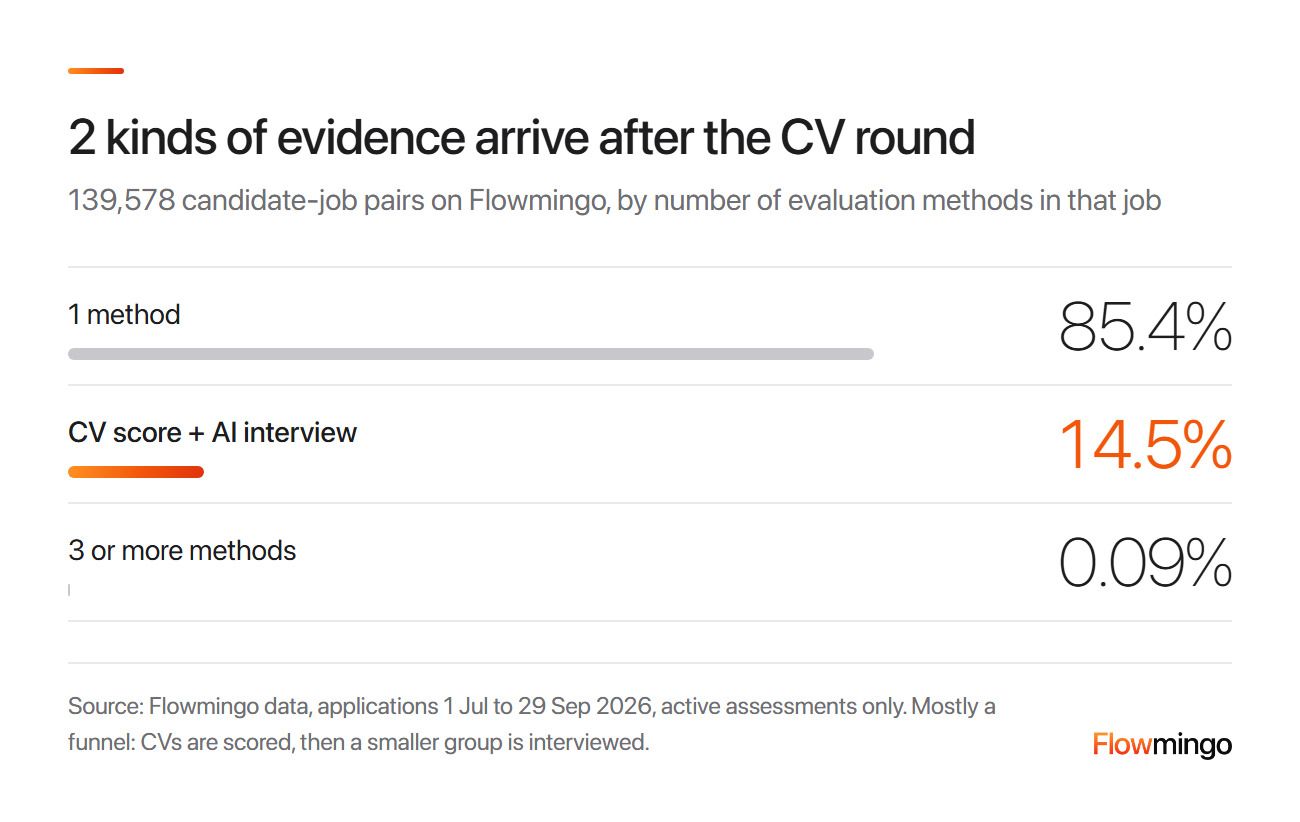
2 kinds of evidence after the CV round: of 139,578 candidate-job pairs, 14.5% had a CV score plus an AI interview. 85.4% had 1 method and 0.09% 3 or more (Flowmingo data).
85.4% of candidate-job pairs had 1 method, mostly applicants who got a CV score and went no further. The 14.5% with a CV score and an AI interview are the shortlisted group, the candidates whose scores you must combine. Fewer than 1 in 1,000 (0.09%) had 3 or more.
How Flowmingo helps
CV Evaluation scores every CV out of 10 on the same criteria as the AI interview, with the evidence behind each score. Each test gets an automatic score. The Full ATS puts every assessment a candidate completes on 1 profile, on a board you can sort by score. On Growth ($99 a month), its CSV export lets you apply the weights above in a sheet.
6.1 Do I need separate candidate assessment software, or can 1 tool score everything?
1 tool is enough if every result lands on the same candidate record. That record can be your ATS, if the tool writes results back. Buy separate candidate assessment software only for a test type it lacks.
An in-house recruiter on r/recruiting ran 2 platforms, and "candidates got confused and our team spent forever switching between dashboards."
7. What audit trail should candidate evaluation software keep in case a rejected candidate challenges us?
For every candidate, keep the criteria and weights, each score with its evidence and author, every override with its reason, and the dated decision. Keep it at least 1 year under US federal rules, and 4 years in California.
For section 4's team lead, that means its table plus each author, override reason and decision date.
This is general information, not legal advice. Under 29 CFR 1602.14, covered US employers keep hiring records for 1 year from the record or the decision, whichever is later. After a discrimination charge, keep the relevant records until it ends.
California's Civil Rights Council rules have required 4 years since 1 October 2025, automated-decision data included. From 1 January 2027, Colorado's SB 26-189 adds an account of the tool's role within 30 days of rejecting a Colorado resident (SHRM). That means you need a per-candidate explanation you can produce well within 30 days.
In May 2025, a US court conditionally certified an age claim over Workday's AI system "to score, sort, rank, or screen applicants" (Proskauer). That is an allegation at an early stage, not a finding of discrimination.
Other places add their own duties.
| Where | Rule, start | Record must show |
|---|---|---|
| New York City | Local Law 144, 5 July 2023 | A yearly independent audit for bias, notice 10 business days ahead |
| Colorado | SB 26-189, 1 January 2027 | Records for 3 years |
| EU | AI Act, 2 December 2027 | Logs kept 6+ months, human oversight |
| Singapore | Workplace Fairness Act, end-2027 | No discrimination on 11 characteristics |
| UK | ICO audit findings (foundational guidance, not a law), November 2024 | No protected-trait filters |
Ask every vendor how long it keeps scores, transcripts and recordings, and whether you can delete them on your own schedule.
8. I have 3 vendor demos booked. What should I check before I buy candidate evaluation software?
Bring 1 real job and 3 anonymised CVs from a past round to every demo, and make each vendor score them while you watch. Then rate each tool on the 12 checks below.
For example, include 1 CV you rejected for a missing must-have, then open its score: check 2 passes only if the tool shows the gap.
SelectSoftwareReviews names accuracy, customisation, ease of use and integration, but not speed to a score, evidence per score or the audit trail.
Score each check from 0 to 5, for a total out of 60. A tool that fails check 2 should not reach your shortlist, whatever its total. If it fails check 8, decide where your team keeps the section 7 record instead.
| # | Check | Pass |
|---|---|---|
| 1 | Same weighted criteria | Weights fixed first |
| 2 | Evidence per score | The answer or CV line behind it |
| 3 | Independent scores | Hidden, then locked |
| 4 | Side-by-side finalists | Missing scores flagged |
| 5 | Combined results | 1 scale for all results |
| 6 | Speed to a score | A measured median |
| 7 | Overrides | A written reason, kept |
| 8 | Audit export | Every section 7 item, dated |
| 9 | Fairness evidence | Latest audit for bias, or pass rates by group |
| 10 | No protected-trait filters | Age or gender filters refused |
| 11 | Candidate side | AI use disclosed |
| 12 | Integration and price | A native ATS connection or an API, and 1 year's total cost ÷ candidates you expect to evaluate |
Ask how the tool records gender, since the UK ICO's foundational November 2024 audit found some tools inferring gender from names.
In a May 2026 Greenhouse survey, 38% of US job seekers had left a process because it included an AI interview. That is why check 11 matters: 70% were never clearly told upfront that AI would evaluate them.
9. Is free candidate evaluation software good enough for a team hiring a few roles a year?
Often, yes, if the free plan scores every candidate with evidence and does not cap how many you evaluate. Check the free tier's limits on candidates, assessment length, recording storage and downloads.
A small company on r/humanresources balked at ATS prices of around $300 a month, even in months with no hires.
A restaurant owner on r/smallbusiness weighed about $400 a month against about $100, and another built an Excel dashboard for interview scores instead (r/smallbusiness).
Google suggests "candidate evaluation software free", yet none of the top 10 results for candidate evaluation software explains what free tiers cap. For example, a cap on candidates can bite in your busiest week.
So ask whether evaluations are capped, how long a free interview runs, how long recordings stay viewable, and whether reports and the API are free.
Storage matters because debriefs slip. If yours slips by 2 weeks, a short limit on how long recordings are kept can remove the evidence before you decide.
Be fair to the spreadsheet. A sheet with a fixed weighted formula already beats a gut debrief (section 3), but it cannot link each score to its evidence.
How Flowmingo helps
AI interviews, CV evaluation and tests are unlimited on every plan, including Free at $0 (pricing). On Free, an AI interview runs up to 20 minutes, and the latest 300 videos stay viewable for 30 days. Free includes 3 PDF or DOCX reports in total. Unlimited report and video downloads start on Starter at $49 a month, so upgrade before day 30 if your record needs a recording. Results, scores and transcripts stay on every plan, and the API is free. Our comparison pages set its plans beside other AI interview tools.
10. After rollout, which numbers prove we decide faster without making worse hires?
Measure the same roles before and after with the 6 numbers below. Check quality at 90 days too, because speed alone can hide worse hires.
Only 20% of organisations used quality-of-hire measures in SHRM's 2025 benchmarking, down from 27% in its previous benchmark.
Our recruiting metrics guide gives the formulas for these 6 numbers.
| Metric | Measure | Worked if |
|---|---|---|
| Days from final interview to decision | Median per role | It falls |
| Scores in before the debrief | Submitted ÷ due | Close to all |
| Offer acceptance | Accepted ÷ offered | Holds or rises |
| 90-day retention | Still employed ÷ hires | Holds or rises |
| Hiring manager satisfaction | 1 to 5 at 90 days | Holds or rises |
| Override outcomes | Overridden hires against the rest, after 20+ hires | Hires that followed the scores do at least as well |
In LinkedIn's Future of Recruiting 2025, 89% of TA pros said measuring quality of hire will matter more, yet 25% felt highly confident doing it. Their usual inputs are performance ratings (66%), retention (60%) and hiring manager satisfaction (44%), the quality rows above.
Say your last 3 team-lead hires took 11, 14 and 9 days from final interview to decision, a median of 11. If the next 3 take 5, 6 and 4 days (median 5) and all 3 stay past day 90, report 3 of 3, not 100%.
10.1 How do I trial it on 1 role before every hiring manager has to use it?
Run 1 live role end to end, and expand only if decision time falls while quality holds.
- Pick 1 role you hire for often, and record its 6 numbers for the last 3 similar hires.
- Agree weighted criteria first, and have interviewers score alone within 24 hours.
- Decide within 1 working day of the final interview, and discuss only criteria where scores split.
- Compare at close and at 90 days before adding a second team.
How Flowmingo helps
Flowmingo is a free AI hiring platform built around the AI Interviewer. You invite the candidates you choose to a structured AI interview in their own time, and get the recording, transcript and scored report. Flowmingo connects to 20+ ATSs on every plan, Greenhouse, Lever and Workday included, and writes AI interview scores and report links back to most. That covers checks 2, 6 and 12 for your first rounds. Keep your final-round scorecards and decision record in your ATS. It suits high-volume, entry to mid-level roles, not the final round of a senior hire. Try Flowmingo as free candidate evaluation software for your first rounds.
11. Sources
Every study, law and survey in this guide links to a source below; Flowmingo figures come from Flowmingo's own platform data.
- Argento, Z., Gordon, P., & Wang, A. (2026, June 12). Colorado amends its AI law, reducing employer obligations. SHRM.
- Becker, W. J., Connolly, T., & Slaughter, J. E. (2010). The effect of job offer timing on offer acceptance, performance, and turnover. Personnel Psychology, 63(1), 223-241.
- Bohnet, I., van Geen, A., & Bazerman, M. (2016). When performance trumps gender bias: Joint vs. separate evaluation. Management Science, 62(5), 1225-1234.
- Bolden-Barrett, V. (2019, July 12). Gartner: Three-quarters of hiring managers are too indecisive. HR Dive.
- California Civil Rights Department (2025, June 30). Civil Rights Council secures approval for regulations to protect against employment discrimination related to artificial intelligence. State of California.
- Dabdoub, A., & Pool, R. (2026). Testing after ChatGPT: Aggregate change in applicant assessment scores. International Journal of Selection and Assessment, 34(3), Article e70077.
- European Union (2024). Artificial Intelligence Act, Article 26: Obligations of deployers of high-risk AI systems. artificialintelligenceact.eu.
- Fisher Phillips (2026, January 7). Get ready for Singapore's new antidiscrimination law. Fisher Phillips.
- Google re:Work Editorial Team (2026). A guide to structured interviewing for better hiring practices. Google re:Work.
- Greenhouse (2026, May 1). 63% of job seekers have faced an AI interview. Most haven't had a good one yet. Greenhouse newsroom.
- Hoffman, M., Kahn, L. B., & Li, D. (2018). Discretion in hiring. The Quarterly Journal of Economics, 133(2), 765-800.
- Human Resources Online (2016, August 12). Does your hiring process take more than a month. Human Resources Online.
- Huntr (2026). The Q1 2026 job search trends report. Huntr.
- Information Commissioner's Office (2024, November 6). ICO intervention into AI recruitment tools leads to better data protection for job seekers. ICO.
- Kahneman, D., Sibony, O., & Sunstein, C. R. (2021). Noise: A flaw in human judgment. Little, Brown Spark. Quoted in Hoover, S. (2021, April 16). Noisy job interviews. SBAM.
- Kuncel, N. R., Klieger, D. M., Connelly, B. S., & Ones, D. S. (2013). Mechanical versus clinical data combination in selection and admissions decisions: A meta-analysis. Journal of Applied Psychology, 98(6), 1060-1072.
- Legal Information Institute (n.d., read 2026). 29 CFR 1602.14: Preservation of records made or kept. Cornell Law School.
- LinkedIn Talent Solutions (2025). Future of recruiting 2025. LinkedIn.
- Metaview (2026, June 26). Inside the 2026 AI & hiring alignment report. Metaview.
- NYC Department of Consumer and Worker Protection (n.d., read 2026). Automated employment decision tools (AEDT). City of New York.
- Proskauer Rose LLP (2025, June 11). AI bias lawsuit against Workday reaches next stage as court grants conditional certification of ADEA claim. Law and the Workplace.
- Sackett, P. R., Zhang, C., Berry, C. M., & Lievens, F. (2022). Revisiting meta-analytic estimates of validity in personnel selection: Addressing systematic overcorrection for restriction of range. Journal of Applied Psychology, 107(11), 2040-2068.
- SelectSoftwareReviews (2026). 11 best talent assessment tools we've tested in 2026. SelectSoftwareReviews.
- SHRM (2025). 2025 recruiting executives benchmarking: Insights to maximize recruitment. SHRM data brief.
- Wilson, K., Sim, M., Gueorguieva, A.-M., & Caliskan, A. (2025). No thoughts just AI: Biased LLM hiring recommendations alter human decision making and limit human autonomy. Proceedings of the AAAI/ACM Conference on AI, Ethics, and Society, 8(3), 2692-2704.