
A talent pool is a group of candidates an employer has already found or assessed and keeps on file for future roles. Unlike the applicants for 1 open job, its members wait for a role that may not exist yet.
Each role you close leaves people you would gladly hire next time. The runner-up who nearly got the offer, a strong CV for a different job and a client's second choice all need a place. Talent pool management is deciding who you keep, what you tell them and when you call them back.
Key takeaways
- What goes into a talent pool? People you have already met or assessed: runners-up, strong applicants for other roles and sourced contacts who replied.
- How is it different from a pipeline? A pipeline holds candidates for roles open now. A talent pool waits for the next opening, which may be months away.
- How long can you keep people in it? Only as long as you need them and told them. In the UK ICO's draft guidance, a firm keeps its top 10 scorers for 6 months, stated on the application form.
- Should you sort it by job title? Sort by skills instead. LinkedIn estimates potential skills-based talent pools at a median 6.1 times the size of title-based ones.
1. What is a talent pool in recruitment?
A talent pool in recruitment is a short list of known people for roles you have not opened yet. It turns the work of past hiring rounds into a head start on the next one.
It usually holds 3 groups: runners-up from past roles, strong applicants who fit a different job, and sourced contacts who said "not now". Recruiters call the first group silver medalist candidates, because they finished second.
It is not a talent pipeline. Greenhouse's glossary separates the 2: the pipeline holds candidates for open roles, while people in a pool may not be tied to any role. It is not your whole ATS database either, because a pool is chosen and an inbox of past applicants is not.
The term also has a formal meaning in US federal hiring. OPM's Agency Talent Portal uses it for qualified candidates on an approved shared hiring certificate who opted in to share their application with other agencies. That opt-in is the useful idea for any employer: people know they are in the pool.
2. What does a talent pool look like on a real role?
On a real role, a talent pool starts the day you choose 1 finalist and keep the others. The payoff comes months later, when a similar role opens and you write to people before you write a job ad.
Here is 1 role worked through, from the close to the next hire.
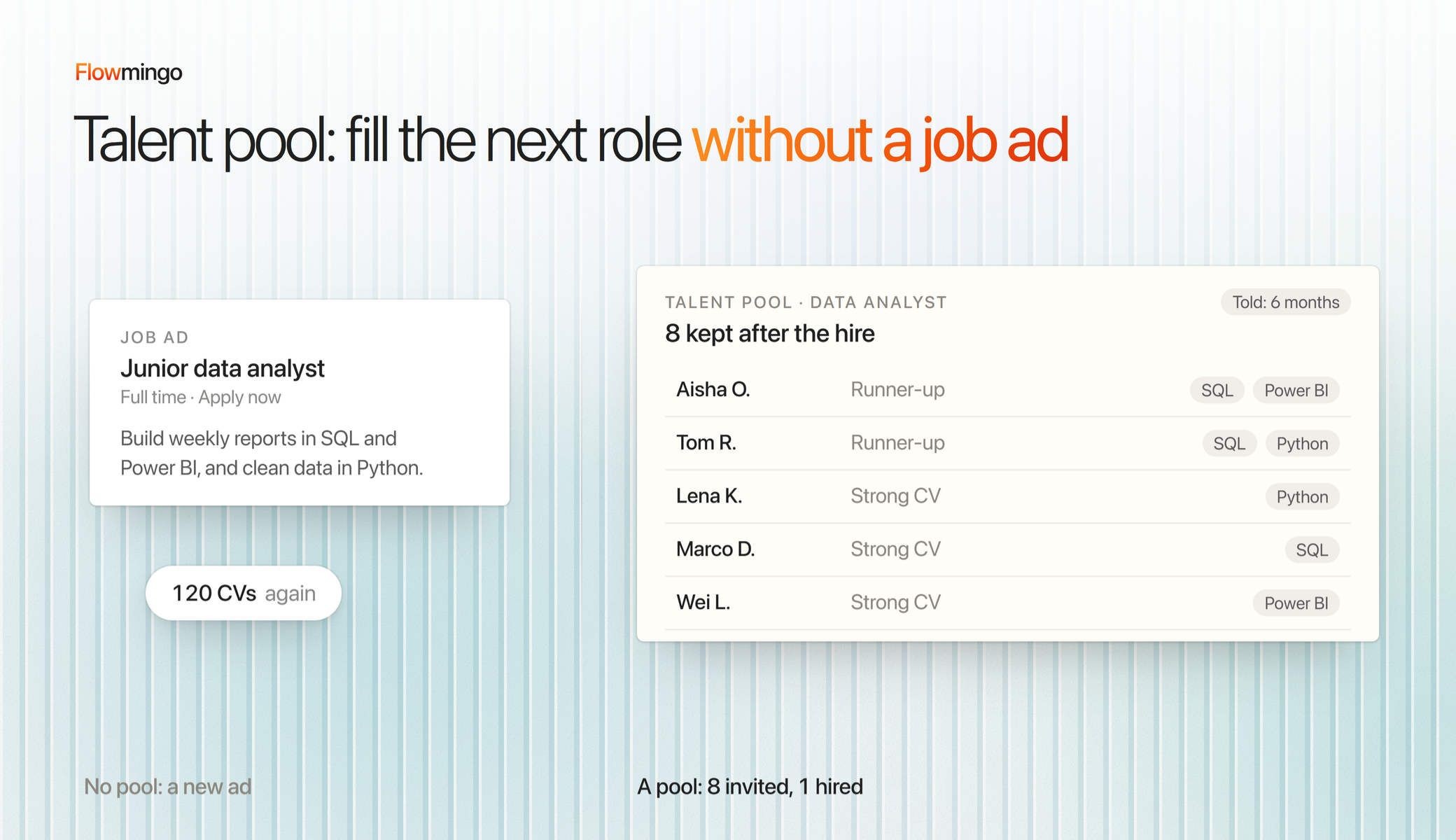
Say you hire a junior data analyst. For example, 120 people apply, 3 finalists reach the last round and 1 is hired.
You keep 8 people in the pool: the 2 runners-up and 6 strong applicants. Each was told on the form that you may contact them for 6 months.
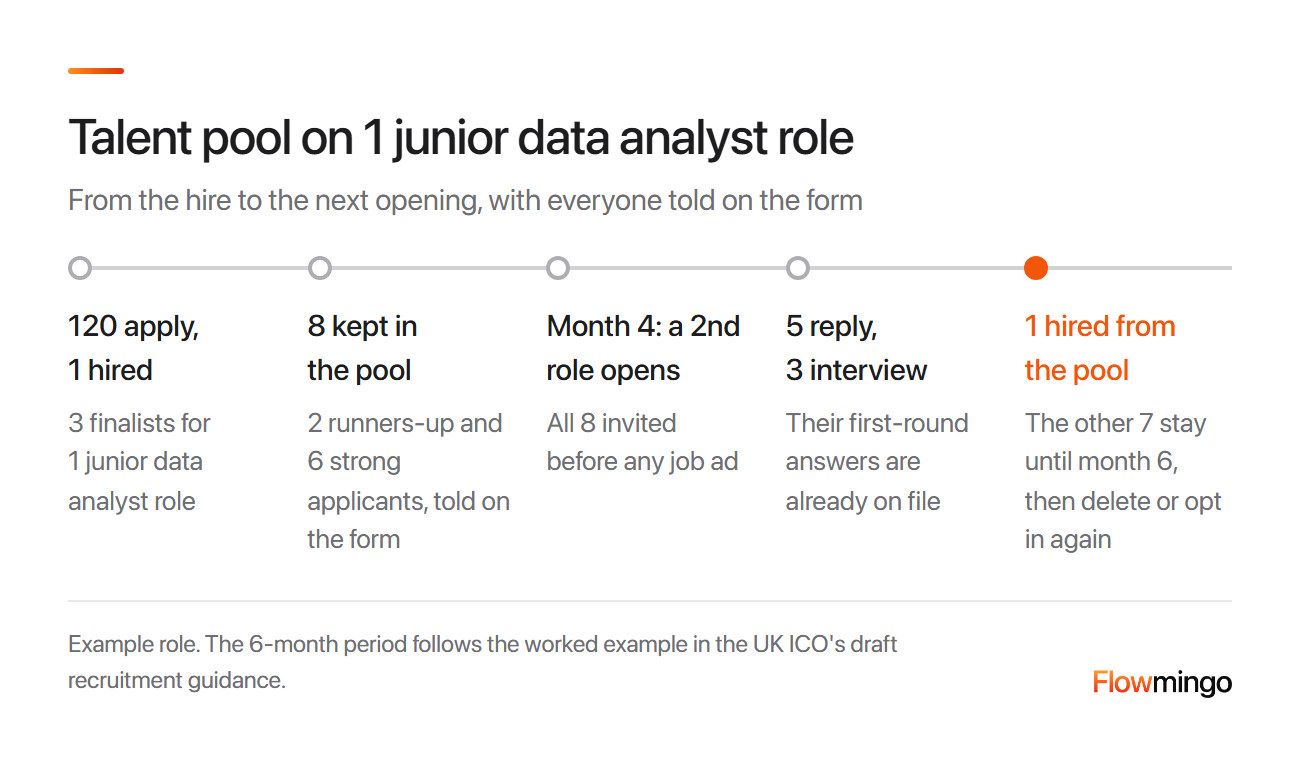
Talent pool on 1 junior data analyst role: 8 people kept after the hire. When a 2nd role opens in month 4, 5 reply, 3 interview and 1 gets the offer.
You tag the 8 by skill, not title: SQL, Python and Power BI. In month 4, a 2nd analyst role opens, and you invite all 8 before any job ad goes live. 5 reply and 3 interview, and their first-round answers are already on file.
1 of them is hired from the pool, so the role closes without an ad. The other 7 stay until month 6. Then you delete their details or ask them to opt in again.
3. How do you build a talent pool you will actually use?
Decide who goes in and what you tell them before you close the role, then tag people by skill and set an end date. A pool you never search is only a list you have to keep safe.
- Pick who goes in at the close, not later. The finalists' evidence is fresh, so you can write why each person earned a place.
- Tell people on the form and again in the rejection email. They can only expect your call if they know they are in the pool. Our candidate rejection email templates show how to say no warmly before you ask.
- Tag each person by skills, not job title. LinkedIn estimates potential skills-based talent pools at a median 6.1 times the size of title-based ones.
- Keep the evidence next to the name. A note on why someone nearly got the job tells the next hiring manager where to start.
- Set an end date and keep it. When it passes, delete the details or ask the person to opt in again.
3.1 How long can you keep candidates in a talent pool?
Only as long as you need them and told them. The UK ICO's recruitment guidance, still a draft under review, says you must not keep information longer than you need it. In general, that means not beyond the period in which a legal claim can be brought.
To keep people for future roles, the ICO says you must have told them first. Its worked example is a law firm that ranks candidates on their scores. The firm tells applicants on the form that it will keep the top 10 scorers' details for 6 months, in case more vacancies open.
So write the period into the form and the rejection email, and put the end date in your calendar. Rules differ by country, so check yours before you set the period. Our guide to the recruitment funnel shows where a pool feeds back into the first stage.
4. How do you keep the evidence for a talent pool with Flowmingo?
Keep the pool as a short list you own, and keep each person's interview evidence where you can read it again. When the next role opens, that evidence tells you who to call first.
Before you start, decide where the list lives and who updates it. For example, a sheet with the name, the skills, the date each person joined and the date they leave covers the 8 people above.
What a sheet cannot hold is the interview itself: the answers, the scores and your team's notes. Keep those together, because they turn a name in the pool into a confident first call.
How Flowmingo helps
In Flowmingo's ATS, every assessment a candidate completes lands on 1 profile, with stages you define and notes and ratings from your team. Each interview comes with the recording, the transcript and a scored report you can read again before a call. Sign up free and keep the proof behind your talent pool on Flowmingo.
5. Sources
Every guideline, research note and glossary page cited in this entry links to its source below.
- Greenhouse. (n.d.). What are talent pools? Retrieved 26 October 2026. Greenhouse
- Information Commissioner's Office. (n.d.). Keeping recruitment records (draft guidance, under review). Retrieved 26 October 2026. ICO
- LinkedIn Economic Graph. (2025, March 3). Skills-based hiring: Increasing access to opportunity [Research note]. LinkedIn. LinkedIn Economic Graph
- U.S. Office of Personnel Management. (n.d.). What is a talent pool? Agency Talent Portal Help Center. Retrieved 26 October 2026. OPM