
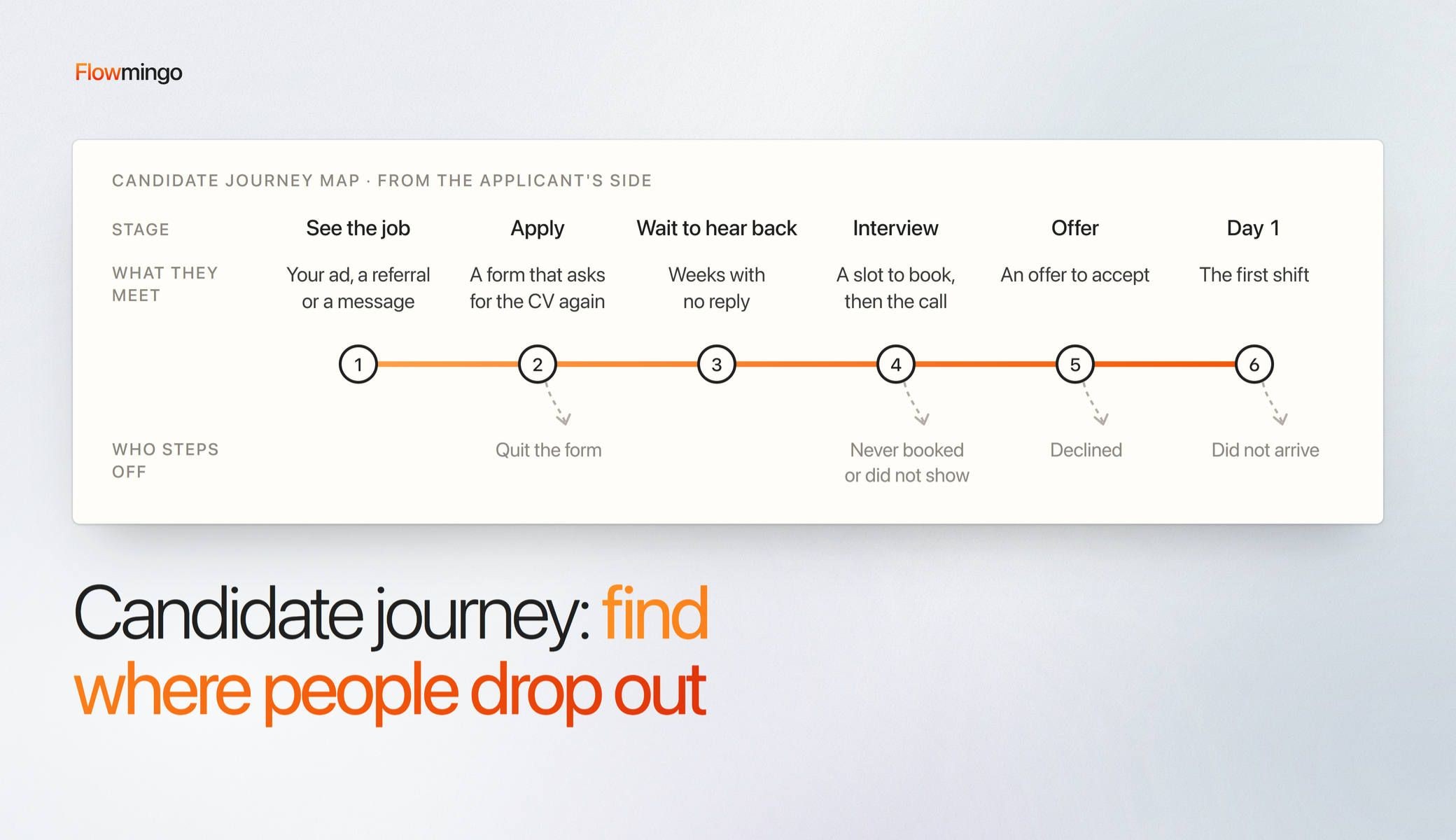
A candidate journey is every stage a person goes through with an employer, from first seeing the job to their first day at work. Recruiters map it to find where good applicants drop out.
You notice it when the numbers stop adding up: 40 people get an interview invite and only 20 attend. A candidate journey map shows you which step lost them and what each person met there.
Key takeaways
- Where does the candidate journey start and end? At the first sight of the job and at day 1 in the job, across 6 stages.
- How is a journey map different from a recruitment funnel? The funnel counts people at each stage. The map adds what each person sees, does and waits for there.
- Where does the journey go quiet? After applying. In the 2025 CandE benchmark, 31% of North American candidates had not heard back 1 to 2+ months later.
- Does the journey end at the offer? No. In CIPD's foundational 2024 UK survey, 27% of employers that recruited had offered candidates fail to arrive on day 1.
1. What is a candidate journey in recruitment?
A candidate journey is the full path from a person's first look at your job to their first day, seen from their side. It covers what they see, do and wait for at each stage, not only whether they pass.
It is not the recruitment funnel, which counts how many people reach each stage. It is not candidate experience either, because that phrase names how the journey feels. A candidate journey map puts the stages, the counts and the moments people leave on 1 page.
The idea comes from customer journey mapping in product design. The Nielsen Norman Group, in foundational 2018 guidance, calls a journey map a visualization of the process a person goes through to reach a goal. In hiring, the goal is the job.
2. What are the stages of the candidate journey?
This guide uses 6 stages: see the job, apply, wait to hear back, interview, offer and day 1. Stages 2 to 6 each carry 1 measured leak, so you know where to look first.
- See the job. The person meets your ad, a referral or a message and decides whether to click.
- Apply. Form length matters here. In Greenhouse's 2025 report, 46% of US candidates abandoned applications that made them re-type CV details.
- Wait to hear back. In the 2025 CandE benchmark, 31% of North American candidates had not heard back 1 to 2+ months after applying. Survale, which sells candidate-survey software, now runs it.
- Interview. In CIPD's foundational 2024 survey, 17% of UK employers that recruited said candidates always or mostly cancelled interviews at little or no notice.
- Offer. In the same survey, 14% said candidates always or mostly accepted an offer and then declined it.
- Day 1. The start date is a stage of its own, because people can still walk away after a yes, as section 4.1 shows.
The CandE data also shows why people pull out midway. Of candidates who withdrew, 32% said their time was disrespected during interviews and appointments, the top reason in the 2025 benchmark.
3. What does a candidate journey map look like for a real role?
A working candidate journey map is a table with 1 row per stage, the people left at each and where the rest went. Here is 1 example for a volume role, with illustrative counts and the decision they led to.
Say you hire 4 care assistants for a home-care provider. For example, 100 people see the job and start applying in 2 weeks, and you count each stage until the first shift.
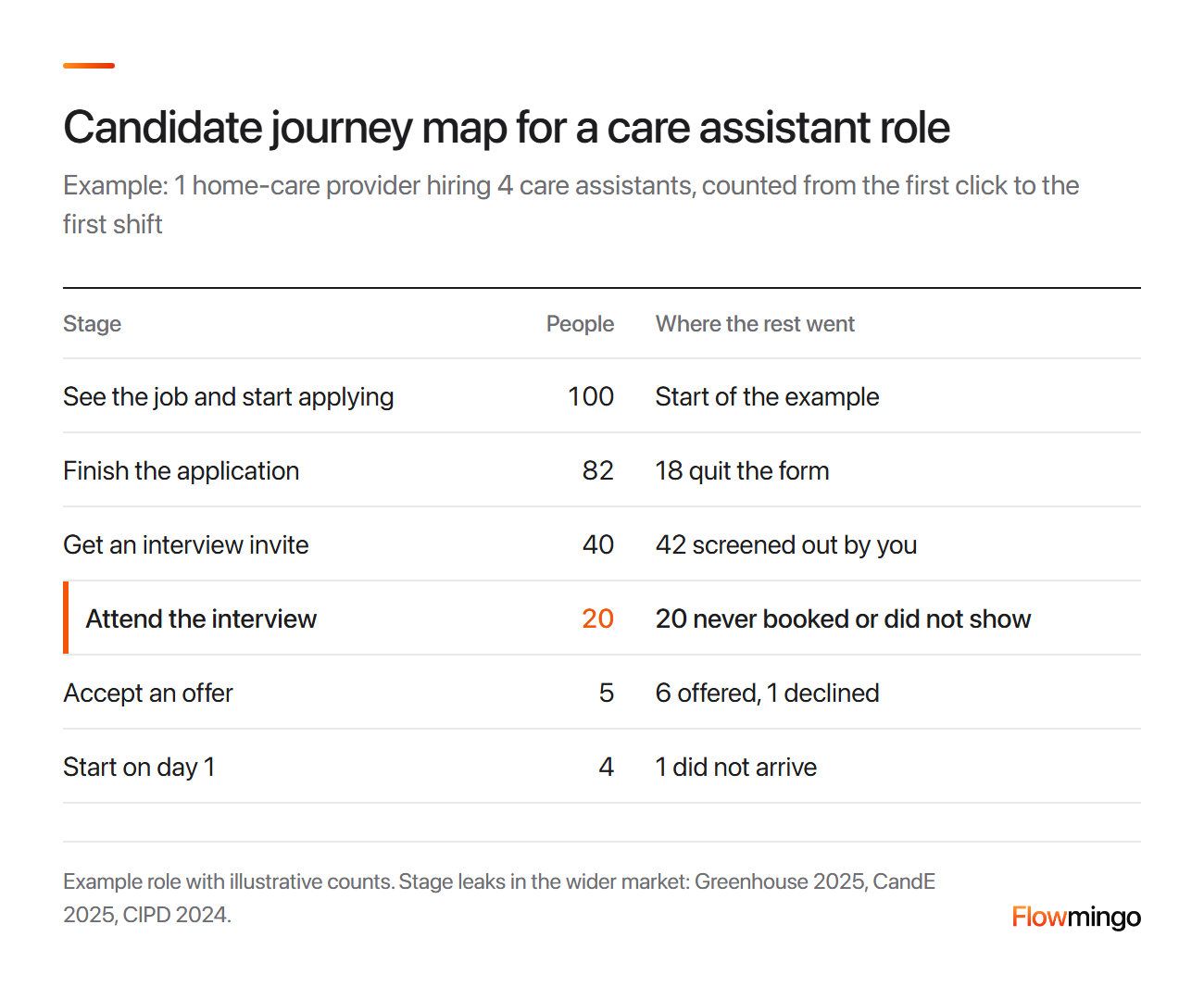
Candidate journey map for a care assistant role: 100 start applying, 20 attend the interview and 4 start on day 1.
82 finish the application and 18 quit the form. You screen out 42, which is a choice rather than a leak, so 40 get an interview invite. Only 20 attend the interview, because the other 20 never booked a slot or did not show.
You make 6 offers, 1 person declines and 5 accept an offer. 1 did not arrive for the first shift, so 4 start on day 1.
The decision: fix the interview stage before you spend more on ads. The form lost 18% of starters, but the interview stage lost 50% of the people you chose to invite. Our interview invitation email templates are a first fix for that stage.
4. How do you map the candidate journey, step by step?
Map the journey from records, not memory, then walk it yourself as an applicant would. These 5 steps take 1 recent role from the ad to day 1.
- Pick 1 recent role with at least 50 applicants. A single role keeps the numbers real, and 50 people give each stage enough to compare.
- Count the people at each of the 6 stages. Your applicant tracking system or your inbox gives the counts, and the gaps between them are your leaks.
- Apply to your own job as a stranger would. Time the form and note every login, upload and retyped field, because those are the steps people quit.
- Write down what the person waits for at each stage. Note the days between steps and every message they get, because silence was the top complaint theme in the 2025 CandE benchmark.
- Fix the biggest leak first, then count again on the next role. 1 change at a time shows you what worked.
4.1 Which stage do most candidate journey maps skip?
Most maps stop at the offer, yet the stretch from a yes to day 1 can still lose people. In CIPD's foundational 2024 survey, 27% of UK employers that recruited had seen offered candidates not arrive on day 1.
That figure splits into 3% who said always, 8% mostly and 16% sometimes. So give this gap its own row on the map, count starts per accepted offer, and keep in touch until the start date.
For the stages before the offer, our look at AI interview platforms shows what applicants see when the first interview is recorded.
5. How do you run the interview stage of your candidate journey with Flowmingo?
Send 1 interview link with the invite, so applicants can do the first round the same day, in their own time. That takes out the booking step, part of the stage that lost 20 of the 40 invited in the example.
Before you start, have your journey map and the job description ready. Write the invite so it names the deadline, the number of questions and the time it takes, so nobody starts blind. Then count stage 4 again on the next role, because only a second count tells you whether the change worked.
How Flowmingo helps
Paste your job description, and the Flowmingo AI interviewer drafts between 1 and 30 questions that you review, then you share a single link. Applicants answer in their own time, in 60+ languages, and you get the recording, the transcript and a scored report. The Free plan is permanent, so sign up free and test it on the interview stage of your candidate journey with Flowmingo.
6. Sources
Each report, survey and guide cited in this glossary entry links to its source below.
- CIPD. (2024). Resourcing and talent planning report 2024. Chartered Institute of Personnel and Development. CIPD
- Gibbons, S. (2018, December 9). Journey mapping 101. Nielsen Norman Group. NN/g
- Greenhouse. (2025). 2025 workforce and hiring report. Greenhouse
- Survale. (2025). 2025 Candidate Experience (CandE) benchmark research: Key statistics. Survale