
A job specification is the list of skills, experience and qualifications a person needs for a job, split into essential and desirable criteria. It describes the person, while a job description describes the work.
You meet the term when a client sends over "the spec" for a role, or a hiring manager asks who should make the shortlist. In the UK it is often called a person specification. Every essential line on it decides who reaches your shortlist.
Key takeaways
- What goes in a job specification? Skills, experience, qualifications and behaviours, each marked essential or desirable, with a note on how you will check it.
- How is it different from a job description? The description covers the duties. The specification covers the person who can do them.
- Why keep the essentials short? Each one is a filter: 88% of employers said exact-match filters screen out qualified high-skill candidates.
- How do you shortlist with it? Turn each point into a checklist and score every application against it, for example 17 of 20, as Acas suggests.
1. What is a job specification?
A job specification sets out who can do the job: the skills, knowledge, experience and qualifications the role needs. Each criterion is either essential, which every shortlisted person must meet, or desirable, which ranks people above that line.
The criteria come in 4 kinds: skills, experience, qualifications and behaviours. For example, a sales role might need negotiation skill, a record of hitting targets, a driving licence and calm under pressure. Oxford Brookes University's HR team describes its version as "a profile of the personal skills and abilities needed for the role".
The name changes with the setting. In the UK, "person specification" is the usual term, and in agencies "the spec" often means the client's whole brief. In US public-sector HR, CalHR's class specifications double as job descriptions: the definition, the minimum qualifications and the typical tasks of a job class.
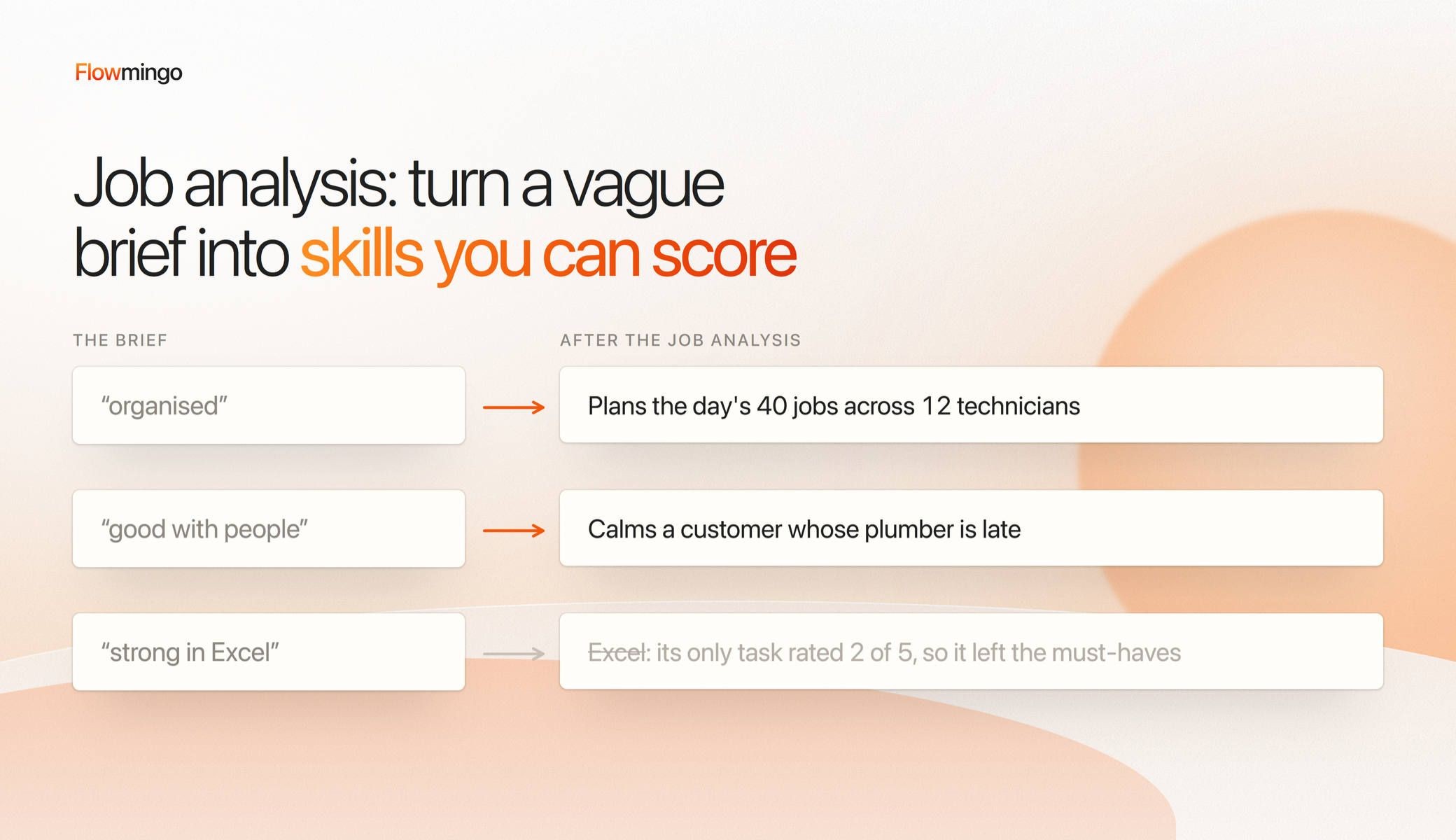
The term comes from job analysis, the study of a job that sits behind both documents. OPM describes it as examining the tasks in a job and the competencies needed to perform them.
2. What does a job specification look like for a real role?
For a real role, a good job specification fits on half a page. Here is 1 example with illustrative numbers: 6 criteria, each marked essential or desirable, with how you check it.
Say a client asks your agency for a payroll specialist, and its draft spec says "5 years of payroll experience". You rewrite it around the work, because a year count says little about the payroll a person actually ran.
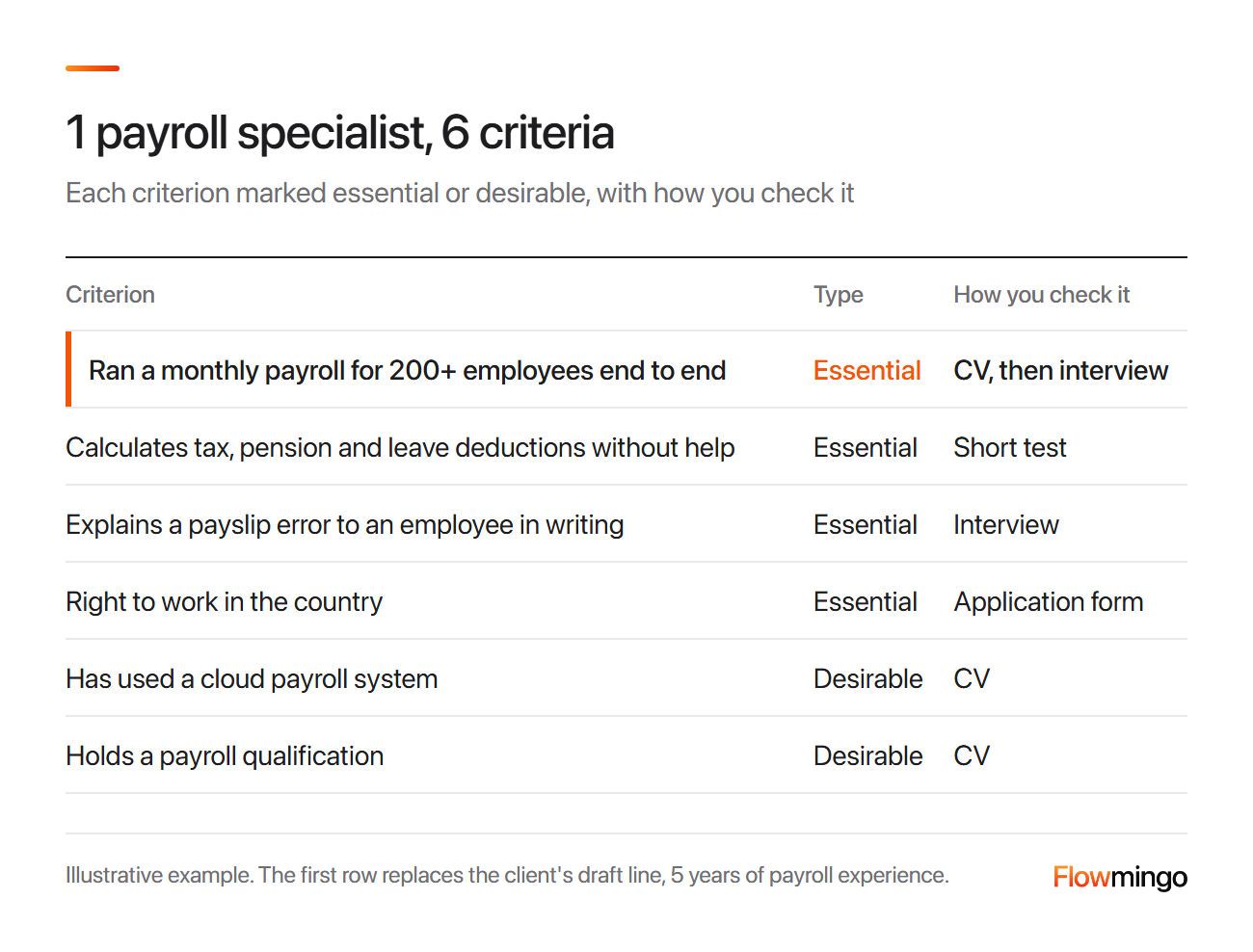
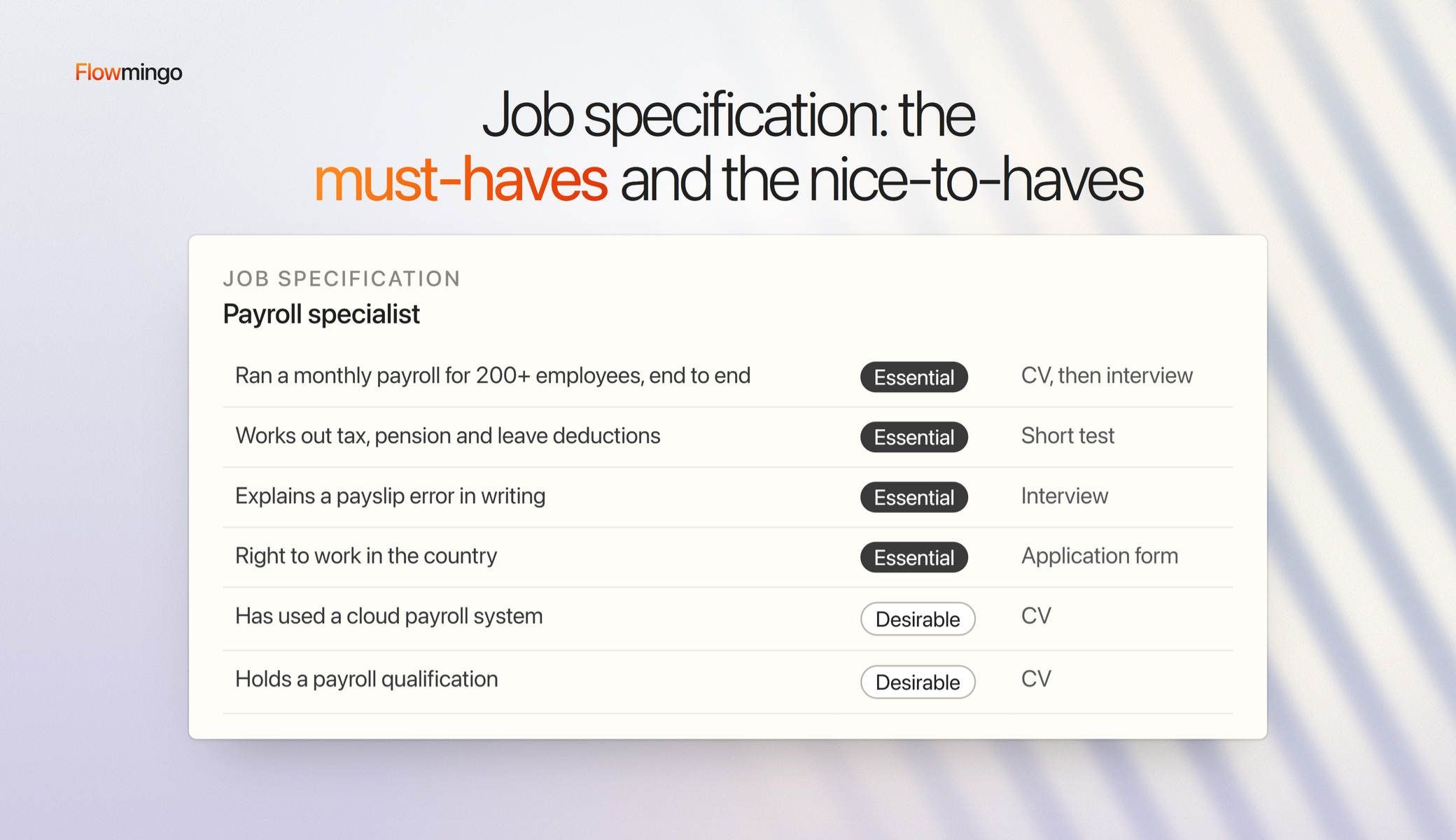
Job specification example: 6 criteria for a payroll specialist, 4 essential and 2 desirable, each with how you check it.
The first essential replaces the year count: ran a monthly payroll for 200+ employees end to end. You check it on the CV, then in the interview. Calculating tax, pension and leave deductions without help is essential too, and a short test checks it.
Explaining a payslip error to an employee in writing is the third essential, and the interview checks it. The right to work in the country is the last essential, read from the application form. Having used a cloud payroll system and holding a payroll qualification are desirable, so the CV only ranks people with them higher.
Under the old line, 2 of your 7 shortlisted applicants would have failed: each had under 5 years but ran a payroll of 300+. The client interviewed both and hired 1 of them.
3. How do you write a job specification?
Start from the work the job must deliver, decide what is essential, and write each criterion so someone can check it. Then fix the list before you read a single CV.
- Start from the job's results, not last year's ad. In a foundational 2021 Harvard Business School and Accenture report, 72% of employers reused or lightly edited an old posting for a middle-skills role. Old ads carry old requirements.
- Keep essentials to what the job cannot run without. At Oxford Brookes, applicants can be shortlisted only if they meet every essential criterion, so each one removes people.
- Describe the quality of experience, not its length. Oxford Brookes tells managers to avoid year counts such as at least 5 years of line management. Each requirement should be clear, specific and justifiable.
- Note how you will check each criterion. Then turn the list into a checklist: Acas suggests scoring an applicant who meets 17 of 20 points as 17 out of 20.
- Fix the list before you read the first CV. In Uhlmann and Cohen's 3 foundational 2005 studies, people rating applicants for jobs such as police chief redefined the criteria to fit their favourite. Committing to the criteria first removed the gender discrimination.
3.1 Which mistakes make a job specification unfair?
The first is a criterion that points at a person, not a skill. Singapore's TAFEP lists phrases such as "Below 30 only" and "Preferably female" as wording to drop, because criteria must relate to skills, knowledge and experience.
The second is too many essentials. In 1 foundational Harvard Business School and Accenture survey, 88% of employers said exact-match filters screen out qualified high-skill candidates. Move nice-to-haves to desirable, where they rank people instead of removing them.
4. How is a job specification different from a job description?
A job description sets out the work: the purpose, the duties and who the role reports to. A job specification sets out the person: what they must know, have done and be able to show.
Many employers put both in 1 document or 1 job ad, so people use the words interchangeably. Acas treats them as 2 lists and turns both into 1 shortlisting checklist.
Write the duties first, because the specification should follow from them. A criterion that no duty needs is a filter with no reason. Our guide on how to write a job description covers that half of the pair.
5. How do you use a job specification with Flowmingo?
You put the essential criteria into the job description you paste, and every applicant you invite is asked and scored against them. You read the reasons and pick the shortlist.
Before you start, have your specification ready with each criterion marked essential or desirable. Keep yes-or-no facts, such as the right to work, on the application form, because an interview is a slow way to check them. Save the interview for criteria that need an answer to judge, like explaining a payslip error.
How Flowmingo helps
Paste your job description with the specification's essentials in it, and the AI interviewer drafts between 1 and 30 questions you can edit. Each requirement is rated 0 to 10 and weighted by its importance, and every hiring decision stays with your team. Sign up free to check every job specification criterion on Flowmingo.
6. Sources
Every report, guide and study in this glossary entry links to its source below.
- Acas. (2026, June 30). Choosing who to interview. Acas
- California Department of Human Resources. (n.d.). Job descriptions (class specifications). Retrieved 26 October 2026. CalHR
- Fuller, J. B., Raman, M., Sage-Gavin, E., & Hines, K. (2021). Hidden workers: Untapped talent. Harvard Business School and Accenture. Wayback Machine copy
- Oxford Brookes University. (n.d.). Job description and person specification. Retrieved 26 October 2026. Oxford Brookes
- Tripartite Alliance for Fair and Progressive Employment Practices. (n.d.). Guide to writing fair job posts and advertisements. Retrieved 27 October 2026. TAFEP
- Uhlmann, E. L., & Cohen, G. L. (2005). Constructed criteria: Redefining merit to justify discrimination. Psychological Science, 16(6), 474-480. DOI
- U.S. Office of Personnel Management. (n.d.). Job analysis. Retrieved 26 October 2026. OPM