
The best applicant tracking systems for a team of 3 recruiters, not 300, are the ones you can price before a demo. If your hiring lives in a Google Sheet and a shared inbox, you know the cost of waiting: rejection emails go out late or never.
The first surprise is pricing, because the best recruiting software bills your team in different units. Some vendors charge per seat, some by headcount, some 1 price per plan and some only on a quote.
For the same 3 recruiters at a 50-person company, published prices run from $0 to $6,000 a year.
The terms of 5 vendors end your access or allow deletion within 90 days of exit, while US law asks employers with 15 or more staff to keep every application for at least a year.
So the choice comes down to 2 things a demo will not show you: whether a plan fits your busiest month at its published price, and whether you can get every record out the day the contract ends.
Flowmingo, the company publishing this list, makes 1 of the 14 tools. It gets no special place: it sits at entry 9, set by how it charges, and we judge it on the same fields as the rest.
Key takeaways
- Which ATS costs least for 3 recruiters? Flowmingo's free plan, at $0 but with no CSV export, and then Manatal, at $540 a year.
- Is per-seat or per-employee pricing cheaper for us? Per seat, once your staff far outnumber your recruiters, because BambooHR bills every employee, not just your 3 recruiters.
- What should we check before signing? The renewal notice and the exit window. Greenhouse and Lever both renew for a year unless you cancel 30 days ahead.
- How long must we keep rejected applicants? At least 1 year in the US at 15 or more staff, and 4 years in California, AI scores included.
- Does AI ranking in an ATS bring legal duties? It can. Under New York City's Local Law 144, a score that substantially assists the decision needs an audit for bias within the past year, and candidates need 10 business days' notice.
1. With 5 to 200 staff, which are the best applicant tracking systems for us in 2026?
Start with a tool that publishes its price, because you can compare it before any sales call. On a tight budget that means Manatal, Zoho Recruit, Breezy or JazzHR, while staffing agencies should look first at Bullhorn.
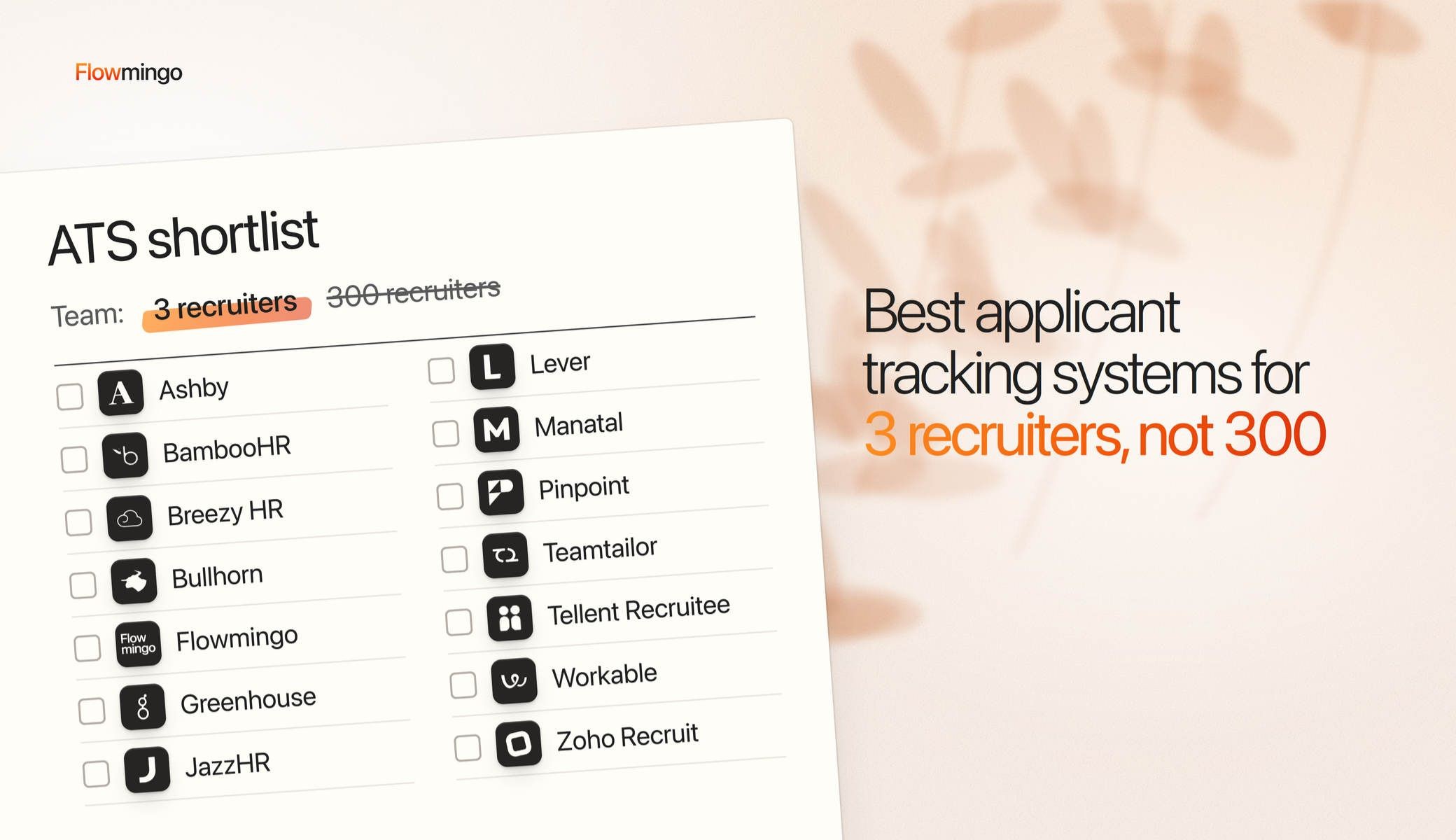
The list below holds 9 tools whose own pages sell to teams of 5 to 200 and show a price. It adds 5 well-known tools that also sell to teams this size but quote only, kept because their own pages or terms state a real limit you can check before a call.
That rule leaves out iCIMS, which is built for enterprise clients. It brings in Lever and Pinpoint, which publish no price but state a real limit: Lever in its terms, Pinpoint on its own comparison page.
We group the entries by how each vendor charges, which decides how your bill grows. They run per seat (1 to 3), by headcount (4 to 6), 1 price per plan rather than per user (7 to 9), and quote only (10 to 14).
Every price comes from the vendor's own page, read on 10 November 2026.
1. Bullhorn
Best for: staffing agencies of 1 to 10 recruiters.
- What it does: Tracking, CV parsing, client management and job posting.
- Price: $99 a user a month on Starter, $165 on Core.
- Real limit: Starter is designed for agencies with 1 to 2 users, its pricing page says, so price a team of 3 on Core.
2. Manatal
Best for: the lowest seat price.
- What it does: CV parsing, AI scoring and unlimited hiring managers.
- Price: $15 a user a month billed yearly, or $19 monthly.
- Real limit: Professional caps you at 15 jobs and 10,000 candidates.
3. Zoho Recruit
Best for: a free start for 1 recruiter, with "No forced contracts".
- What it does: Candidates, email and scheduling on Free, then sourcing and assessments on Standard.
- Price: Free, then $25 a recruiter a month billed yearly.
- Real limit: Free holds 1 user and 1 active job (Zoho help), and hiring-manager licences come in packs of 10.
4. Ashby
Best for: fast-growing companies under 100 staff.
- What it does: Sourcing sequences, a candidate CRM and AI search.
- Price: $300 a month at 1 to 10 employees, up to $900 at 76 to 100.
- Real limit: Above 100 employees, the price is quote only.
5. BambooHR
Best for: HR and hiring in 1 system.
- What it does: HR records plus an ATS with offer and rejection templates.
- Price: $250 a month up to 25 staff, then $10 to $10.25 an employee a month.
- Real limit: Core's ATS holds 5 job openings, and you pay for every employee.
6. Workable
Best for: companies of 10 to 50 staff hiring steadily.
- What it does: Sourcing, unlimited active jobs under fair use and 3,000 free AI credits.
- Price: $299 a month billed yearly for 1 to 20 employees.
- Real limit: Video interviews (+$109 a month) and assessments (+$59 at 1 to 20 staff, +$99 at 21 to 50) cost extra.
7. Breezy HR
Best for: many hiring managers who need a log-in.
- What it does: Unlimited users, 50+ job boards, bulk actions and one-way video.
- Price: $157 a month billed yearly, or $189 monthly.
- Real limit: No free plan, and AI scoring costs credits from $30 per 100,000, which Breezy says is enough to score about 200 applicants.
8. JazzHR
Best for: single-site small businesses on a fixed budget.
- What it does: Job postings and email templates on Hero, structured interviews on Plus.
- Price: $1,000 a year on Hero and $3,480 on Plus.
- Real limit: Hero starts at 3 job postings a month, and standard pricing excludes agencies.
9. Flowmingo
Best for: high-volume screening on little budget.
- What it does: A drag-and-drop pipeline with every AI interview, CV score and test on 1 profile.
- Price: $0 with no end date and no card, then from $42 a month billed yearly for unlimited team members.
- Real limit: Free keeps the latest 300 videos for 30 days, allows 3 report downloads in total and has no CSV export.
10. Greenhouse
Best for: structured hiring with interview kits.
- What it does: Sourcing and a CRM, plus structured interview kits and scorecards.
- Price: No public price, since "pricing is customized".
- Real limit: The contract renews for 1 year unless you cancel 30 days ahead.
11. Lever
Best for: teams that want an ATS and a candidate CRM in 1 tool.
- What it does: An ATS and a candidate CRM on every plan, with reporting and AI matching that ranks candidates, while AI Screening by VONQ and onboarding are quoted add-ons.
- Price: No public price: it is "available upon request", tailored to your size and hiring needs.
- Real limit: Its terms, dated August 2023 and still online on 20 November 2026, renew for 1 year unless you cancel 30 days ahead, and once the term ends, Lever deletes your data promptly.
12. Pinpoint
Best for: in-house teams of mid-size and up, hiring across departments, brands and regions.
- What it does: A talent CRM, a careers site in several languages, one-way video interviews and unlimited hiring-manager access.
- Price: No public price: Pinpoint gives one after a short call about your company and hiring process.
- Real limit: It "may not be ideal" for a staffing agency or for "a very small team hiring only a handful of roles a year", its own comparison says.
13. Teamtailor
Best for: a strong careers site, hiring all year.
- What it does: A careers site and ATS with unlimited users and job postings, Teamtailor AI included.
- Price: No public price: "Let us give you a quote".
- Real limit: Its terms renew for 12 months unless you give 1 month's notice, with no refund for leaving early.
14. Tellent Recruitee
Best for: hiring across several locations and languages.
- What it does: An ATS with a careers site and posting to many job boards. Its Advance plan adds unlimited job posts and a multilingual careers site.
- Price: No public price: plans come through a demo.
- Real limit: The Start plan holds 5 active job posts.
2. We have 3 recruiters: what will the best applicant tracking systems cost us over 12 months?
At a 50-person company, the software for 3 recruiters costs $0 to $6,000 a year at published prices. Headcount pricing is the one that grows with your company.
The table prices the same team on each vendor's own page: 3 recruiter seats on the entry plan, billed yearly where offered, with no add-ons. For Zoho that means Standard, because its Free plan holds only 1 user.
No list on Google's first page does this sum.
| Tool (entry plan) | How it charges | 12 months at 50 staff | 12 months at 200 staff |
|---|---|---|---|
| Flowmingo (Free) | Free plan | $0 | Same |
| Manatal (Professional) | Per user | $540 | Same |
| Zoho Recruit (Standard) | Per recruiter licence | $900 | Same |
| JazzHR (Hero) | 1 yearly price | $1,000 | Same |
| Breezy HR (Startup) | 1 price, unlimited users | $1,884 | Same |
| Workable (Standard) | Company-size band | $5,028 | $11,388 |
| Ashby (Foundations) | Company-size band, less 10% yearly | $5,400 | Quote only |
| Bullhorn (Core, agencies) | Per user | $5,940 | Same |
| BambooHR (Core) | Per employee | $6,000 to $6,150 | $24,000 to $24,600 |
| Greenhouse, Lever, Pinpoint, Teamtailor, Tellent Recruitee | Quote only | Ask | Ask |
These are list prices, before volume discounts and without hiring managers, and Workable's larger bands come from its pricing page's size picker.
Bullhorn appears at its monthly price on Core, as Starter is designed for 1 to 2 users. Flowmingo sits at Free because no plan limits its jobs or team members.
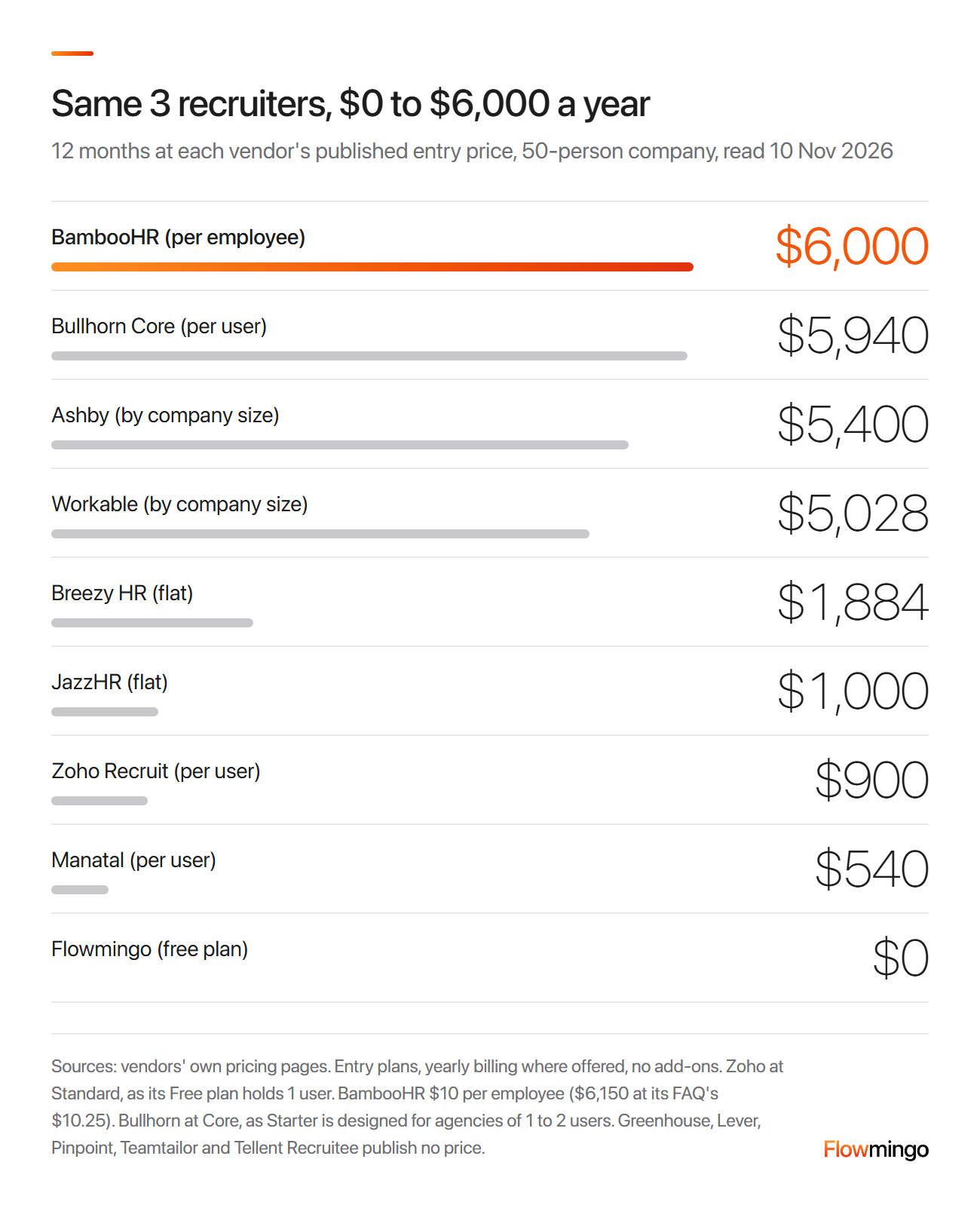
Same 3 recruiters, 12 months: $540 on Manatal's per-seat plan and $6,000 on BambooHR, which bills every employee, at a 50-person company.
The top bar is about 11 times the Manatal bar, because BambooHR bills all 50 employees while Manatal bills only 3 seats.
Flat prices, like Breezy's and JazzHR's, stay put as you grow, while at 200 staff Workable rises to $11,388 a year and BambooHR to at least $24,000.
2.1 Should we use the hiring module in our payroll or HR system instead?
Only if you already pay for the HR suite and keep 5 or fewer roles open at once. BambooHR's ATS comes with its HR records, and its Core plan holds 5 job openings while Pro holds 25.
A 40-person company on Core that opens 8 roles at once has outgrown those 5 openings, and must then price Pro or a separate ATS.
3. With 3 recruiters and 40 hires a year, how do we avoid an ATS built for 500-person companies?
Write down your hiring load before any demo, then shortlist only the plans whose caps fit it.
Fill in these 5 lines first, because the best ATS for small business fits your peak, not your average week.
- Recruiters who need a seat: __
- Hiring managers who need a log-in: __
- Jobs open at once, at the peak: __
- Applicants per role, at the peak: __
- Hires a year: __
Then cross out every plan whose job cap sits below line 3. If 8 jobs are open at your peak, for example, that rules out BambooHR Core with its 5 openings and Tellent Recruitee's Start plan with 5 posts.
JazzHR Hero needs a question first: its page counts job postings, starting at 3 a month, not jobs open at once, so ask whether Hero can hold 8 open jobs.
Manatal's Professional plan, with up to 15 jobs, stays on the list.
Flowmingo data · 3,194 hiring projects at 1,188 companies, 12 Aug to 9 Nov 2026
- 5 candidates sat in the median hiring project over these 3 months.
- 20 candidates or more sat in the busiest quarter of hiring projects.
- 69 or more candidates sat in the busiest 10% of hiring projects.
Not counting Flowmingo's auto-apply feature for job seekers, which lifts the median to 8. Includes people who applied, were invited or were added by the team. Projects opened before 12 Aug count only candidates added from then. It shows pipeline size, not hires.
So a job cap binds long before Manatal's 10,000-candidate cap does.
Next, trial 1 live role: post it, screen it, reject 20 people at once, then export them. Flowmingo, for example, has no bulk reject. You select several candidates, choose Move to and pick the stage you use for rejections, and they get an email only if that stage is set up to send one.
Then pick the tool your hiring managers will fill scorecards in, because a scorecard helps only when it gets used.
Scorecards are how a structured interview works: every candidate gets the same questions, rated on the same scorecard. That method ranked first among selection methods in a 2022 re-analysis by Sackett et al., now more than 3 years old.
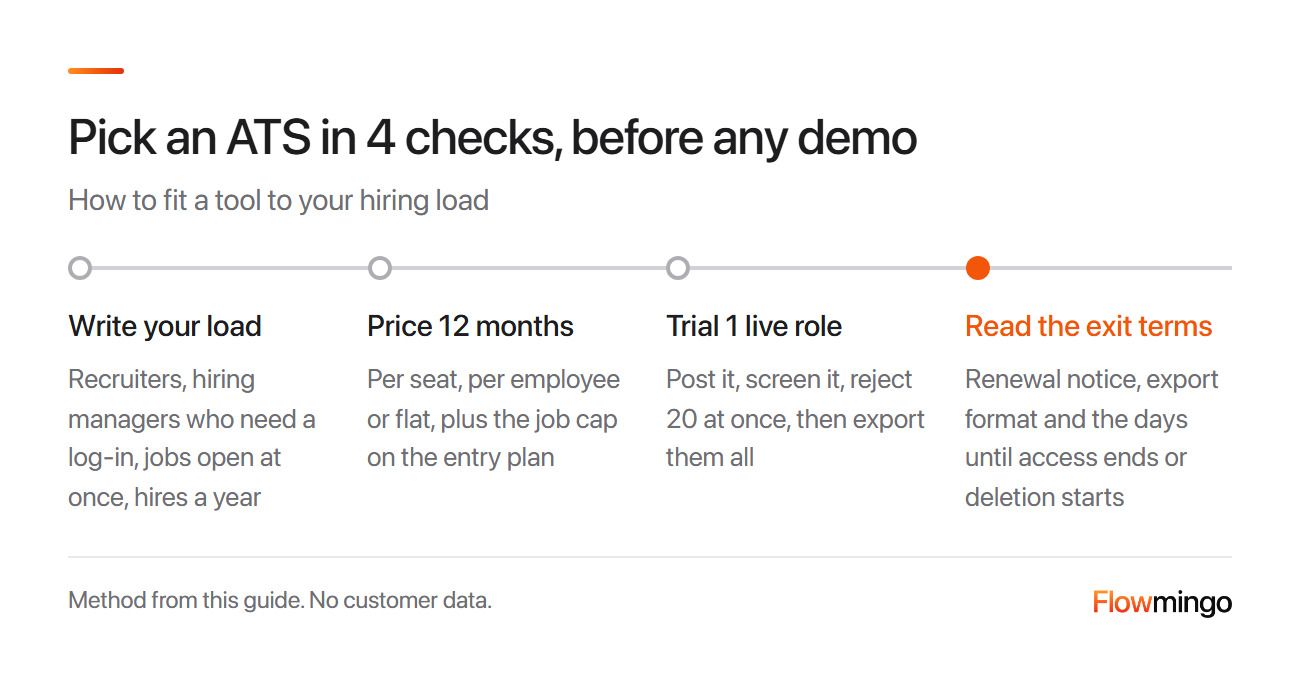
Picking an ATS in 4 checks: write your load, price 12 months, trial 1 live role, then read the exit terms.
Our structured interview guide and interview scorecard template show how to build them.
3.1 Still on a spreadsheet with 5 to 10 hires a year: do we need an ATS yet?
Not always, because the trigger is missed replies and records you cannot produce, not headcount.
On r/Recruitment, a startup founder hiring 5 people from a Google Sheet and a shared inbox double-booked an interview and fell behind on rejection notes.
Move to a free plan if any of these 3 checks fails:
- You can produce a rejected applicant's record from 11 months ago within a day.
- No applicant has waited more than 2 weeks for a reply.
- Only 1 person edits the sheet.
4. Leadership asks what everyone uses: is the most common ATS the safe pick for our size?
Not necessarily. No neutral data we found ranks ATS use at companies your size, and the best-known names sell mainly to large employers, so fit to your hiring load is the safer pick.
Vendors' own customer counts cannot settle the question, because each vendor counts in its own unit. For example, iCIMS claims more than 4,400 companies, Bullhorn 4,500+ small staffing agencies and Zoho Recruit over 800,000 recruiters.
None of those figures can be set against another.
Nor is the most listed tool the most used. On 10 November 2026, Google's first page held 4 lists: Zapier, Truffle, TechnologyAdvice and People Managing People, the last read from its March 2026 archive copy.
Greenhouse and JazzHR appear in all 4, and Breezy, Pinpoint, BambooHR and Workable in 3.
Lists repeat each other's shortlists, and our own best AI recruiting software comparison is a list like any other, so a name that appears everywhere tells you about the lists, not about your fit.
On r/recruiting, a 120-person company with 3 recruiters signed for 12 months with the top-rated tool, and by month 4 its setup needed a consultant.
At your size, a safe pick has 3 things: a published price that holds as headcount grows, a renewal notice you can meet and an export you can read. You can test the best applicant tracking systems above on all 3 in an afternoon.
5. Which ATS suits a 1-10 recruiter agency, and does it need a CRM built in?
Start with Bullhorn, Manatal or Zoho Recruit, and yes, an agency needs its candidates, clients and jobs linked in 1 place. Check which plan holds the full client CRM, because the entry plan often has only part of it.
Bullhorn's Starter includes client management, but the client sales pipeline, the CRM part agencies ask for, starts on Pro with AI search, priced on request.
For 8 recruiters over 12 months, Bullhorn Core costs 8 x $165 x 12 = $15,840, against $1,440 on Manatal.
Zoho Recruit Standard costs $2,400 at its corporate price, and Zoho prices its staffing edition separately.
Manatal's low price comes with its 15-job cap, which a busy desk hits, and Enterprise, with unlimited jobs, costs $35 a user. So price the plan you will need by month 6.
Read the exclusions before a trial. JazzHR's standard pricing "does not apply to staffing or recruiting agencies", and Tellent Recruitee quotes agencies separately.
Pinpoint's own comparison page says it is built for in-house teams, "not for staffing agencies hiring on behalf of clients".
Ask where candidate replies land. On r/recruiting, a 4-recruiter agency moving about 60 candidates a week says WhatsApp replies never reach its ATS.
Tellent Recruitee, for one, lists a WhatsApp Hiring product, so ask each vendor where those messages get logged.
How Flowmingo helps
A free client link shows your client a candidate's report while hiding contact details and the CV.
The free applicant tracking system comes with every plan, and so do connections to 23 other ATSs, the other 13 tools here included. Flowmingo sends the AI interview at the stage you pick and writes the score back.
6. We have no ATS budget: are the free plans of the best applicant tracking systems enough?
A free plan is enough for a few roles, as long as you can live with its caps and still export your data. Only 2 of the 14 tools here have one with no end date.
- Zoho Recruit Free: 1 user and 1 active job, with no add-ons, so 3 recruiters need Standard. Zoho may delete an unpaid account left inactive for 120 days, with notice.
- Flowmingo Free: no cap on team members or jobs, AI interviews of up to 20 minutes, CV scores and tests. It keeps the latest 300 videos for 30 days and allows 3 report downloads in total.
Free sessions also show Flowmingo's brand beside yours, and candidates may be offered optional paid extras for themselves, such as a practice run, a report on their own performance or a question retake, as Flowmingo's model page lists.
The candidate pays, never your company, and none is needed to finish the interview. Sponsoring a session removes the brand and these offers, at $0.49 a candidate on Free, or $0.98 for a technical test.
Flowmingo Free fails the export test. CSV export skips Starter, at $42 a month billed yearly ($499.80 a year), and starts on Growth, at $84 a month billed yearly ($1,009.80 a year). Ask Zoho what its Free plan exports.
Screening is the other cost to count when you compare free ATS software, because at least 4 of the 9 priced tools charge extra for it. Workable sells assessments, Manatal an AI Interviewer add-on, Breezy AI scoring credits and Zoho video interviews per job.
A top reply on r/humanresources warns that you may pay for a free product with your data.
So ask any vendor for a data processing agreement, the contract that sets what it may do with your applicants' records.
Test any AI score before you rely on it, ours included. In The Algorithm, a book on AI in hiring that Hilke Schellmann published in 2024, a video-interview tool gave her a 73% match when she read a German Wikipedia page instead of answering, as Evan Selinger's review recounts.
So answer 1 trial interview off topic and check the score drops.
7. Our applications fell after we switched ATS: which one gives candidates the best experience?
The best candidate experience comes from a short apply form, no forced log-in and an automatic reply to every applicant.
Get those wrong and applications can fall fast. On r/recruiting, a sourcer went from 10 to 20 qualified applicants per free job post to 0 to 2 after moving the posts into an ATS.
The replies blamed long forms, required log-ins and job board settings, all of which you can check in a trial.
The wider gap is basic follow-up. Survale, a survey vendor, now publishes the Candidate Experience (CandE) benchmark, a survey of job candidates that Talent Board started in 2011.
In its 2025 edition, 31% of North American candidates had not heard back 1 to 2 months or more after applying.
Replies like those are what an ATS should send on its own, so run this 3-part test on every trial job:
- From a mobile browser after 9 pm, apply to your own trial job and count the minutes and steps.
- Check the automatic acknowledgement arrives, in your company's name.
- Reject yourself and check the message arrives, with our candidate rejection email templates as the bar.
Step 2 must run on its own, because many applicants arrive after hours.
Flowmingo data · candidates' own local time, 12 Aug to 9 Nov 2026
- 46.4% of 12,858 job-post applications at 490 companies arrived outside 9 am to 6 pm, on any day of the week.
- 44.6% of the 4,373 applications on companies' own job and careers pages arrived outside 9 am to 6 pm.
- 43.6% of 45,956 AI interviews at 838 companies started outside 9 am to 6 pm.
Time zone from the candidate's internet connection, so applications count only where the applicant also started an AI interview (51%). Of the applications, 8,054 came through Flowmingo's public job portal.
Most applicants are in Asian and African time zones. In all, 40,408 candidates started the interviews, mostly in India, Nigeria, the Philippines and Indonesia. It shows when candidates acted, not when teams worked.
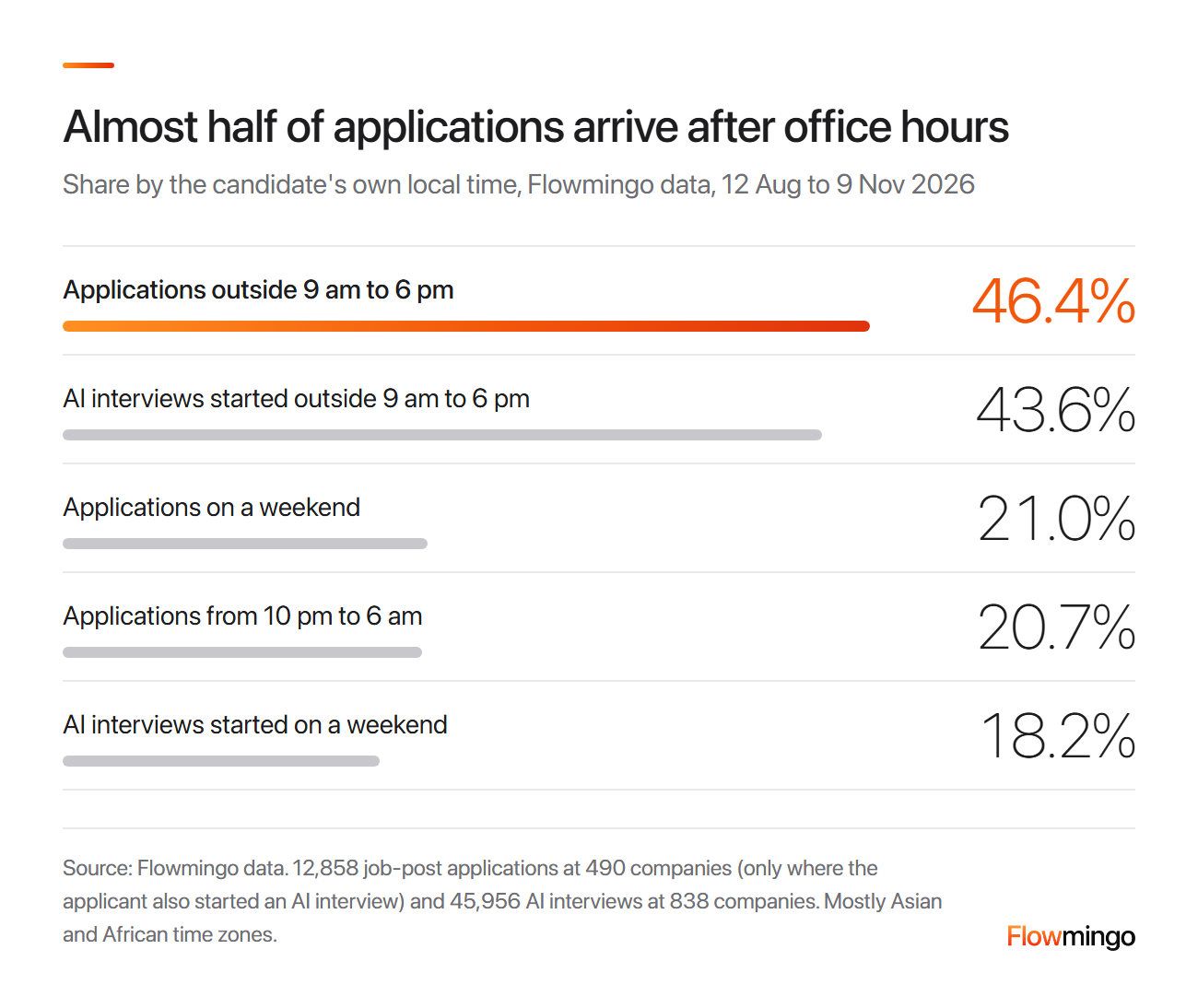
After-hours applicants: 46.4% of job-post applications and 43.6% of AI interviews came outside 9 am to 6 pm local time on any day. Weekends brought 21.0% and 18.2%, and 10 pm to 6 am brought 20.7% of applications.
The pattern holds at night and at weekends, so an acknowledgement that a person has to send can wait until the next working day.
Close to half of applications arrive after hours even on companies' own job and careers pages, so a careers page does not fix it.
How Flowmingo helps
Rules on a job post can invite every applicant to the AI Interviewer, from immediately to 7 days after they apply. Each invite carries your company's name, and Flowmingo rejects nobody automatically.
Run the same 3-part test on Flowmingo as on every other tool here.
8. Before we sign one of the best applicant tracking systems, which contract terms should we check?
Check 4 terms before you sign: the renewal notice, the export format, what happens to your data after the end and the EU data agreement. Get each in writing, with any setup or exit fee.
Most of the contracts we read roll over for a full term. Greenhouse's agreement of 1 February 2026 renews for 1 year if you do not cancel at least 30 days before the end.
Your order form can say otherwise, and Greenhouse warns you at least 60 days ahead. For example, on a Greenhouse term starting 1 January, the deadline is 2 December, so put it in the calendar the day you sign.
Lever's terms, last updated in August 2023 and still the version online on 20 November 2026, renew for 1 year on the same 30 days' notice.
Those terms cap each renewal rise at the change in the US Consumer Price Index plus 5%, unless Lever gives 6 months' notice of new fees before the term ends, so year 2 can cost more for the same plan.
They also price against an "Employee Limit", your total headcount when you sign, and Lever may charge more if you grow past it, prorated on a multi-year term.
Setup fees hide in quotes. Bullhorn includes implementation on Starter, Core and Pro, but not on Max, which is quote only.
Leaving can cost money as well. Greenhouse's API export is free during the term, but an export file afterwards costs its migration rates.
| Check | What the vendor's own terms say |
|---|---|
| Renewal notice | Greenhouse and Lever: 1 year, 30 days' notice. JazzHR, Breezy and Zoho also auto-renew |
| Export format | Breezy: export listed under Custom Pro, so ask. Flowmingo: CSV from Growth. A raw dump is hard to read, buyers say |
| Days after the end | JazzHR: access ends with the term. Lever: access ends with the term, then prompt deletion. Ashby: may erase at 30. Teamtailor: deletes within 60 if you give no instruction. Greenhouse: access ends at once, deletion queued at 90 |
| EU data agreement | GDPR Art. 28 lets you choose return or deletion. Greenhouse EU addendum: 30 days to export, then 30 to retrieve |
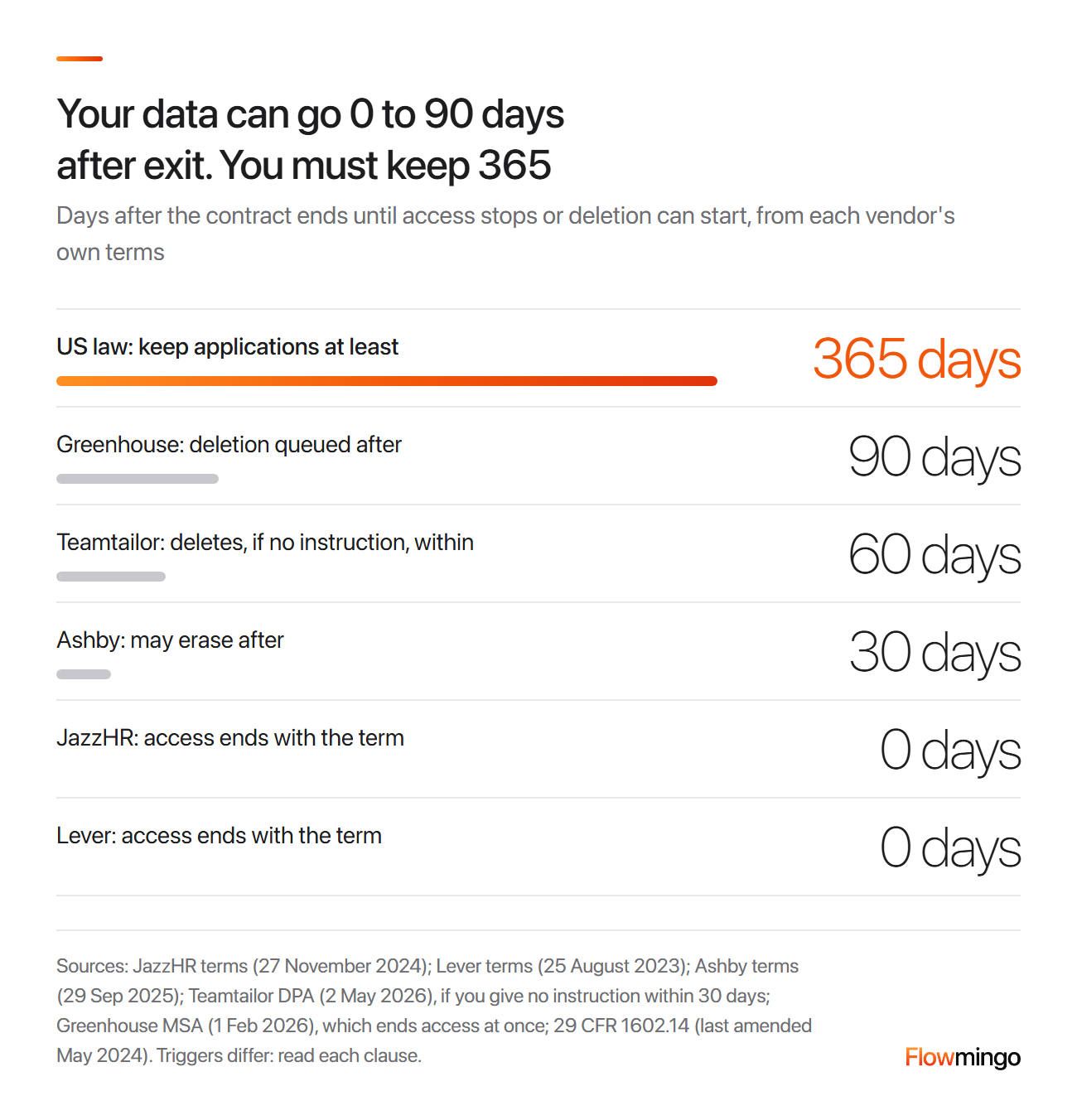
Days after the contract ends until access stops or deletion can start: JazzHR and Lever 0, Ashby 30, Teamtailor 60, Greenhouse 90. US law asks you to keep applications 365 days (29 CFR 1602.14, last amended May 2024).
Every applicant from your last 12 months is still inside the 1-year duty on the day the contract ends, so export them all before then.
And ask every vendor, us included, for its exit terms in writing.
9. Hiring in the US and EU with AI scores: which laws must our ATS meet?
Keep US applications at least 1 year at 15 or more staff, and EU candidates no longer than needed (GDPR Article 5, applying since May 2018). If your ATS ranks applicants with AI, New York City's Local Law 144 can apply when the score substantially assists the decision.
This is general information, not legal advice.
| Where | Rule and start | What your ATS must let you do |
|---|---|---|
| US | 29 CFR 1602.14 (last amended May 2024), 15+ staff (42 U.S.C. 2000e) | Keep every application 1 year, and everything relevant once someone files a charge: ask for a legal hold |
| New York City | Local Law 144 rule and FAQ (enforced since July 2023) | Can apply when you rely on an AI score alone, weight it above all else or let it overrule a person. Then you, not the vendor, owe an audit within the past year and notice 10 business days ahead |
| EU | Regulation (EU) 2026/1744 | High-risk duties for AI that filters candidates apply from 2 Dec 2027 |
| Illinois, Colorado | Illinois HB 3773, from 1 Jan 2026 (law firm summary, September 2024). Colorado SB26-189, from 1 Jan 2027 | Illinois: tell employees when you use AI, and drop any AI whose effect is to discriminate. Colorado: notice before the AI is used; within 30 days of a rejection, its role in plain language and a way to request human review; records kept 3 years; and the developer's technical documents |
Under California's Civil Rights Department rule, employers keep records, AI scores included, for at least 4 years.
For example, an applicant there rejected on 1 November 2026 stays on file until 1 November 2030.
Ranking can also copy old bias. In a 2024 lab study by Wilson and Caliskan, 3 AI models that rank CVs by how closely each matches a job description significantly favoured White-associated names in 85.1% of cases, across 9 occupations.
With names matched for how common they are, the preference reversed toward Black-associated names, so a ranking can shift on a detail as small as a name. Swap names on a few trial CVs and check whether the order changes.
One more change matters only if you hold US federal contracts. Many guides still quote a 2-year record rule for contractors, which came from the regulations under Executive Order 11246.
OFCCP, the federal office that issues those contractor rules, rescinded the regulations from 26 October 2026 (Crowell & Moring), so that 2-year rule no longer applies.
The veterans' rule (VEVRAA) still keeps records 2 years at contractors with 150 or more staff and a $200,000 contract (41 CFR 60-300.80).
9.1 Other lists worth reading
Both of these Work Insiders lists include Flowmingo, and we wrote neither. They compare screening and interviewing tools rather than ATSs, though both list Flowmingo with a built-in ATS.
How Flowmingo helps
On every plan, results, scores and transcripts stay readable. On Free, only the latest 300 videos stay viewable, for 30 days, and CSV export needs Growth.
So plan your 1-year export before you rely on Free for records, and judge Flowmingo on the same fields as the other best applicant tracking systems.
10. Sources
We read every vendor price and term on its own page on 10 November 2026, re-read 4 pages on 12 November, and read Lever's terms and Pinpoint's comparison page on 20 November. Flowmingo figures are our own data.
- Ashby (n.d.). Pricing. Ashby. Retrieved 10 November 2026.
- Ashby (2025, September 29). Terms. Ashby.
- BambooHR (n.d.). Plans and pricing. BambooHR. Retrieved 10 November 2026.
- Breezy HR (n.d.). Pricing. Breezy HR. Retrieved 10 November 2026.
- Breezy HR (2026, August 10). Terms. Breezy HR.
- Bullhorn (n.d.). Staffing ATS software plans that fit your agency. Bullhorn. Retrieved 12 November 2026.
- California Civil Rights Department (2025, June 30). Civil Rights Council secures approval for regulations to protect against employment discrimination related to artificial intelligence. CRD.
- Colorado General Assembly (2026). SB26-189: Automated decision-making technology. Colorado General Assembly.
- Crowell & Moring (2026, August 21). OFCCP completes overhaul of federal contractor compliance framework: three final rules. Crowell & Moring.
- European Union (2026). Regulation (EU) 2026/1744, the Digital Omnibus on AI. Official Journal of the European Union.
- Ferrer, R. A. (2026, October 26). Top applicant tracking systems (ATS). TechnologyAdvice.
- Flowmingo (n.d.). Connect your ATS to Flowmingo. Flowmingo. Retrieved 12 November 2026.
- Flowmingo (n.d.). Pricing. Flowmingo. Retrieved 10 November 2026.
- gdpr-info.eu (n.d.). Art. 5 GDPR: Principles relating to processing of personal data. Regulation (EU) 2016/679.
- gdpr-info.eu (n.d.). Art. 28 GDPR: Processor. Regulation (EU) 2016/679.
- gdpr-info.eu (n.d.). Art. 99 GDPR: Entry into force and application. Regulation (EU) 2016/679.
- Greenhouse (n.d.). Plans and pricing. Greenhouse. Retrieved 12 November 2026.
- Greenhouse (2026, February 1). EU Data Act addendum. Greenhouse.
- Greenhouse (2026, February 1). Master subscription agreement. Greenhouse.
- iCIMS (n.d.). Enterprise recruiting software and AI-powered applicant tracking system. iCIMS. Retrieved 10 November 2026.
- JazzHR (n.d.). Pricing. JazzHR. Retrieved 10 November 2026.
- JazzHR (2024, November 27). Terms of service. JazzHR.
- Legal Information Institute (n.d.). 29 CFR 1602.14: Preservation of records made or kept. Cornell Law School.
- Legal Information Institute (n.d.). 41 CFR 60-300.80: Recordkeeping. Cornell Law School. Retrieved 10 November 2026.
- Legal Information Institute (n.d.). 42 U.S. Code 2000e: Definitions. Cornell Law School.
- Lever (n.d.). Pricing. Lever. Retrieved 10 November 2026.
- Lever (2023, August 25). Terms of service. Lever. Retrieved 20 November 2026.
- Manatal (n.d.). Pricing and plans. Manatal. Retrieved 10 November 2026.
- New York City Department of Consumer and Worker Protection (2023, June 29). Automated employment decision tools: Frequently asked questions. DCWP.
- New York City Department of Consumer and Worker Protection (2023). Notice of adoption of final rule: Automated employment decision tools. DCWP.
- People Managing People (n.d.). 20 best ATS for small businesses in 2026. People Managing People. Read from the Internet Archive copy of 7 March 2026.
- Pinpoint (n.d.). Request pricing. Pinpoint. Retrieved 10 November 2026.
- Pinpoint (2026, July 15). Talent acquisition software comparison: 10 platforms compared and how to choose. Pinpoint. Retrieved 20 November 2026.
- r/humanresources (2026, July 14). Discussion thread on finding an affordable ATS. Reddit.
- r/recruiting (2026, March 21). Discussion thread on applicants falling after a move to an ATS. Reddit.
- r/recruiting (2026, September 6). Discussion thread on an ATS overbuilt for a 3-recruiter team. Reddit.
- r/recruiting (2026, September 15). Discussion thread on leaving an enterprise ATS at the end of a contract. Reddit.
- r/recruiting (2026, November 9). Discussion thread on WhatsApp replies at a 4-recruiter agency. Reddit.
- r/Recruitment (2026, January 13). Discussion thread on moving a startup's hiring off a spreadsheet. Reddit.
- Sackett, P. R., Zhang, C., Berry, C. M., & Lievens, F. (2022). Revisiting meta-analytic estimates of validity in personnel selection: Addressing systematic overcorrection for restriction of range. Journal of Applied Psychology.
- Schellmann, H. (2024). The algorithm: How AI decides who gets hired, monitored, promoted, and fired and why we need to fight back now. Hachette Books.
- Selinger, E. (2024, May 31). Keeping humans in the loop: On Hilke Schellmann's The Algorithm. Los Angeles Review of Books.
- Strauss, L. (2026, July 28). The 9 best applicant tracking systems in 2026. Zapier.
- Survale (2025). 2025 Candidate Experience (CandE) benchmark research key statistics. Survale.
- Taft (2024, September 3). New Illinois law restricts use of AI in employment practices. Taft.
- Teamtailor (n.d.). Pricing. Teamtailor. Retrieved 12 November 2026.
- Teamtailor (2026, May 2). Terms and conditions, including the Data Processing Agreement (Sec. 10). Teamtailor.
- Tellent Recruitee (n.d.). Pricing. Tellent Recruitee. Retrieved 10 November 2026.
- Truffle (2026, October 9). The 7 best applicant tracking systems for small businesses. Truffle.
- Wilson, K., & Caliskan, A. (2024). Gender, race, and intersectional bias in resume screening via language model retrieval. AIES 2024. Erratum: arXiv v3.
- Work Insiders (2026). AI screening tools: 112 compared. Work Insiders. Retrieved 12 November 2026.
- Work Insiders (2026). Free AI interviewing software. Work Insiders. Retrieved 12 November 2026.
- Workable (n.d.). Pricing. Workable. Retrieved 10 November 2026.
- Zoho (n.d.). Managing users. Zoho. Retrieved 10 November 2026.
- Zoho (n.d.). Terms of service. Zoho.
- Zoho (n.d.). Zoho Recruit corporate pricing. Zoho. Retrieved 10 November 2026.