
By Friday you have to choose 1 of 4 finalists, so you need to compare candidates side by side. Their notes sit in 5 formats: 2 ATS scorecards, a Slack thread, an email, a voice memo and an AI interview report.
Each format records a different interview, so your candidate comparison drifts toward whoever you remember best, and that is usually the last person you met.
The order you met them in shapes the scores as well. In a study of about 29,000 interviews by Radbruch and Schiprowski, the candidate an evaluator had seen just before swayed the next score about 3 times as much as the average other candidate did.
The risk is a decision that feels certain but sits close to a coin toss. Daniel Kahneman and 2 co-authors put numbers on that risk in Noise, their 2021 book on human judgement.
If all you know is that 1 finalist interviewed better than another, they write, the chance that this finalist really is the better one is only about 56% to 61%.
What moves those odds is evidence you can check: a quote behind every score, the same rows for all 4 finalists, and a rule for close calls agreed before anyone argues for a favourite.
A finalist who leads only because of memory, interview order or the format of their notes fails that check, and a finalist who leads on quoted evidence passes it.
Key takeaways
- How do I compare 4 finalists whose notes sit in 5 formats? Turn every note into 1 quote under 1 criterion, then put all 4 on 1 grid.
- Why read the grid row by row? In a lab study, evaluators who saw 2 candidates side by side picked the stronger performer 54% of the time and the weaker 8%. Judged 1 at a time, it was 62% against 52%, too close to tell from chance.
- Is the highest total enough to decide? No. In 68.1% of Flowmingo interview sets with a Must Have, a criterion the job cannot do without, the top AI interview scorer was beaten on a Must Have by the 2nd or 3rd.
- What if 2 finalists are 0.1 apart? Treat a gap of 0.2 or less out of 10 as a tie. In 54.6% of Flowmingo interview sets, the top 2 AI interview scores sat that close.
- What should the debrief do first? Hear what only 1 interviewer heard. Groups whose members each held part of the facts were 8 times less likely to find the best option than fully informed groups.
1. How do I compare candidates side by side when my notes are in 5 formats?
Turn every note into the same unit before you compare anything: 1 criterion, 1 score, 1 quote and the name of the person who heard it. Then lay those units on 1 grid, with the criteria as rows and the finalists as columns.
The conversion matters because formats are not neutral. A voice memo carries adjectives, a scorecard carries numbers and an AI report carries quotes, and the format that looks most exact tends to win the argument.
Chang and colleagues measured how strong that pull is in experiments first published in October 2024. In one, they asked 1,000 people to choose between 2 internship candidates who had interviewed equally well.
Each candidate led on 1 of 2 grades, management or calculus, and the only change between the groups was which grade appeared as a number.
When the management grade was a number, 83.8% chose the candidate with the higher one. When it was a letter, 68.9% still did, so showing that grade as a number added about 15 points to its leader's share.
In a grid, that means a row that arrives as a number quietly outweighs a row that arrives in words. So convert every note into the same unit first, in 4 steps:
- Find the criterion it shows. "Ran a 9-week rollout" from the voice memo goes under onboarding projects.
- Copy the words, not your summary. Keep the quote and its source.
- Get the score from the person who heard it. You did not hear the answer, so you cannot score it.
- Park anything with no criterion. "Loved the energy" goes in a separate box, since no row asks for energy.
The rule is not new. Edward Thorndike, the psychologist who named the halo effect, in which 1 strong impression colours every other rating, wrote in a 1920 paper that the observer "should report the evidence, not a rating" (Thorndike).
2. What goes in a candidate comparison matrix for 4 finalists so every cell has evidence?
Use 4 to 6 job criteria as rows and 1 column per finalist. Every cell holds a score, a quote, its source and the scorer, with the weighted total below.
Evidence goes in every cell because a bare number cannot be checked, and a bare total hides where the finalists differ. Set the weights from the job before the first interview, as our guide to candidate ranking shows.
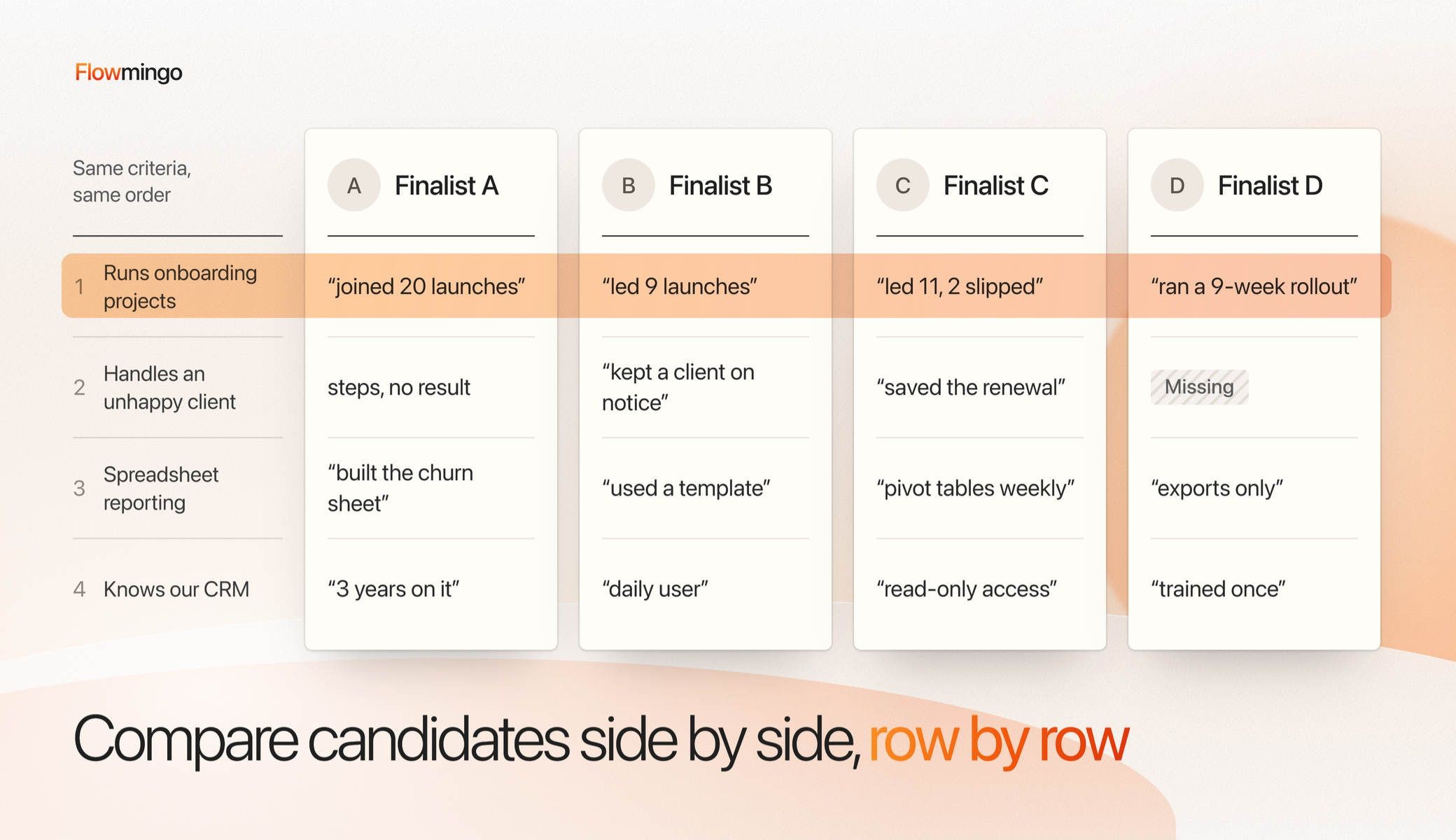
Here is the grid for 1 Customer Onboarding Lead role (illustrative, not customer data). Nadia interviewed A and B, and Ken interviewed C and D. The client row comes from an AI interview that A, B and C took in an earlier round, and D did not.
| Criterion (weight) | A | B | C | D |
|---|---|---|---|---|
| Runs onboarding projects (4) | 7, Nadia: "joined 20 launches" | 8, Nadia: "led 9 launches" | 8, Ken: "led 11, 2 slipped" | 9, Ken: "ran a 9-week rollout" |
| Handles an unhappy client (4) | 6, AI report: steps, no result | 9, AI report: "kept a client on notice" | 9, AI report: "saved the renewal" | Missing: no AI interview |
| Spreadsheet reporting (1) | 8, Nadia: "built the churn sheet" | 7, Nadia: "used a template" | 8, Ken: "pivot tables weekly" | 6, Ken: "exports only" |
| Knows our CRM (1) | 9, Nadia: "3 years on it" | 8, Nadia: "daily user" | 6, Ken: "read-only access" | 6, Ken: "trained once" |
| Weighted /10 | 6.9 | 8.3 | 8.2 | 6.0 to 8.8 |
| Scores in | 4 of 4 | 4 of 4 | 4 of 4 | 3 of 4 |
Onboarding and the client row are the job's Must Haves, the 2 criteria it cannot do without, so each carries a weight of 4, while reporting and the CRM carry 1 each.
To get a total, multiply each score by its weight, add the results and divide by the 10 weight points. For B, that is (4 x 8 + 4 x 9 + 7 + 8) / 10 = 8.3.
Read across each row before you look at the totals, because the rows show where the finalists differ. D leads on onboarding with a 9, while on the client row B and C tie at 9 and D has no score at all.
Only then read the bottom line: B leads at 8.3, C sits 0.1 behind at 8.2, and A trails at 6.9. D could land anywhere from 6.0 to 8.8: 6.0 if the empty client cell counts as a 3 for no evidence, and 8.8 had D scored a 10 there.
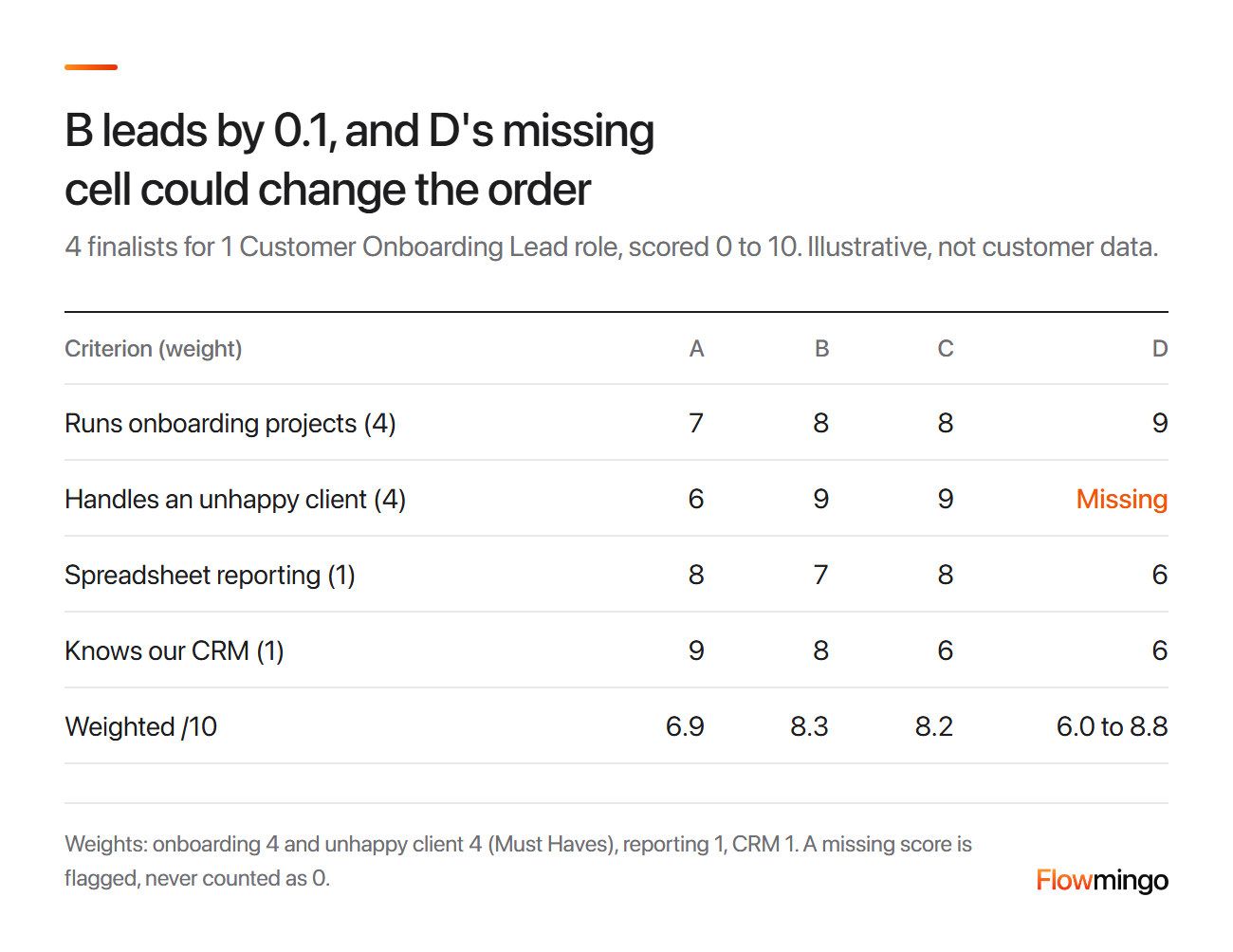
Candidate comparison matrix: B leads at 8.3, C has 8.2 and A has 6.9. Counting D's missing client score from 3 to 10 puts D between 6.0 and 8.8.
Reading across is what makes side by side work, and a 2016 lab study shows why. Evaluators picked candidates by their past scores on a task, seeing either 1 candidate at a time or 2 side by side, and could always pass and take a random one from the pool instead.
Judged 1 at a time, a stronger performer was picked 62% of the time and a weaker one 52%, a gap of 10 points that the study could not tell from chance. Side by side, it was 54% against 8%, a gap of 46 points, and the other 38% passed.
The study used task scores, not interviews, so applying it to finalists is our inference. To keep the rows comparable, each interviewer fills their cells from the same interview scorecard.
2.1 Can I paste 4 finalists' interview notes into ChatGPT and ask it to compare them?
Use it to sort notes into rows, not to pick the finalist. Ask it to place each note under a criterion as a quote, then check every quote against the source.
The reason to keep it away from the pick is that AI tools have order effects. In a 2026 study of 22 AI models by Rozado, the CV listed first won 63.5% of the time when the models chose between 2 equally qualified CVs.
Those were CVs rather than interview notes, so applying the result to notes is our inference. Even so, run the sort twice with the notes in a new order, because if the order changes the answer, the answer was the order.
Interview notes are also personal data, so check your AI tool's data terms before you paste anything in.
3. How do I compare candidates side by side when no interviewer met all 4 finalists?
Build the comparison on a row where the finalists answered the same questions, then swap quotes so each interviewer also scores the finalists they never met. Until you do, the numbers may measure the interviewers rather than the finalists.
In a 2013 meta-analysis, Huffcutt and colleagues pooled 125 earlier measurements of how closely interviewers agree, on a scale from 0, no agreement, to 1, full agreement.
Interviewers on the same panel agreed at 0.74, but interviewers who each held a separate interview agreed at only 0.44. So a 1-point gap between a finalist Nadia scored and one Ken scored may say more about Nadia and Ken than about the finalists.
In the grid, A, B and C answered the same AI interview questions on the client row, so that row is your common ground. For the other rows, swap quotes before the debrief: Nadia scores C's and D's quotes, and Ken scores A's and B's.
Both of them score against the same written anchors, the short descriptions of what a low, middle and high score looks like on each row.
If a quote's second score differs from its first by 3 or more points out of 10, the gap lies between the interviewers, not the candidates. When that happens on several rows, run the calibration in our guide to how to evaluate candidates consistently.
The swap only works because the questions were shared, which is the heart of a structured interview. Shared rows matter just as much when 1 finalist is internal, meaning they already work for you, though none of the 4 here is.
You know an internal finalist from their work and the others from their interviews, so score everyone on the same rows and anchors. The internal finalist's track record then counts only on the rows where it gives evidence, just as every other cell needs a quote behind its score.
How Flowmingo helps
Say every finalist did the same AI interview in an earlier round. Each criterion then has a score from 0 to 10 with a 3 to 5 sentence justification.
Flowmingo's How we score page says to compare candidates within the same role and criteria, which is the shared row this section needs.
4. How do I compare candidates side by side when one finalist is missing a whole interview?
Mark the empty cells as missing, never as 0 and never as the average of the others. Then fill them before the debrief with a short call on just those criteria, or call the decision provisional.
A single missing cell can decide the outcome on its own, because D's client row carries 4 of the 10 weight points. Count the gap as a 3, a low score for no evidence, and D's total is 6.0; had D scored a 10 there, it would be 8.8.
B's 8.3 sits inside that range, so nobody can rank B above D yet. In practice, book a 20-minute call that asks D the client questions the others answered, scored on the same anchors. Say D scores 5: D's total settles at 6.8, below B and C.
Never fill the gap with an impression, because an impression can make a prediction worse. In a 2013 study, Dana, Dawes and Peterson had students predict other students' grades from background information such as past grades.
Some of the predictions followed a free-form, unstructured interview and some did not. On a 0-to-1 scale where 1 is a perfect match, the predictions matched real grades at 0.61 without an interview and at only 0.31 after one.
The interviewers even formed confident views of students who were secretly answering at random.
A structured round leaves gaps too, because a candidate's answers do not always give evidence on every criterion. The card counts how often that happened in Flowmingo interview sets, each one the group of candidates who took the same AI interview.
Flowmingo data · 1,851 top-3 AI interview scorers · 617 interview sets · 297 companies · interviews 9 Jul to 11 Nov 2026
- 19.3% of the top 3 scorers in each interview set had at least 1 criterion the AI could not evaluate.
- 4.8% of the top 3 scorers in each interview set had a Must Have criterion the AI could not evaluate.
"Could not evaluate" means the answers gave no evidence on that criterion, not that the candidate lacks the skill. AI interview scores; the top 3 stand in for finalists.
So about 1 finalist in 5 arrives with an empty cell even after a structured round, and about 1 in 20 with an empty Must Have.
How Flowmingo helps
In a partly evaluated interview, Flowmingo counts a requirement it could not evaluate as 3.0 with its full weight, the same floor of 3 the grid above uses for D.
How we score tells you to check missing evidence before shortlisting, because an unanswered requirement may need a follow-up interview.
5. The hiring manager loves the last candidate we saw: recency, contrast or real signal?
Treat it as a contrast effect, a candidate looking stronger because the one before was weaker, until the grid shows otherwise. Check whether the last finalist leads on the rows, or only looked strong next to the person before.
Radbruch and Schiprowski, whose study opened this guide, measured that pull in about 29,000 admission interviews for a German study grant, in which candidates met evaluators almost at random.
The previous candidate's influence on a score was about 3 times that of the average other candidate. The pull also ran against the last vote: an evaluator who had just voted yes was about 6 percentage points less likely to vote yes on the next person.
That figure comes from the authors' working paper. The published study adds that the effect changed final admission and hiring decisions, and that breaks between interviews weakened it.
A whole day of interviews can do the same. In a 2013 study of more than 9,000 MBA admission interviews, Simonsohn and Gino found that interviewers marked the next applicant down after a strong day.
The drop was worth about 23 months of work experience, which is how much more an applicant would have needed to make up for it.
For example, say B interviewed last, at 4 pm on Wednesday, straight after A's weakest answer of the week, and the hiring manager now calls B "the best by far". On the grid, B leads C by 0.1 and ties C on both Must Haves, so "by far" is not in the evidence.
Before you accept the manager's view, test it 2 ways:
- Reorder the columns, so the last interview is not the last column.
- Ask row by row what B showed that C did not, and write it as a quote.
When you compare candidates side by side this way, a real signal survives the reshuffle and a contrast effect does not. For the next round, leave a break between back-to-back final interviews, since breaks weakened the previous candidate's pull in Radbruch and Schiprowski's study.
6. One finalist dazzled early and is everyone's favourite: how do we stop the halo effect?
Hide the totals and argue 1 row at a time, starting with the favourite's weakest row. The halo is the belief that a strong impression on 1 thing means strength on everything.
In a 1977 study, Nisbett and Wilson showed students 1 of 2 videos of the same lecturer, who acted either warm or cold.
The students who saw him warm found his appearance, mannerisms and accent appealing, and those who saw him cold found the same things irritating. Neither group realised that his warmth had done it.
First impressions are not pure noise, though. In a 2010 study, Barrick and colleagues found that ratings from the first minutes of rapport building predicted the final interview score at 0.42, on a 0-to-1 scale where 1 is a perfect prediction.
The authors say those early ratings may carry real signal about competence. That is why the fix is to check a first impression against the rows, not to ignore it.
The check matters because the person on top rarely leads on every row, even when the scores come from a structured AI interview rather than an impression.
Flowmingo data · 617 interview sets · 1,851 top-3 AI interview scorers · 297 companies · interviews 9 Jul to 11 Nov 2026
- 91.7% of interview sets had their top scorer outscored by the 2nd or 3rd on at least 1 criterion.
- 68.1% of the 601 sets with a Must Have criterion had their top scorer outscored on a Must Have.
- 47.2% of interview sets had each of their top 3 scorers leading outright on at least 1 criterion.
AI interview scores, not job performance. The top 3 by score stand in for finalists, and more Must Haves mean more chances to be outscored.
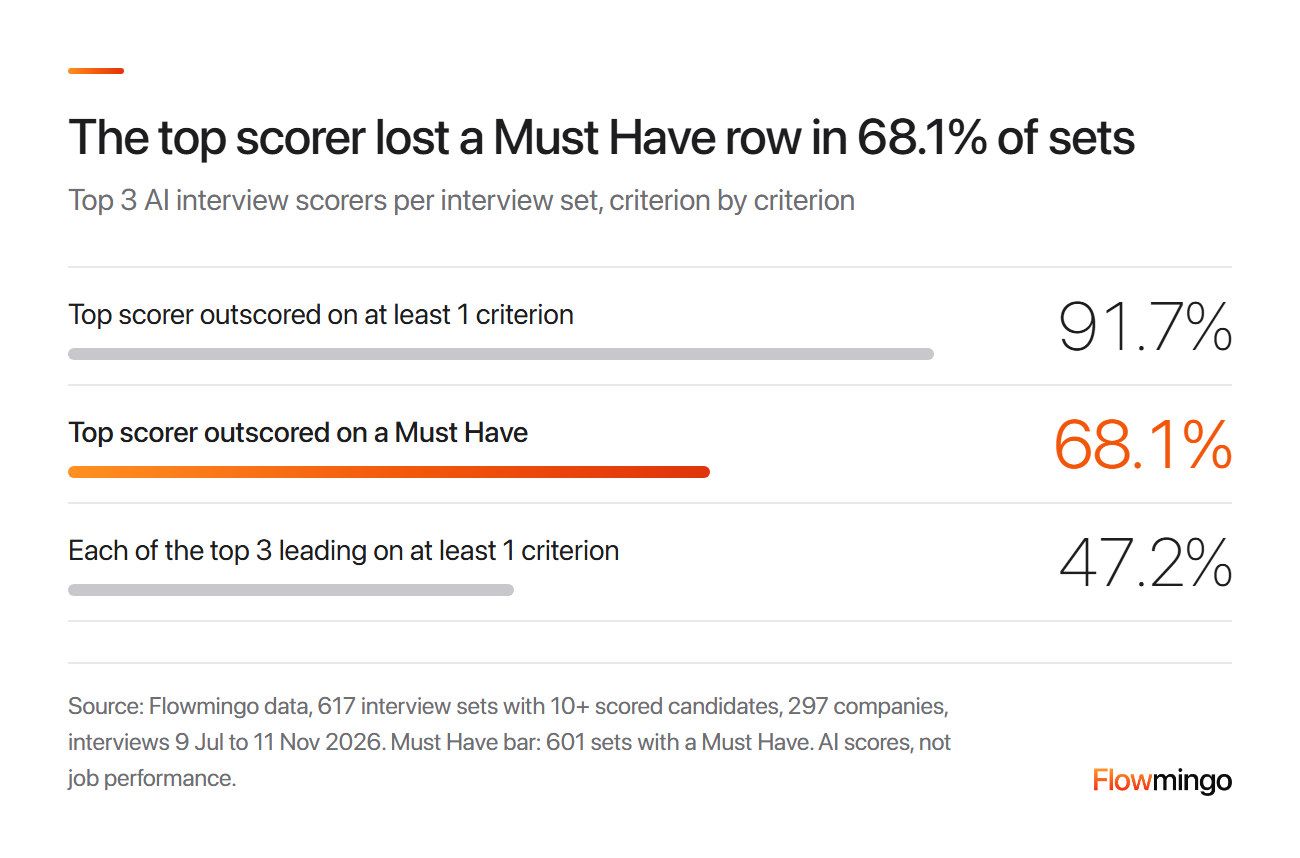
Rows inside the top 3: the top scorer was outscored on a criterion in 91.7% of sets, and on a Must Have in 68.1%.
In practice, cover the total row while you discuss, so the rows where the leader trails stay in view. Then ask for the quote behind the favourite's lowest row. If nobody has one, the score came from the halo, not from the evidence.
7. My gut says one finalist and the grid says another: which do I trust?
Trust the grid, unless you can write down the evidence it missed and the row it belongs to. A gut call you cannot place in a row is the very impression the grid exists to check.
In a 2013 meta-analysis, Kuncel and colleagues compared 2 ways of combining the same facts about applicants: a fixed formula, and people weighing the facts in their heads.
The formula predicted job performance at 0.44 on a 0-to-1 scale, and the people at 0.28. The authors call that an improvement in prediction of more than 50%.
Your gut still has a place, but at the end. In 1955, Daniel Kahneman had Israeli army interviewers rate 6 traits of each recruit first, and only then give an overall view.
His 2002 Nobel autobiography recalls that the interviews' predictive power rose to close to 0.30 from about 0.10, on the same scale as Kuncel's figures. The overall view, made after the 6 ratings, was by far the most predictive.
So write the gut reason in 1 sentence and find its row. Say the manager's gut says B, because "B will calm our angry clients". That fits the client row, where B and C both scored 9, so the gut adds nothing new.
A reason such as "C seemed flat" fits no row at all, so it stays out of this decision.
8. Our top 2 finalists are 0.1 apart when we compare candidates side by side: what tie-breaker is fair?
Call any gap of 0.2 or less out of 10 a tie, as our guide to candidate ranking does. Then break it by a rule written before the debrief: the Must Have rows, then any open evidence, then a short work sample.
You will need that rule often, because a near-tie at the top is the normal case rather than the exception.
Flowmingo data · 756 interview sets · 48,922 candidates · 334 companies · interviews 9 Jul to 11 Nov 2026
- 54.6% of interview sets had their top 2 AI interview scores within 0.2 points out of 10.
- 15.9% of interview sets had their top 2 AI interview scores exactly tied with each other.
- 87.8% of interview sets had their top 3 AI interview scores within 1.0 point of each other.
AI interview scores in sets with 10+ scored candidates, not job performance. The top 3 by score stand in for finalists, and bigger sets have more near-ties.
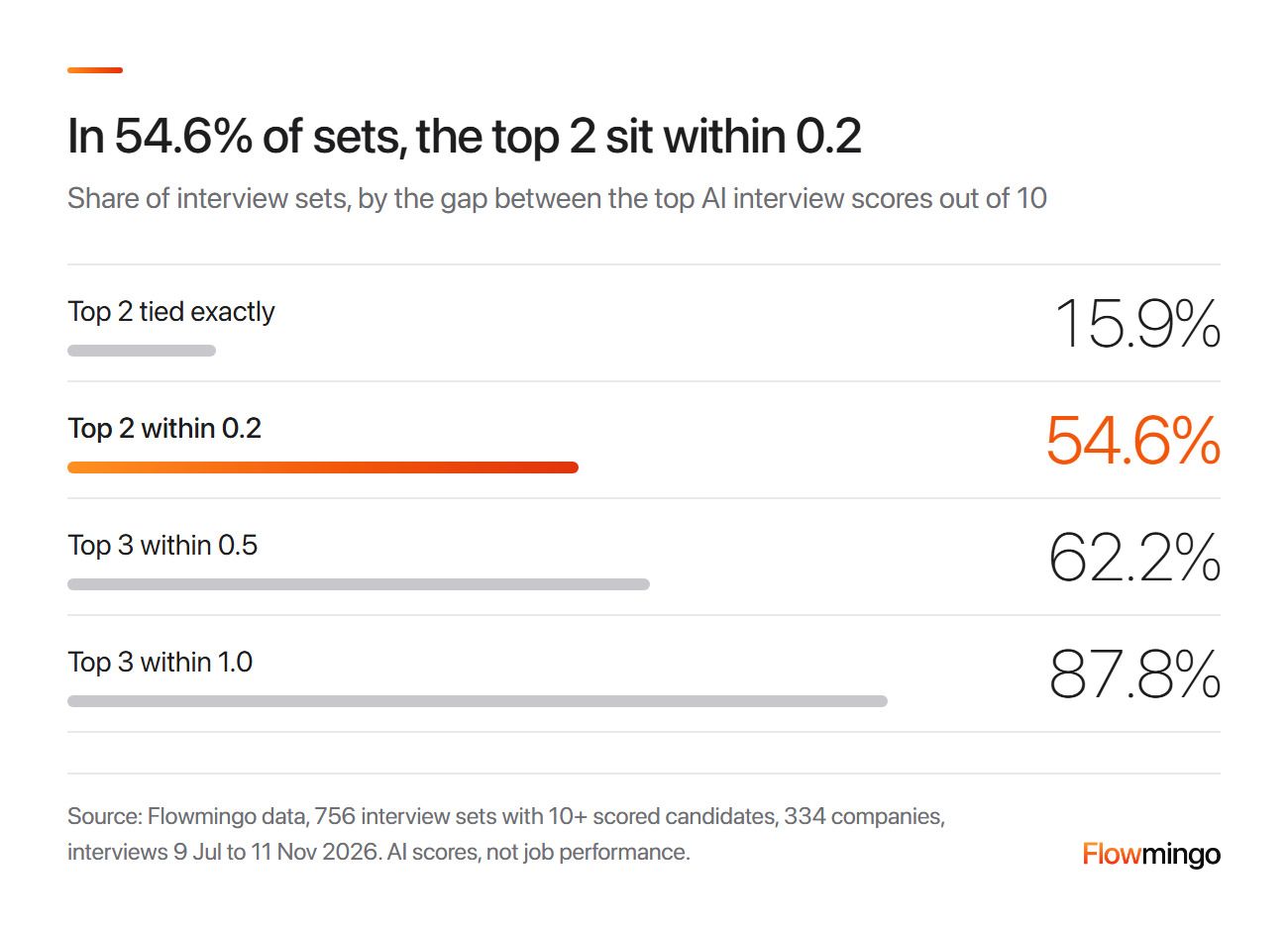
Top 2 gap in AI interview scores: tied exactly in 15.9% of sets and within 0.2 in 54.6%. The top 3 sat within 0.5 in 62.2% and within 1.0 in 87.8%.
So a tie line at 0.2 would send more than half of these top pairs to the tie-break. That is why the rule has to be written before the debrief, not argued out in it.
Here is the rule applied to B and C, at 8.3 and 8.2:
- The Must Have rows. Both scored 8 on onboarding and 9 on the client row, so neither separates them.
- Any open evidence. That means an empty cell or a question still waiting for an answer, and between B and C there is none.
- A 45-minute work sample on onboarding. Each plans a new client's first 30 days, scored on the same anchors.
A work sample makes a fair last step because it tests the job itself. In a 2022 re-analysis of hiring methods by Sackett and colleagues, work samples tracked job performance at 0.33, close behind structured interviews at 0.42.
Say C's plan names 3 risks and a go-live date, while B's lists tasks. That is a difference on onboarding, a Must Have, so C gets the offer.
What should never break a tie is gut feel or "culture fit", for the reasons our interview bias guide explains.
9. What agenda should a hiring debrief follow when 4 interviewers each back a different finalist?
Lock every score before the meeting, open with the evidence only 1 person heard, then go row by row with the Must Haves first. Apply the tie-break rule, and let the hiring manager decide in the room.
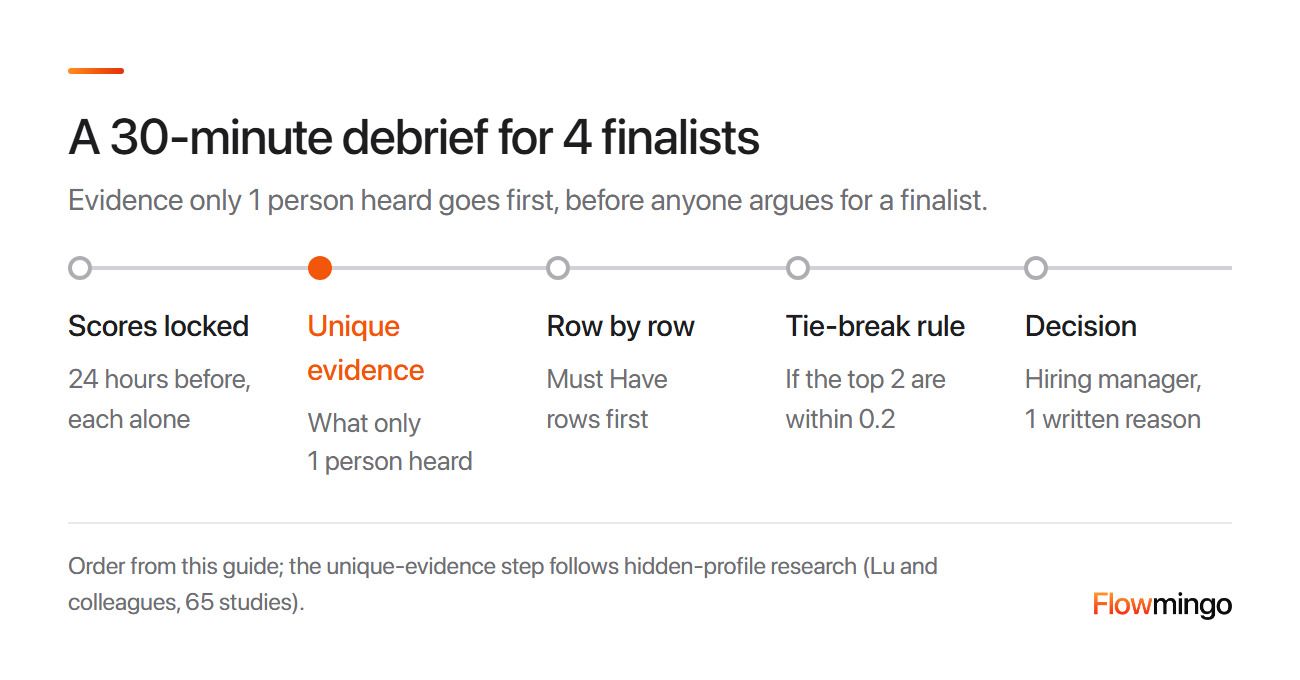
Debrief agenda: scores locked 24 hours before, then what only 1 person heard and the Must Have rows first. The tie-break rule applies within 0.2, then the hiring manager decides.
Here is the agenda for 4 finalists in 30 minutes:
- Before: scores locked, 24 hours ahead. Each interviewer fills their cells alone.
- First 5 minutes: unique evidence. Each person names what only they heard, such as why C's 2 launches slipped.
- Next 15 minutes: row by row. Must Have rows first, discussing only splits of 3 or more points.
- Then 5 minutes: the tie-break rule, only if the top 2 sit within 0.2.
- Last 5 minutes: the decision. The most senior person speaks last, and the hiring manager gives 1 written reason.
The order matters because groups talk most about what everyone already knows. In a 1985 study, Stasser and Titus gave each member of a mock political caucus part of the facts about the candidates.
Put together, those facts pointed to the best candidate. The groups talked over what they already shared instead, and chose the early favourite.
The finding held up in a 2012 meta-analysis by Lu and colleagues, which pooled 65 studies of 3,189 groups. Those whose information was split among members were 8 times less likely to find the best option than fully informed groups.
That is why the evidence only 1 person heard goes first, before anyone argues for a finalist.
UK guidance backs the first step, locking the scores. The code of practice that the UK's Equality and Human Rights Commission (EHRC) issued for employers in 2011 asks for marks made separately "before a final mark is agreed".
Decide in the room, because waiting costs people. In a 2026 Metaview survey of 505 recruiting leaders and hiring managers, 67% said they lose qualified candidates to faster rivals every month.
9.1 The panel and the hiring manager disagree on the finalist: who makes the final call?
The hiring manager decides, because they own the result, but only with a reason tied to a row of the grid. The panel's dissent goes into the decision note in 1 line.
Disagreement is normal, even between people who get on. In the same Metaview survey, 90% rated the recruiter and hiring manager relationship good or excellent, yet 58% wished they could work around their counterpart.
So agree before the debrief how you will settle a split. For example, the panel may ask for 1 more piece of evidence, and both views go in writing.
10. How do I write down why we picked finalist A over B, in case it's challenged?
Keep the grid, plus a short decision note: who decided, the deciding rows, the tie-break, each runner-up's gap and the date. Keep both for at least 1 year, and longer while any claim is still running.
Here is the decision note for the onboarding role, where C got the offer over B (illustrative, not customer data):
| Line | Example |
|---|---|
| Decided by | The hiring manager, after a 30-minute debrief |
| Scores | Locked 24 hours before, 16 of 16 cells filled |
| Deciding rows | The 2 Must Haves: B and C tied at 8 and 9 |
| Tie-break | Work sample: C named 3 risks and a go-live date |
| Runner-up gaps | B: tasks, no risks. A: client row 6. D: client row 5 |
| Dissent | None, or 1 line naming the row |
Every line points back to a cell on the grid, which is what makes the note hold up if the decision is challenged. How long to keep the grid and the note depends on where you hire.
In the US, the federal rule 29 CFR 1602.14 says to keep hiring records for 1 year from the date of the record or of the decision, whichever is later. If someone files a discrimination charge, you keep them until it closes.
In the UK, the same EHRC code asks for records that "justify each decision", or an employment tribunal may draw an adverse inference of discrimination from their absence.
In Singapore, the 2025 TAFEP guide from the Tripartite Alliance for Fair and Progressive Employment Practices says to keep a record of the interview, the assessment and the job offer for at least 1 year. This is general information, not legal advice.
10.1 How do I tell the runner-up finalist no without losing them for the next role?
Hold the runner-up until your first choice accepts, then call them yourself with 1 honest reason from the note. Make the open door specific: the role, who will call and when, and their consent to keep their details.
For example, call B and say: "Your onboarding plan was strong, and the other finalist covered the risks in more depth. I'll call you before we post the next lead role in March."
An email the same day confirms the call, so B has the promise in writing. Our candidate rejection email templates include a runner-up email you can start from.
How Flowmingo helps
Flowmingo is a free AI hiring platform. Each AI interview comes back with the recording, the transcript and a report scored against your criteria.
Copy each criterion's 0 to 10 rating into the finalist's cell on your grid, with an exact transcript phrase, not a paraphrase, as the quote. Then compare candidates side by side row by row, and run the AI interviews free on Flowmingo.
11. Sources
Every study, law, guide and survey in this guide links to a source below; Flowmingo figures come from Flowmingo's own platform data.
- Barrick, M. R., Swider, B. W., & Stewart, G. L. (2010). Initial evaluations in the interview: Relationships with subsequent interviewer evaluations and employment offers. Journal of Applied Psychology, 95(6), 1163-1172.
- Bohnet, I., van Geen, A., & Bazerman, M. (2016). When performance trumps gender bias: Joint vs. separate evaluation. Management Science, 62(5), 1225-1234.
- Chang, L. W., Kirgios, E. L., Mullainathan, S., & Milkman, K. L. (2024). Does counting change what counts? Quantification fixation biases decision-making. Proceedings of the National Academy of Sciences, 121(46), e2400215121.
- Dana, J., Dawes, R., & Peterson, N. (2013). Belief in the unstructured interview: The persistence of an illusion. Judgment and Decision Making, 8(5), 512-520.
- Equality and Human Rights Commission (2011). Equality Act 2010 code of practice: Employment statutory code of practice, paragraphs 16.44-16.50. EHRC.
- Huffcutt, A. I., Culbertson, S. S., & Weyhrauch, W. S. (2013). Employment interview reliability: New meta-analytic estimates by structure and format. International Journal of Selection and Assessment, 21(3), 264-276.
- Kahneman, D. (2002). Daniel Kahneman: Biographical. The Nobel Prize.
- Kahneman, D., Sibony, O., & Sunstein, C. R. (2021). Noise: A flaw in human judgment. Little, Brown Spark. As quoted by NPR Planet Money (2021, March 23), How to make job interviews less horrible.
- Kuncel, N. R., Klieger, D. M., Connelly, B. S., & Ones, D. S. (2013). Mechanical versus clinical data combination in selection and admissions decisions: A meta-analysis. Journal of Applied Psychology, 98(6), 1060-1072.
- Legal Information Institute (current text). 29 CFR 1602.14, preservation of records made or kept. Cornell Law School.
- Lu, L., Yuan, Y. C., & McLeod, P. L. (2012). Twenty-five years of hidden profiles in group decision making: A meta-analysis. Personality and Social Psychology Review, 16(1), 54-75.
- Metaview (2026). Inside the 2026 AI & Hiring Alignment Report. Metaview.
- Nisbett, R. E., & Wilson, T. D. (1977). The halo effect: Evidence for unconscious alteration of judgments. Journal of Personality and Social Psychology, 35(4), 250-256.
- Radbruch, J., & Schiprowski, A. (2025). Interview sequences and the formation of subjective assessments. The Review of Economic Studies, 92(2), 1226-1256. Working paper: IZA DP No. 14799 (2021).
- Rozado, D. (2026). Gender and positional biases in LLM-based hiring decisions: Evidence from comparative CV/resume evaluations. PeerJ Computer Science.
- Sackett, P. R., Zhang, C., Berry, C. M., & Lievens, F. (2022). Revisiting meta-analytic estimates of validity in personnel selection: Addressing systematic overcorrection for restriction of range. Journal of Applied Psychology, 107(11), 2040-2068.
- Simonsohn, U., & Gino, F. (2013). Daily horizons: Evidence of narrow bracketing in judgment from 9,000 MBA-admission interviews. Psychological Science, 24(2), 219-224.
- Stasser, G., & Titus, W. (1985). Pooling of unshared information in group decision making: Biased information sampling during discussion. Journal of Personality and Social Psychology, 48(6), 1467-1478.
- Thorndike, E. L. (1920). A constant error in psychological ratings. Journal of Applied Psychology, 4(1), 25-29.
- Tripartite Alliance for Fair & Progressive Employment Practices (2025, November). Fair recruitment and selection. TAFEP.