
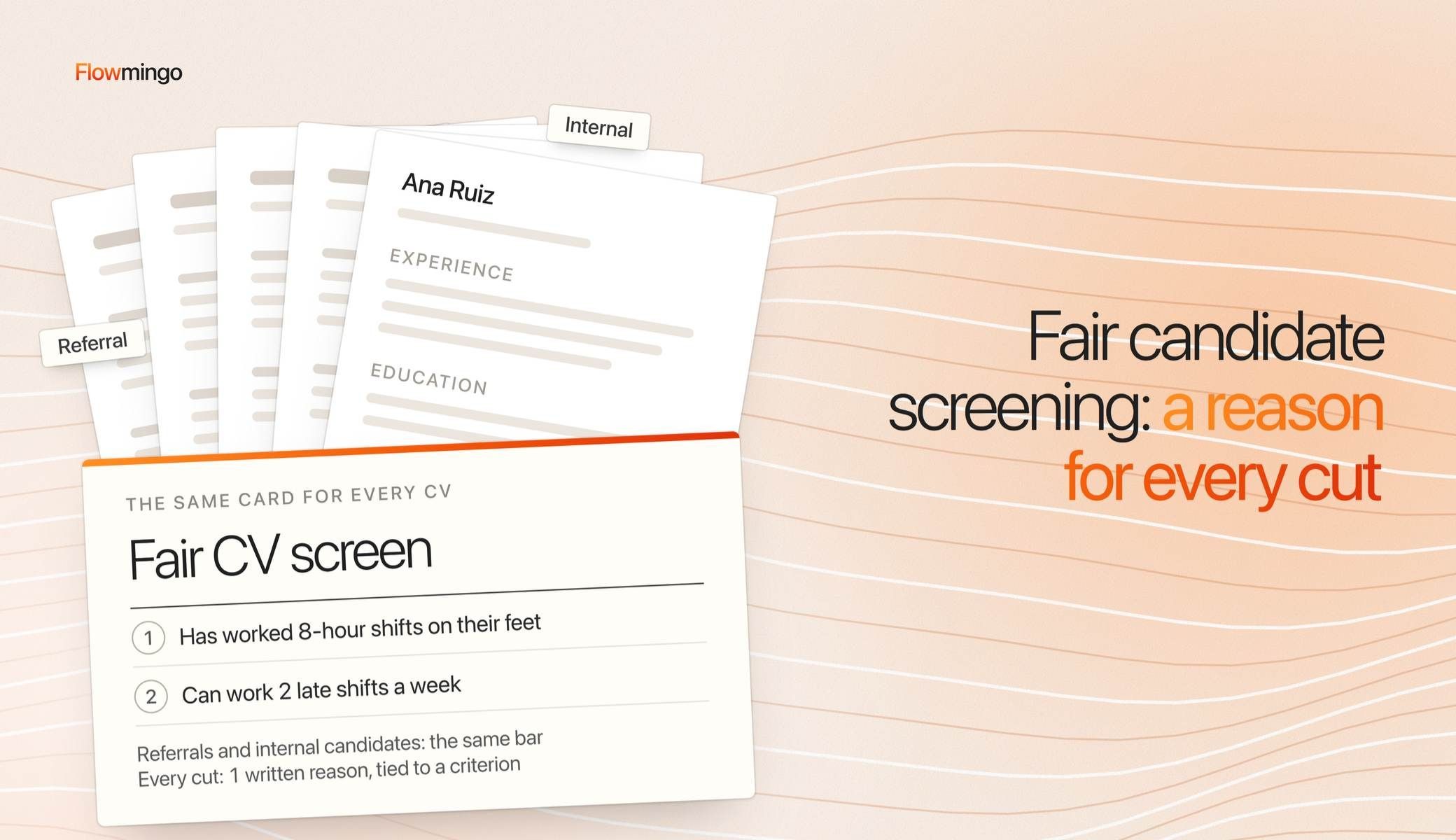
A candidate you cut at the CV stage has written to ask why, and legal wants your answer this week. With fair candidate screening, that answer takes 2 lines, because the screening criteria were written before the first CV and every cut already has its reason on file.
Soon, for some employers, that answer will also have a deadline. From 1 January 2027, an employer whose AI tool materially influences a Colorado hiring decision must explain a rejection within 30 days.
Fair hiring practices that live only in people's heads can't meet that clock. Nor can they show that racial bias in callbacks, which researchers have measured for decades, stayed out of your screen.
A 2017 meta-analysis of field experiments found that since 1989 white applicants got on average 36% more callbacks than matched African American applicants, with no change over 25 years (Quillian and colleagues).
Fairness you can prove rests on 2 things: every requirement traces to the work, and every applicant faces the same questions. Pass rates by group at each cut, and a written reason for each person who stops, show that both held.
Key takeaways
- What must fair candidate screening show on paper? Criteria with job reasons, the same questions for all and 1 reason per person cut, kept at least 1 year in the US.
- Could a degree or 5-year requirement count as adverse impact? Yes, if it screens out 1 group more without a job reason. In 878 Flowmingo projects, only 11.4% of degree criteria offered an equivalent route.
- Can a manager ask for only women or younger applicants? Almost never. In 1 US case, software that auto-rejected older applicants cost the employer $365,000.
- Does the 4/5ths rule still apply in the US? It is still in the federal rulebook on 22 November 2026, with a repeal under White House review, so keep running it.
- Which AI screening rules start next? Colorado for decisions from 1 January 2027, the EU on 2 December 2027 and Singapore's Workplace Fairness Act, a general anti-discrimination law rather than an AI rule, slated for end-2027.
1. Legal wants proof our CV screen is fair. What does fair candidate screening need on paper?
It needs a file that shows the bar came before the CVs and applied to everyone: criteria with job reasons, the same questions for all and 1 reason for each person cut.
Legal can't defend a feeling, because a memory rebuilt after a complaint persuades nobody. In the US, employers must keep application forms and hiring records for 1 year from the record or the decision, whichever is later (29 CFR 1602.14).
Colorado's new law sets a longer clock. For AI-assisted decisions made from 1 January 2027, it asks for at least 3 years of records (SB 26-189).
In practice, the file holds 6 records for every role:
- Criteria, version 1: each requirement, the task it stands for and the sign-off date, with a new version for any later change.
- Questions: the same screening questions, in the same order, for every applicant.
- A reason per person: the stage reached and the criterion that stopped them.
- Adjustments: what each applicant asked for and what you gave.
- Pass rates: the share passing each cut, by group where collected lawfully.
- AI use: the notice sent, the audit or test run and who reviewed the output.
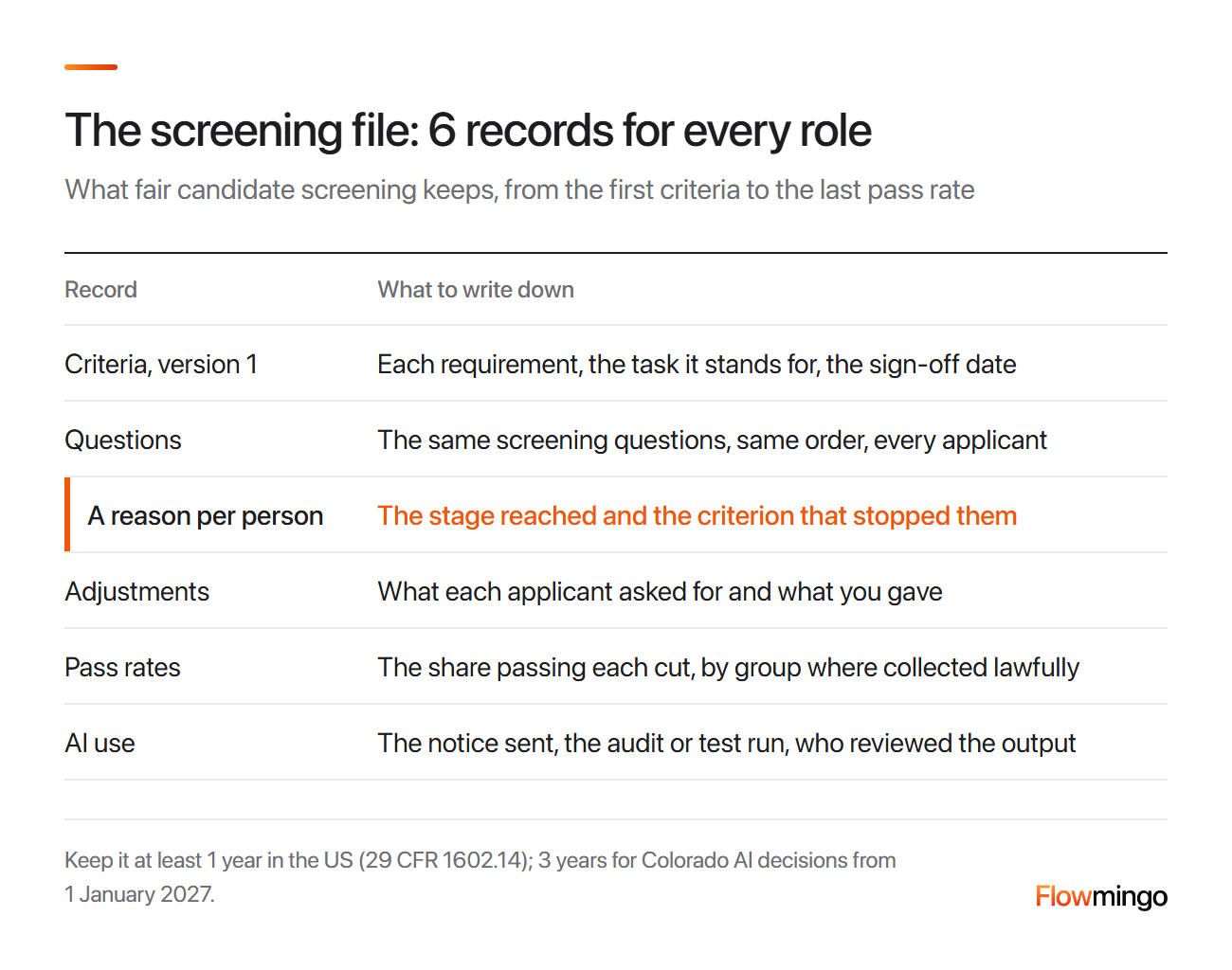
Screening file: 6 records that show the bar came first and applied to everyone, kept at least 1 year in the US.
If you also hire in Singapore, the criteria record matters there too. Singapore's Tripartite Guidelines on fair employment ask employers to select on merit, with criteria tied to the job's skills and experience.
Criteria often change mid-screen, and that is fine as long as the file shows it. Say your hiring manager adds Mandarin halfway through a 300-CV screen: log it as version 2, with its reason and the date.
Then re-score the CVs you already cut, or write down why the change can't affect them, because a bar applied to only half the pile is no longer the same bar for all. Our candidate shortlisting guide shows how to write the criteria before the first CV.
How Flowmingo helps
CV Evaluation drafts criteria from your job description, and you rename, rewrite or remove any of them. You rate each one from Must Have to Good to Have.
Every CV comes back scored out of 10 with the evidence for each criterion, and it stays in your list until you decide.
2. Could our degree and 5-year requirements count as adverse impact, and how do we justify them?
They can, if they screen out 1 group more than others and the job can't show it needs them. Write the job reason beside each one, and add an equivalent route such as "or 3 years running payroll".
Adverse impact is the legal name for that effect, and it is judged by the result, not the intent. Title VII, the US federal law on job discrimination, bars such a practice unless it is job related and consistent with business necessity (42 USC 2000e-2(k)).
The test began with Griggs v Duke Power, a 1971 case in which a high school diploma rule and an aptitude test screened out Black applicants. Neither had a shown link to job performance, so the US Supreme Court found both unlawful.
So, for each requirement, write 2 answers into the criteria record from section 1. The first is whether it cuts 1 group more, which you measure by comparing pass rates with the 4/5ths check in section 8.
The second is the task behind it, for example "handles 40 renewals a quarter alone" for "5+ years".
Years of experience struggle with that second answer, because they barely predict performance. In a 2022 re-analysis, Sackett and colleagues put years of job experience at 0.07 on a 0 to 1 scale of how well each predicts job performance, against 0.42 for structured interviews.
Flowmingo data · 5,064 hiring projects · 2,055 companies · 252,416 CVs scored 10 Jul to 11 Nov 2026
- 46.5% of hiring projects scored CVs on a degree line, a years-of-experience line or both.
- 82% of years-of-experience criteria carried the top weight, Must Have, against 47% of all criteria.
- 11.4% of degree criteria offered an equivalent route such as "or equivalent experience", in a narrower group of 878 projects, each with 10+ scored CVs from the company's own upload, shared link or job post.
AI drafts the criteria from each job description and teams may edit them. Matched by keyword and checked by hand on a sample. This counts criteria, not who was rejected: a criterion is weighted, never an automatic filter.
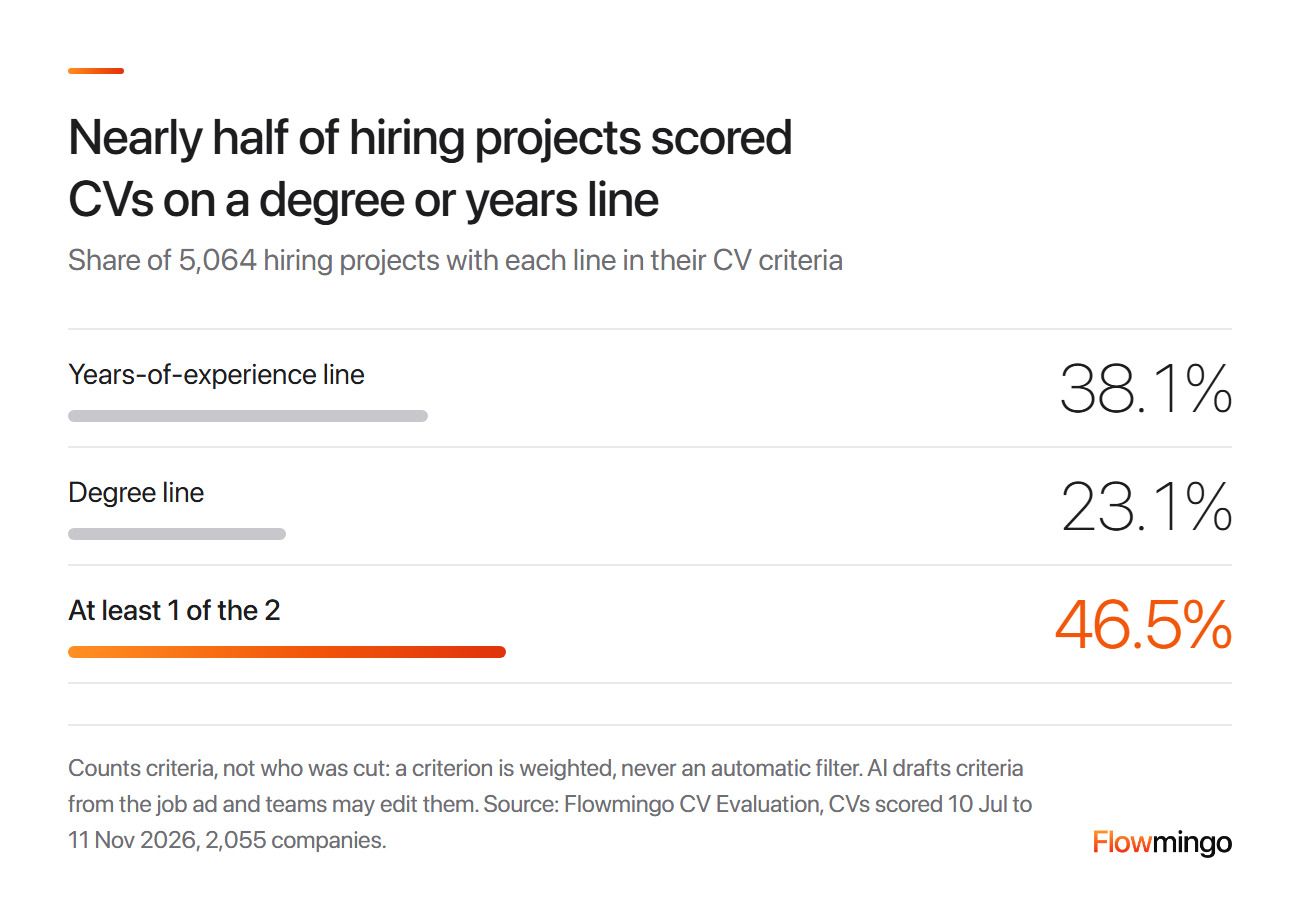
Degree and years lines: 38.1% of 5,064 hiring projects had a years line, 23.1% a degree line and 46.5% at least 1 of the 2.
Minimums like these, often called floors, are routine: a years line sat in 38.1% of projects, a degree line in 23.1% and 1 of the 2 in 46.5%. Most years lines carried the top weight, and in the narrower group only about 1 in 9 degree lines offered another route.
A yes/no screening question about minimum years faces the same test whenever you cut on its answer, because it is the same floor asked another way.
Flowmingo data · 6,221 answers · 6,002 applicants · 368 companies · yes/no screening questions, applications to 30 Sep 2026
- 80.5% of applicants answered Yes to a minimum-years-of-experience screening question, so about 1 in 5 answered No.
What applicants said, not checked, and only from people who submitted the form. Questions may be drafted by AI, then kept or edited by the team.
Our skills-based hiring guide shows how to rewrite each line and what to test once the degree line goes.
3. A manager wants only women or younger applicants. Can fair candidate screening filter on that?
Almost never: US law protects sex, and age from 40, and Singapore's guidelines say to select on merit regardless of age or gender. Turn the request into the job requirement behind it.
The request often hides a real need, for example pace on a busy shift. Screening on the need instead is legal, and it finds the 52-year-old who can keep that pace.
Filtering on age itself can be expensive. iTutorGroup programmed its tutor application software to reject women aged 55 or over and men aged 60 or over automatically, turning away more than 200 qualified US applicants.
In September 2023 it paid $365,000 to settle a suit by the EEOC, the federal agency that enforces US job discrimination law.
The risk can also sit inside the software. In audits reported in November 2024, the UK's data regulator, the ICO, found AI recruitment tools that let recruiters filter out people with protected characteristics (ICO).
Other tools inferred gender or ethnicity from an application, or even from just a name, instead of asking candidates directly.
Singapore's fair-employment body, TAFEP, says in its guidelines to avoid age as a criterion unless a legal rule requires it. A law is also on the way: the Workplace Fairness Act, which Singapore's Ministry of Manpower (MOM) says is slated to take effect at end-2027.
Singapore's Parliament passed the Act on 8 January 2025 (MOM). It bars adverse hiring decisions on 5 groups of traits, such as age, nationality, sex and disability, and firms with fewer than 25 employees are exempt at first (MOM fact sheet).
So answer the manager with a question about the work, as in these illustrative rewrites:
| Request | The need behind it | What you screen everyone on |
|---|---|---|
| "Someone young and energetic" | Pace on a busy shift | "Has worked 8-hour shifts on their feet" |
| "Only women, for the client" | Rapport with the client's customers | A scored role-play on a real customer scenario |
| "No mothers, the hours are long" | 2 late shifts a week | "Can work 2 late shifts a week", asked of all |
A question you ask everyone, scored the same way, is a requirement. A guess about a group is a filter.
4. We're choosing between blind CV review and a scoring rubric. Which makes our screen fairer?
Use both, in that order: hide what your criteria don't use, then score every CV on the same rubric. Hiding alone has helped in some trials and backfired in others.
The evidence comes from 3 European trials of anonymous applications, published between 2012 and 2015. Their results point both ways.
In Sweden, anonymous applications raised the chance that women and applicants of non-Western origin reached an interview (Åslund and Nordström Skans). Women also gained job offers in that study.
Minority applicants, though, were as far behind at the offer stage as under the usual process. For them, anonymity opened the door to the interview and no further.
In France, a trial run by the public employment service found the opposite: anonymous CVs widened the minority interview gap from 2.4 to 13 percentage points (Behaghel and colleagues). Our interview bias guide explains why that trial backfired.
In a German pilot at 8 organisations, a standard application form worked better than blacking out CVs by hand, which proved slow and error-prone (Krause and colleagues).
AI screeners read names too. In a 2024 study, Wilson and Caliskan tested 3 AI models that rank real CVs by how closely each matches a job description.
Across 9 occupations, the models significantly favoured White-associated names in 85.1% of cases and Black-associated names in 8.6%.
A correction the authors posted in August 2026 reversed the study's gender results but left these race results standing. Names, in other words, are worth hiding from software as well as from people.
In practice, drop the fields Singapore's TAFEP tells employers to remove from application forms, and hide the same on CVs:
- Age, gender, race, religion, marital status and family responsibilities.
- Disability, photographs and national service liability.
- Then anything your criteria don't use, such as the name and graduation years (our suggestion).
Then score each CV per criterion against written anchors, short descriptions of what each score looks like, because hiding ends when the person walks in and the rubric does not. That pairing is the core of fair candidate screening at the CV stage.
5. Do referrals and internal candidates have to pass the same screen as every other applicant?
Yes. A referral can earn a faster read, never an easier bar: same criteria, same questions, same way of scoring.
Referral pools tend to look like the team you already have. Wisconsin's civil rights office notes that referral recruiting "may be unlawful if the current workforce is not representative of the area population" (Wisconsin DWD).
Asking everyone the same questions also lets you compare answers side by side. In a 2016 study, evaluators who did that based their decisions more on performance (Bohnet and colleagues).
Evaluators who judged 1 candidate at a time leaned more on gender stereotypes. So score your first round question by question: every answer to question 1, then every answer to question 2.
Say a VP forwards a friend's CV with "great guy, fast-track him". Log the referral, then run the CV through the same criteria and first-round questions. If it scores 5.8 and your cut is 6.5, the note doesn't move it, and you tell the VP which criterion fell short.
Internal candidates get the same screen, because a manager who already knows them brings an opinion into it. Write down who may skip the CV screen, if anyone, and why.
How Flowmingo helps
Applicants do the AI interview in their own time, from a shared base interview and your written criteria. You mark the questions that must always be asked.
When an answer is thin or off topic, the AI asks a follow-up, so follow-ups can differ by answer. The recording and transcript sit beside each score.
6. A candidate asks for extra time or another format. What adjustments do we owe at screening?
Offer every applicant the same chance to ask, then give what is reasonable: more time, another format or a retake when the tech fails. Write down what was asked for and what you gave.
A timed or recorded format can end up measuring a disability instead of the skill. When that happens, it is the format that may have to change.
In the UK, when a practice puts a disabled person at a substantial disadvantage, the employer must take reasonable steps to avoid it (Equality Act 2010, s.20). The Act also bars health questions before an offer, except to learn whether an assessment needs adjusting (s.60).
In New York City, an employer using an automated hiring tool must give candidates a notice that says how to ask for a reasonable accommodation, according to the city's consumer protection agency (DCWP).
The notice can go in the job ad, by email or on the careers page, at least 10 business days before the tool is used.
Candidates also start out wary of AI. In a 2025 Gartner survey of 2,918 job candidates, only 26% trusted AI to evaluate them fairly.
So ask about adjustments, never about health, and ask everyone. Put this line in every invitation, word for word:
"If anything about this format makes it harder to show your skills, reply and tell us what would help, for example more time or written answers. You don't need to tell us why."
Log the request and the change in the screening file. If 3 people ask for written answers in 1 week, the format itself needs a second look.
How Flowmingo helps
Candidates take the interview in their own time and choose from the 60+ languages you allow. Flowmingo's plans set the length: an interview runs up to 20 minutes on Free, 30 on Starter and 60 on Growth and Scale.
You can allow a retake, which creates a new attempt and keeps the earlier one.
7. When can we run a criminal background check, and can we reject anyone with a record?
Run it last, after a conditional offer, and only for what the job needs. Before you pull an offer over a record, show the applicant the report and give them time to respond.
Order matters because an early question about records changes who gets read at all. In a 2018 field experiment, employers that asked about records were 63% more likely to call applicants with no record (Agan and Starr).
There was a catch. At firms that removed that question, the white-Black callback gap grew from 7% to 43%.
The authors' best interpretation is that employers, no longer able to ask, guessed who had a record from race, relying on exaggerated impressions of real-world racial differences in felony conviction rates.
So moving the check later is only half the fix. It helps fair candidate screening only if the CV screen also stays on written criteria, so each cut rests on a job reason rather than a guess about who has a record.
In New York City, employers with 4 or more employees may not consider criminal history before a conditional offer (NYC Commission on Human Rights). California's Fair Chance Act generally bars employers with 5 or more employees from asking about convictions before a job offer.
New York City also sets the steps for taking an offer back. The employer shares the background check and a written Fair Chance Analysis, then gives the applicant at least 5 business days to respond.
On 29 October 2026, the EEOC announced that it had rescinded its 2012 guidance on arrest and conviction records. Title VII still bars race and national-origin discrimination, though, and state and local laws still apply (Morgan Lewis).
When a screening company runs the check, the Fair Credit Reporting Act requires a standalone written disclosure and written consent first. Before you act on the report against the applicant, give them a copy and a summary of their rights (15 USC 1681b).
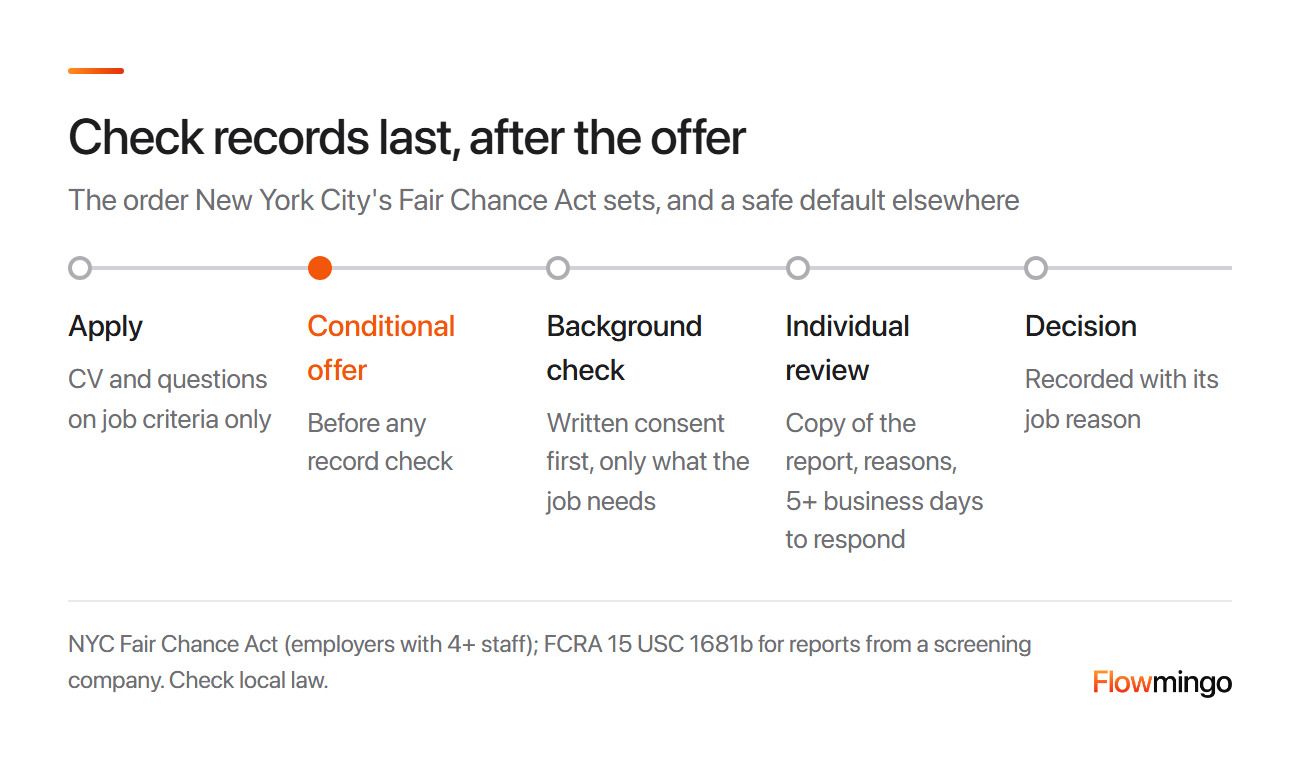
Fair chance order: screen on job criteria, make the offer, then check, review and decide, with 5+ business days to respond in NYC.
The figure above sets out that order in 5 steps:
- Apply: applicants are screened on job criteria only.
- Conditional offer: it comes before any record check.
- Background check: it covers only what the job needs.
- Individual review: you share the report and your reasons, then give the applicant time to respond.
- Decision: you record it with its job reason.
8. We use AI to rank 400 CVs. How do I run the 4/5ths rule on it?
Divide each group's pass rate at a cut by the highest group's rate to get its impact ratio. A ratio under 80% is the classic sign of adverse impact, so check the criterion behind it before you go on.
The rule comes from the federal Uniform Guidelines on employee selection, adopted in 1978, which also warn that small samples can mislead. As of 22 November 2026, the rule is still in the eCFR, the federal rulebook online.
It is under pressure, though. On 9 June 2026, the Justice Department's Office of Legal Counsel called the guidelines an unconstitutional reading of Title VII.
On 16 October 2026, the EEOC sent a final rule rescinding the guidelines' interpretive parts to White House review (Ogletree). The EEOC's agenda lists the rescission for November 2026, effective January 2027 (Ogletree).
Keep the check anyway, because private plaintiffs can still bring disparate-impact claims, the lawsuits over adverse impact, under Title VII. New York City's bias audits of AI hiring tools, covered in section 9, must also report impact ratios by sex and race or ethnicity (DCWP).
Here is the arithmetic on illustrative numbers: an AI ranks 400 CVs, and you shortlist the top 80.
| Group | Applicants | Shortlisted | Pass rate |
|---|---|---|---|
| Group A | 240 | 60 | 25% |
| Group B | 160 | 20 | 12.5% |
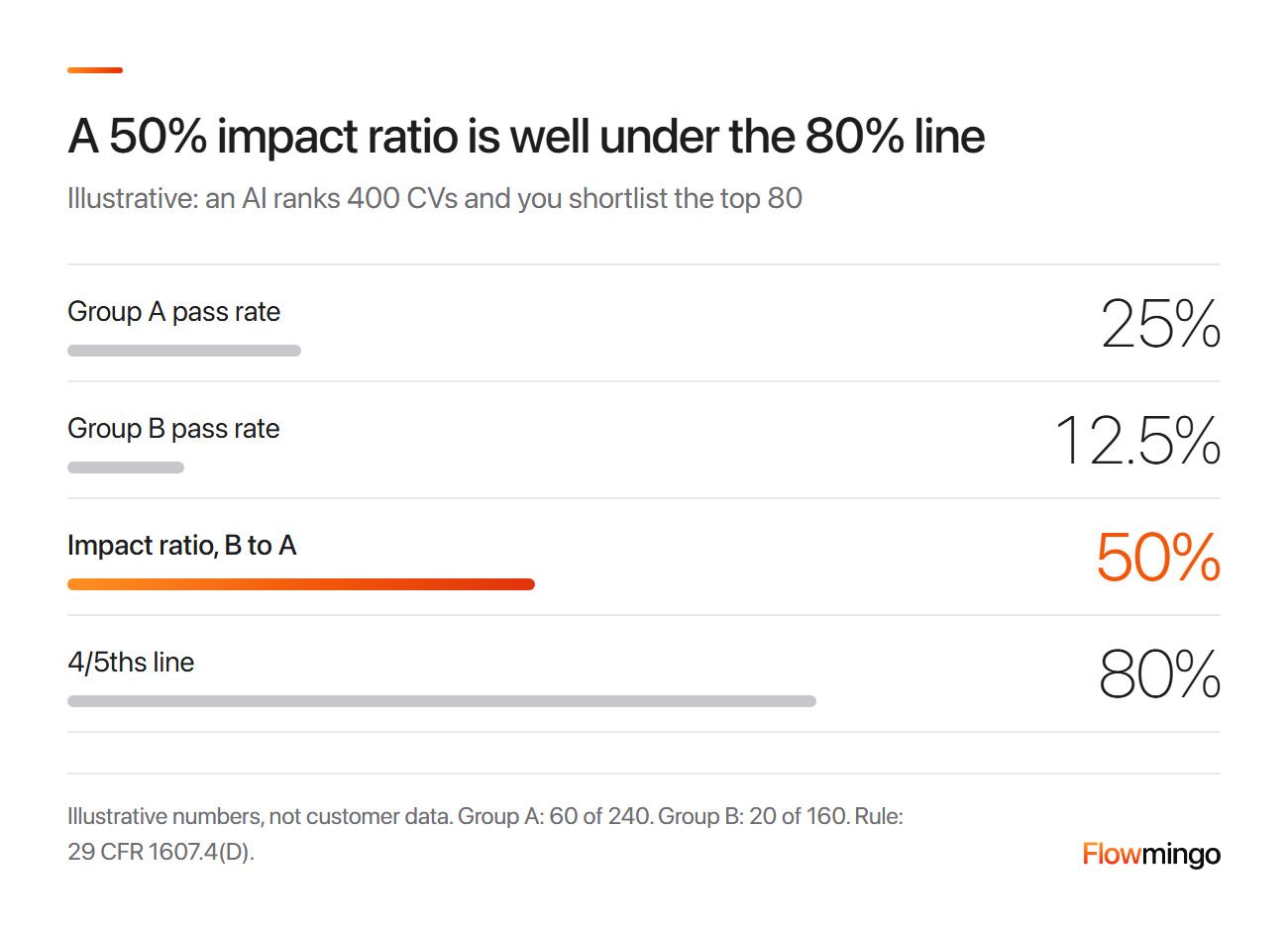
4/5ths check, illustrative: Group A passes at 25% and Group B at 12.5%, so the impact ratio, B to A, is 50%.
Group B passes at half Group A's rate, an impact ratio of 50%, well under the 4/5ths line of 80%. To find the criterion behind the gap, re-run the ranking without 1 criterion at a time, starting with any years floor.
If the ratio climbs past the line without that floor, the floor was doing the cutting, and section 2 says what to do. In a group of 10, 1 person moves the rate by 10 points, so read small groups with care.
The same test can reach the vendor. On 16 May 2025, a US federal court preliminarily certified a nationwide age claim against Workday, a screening vendor (Holland & Knight).
The claim covers applicants aged 40 and over who were denied employment recommendations through Workday's platform. The order lets the claim go forward as a group; it is not a decision on the merits.
9. Which fair candidate screening rules apply to AI in NYC, Illinois, Colorado, the EU and Singapore?
New York City and Illinois rules apply now, and Colorado starts with decisions from 1 January 2027. The EU's high-risk duties follow on 2 December 2027, and Singapore's Act is slated for end-2027.
Start with the 2 rules already in force, in New York City and Illinois, because each requires a notice about your AI use. That notice belongs in your job ads or careers page now, before any tool scores an applicant (in New York City, at least 10 business days before).
The written reasons from section 1 then feed Colorado's 30-day explanation.
Each rule has its own trigger. For an employer, New York City's rule applies when the job is based at an office in the city, at least part time, or is a remote job tied to an office there (DCWP).
Colorado's law covers job applicants who live in Colorado, plus anyone a business operating there assesses for an opportunity in the state (SB 26-189). This is general information, not legal advice.
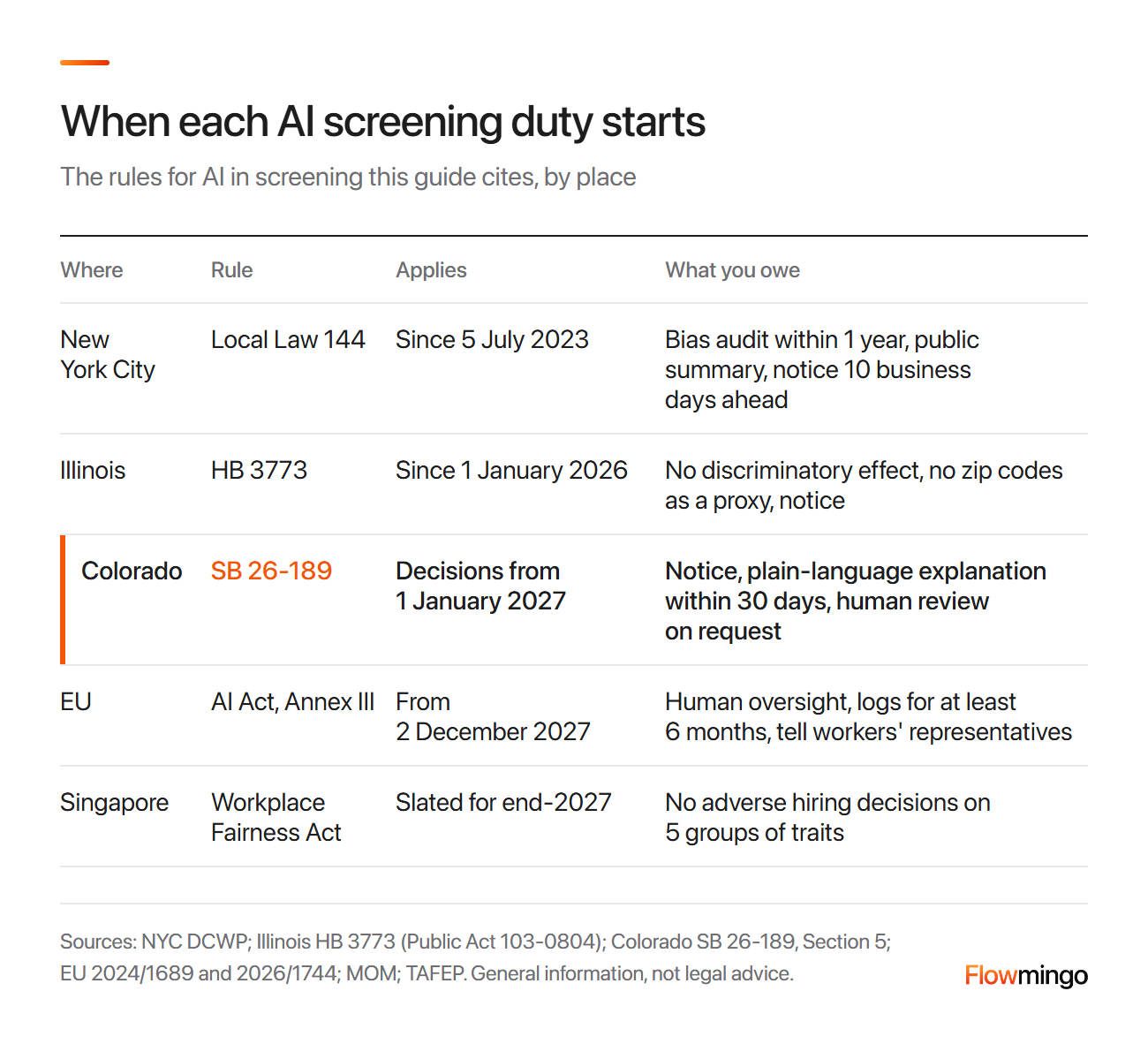
AI screening rules: NYC and Illinois apply now, Colorado from 1 January 2027, the EU from 2 December 2027 and Singapore slated for end-2027.
New York City. Local Law 144 requires a bias audit within 1 year before an automated tool is used, a public summary of the results and notice to candidates 10 business days ahead. The city has enforced it since 5 July 2023.
Illinois. Since 1 January 2026, HB 3773 has barred employers from using AI with a discriminatory effect in recruitment and hiring (Public Act 103-0804). They may not use zip codes as a proxy for a protected group, and they must give notice that they use AI.
Colorado. For decisions from 1 January 2027, SB 26-189 reaches a CV cut that an AI tool materially influences (signed act, Section 5).
Under that law, you tell applicants before the tool scores anyone. Within 30 days of a cut, you give a plain-language reason and the tool's part in it, and you allow human review on request where commercially reasonable.
EU. The AI Act lists AI that analyses and filters job applications or evaluates candidates as high-risk (Annex III). A 2026 amendment moved the start of its high-risk duties for such tools to 2 December 2027 (Regulation 2026/1744).
Employers using such a tool need human oversight with real authority, logs kept for at least 6 months and workers' representatives informed first (Article 26).
Singapore. The Workplace Fairness Act, a general anti-discrimination law rather than an AI rule, is slated for end-2027 (TAFEP). The Tripartite Guidelines apply now (section 3).
9.1 Do we have to tell applicants an AI screened them, and must a person review every rejection?
In New York City, Illinois and Colorado, yes, and Colorado adds human review on request where commercially reasonable. Everywhere else, a person reviewing each AI-ranked cut is the safer default.
In March 2026, the UK's ICO said candidates must be told about automated decisions, with a route to challenge one and get human review. A notice can do that in 3 sentences, as in this example:
"We use [tool name] to score your CV against the written criteria for this job. A member of our team reviews every score before any decision. To ask for another format or a human review, reply to this email."
How Flowmingo helps
Flowmingo's AI ethics page says a person makes the hiring decision, and candidates can ask for human review by writing to compliance@flowmingo.ai.
It also says Flowmingo has not commissioned a third-party algorithmic bias audit and does not claim conformity with the EU AI Act. You stay the decision-maker, including under any local rule on automated assessment.
10. What does a fair candidate screening checklist look like for the next role we open?
It's 10 checks, from criteria sign-off before the job ad to a pass-rate review after the first cut.
The order follows the screen itself, because a check made after the cut can't change who was cut. For example, a years floor found at check 2 costs a 5-minute rewrite, while the same floor found at check 9 costs a re-screen.
- Write each criterion as a task with its job reason, signed off as version 1.
- Keep a degree or years floor only with a reason and an equivalent route.
- Strip age, gender, photo and other traits from the form and the CV view.
- Ask everyone the same screening questions, in the same order.
- Put the AI notice in the job ad or careers page before any tool scores (10 business days ahead in New York City), and the adjustments line in every invitation; log each request.
- Send referrals and internal candidates through the same screen.
- Score per criterion against written anchors, question by question.
- Record 1 reason per person cut, tied to a criterion.
- Run the 4/5ths check at each cut, and test the criterion behind any gap.
- Keep the file at least 1 year in the US, or 3 years for Colorado AI decisions.
Written down, these turn good intentions into a record you can show a lawyer, a regulator or the candidate who asked why.
How Flowmingo helps
Flowmingo is a free AI hiring platform: CV evaluation, AI interviews and an applicant tracking system (ATS) in 1 hiring project, with every score beside its evidence. How we score shows the arithmetic, and the AI ethics page lists what we have and haven't done.
Start your next role on Flowmingo and keep every criterion, score and its evidence for your fair candidate screening file.
11. Sources
Every law, study and survey in this guide links to a source below; Flowmingo figures come from Flowmingo's own platform data.
- Agan, A., & Starr, S. (2018). Ban the box, criminal records, and racial discrimination: A field experiment. The Quarterly Journal of Economics, 133(1), 191-235.
- Åslund, O., & Nordström Skans, O. (2012). Do anonymous job application procedures level the playing field?. ILR Review, 65(1), 82-107.
- Behaghel, L., Crépon, B., & Le Barbanchon, T. (2015). Unintended effects of anonymous résumés. American Economic Journal: Applied Economics, via J-PAL.
- Bohnet, I., van Geen, A., & Bazerman, M. (2016). When performance trumps gender bias: Joint vs. separate evaluation. Management Science, 62(5), 1225-1234.
- California Civil Rights Department. (n.d., read 2026). Fair Chance Act. State of California.
- Colorado General Assembly. (2026). SB26-189: Automated decision-making technology. Colorado General Assembly.
- Colorado General Assembly. (2026, May 14). Senate Bill 26-189, signed act. Colorado General Assembly.
- Electronic Code of Federal Regulations. (1978, current text). 29 CFR Part 1607: Uniform Guidelines on Employee Selection Procedures. eCFR, checked 22 November 2026.
- Electronic Code of Federal Regulations. (1978, current text). 29 CFR 1607.4: Information on impact. Legal Information Institute.
- European Union. (2024). Artificial Intelligence Act, Annex III: High-risk AI systems. EU Artificial Intelligence Act.
- European Parliament and Council. (2024). Regulation (EU) 2024/1689, the Artificial Intelligence Act. Official Journal of the European Union.
- European Parliament and Council. (2026). Regulation (EU) 2026/1744 amending Regulation (EU) 2024/1689, the Digital Omnibus on AI. Official Journal of the European Union.
- Gartner. (2025, July 31). Gartner survey shows just 26% of job applicants trust AI will fairly evaluate them. Gartner newsroom.
- Holland & Knight. (2025, May). Federal court allows collective action lawsuit over alleged AI hiring bias. Holland & Knight.
- Illinois General Assembly. (2024). Public Act 103-0804 (HB 3773). ILGA.
- Information Commissioner's Office. (2024, November). AI tools in recruitment: Audit outcomes report. ICO.
- Information Commissioner's Office. (2026, March 31). Blog post on automated decisions in recruitment and the safeguards they need. ICO.
- Krause, A., Rinne, U., & Zimmermann, K. F. (2012). Anonymous job applications in Europe. IZA Journal of European Labor Studies, 1, 5.
- Ministry of Manpower, Singapore. (2024, November 12). Fact sheet: Introduction of Workplace Fairness legislation to preserve and entrench fair and harmonious workplace norms. MOM.
- Ministry of Manpower, Singapore. (2025, January 8). Passing of Workplace Fairness Bill marks next step in building fair and harmonious workplaces. MOM.
- Ministry of Manpower, Singapore. (2025, November 4). Workplace Fairness (Dispute Resolution) Bill provides framework for resolving workplace discrimination disputes amicably and expeditiously. MOM.
- Morgan Lewis. (2026, October 30). EEOC rescinds guidance on employers' use of arrest and conviction records in employment decisions. Morgan Lewis.
- NYC Commission on Human Rights. (2021, read 2026). Fair Chance Act: legal enforcement guidance. City of New York.
- NYC Department of Consumer and Worker Protection. (n.d., read 2026). Automated employment decision tools (AEDT). City of New York.
- NYC Department of Consumer and Worker Protection. (2023). Automated employment decision tools: Frequently asked questions. City of New York.
- Office of Legal Counsel, U.S. Department of Justice. (2026, June 9). Constitutionality of disparate-impact liability under Title VII. U.S. Department of Justice.
- Ogletree Deakins. (2026, July 7). The EEOC's regulatory agenda: 10 signs of intent. Ogletree Deakins.
- Ogletree Deakins. (2026, October 21). EEOC sends OIRA final rule rescinding Uniform Guidelines on Employee Selection Procedures. Ogletree Deakins.
- Quillian, L., Pager, D., Hexel, O., & Midtbøen, A. H. (2017). Meta-analysis of field experiments shows no change in racial discrimination in hiring over time. Proceedings of the National Academy of Sciences, 114(41), 10870-10875.
- Sackett, P. R., Zhang, C., Berry, C. M., & Lievens, F. (2022). Revisiting meta-analytic estimates of validity in personnel selection: Addressing systematic overcorrection for restriction of range. Journal of Applied Psychology.
- Tripartite Alliance for Fair and Progressive Employment Practices. (n.d., read 2026). Tripartite Guidelines on Fair Employment Practices. TAFEP.
- Tripartite Alliance for Fair and Progressive Employment Practices. (n.d., read 2026). Preparing job application forms. TAFEP.
- Tripartite Alliance for Fair and Progressive Employment Practices. (n.d., read 2026). Workplace Fairness. TAFEP.
- UK Parliament. (2010). Equality Act 2010, section 20: Duty to make adjustments. legislation.gov.uk.
- UK Parliament. (2010). Equality Act 2010, section 60: Enquiries about disability and health. legislation.gov.uk.
- U.S. Code. (current text). 15 USC 1681b: Permissible purposes of consumer reports. Legal Information Institute.
- U.S. Code. (current text). 42 USC 2000e-2: Unlawful employment practices. Legal Information Institute.
- U.S. Code of Federal Regulations. (current text). 29 CFR 1602.14: Preservation of records made or kept. Legal Information Institute.
- U.S. Equal Employment Opportunity Commission. (2023, September 11). iTutorGroup to pay $365,000 to settle EEOC discriminatory hiring suit. EEOC.
- U.S. Supreme Court. (1971). Griggs v. Duke Power Co., 401 U.S. 424. Legal Information Institute.
- Wilson, K., & Caliskan, A. (2024; erratum 2026). Gender, race, and intersectional bias in resume screening via language model retrieval. Proceedings of the AAAI/ACM Conference on AI, Ethics, and Society; arXiv.
- Wisconsin Department of Workforce Development. (n.d., read 2026). Fair hiring and avoiding discriminatory interview questions. Equal Rights Division.