
If you searched for a job posting template, you probably got posters to decorate and Word files to download. Neither tells you what to write, and the words decide who applies.
The search results explain why. Of the top 10 Google results, 7 are galleries of pictures or file downloads, and only 1, Indeed's guide, prints a job ad template as text you can copy.
That matters because a weak ad costs you twice: too few people apply, or hundreds do and you read every CV by hand.
A weak ad can also be an illegal one. In 14 US states plus DC, an ad without a pay range can break the law: the law firm Jackson Lewis lists 11 such states, and 3 more, Virginia, Maine and Connecticut, joined in 2026.
Most of what separates a good shortlist from an empty inbox or a flood sits at the 2 ends of the ad. At the top, pay, place and schedule are what draw applicants, so this guide puts them in line 2, right under the title.
At the bottom, the apply link decides whether hundreds of applicants arrive as a pile of CVs or as answers you can score, with a person making the call.
Flowmingo, the company publishing this guide, runs a free AI hiring platform, and some figures below come from job posts and hiring projects on it.
Key takeaways
- What goes first in a job posting template? Pay, place and schedule, in line 2 under the title (our practice). At the same salary, flexible jobs drew 62% to 92% higher application rates in a job-board experiment.
- Do I have to put the pay range in the ad? In many places, yes: in 14 US states plus DC, some from 1 employee, and in Singapore for Employment Pass and S Pass roles.
- Does showing pay get more applicants? Probably. Indeed reports 3.8 times more applications for jobs with an employer-provided salary, but that is its own figure, with no published method.
- Will a longer ad get more applicants? Not on its own. At the 386 Flowmingo employers that wrote both shorter and longer posts, the median gap was 0.
- Where should the apply link go? To 1 short scored step, with a person deciding. Say so in the ad, because only 26% of candidates trust AI to judge them fairly.
1. Can I get a job posting template I can copy and paste, not a poster?
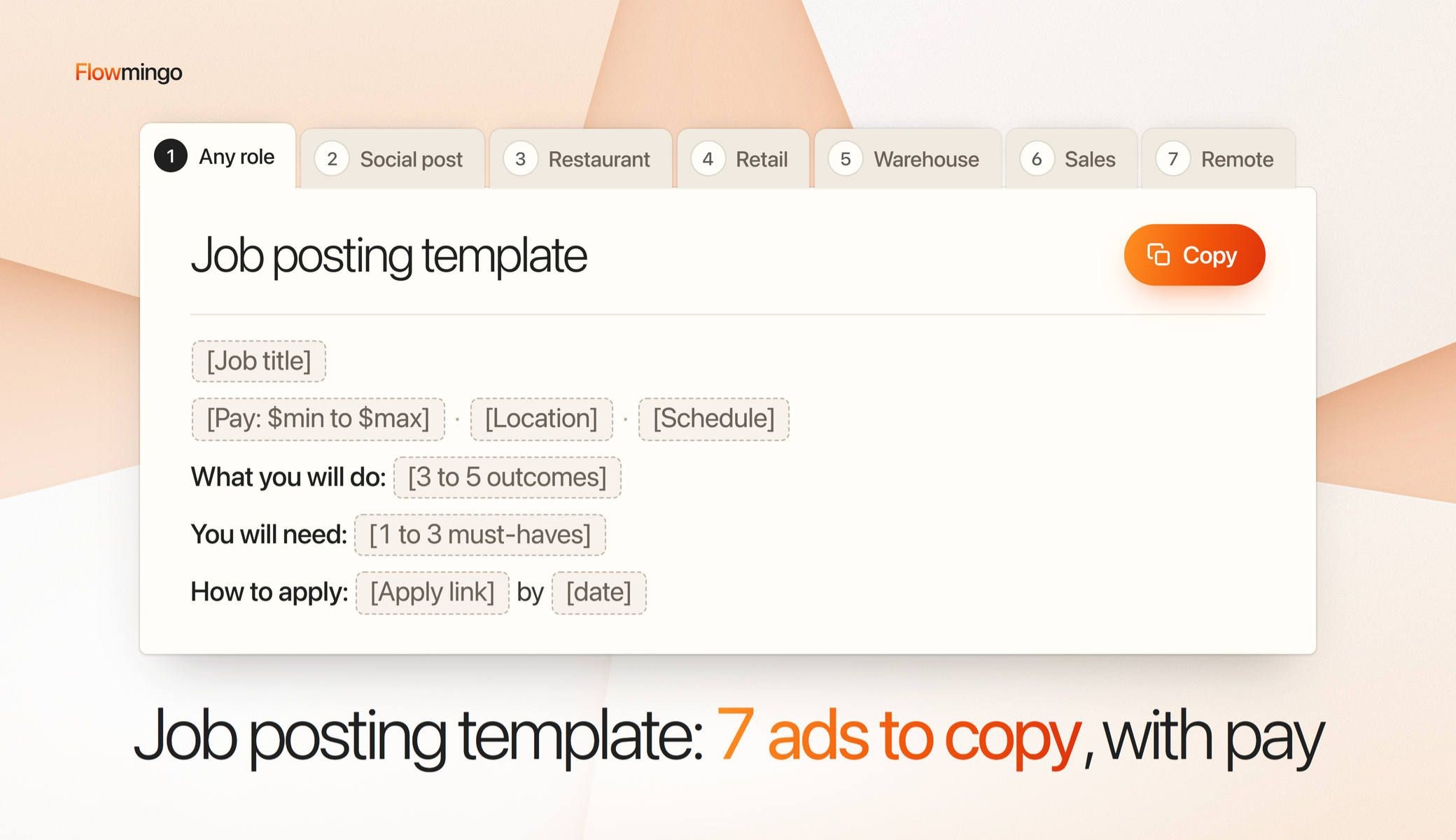
Yes. Copy the plain-text template below, fill in the brackets and paste it into any job board or careers page.
Plain text matters because the words, not the pictures, decide who applies. The figure below shows the order we recommend.
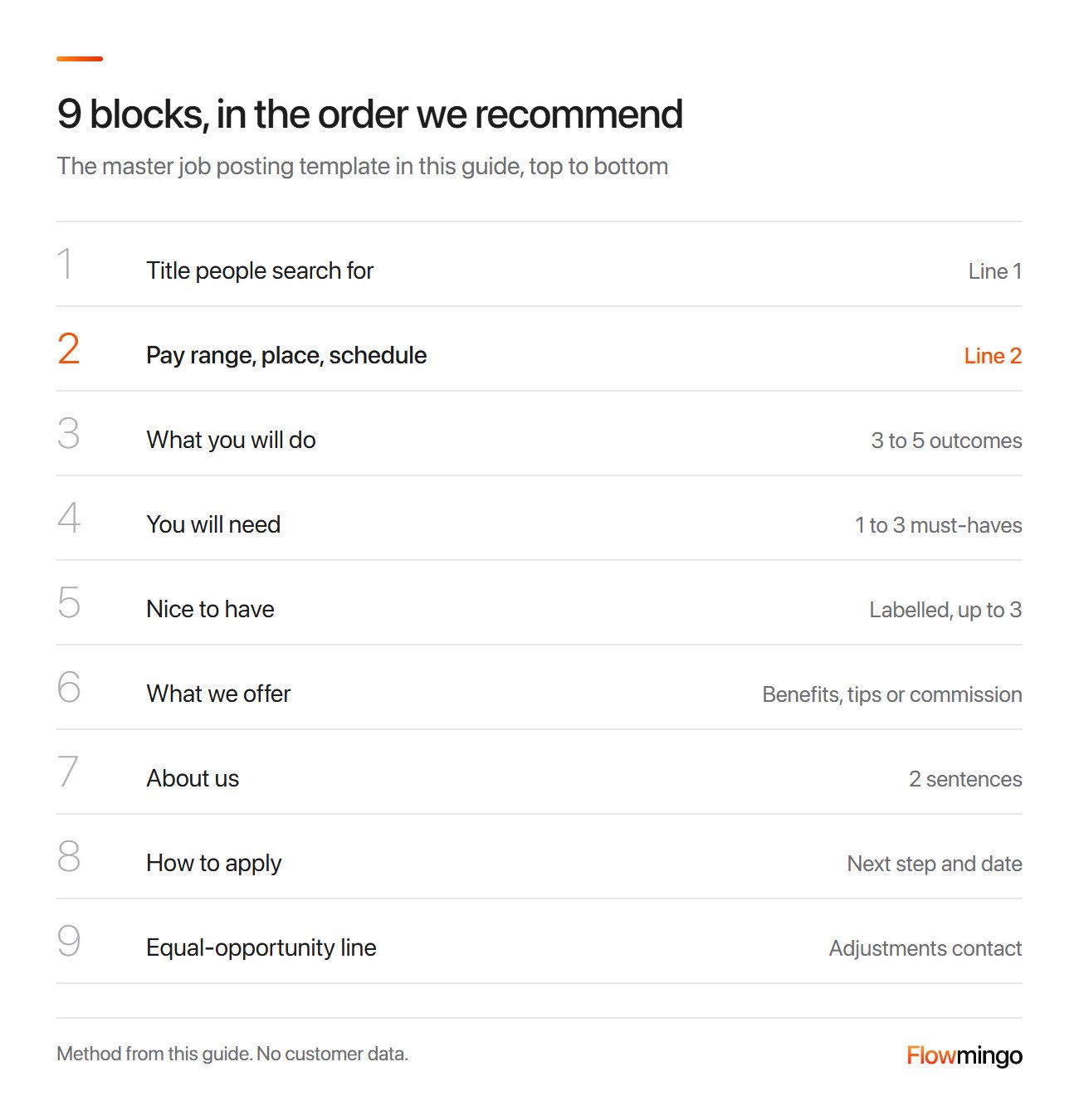
Job ad anatomy: 9 blocks run from the title people search for to the equal-opportunity line. Pay, place and schedule sit in line 2.
Line 1 is the title candidates search for. Line 2 carries pay, place and schedule, because those draw applicants (section 4).
The middle holds the work itself and 1 to 3 must-haves. The end gives the next step, the date by which you will reply, and an email address for candidates who need adjustments.
Adjustments are changes to the hiring process for a candidate with a disability or health condition. If your applicants say accommodations, use that word.
Template 1: master job posting template (any role)
[Job title people search for]
$[min] to $[max] [an hour or a year] · [City, Remote from (countries) or Hybrid] · [Full-time or Part-time, schedule] · [Commission-based, if so]
What you will do: [3 to 5 outcomes, each a verb and a result, like: keep 40 accounts growing.]
You will need: [1 to 3 must-haves, each job-related.] Nice to have, labelled: [up to 3 things you would hire without.]
What we offer: [benefits]. [Tips or commission: how much, and how people earn them.]
About [Company]: [2 sentences, with 1 fact showing the job is real.]
How to apply: [link], by [date]. Answer [3] short questions [or do a short AI interview with follow-up questions, about (X) minutes]. A person reviews every result, and you will hear from us by [date].
[If AI scores answers: say so, say a person decides, and add any notice your state requires (section 9).]
Equal opportunity employer. Adjustments: email [address].
This is a template, not legal advice: check the law where the job is done.
1.1 Can AI write my job posting template, and what do I check?
Yes, but you own every claim in it, because a chatbot does not know your pay band or the law where you hire. Check 5 things:
- Pay shows both ends of a real range (section 5).
- No age, "native speaker" or unneeded degree line (sections 2 and 8).
- The title is one people search for (section 3).
- The next step has a date.
- Every fact about the job is true.
The last check matters more than it seems. Only 50% of candidates trust that the jobs they apply to are real, according to Gartner surveys reported by UNLEASH.
A named team, a real range and a reply date make an ad read as genuine, and all 3 fit in the short social-post version below.
Template 2: short version for social posts
[Company] is hiring a [Job title]: $[min] to $[max] [an hour or a year], [place], [schedule]. You will [1 outcome and its result]. You need [2 requirements]. We offer [2 benefits].
Apply at [link to the full ad]. A person reviews every answer, and you will hear from us by [date]. Equal opportunity employer. Adjustments: email [address].
2. I have the internal job description. What do I cut to turn it into the ad?
Keep the outcomes, requirements, pay and place. Cut the grade, the internal codes and every line you would hire without, then add the next step and a reply date.
The ad is cut from your internal job description, but it speaks to the candidate rather than to HR.
For example (the numbers are illustrative), "Band C, 40% of time on account reviews" becomes "You will review 40 client accounts a quarter", which says what the work is, not where it sits on your pay grid.
One state asks you to keep more, not less. In New York State, the ad must also contain the job description if one exists (NYS DOL FAQ).
No study gives a number for how many requirements to keep. Our practice, as in our job description guide, is 5 or 6 requirement lines, of which 1 to 3 are must-haves.
2.1 Should the degree and years-of-experience lines stay in the ad?
Only if the job truly needs them, but deleting the line alone changes little unless the screen behind the ad changes too.
A report that Harvard Business School and the Burning Glass Institute published in February 2024 shows why (Sigelman, Fuller and Martin).
At the large US firms it studied, dropping degree requirements changed fewer than 1 in 700 hires, and 45% of the firms that dropped them hired as before.
So the ad and the screen behind it must match, which is the core problem in skills-based hiring.
So turn a years line into proof a candidate can show. "5+ years of experience" becomes "Has run 20+ accounts, with scope and a result", which a CV can show and a screen can check.
How Flowmingo helps
Paste your job into CV Evaluation. Flowmingo drafts weighted criteria from your job description and scores every CV against them out of 10, with the evidence behind each score. Use the same requirements in the ad.
3. What job title should I put on the ad so the right people find it?
Use the plain title a candidate would type into a job board, not your internal grade. Keep it gender-neutral, and add a level only if it changes who should apply.
Titles matter because job boards match searches to them. One owner whose Indeed ad drew few applicants said it sat "on like page 20 for job seekers" (r/smallbusiness).
Our practice is 1 role per title, with no internal codes such as "Associate II" and no jokes like "ninja".
For EU roles, the gender-neutral part is also law. Article 5(3) of the EU Pay Transparency Directive, adopted in 2023, requires gender-neutral job titles (EUR-Lex), so you write "server", not "waitress".
The directive binds employers through each country's national law, so check your country's version.
Here is a weak top line, rewritten (an illustrative example). "Rockstar Front of House Hero! Competitive pay. Family environment. DOE." becomes "Restaurant Server, evenings and weekends · $17 to $20 an hour plus tips · [city], 4 shifts a week".
The new title is one people search for, the pay shows both ends instead of DOE (depending on experience), and the place and schedule come first.
To test a title, search for it on your job board; if the results are not jobs like yours, change it.
4. Pay, location or schedule: what goes first in the ad, and what must it include?
Put pay, place and schedule in line 2, right under the title (our practice), because those draw applicants. Then come the work, the requirements, the benefits, a line about the company and how to apply.
The clearest evidence is for flexibility. In a field experiment on a large job board in China, published in 2021, researchers randomly varied the flexibility and salary of job ads (He, Neumark and Weng).
At the same salary, flexible ads drew 62% to 92% higher application rates. When an ad offered no flexibility, 0.24% of the job seekers who were sent it applied. When it offered flexibility on both hours and place, 0.45% did.
Flexibility nearly doubled the application rate, which is why this guide puts it in line 2 when the job has it.
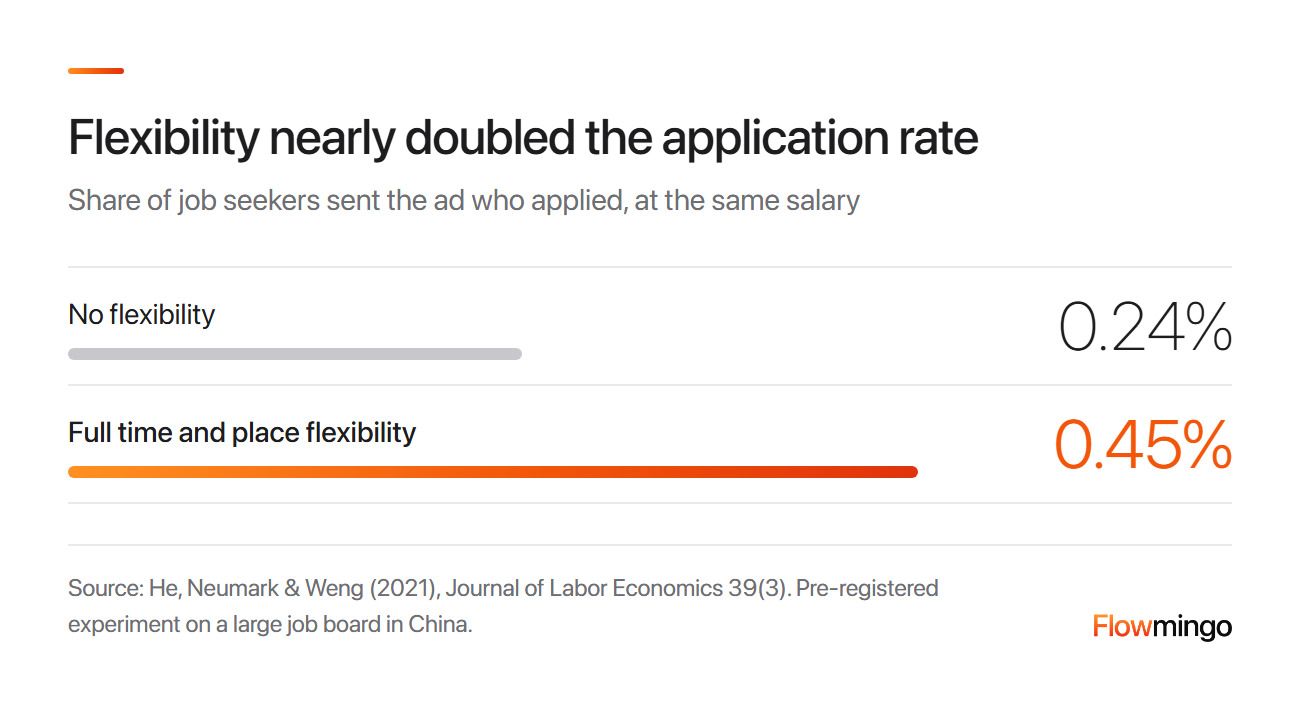
Flexibility and applications: at the same salary, 0.24% of job seekers who were sent the ad applied when it offered no flexibility. With full flexibility on time and place, 0.45% did.
Pay works the same way. In another field experiment, published in 2022, researchers randomly varied the wages of pairs of near-identical vacancies on a job platform (Belot, Kircher and Muller). A 1% higher posted wage drew 0.7% to 0.9% more saves by job seekers.
Write for a phone, too. One employer saw people quit halfway because the apply flow was long and mobile was terrible (r/recruiting).
We keep the top 3 lines short enough for a phone screen. Then close the apply block with "You will hear from us by [date]", a line that tells a candidate the job is real and cuts the follow-up emails.
No top-10 template we could read includes that line. Duke University's and the University of Denver's are Word files, and SHRM, the US HR association, keeps its own behind a member gate.
5. Must my job posting template show a pay range, and in which states and countries?
Yes in 14 US states plus DC, including New York, Colorado, California, Washington, Illinois and Connecticut. Thresholds run from 1 employee in Colorado and Connecticut to 50 in Hawaii, and the EU and Singapore have their own rules.
Write both ends of a real range everywhere, because the strictest rule you hire under sets the bar.
| Where | Since | Who | The ad must show |
|---|---|---|---|
| New York City | 1 Nov 2022 | 4+ employees | Good-faith minimum and maximum |
| New York State | 17 Sep 2023 | 4+ employees, remote included | Minimum, maximum, whether commission-based, and any job description |
| Colorado | 1 Jan 2021, amended 1 Jan 2024 | 1+ employee in Colorado | Pay or range, benefits and the application deadline |
| Washington, Illinois | 1 Jan 2023, 1 Jan 2025 | 15+ employees | Pay range, plus benefits |
| California | Good-faith rule from 1 Jan 2026 | 15+ employees | The range you reasonably expect to pay |
| Other US states (Jackson Lewis) | Hawaii, Maryland, Massachusetts, Minnesota, New Jersey, Vermont, DC; Virginia and Maine from July 2026, Connecticut from 1 Oct 2026 | 1 to 50+ employees | A range; check where the person works |
| EU | Due 7 Jun 2026 | Per national law | Starting pay or range, in the ad or before the interview |
| Singapore | In force | Employment Pass and S Pass roles; firms under 10 staff and roles at S$22,500+ a month exempt | A range on MyCareersFuture for 14+ consecutive days, top at most 2x bottom |
This is general information, not legal advice.
New York City rules out open-ended ranges such as "$15 per hour and up" (NYC Commission on Human Rights).
California's test, from 1 January 2026, is the range an employer "reasonably expects to pay" on hire (Liebert Cassidy Whitmore). So $40,000 to $140,000 for a $60,000 job would likely fail it (an illustrative example, and our reading).
Remote roles count too. New York State covers roles that report to a New York supervisor, office or site, even when the work happens elsewhere (NYS DOL FAQ).
Illinois makes a missing range easy to prove, because anyone can report a posting without pay within 1 year, using a screenshot.
Outside the US, the EU directive also bans questions about pay history, so drop them from EU application forms.
In Singapore, the rule covers jobs advertised before an Employment Pass or S Pass application, 2 of the work passes for hiring foreign staff.
There, the top of the range can be at most 2 times the bottom. That cap allows S$4,500 to S$9,000, so a wider band needs a second ad (MOM).
6. Does putting the salary in the ad actually get more people to apply?
Probably, though the only figure on applications is Indeed's own: 3.8 times more for jobs with an employer-provided salary, method unpublished (Indeed). Independent studies show that pay draws interest, and that posting it did not measurably cut jobs.
Showing pay is already the norm on Indeed. Of US ads there, 52.2% showed pay in September 2023 and 57.8% in September 2024 (Indeed Hiring Lab), and 59% did by May 2025 (Indeed).
So an ad without a range is now in the minority on Indeed, and stands out for the wrong reason.
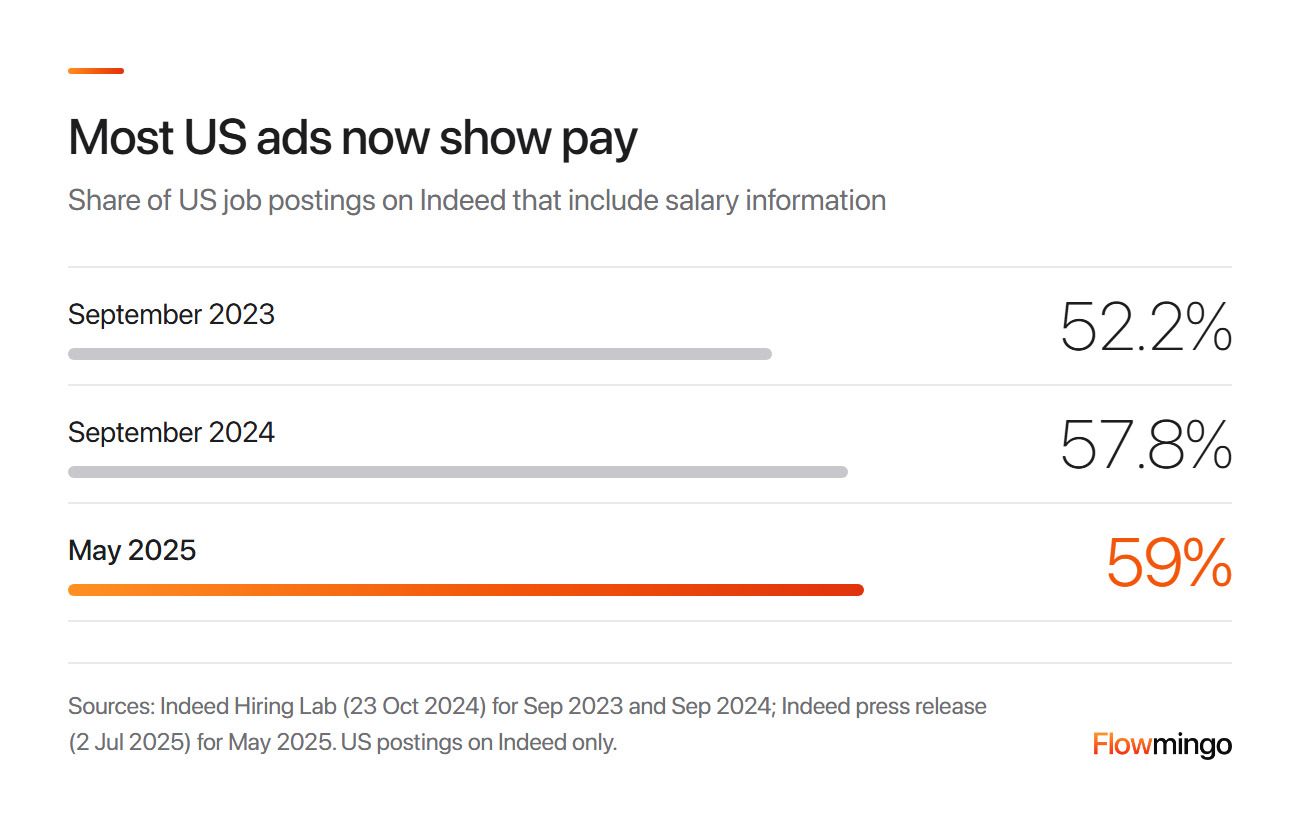
Salary shown in US Indeed postings: 52.2% in September 2023, 57.8% in September 2024 and 59% in May 2025.
Where a law already requires a range, as Colorado's does, the question is which range to post, because the number also sorts the people it draws.
The Belot experiment from section 4 shows how. Of those who saved the lower-paid version of a vacancy, 42% did not save its higher-paid twin, which the researchers read as avoiding competition.
A higher number draws more interest but also signals more competition, so some people step back. Set the range you would actually pay.
For 3 seniority levels, post 3 ads (our practice, answering a question on r/recruiting), and for commission or tips, state the base first, then how people earn the rest.
Evidence that posting pay did not cut jobs comes from the pay-range laws. A 2025 working paper from the National Bureau of Economic Research, not yet peer-reviewed, tracked Colorado's law from its start in January 2021 (Arnold, Quach and Taska).
The share of postings that showed pay rose by up to about 30 percentage points. Advertised pay rose 3.6%, and the pay workers reported on Glassdoor rose 1.3%, with no measurable fall in employment or postings.
So pay competition moved into the open without costing hires.
7. Which job posting template fits a restaurant, retail, warehouse, sales or remote role?
Start from Template 1 and change 3 things: the top line, which requirements are real, and how you write pay. The 5 job ad examples below cover each role.
Hourly ads need a fast screen, because they draw volume. One owner who posted 2 openings got 85 applicants for the entry-level role and 45 for the trained one, 130 in all (r/smallbusiness).
Check the state rules from section 5, too. A Colorado ad needs an apply-by date ("by [date]" after the link, as in Template 1) and a general description of all the benefits you offer.
That Colorado rule (CDLE) means a restaurant ad like Template 3 below lists every benefit you offer, not only the staff meal. A New York State ad needs the job description, if one exists.
Template 3: restaurant server (hourly)
Restaurant Server, evenings and weekends
$[min] to $[max] an hour plus tips · [Restaurant, city] · Part-time, [4] evening shifts a week
Tips: [pooled], about $[X] an hour on a [Friday]. You will run [6] tables so every guest gets served within [10] minutes. You need [weekend evenings] [and a food-handler card].
We offer a staff meal. About [Company]: [1 fact showing the job is real]. Apply at [link]: 3 short questions a person reads. You will hear from us by [date].
Equal opportunity employer. Adjustments: email [address].
Template 4: retail sales associate (hourly)
Retail Sales Associate, [store]
$[min] to $[max] an hour · [Store, city] · Part-time, [20 to 30] hours a week
You will help customers find what they came for and keep shelves full. You need [2] weekends a month. Nice to have: [cash handling].
We offer [a staff discount]. About [Company]: [1 fact showing the job is real]. Apply at [link]: 3 short questions a person reads. You will hear from us by [date].
Equal opportunity employer. Adjustments: email [address].
Template 5: warehouse associate (shifts)
Warehouse Associate, [day / night] shift
$[min] to $[max] an hour · [Site, city] · Full-time, [6am to 2:30pm, Monday to Friday]
You will pick, pack and load [X] orders a shift, so trucks leave on time. You need to lift boxes up to [X] lb / kg, with or without adjustments.
We offer overtime after [X] hours. About [Company]: [1 fact showing the job is real]. Apply at [link]: 3 short questions a person reads. You will hear from us by [date].
Equal opportunity employer. Adjustments: email [address].
Commission roles need extra care, because readers can doubt they are real jobs. One owner's Facebook ad for a commission reseller role drew replies calling it not a real job, or a scam (r/smallbusiness).
That is why Template 6 puts the base and the commission on separate lines, so readers see the base pay first.
Template 6: account executive (base plus commission)
Account Executive, [segment], commission-based
Base $[min] to $[max] a year plus commission · On-target earnings $[X] to $[Y] · [Company], [City or Remote from (states)] · Full-time
Commission: [X]% of first-year contract value, paid [monthly]. You will close $[X] of new [segment] business a quarter. You have closed [B2B software] deals of $[X] or more, and can name 1.
We offer [health cover]. About [Company]: [1 fact showing the job is real]. Apply at [link] with your CV [and a (X)-minute AI interview with follow-up questions], reviewed by a person. You will hear from us by [date].
[If AI scores answers, say so, as in Template 1.]
Equal opportunity employer. Adjustments: email [address].
Remote roles need the places people can work from and the core hours. Template 7 is cut from the Customer Success Manager example in our job description guide.
Template 7: customer success manager (remote)
Customer Success Manager (remote, [region])
$[min] to $[max] a year · [Company], remote from [countries or states] · Full-time, core hours [10am to 3pm, time zone]
You will keep [40] accounts renewing and growing after they sign. You have renewed a B2B account book, with its size and a result, and write clear English for customer emails.
We offer [paid leave days]. About [Company]: [1 fact showing the job is real]. Apply at [link]: 3 short questions a person reads. You will hear from us by [date].
Equal opportunity employer. Adjustments: email [address].
7.1 Posting the same ad on LinkedIn, Indeed and social media
Write 1 full ad, then cut it for each channel (our practice), because each shows the ad differently.
For example, Template 4 goes on your careers page in full. On Indeed and other free job posting sites, you also type the range into the pay field.
In a LinkedIn or Facebook feed post, use Template 2 with a link to the full ad. A LinkedIn job post takes the full ad, and our guide on how to post a job on LinkedIn covers the steps.
How Flowmingo helps
Every plan, including Free, includes job posts with free boosting, which passes the post on to other job boards (pricing). Not every board takes every post, so reach varies by board and role.
8. Which words put good applicants off, and do I need an EEO statement?
Cut anything that hints at age, sex, race, religion or origin, and any language rule the job does not need. Then add a short equal-opportunity and adjustments line.
In the US, the ad itself can break the law, whoever you end up hiring, because federal law bans job ads that show any such preference (42 USC 2000e-3, 29 USC 623).
The equal-opportunity line, often called an EEO statement, is a different matter. We found no federal rule that makes every private employer add one, though a state rule may still require it where you hire.
The standard tagline for federal contractors came from Executive Order 11246, which Executive Order 14173 revoked on 21 January 2025 (The White House).
If you keep the line, as the templates here do with "Equal opportunity employer", word it to fit the laws that still apply, such as the federal bans above.
Gendered words are a smaller lever than they look. In student experiments published in 2011, masculine-coded words such as "competitive" made women feel they would belong less (Gaucher, Friesen and Kay).
But a study of about 300,000 real postings, published in 2023, found that more neutral wording barely changed who applied (Castilla and Rho). So check the words, but spend more effort on pay, flexibility and requirements.
8.1 Can my ad say 'students only', 'young team' or 'Chinese speakers'?
Not "young team", and "students only" can read as an age preference.
The US Equal Employment Opportunity Commission names "college student" and "young" as terms that break US age law in a job ad (29 CFR 1625.4). So write the schedule students want instead.
Singapore goes further and adds language. Its Tripartite Alliance for Fair and Progressive Employment Practices (TAFEP) lists "Age 25 to 30 years old" and unexplained Chinese-and-English requirements as phrases to avoid.
For example, "Chinese speakers" becomes "Mandarin for daily calls with our Taiwan suppliers", which gives the job reason.
9. Where should the apply link in my job posting template send 1,000 applicants?
Send them to 1 short screening step that scores everyone against the requirements in the ad. Say in the ad what the step is, and that a person reviews it.
Floods do happen. One employer got more than 2,000 applicants, 100 or more of them well qualified (r/recruiting). Another got nearly 1,000 on LinkedIn, most of them not authorised to work in the US (r/recruiting).
On most projects, though, the pile is small. On Flowmingo, employers gather the people they are considering in a hiring project, so the card below measures workload, not how far an ad reached.
Flowmingo data · about 10,600 hiring projects with 1+ applicant · 5,048 companies · created 1 Jul 2025 to 7 Sep 2026
- 3 applicants was the median for these hiring projects on Flowmingo.
- 5.0% of these hiring projects had more than 100 applicants, and 9.3% had more than 50.
Anyone added to a project counts, uploaded CVs included, so this is not ad reach. The median of 5 in our hiring process guide comes from a different period, 1 Jan to 28 Aug 2026.
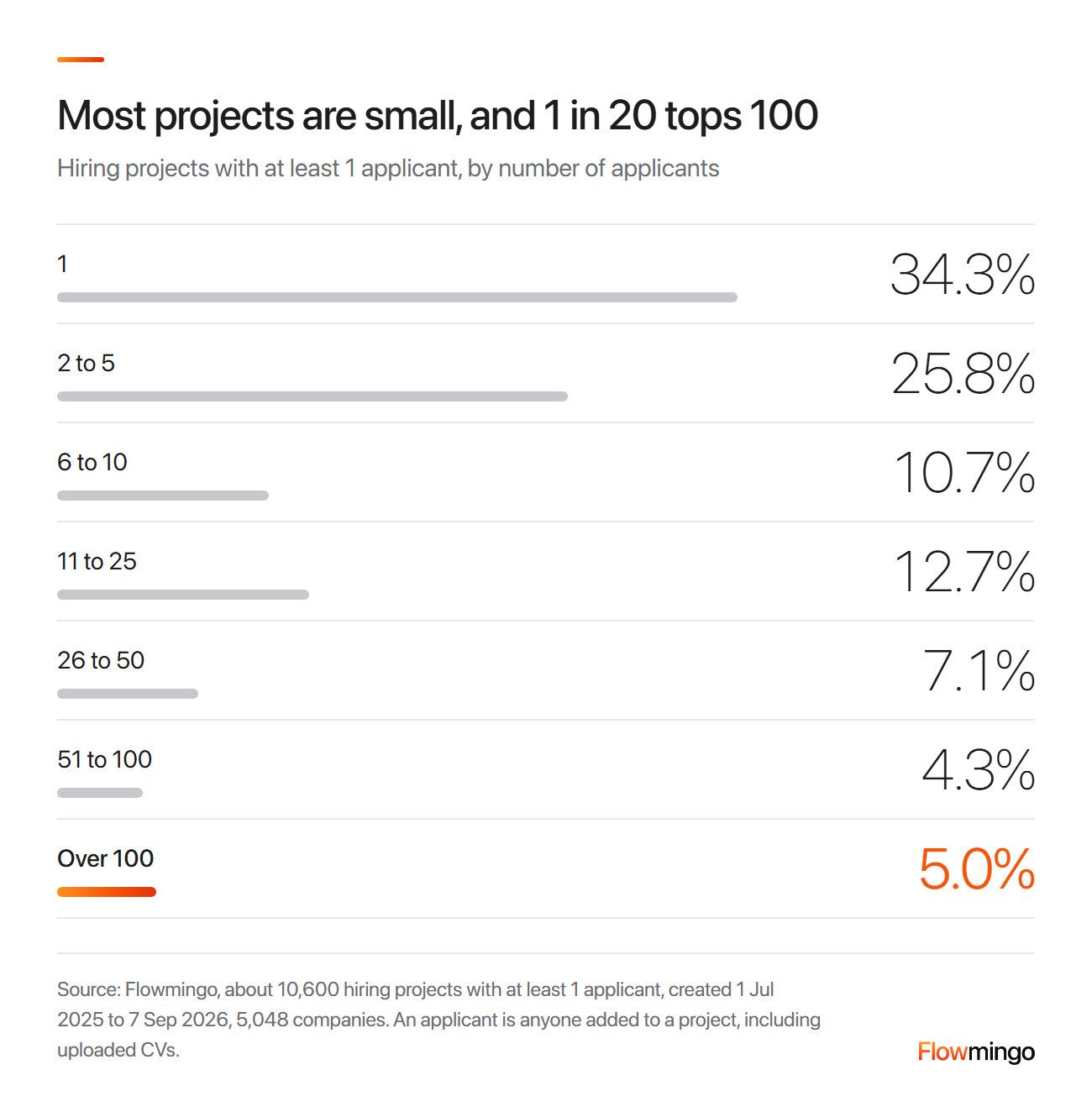
Applicants per hiring project (projects with at least 1 applicant): 34.3% had 1, 25.8% 2 to 5 and 10.7% 6 to 10. Then 12.7% had 11 to 25, 7.1% 26 to 50, 4.3% 51 to 100 and 5.0% over 100.
So while the median project had 3 applicants, 1 in 20 topped 100 people, and at that size reading CVs 1 by 1 breaks down. That is when to ask hard facts, such as the right to work, in the form (pre-screening interview questions).
Then say in the ad what happens to the answers, because only 26% of candidates trust AI to judge them fairly (Gartner, via UNLEASH). Our AI in recruitment guide has a sample notice.
If you hire in New York City or Illinois, the screening step can bring legal duties of its own. In New York City, a covered automated employment decision tool, one that substantially helps decide who moves on, needs an independent audit for bias within the past year (NYC DCWP).
The employer must also publish a summary of the audit and give candidates 10 business days' notice. Human review alone does not exempt the tool.
Illinois has required notice of AI in hiring since 1 January 2026 (DLA Piper). Our pre-screening guide adds the state's consent rule for AI video interviews.
How Flowmingo helps
Send applicants 1 AI Interviewer link, or upload the CVs you have into CV Evaluation. CV screening uses the same criteria as the interview, so you can compare the 2 results directly. CV Evaluation is unlimited on every plan, including Free.
10. My ad has been live 2 weeks with few applicants. What do I change?
Check reach first, meaning whether job seekers see the ad at all, then change 1 thing at a time, starting with title, pay and schedule. Length is rarely the problem.
The card below shows how often job posts on Flowmingo drew an application through the post in 30 days.
Flowmingo data · 6,277 job posts · 3,370 companies · published 21 May to 7 Sep 2026
- 24.6% of job posts on Flowmingo got at least 1 application through the post in 30 days.
- 4 applications was the median for posts that got any application.
Includes job seekers who had asked Flowmingo to apply on their behalf (auto-apply). Without those applications, the share barely changes (24.6% to 24.3%) and the median drops from 4 to 3. Many posts were likely shared only as a link.
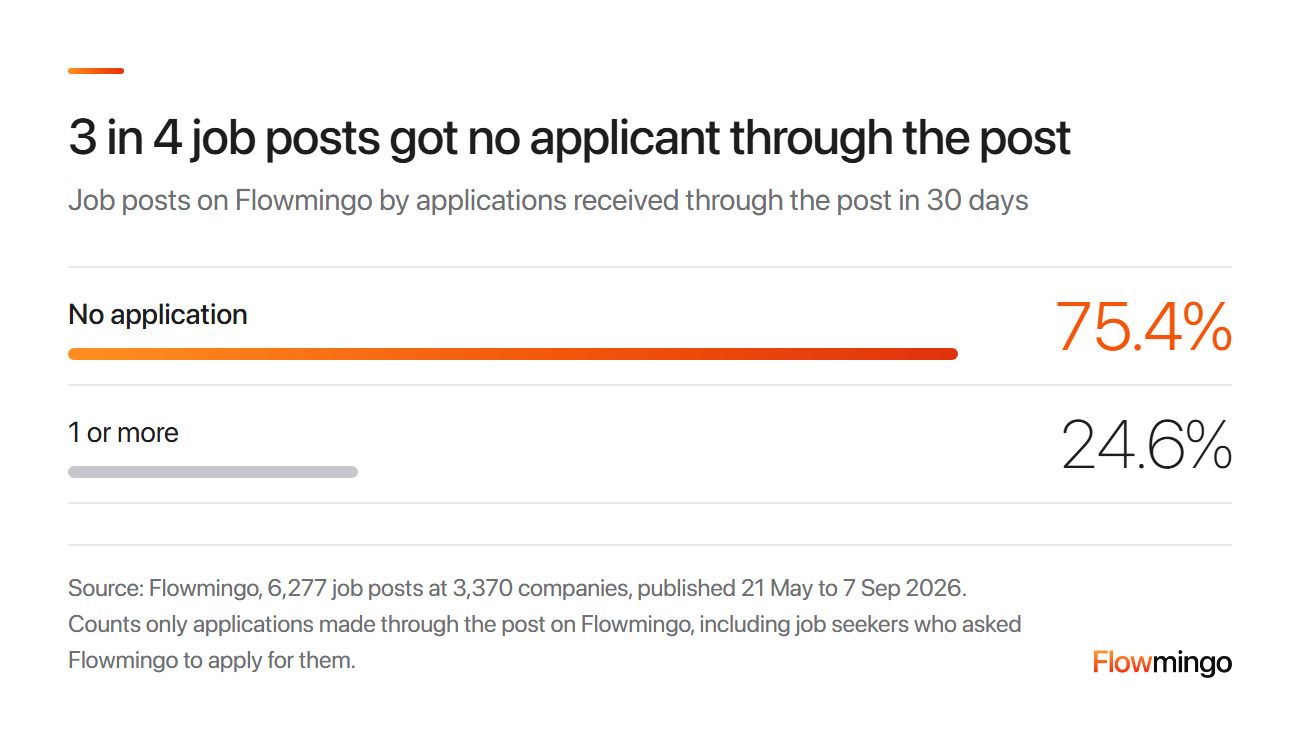
Job posts with applicants: of 6,277 job posts on Flowmingo, 75.4% got no application through the post in 30 days, and 24.6% got 1 or more.
So 3 in 4 posts drew no application through the post. Most likely, too few job seekers saw them, rather than the wording putting them off.
Many of those posts likely went out only as a link, and our free job posting sites guide found that link-only posts almost never drew an application.
Diagnose in this order (our practice), because an unseen post gets 0 applicants, however good it is:
- Nobody applies: put the post on job boards and your careers page, not just a link. Then fix title, pay and place (sections 3 and 5).
- People look but don't finish: fix the apply flow on mobile (section 4).
- The wrong people apply: fix the requirements and the screening step (sections 2 and 9).
10.1 How long should the ad be, and how long should it stay up?
Write what the candidate needs and no more, about 2 phone screens (our suggestion). Within the same employer, longer posts did no better.
Flowmingo data · 6,277 job posts · 3,370 companies, 386 with both shorter and longer posts · 21 May to 7 Sep 2026
- 5.3 applications on average went to the longest quarter of posts, against 2.4 for the shortest, across all employers.
- 0 was the median gap between longer and shorter posts at the 386 companies that wrote both.
Association, not cause, controlled for company but not role or posting date. Shorter means 283 words or fewer. Auto-apply excluded.
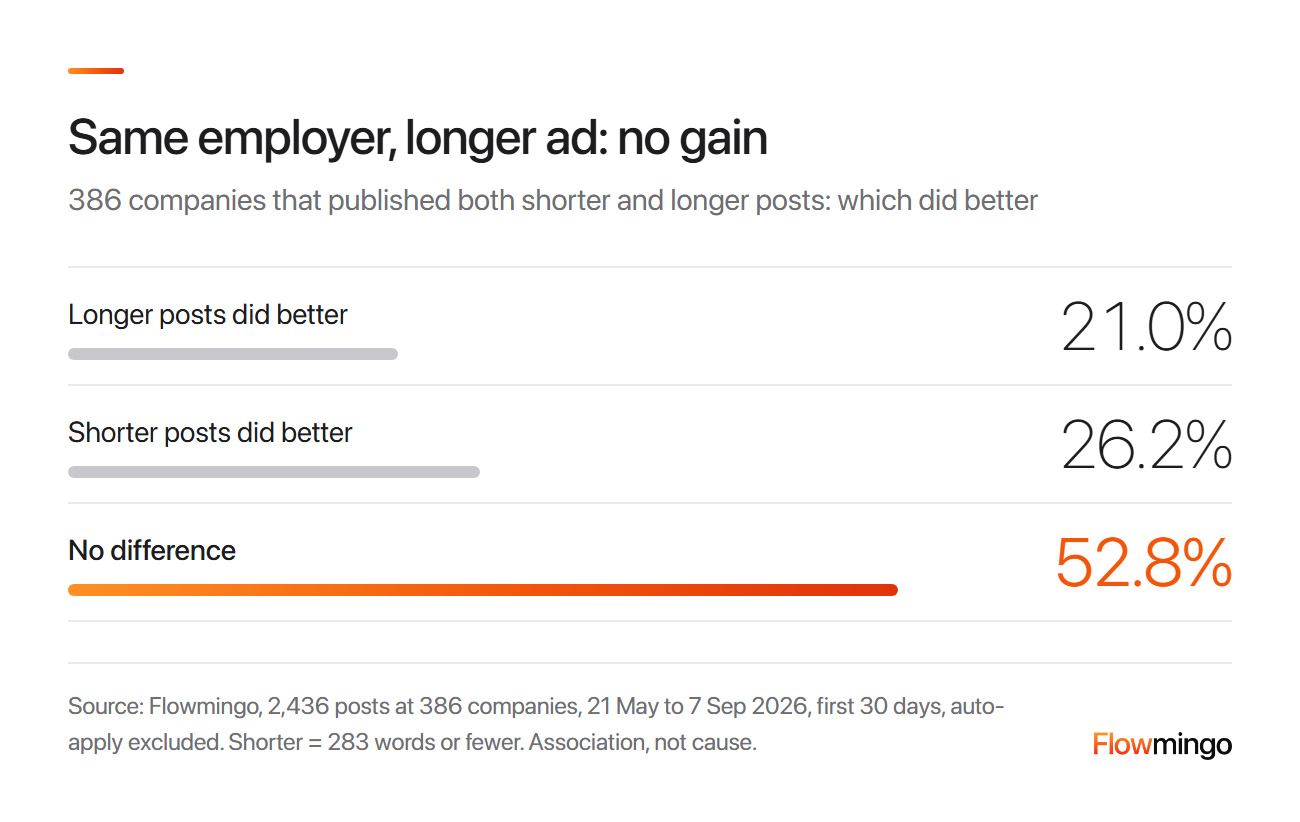
Same employer, longer ad: of 386 employers, longer posts did better at 21.0% of them and shorter posts at 26.2%. At 52.8% of the employers there was no difference.
The 2 lines of that card seem to disagree, and the second explains the first. Across all employers, long ads looked better, with 5.3 applications on average against 2.4.
Within the same employer, though, the gap vanished. So what differs is which employers write long ads, not their length.
No study says how long to keep an ad up, so we suggest reviewing it at 7 and 14 days. One rule does set a floor: Singapore Employment Pass and S Pass jobs must stay on MyCareersFuture for 14 or more consecutive days.
How Flowmingo helps
Paste your job, and Flowmingo drafts the questions and weighted criteria you score applicants on. To screen everyone the ad brings, try Flowmingo with this job posting template.
11. Sources
Every study, law and quote in this guide links to a source below. Flowmingo figures come from Flowmingo's own platform data.
- Arnold, D., Quach, S., & Taska, B. (2025). The impact of pay transparency in job postings on the labor market (NBER Working Paper No. 34480). National Bureau of Economic Research. https://doi.org/10.3386/w34480
- Belot, M., Kircher, P., & Muller, P. (2022). How wage announcements affect job search: A field experiment. American Economic Journal: Macroeconomics, 14(4). https://doi.org/10.1257/mac.20200116
- California Legislature (2025). Labor Code section 432.3, as amended by SB 642. California Legislative Information.
- Castilla, E. J., & Rho, H. J. (2023). The gendering of job postings in the online recruitment process. Management Science, 69(11).
- Colorado Department of Labor and Employment (2024, May 29). INFO #9A: Transparency in pay and job opportunities. CDLE.
- DLA Piper (2024). Illinois becomes second state to enact AI law for employers. DLA Piper Knowledge.
- DLA Piper (2026). Virginia pay transparency law goes into effect July 1, 2026. DLA Piper Knowledge.
- European Parliament and Council (2023). Directive (EU) 2023/970 on pay transparency. EUR-Lex.
- Executive Order No. 14173 (2025, January 21). Ending illegal discrimination and restoring merit-based opportunity. The White House.
- Fisher Phillips (2026). Maine sets new pay transparency requirements. Fisher Phillips.
- Foley & Lardner (2026). Connecticut expands pay transparency requirements starting October 1, 2026. National Law Review.
- Gaucher, D., Friesen, J., & Kay, A. C. (2011). Evidence that gendered wording in job advertisements exists and sustains gender inequality. Journal of Personality and Social Psychology, 101(1), 109-128.
- He, H., Neumark, D., & Weng, Q. (2021). Do workers value flexible jobs? A field experiment. Journal of Labor Economics, 39(3), 709-738. https://doi.org/10.1086/711226
- Illinois Department of Labor (2024, December 16). Pay transparency law takes effect January 1. Press release.
- Indeed (2025, July 2). Pay transparency across high-earning sectors. Press release.
- Indeed Hiring Lab (2024, October 23). Salary transparency growth slows but momentum continues. Indeed Hiring Lab.
- Jackson Lewis (2026, January 30). Navigating 2026 pay transparency laws and employer obligations. Jackson Lewis.
- Liebert Cassidy Whitmore (2025, November 13). SB 642: Pay scale and wage ranges. LCW.
- Ministry of Manpower Singapore (2026). Consider all candidates fairly (Employment Pass). MOM.
- New York City Commission on Human Rights (2022). Salary transparency in job advertisements. Fact sheet.
- New York City Department of Consumer and Worker Protection (2023). Automated employment decision tools. City of New York.
- New York State Department of Labor (2023). Pay transparency. NYS DOL.
- New York State Department of Labor (2023). Pay Transparency Act frequently asked questions. NYS DOL.
- Reddit (2020 to 2026). Employer threads on r/recruiting and r/smallbusiness, linked in the text where each is cited. Reddit.
- Sigelman, M., Fuller, J., & Martin, A. (2024, February 14). Skills-based hiring: The long road from pronouncements to practice. Harvard Business School Project on Managing the Future of Work and Burning Glass Institute.
- Tripartite Alliance for Fair and Progressive Employment Practices (2026, May 18). Fair recruitment practices for employers in Singapore: Preparing for the Workplace Fairness Act. TAFEP.
- UNLEASH (2025, September 8). AI in hiring: The growing trust gap between employers and job candidates. UNLEASH.
- United States Code (current text). 29 USC 623(e): Printing or publication of notice or advertisement indicating preference based on age. Legal Information Institute.
- United States Code (current text). 42 USC 2000e-3(b): Printing or publication of notices or advertisements indicating prohibited preference. Legal Information Institute.
- US Code of Federal Regulations (current text). 29 CFR 1625.4: Help wanted notices or advertisements. Legal Information Institute.
- Washington State Department of Labor and Industries (2025, December 3). Administrative Policy ES.E.2: Pay transparency requirements. L&I.