
Open the last 20 CVs you rejected and hold each reason up against the resume screening best practices in this guide. If "no degree", a gap or "only 3 years" keeps coming up, a shortcut may have made the call, not the job.
Flowmingo, the hiring platform behind this guide, can put a number on the first of those CV screening mistakes, because its AI scores every CV out of 10 on each line of a job's criteria.
Between 10 Jul and 11 Nov 2026, 4,142 of the CVs scored on a line asking for a degree averaged 7 or more on all the other lines. Of those, 554, about 1 in 7, scored below 5 on the degree line itself, so a degree cut-off would have dropped them.
Employers suspect their own software makes the same mistake. Hidden Workers, a report that Harvard Business School and Accenture published in 2021, surveyed 2,275 executives in the US, UK and Germany about their high-skills hires and, separately, their low- to middle-skills ones.
Among those whose firms screen with software, 88% said it at least sometimes drops qualified high-skills candidates who miss the exact criteria in the job description. That is a belief rather than a measured rate, but those candidates apply elsewhere.
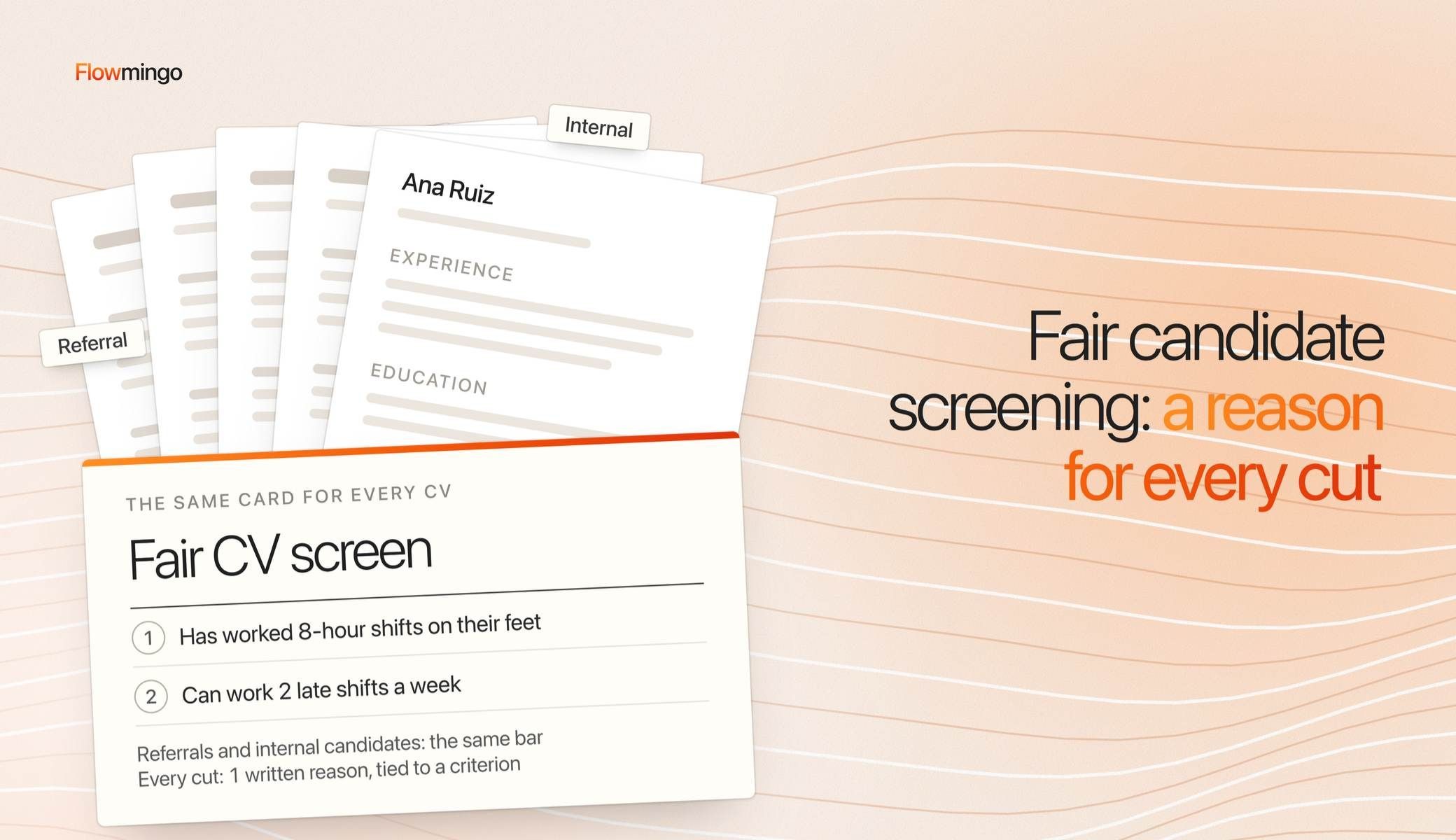
A fair no, then, rests on a skill the job needs, written down before you open the first CV, not on the exact wording of an old ad. A degree line, a gap, a long day or the CV read just before can each decide a no the job never required.
Key takeaways
- Should I reject CVs without the degree the ad asks for? Not as a knockout, a line that rejects anyone who misses it. In Flowmingo projects, 13.4% of CVs strong on everything else fell below 5 on the degree line.
- Is a gap a fair reason to cut a CV? Make it a question instead. Almost half of employers with screening software filtered out middle-skills CVs over a gap of more than 6 months.
- Does the CV I read just before change my score? It can. In 1 experiment, 72 US employers scored their interest in hiring from 1 to 10, and an identical CV scored 4% lower when it came right after a white man's CV.
- Should a typo cost someone the interview? Only when writing is part of the job. Among 445 recruiters, 2 spelling errors cut their stated interview chance by 7.3 points out of 100.
- How fast should applicants hear back? Clear screen-outs within 3 to 5 days of applying. In 2025, 31% of North American candidates were still waiting after a month or more.
1. With 200 applicants for 1 role, which resume screening best practices stop me cutting the best people?
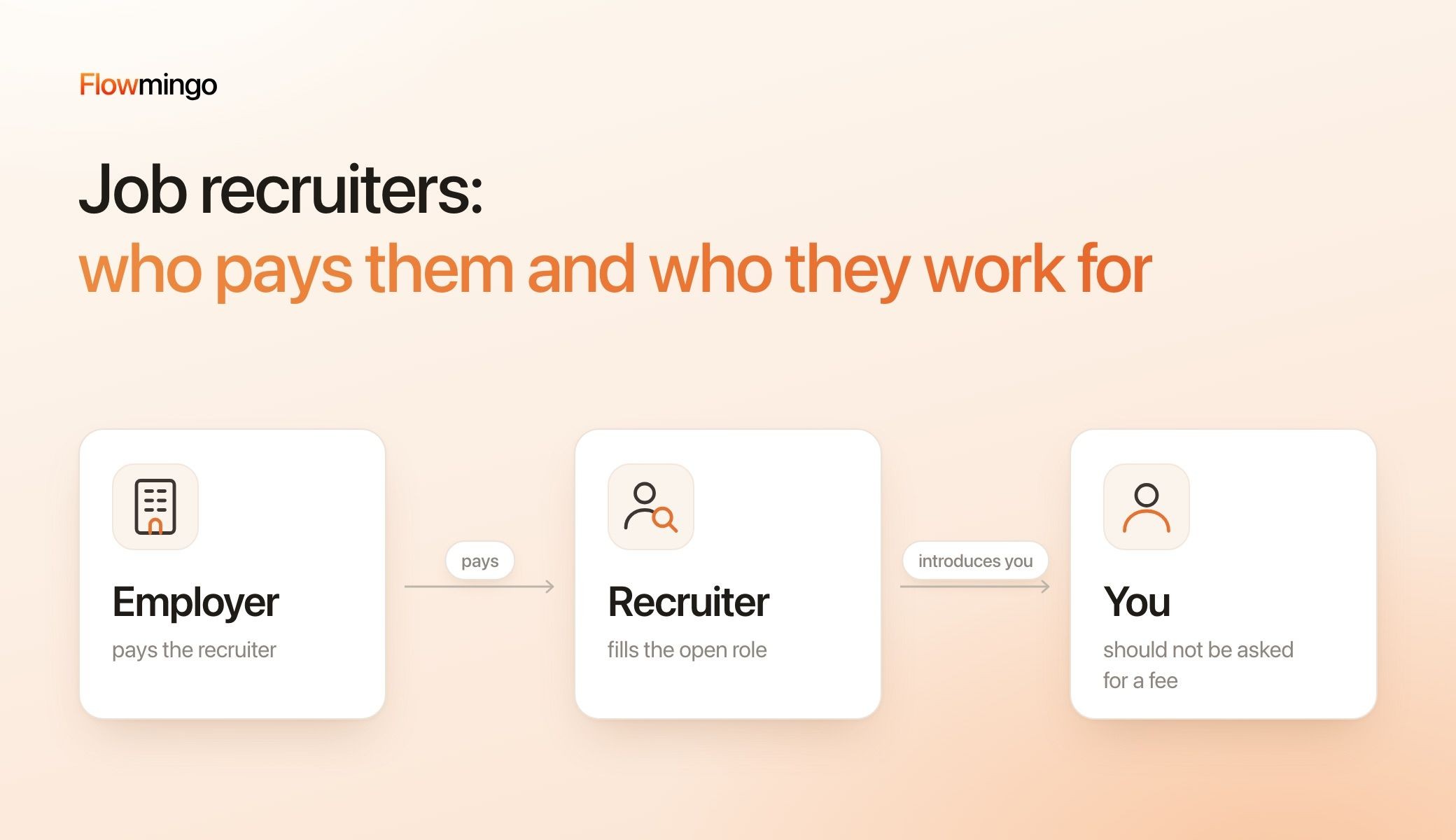
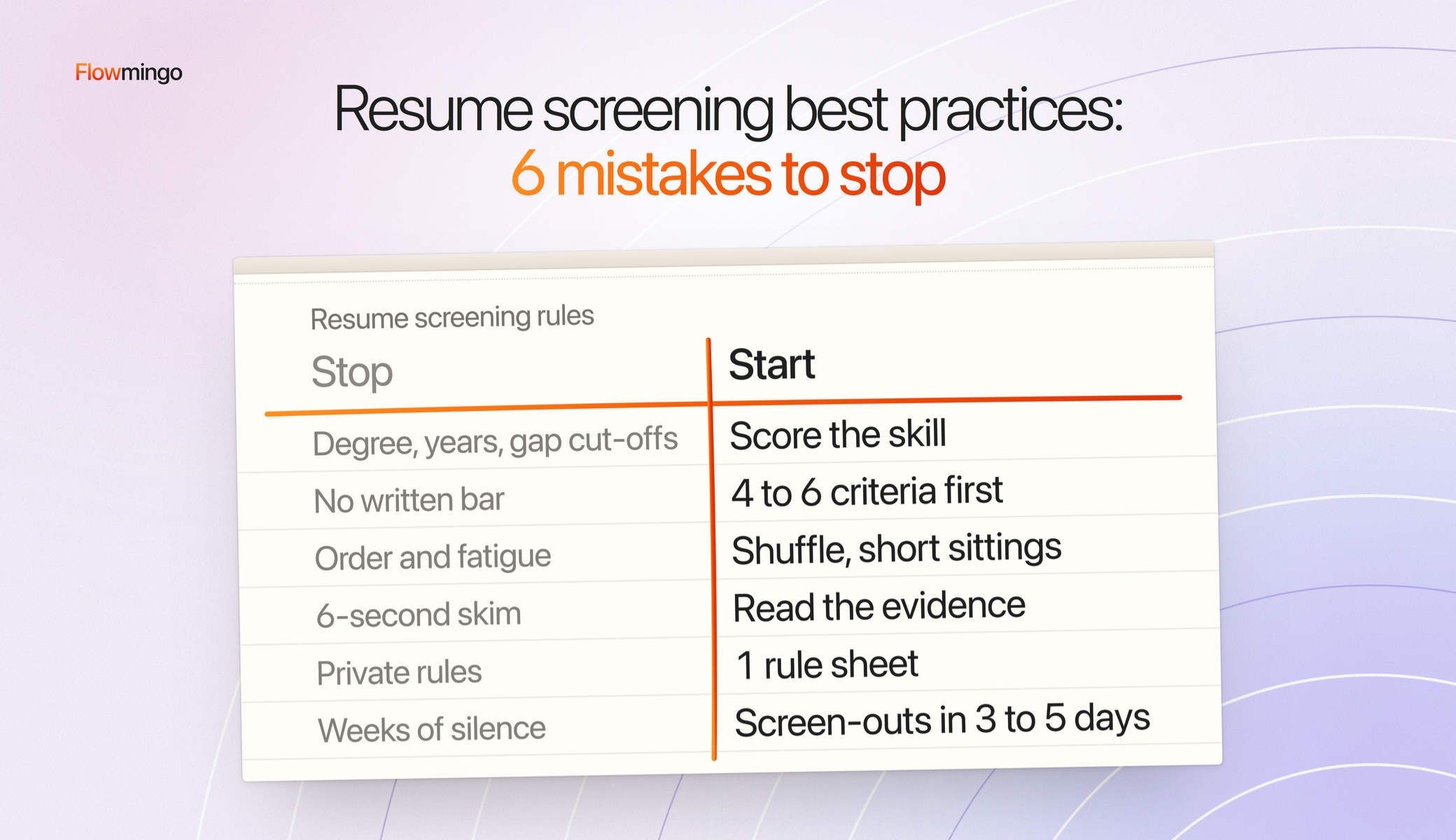
Stop 6 habits, from cutting on proxies, the lines such as a degree or a gap that stand in for a skill, to replying weeks late. Each has a cheap fix, shown in the table below.
Say you're hiring a warehouse shift supervisor and 200 people apply in a week, an illustration rather than customer data. The ad asks for a bachelor's degree and 5 years in logistics, and this guide follows that role through every mistake.
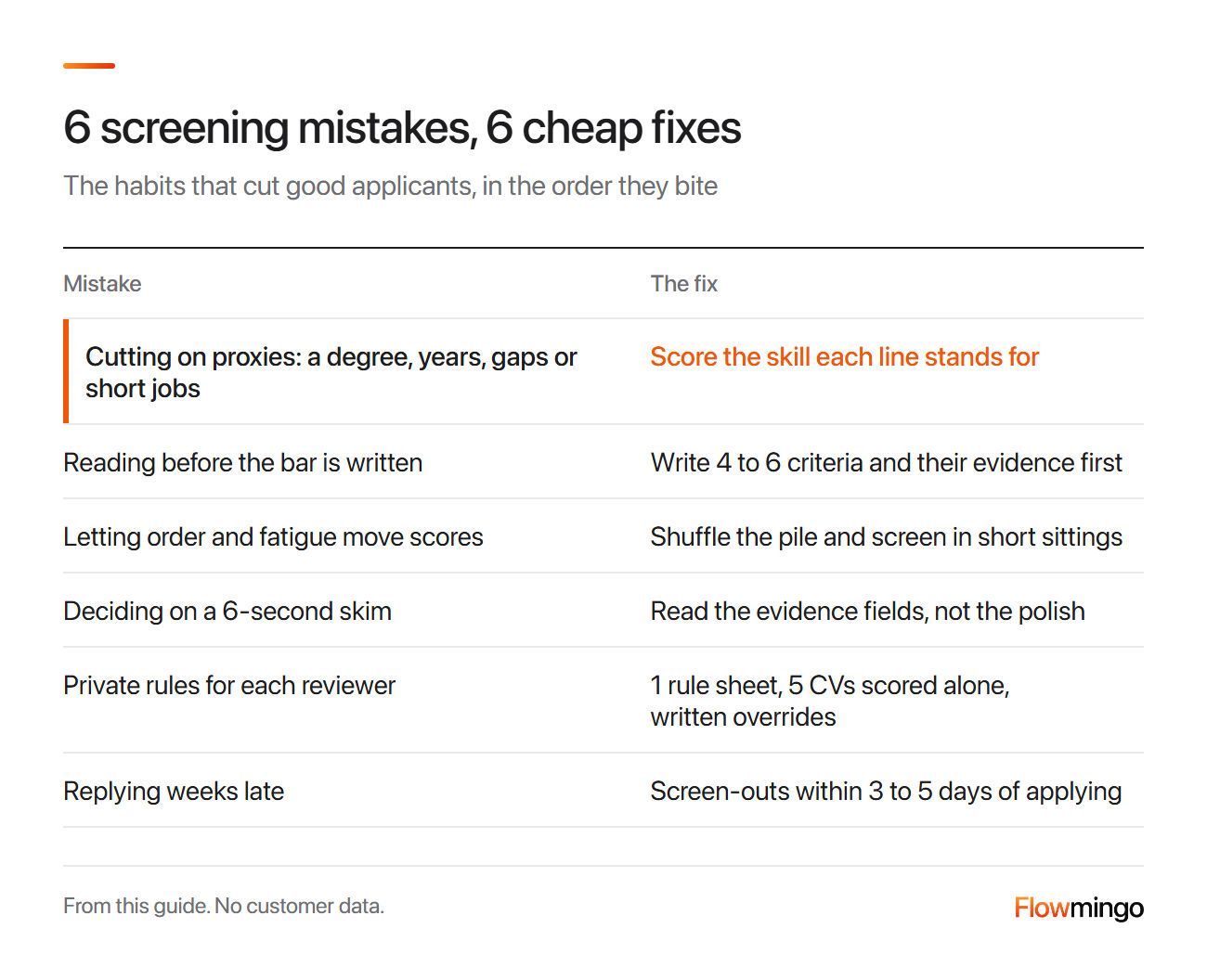
6 screening mistakes and fixes: proxies, no written bar, order and fatigue, the skim, private rules and slow replies, each with its cheap fix.
In the table, the first 2 rows decide who you cut before you weigh any evidence. Cutting on a degree, years, gaps or short jobs gives way to scoring the skill each line stands for.
Reading CVs before you write the bar gives way to writing 4 to 6 criteria first, each with what counts as evidence.
Rows 3 and 4 decide how you read. Shuffle the pile and screen in short sittings, so order and fatigue don't move your scores. Then read the evidence, not the polish, instead of a 6-second skim.
The last 2 rows reach past your own desk, to your team and your applicants. Private rules for each reviewer give way to 1 rule sheet and written overrides, and replying weeks late gives way to screen-outs within 3 to 5 days.
For the screening step itself, our CV screening guide has the basics.
2. The ad asks for a degree and 5 years. Should I reject strong CVs without them?
No, not as a knockout, a line that rejects anyone who misses it. Score the skill each line stands for, and keep a degree as a hard rule only where a licence or the law requires it.
A knockout feels safe on a degree or years line because both are easy to check. Yet a degree shows where someone learned and a years count shows how long they worked, and neither shows what they can do.
A 2019 review of 81 samples found that prior work experience tracked job performance at 0.06, barely above the 0 that means no link at all.
Deleting the line from the ad is not enough on its own, though. In a February 2024 study, the Burning Glass Institute followed 11,300 roles at large US firms.
About 45% of the firms that dropped a degree requirement seemed to do so in name only, the study found. Where firms followed through, non-degree hires had a 2-year retention rate of 58%, against 48% for colleagues with degrees.
US law has its own test for such lines. In Griggs, a 1971 case, the Supreme Court ruled against a diploma rule that screened out more Black applicants.
The rule had not been shown to relate to the job, and the court's test is business necessity: the job must need it.
Flowmingo data · 5,064 hiring projects · 2,055 companies · 252,416 CVs scored 10 Jul to 11 Nov 2026
- 46.5% of hiring projects scored CVs on a degree line, a years-of-experience line or both.
- 82% of years-of-experience criteria carried the top weight, Must Have, against 47% of all criteria.
AI drafts the criteria from the job description and recruiters may edit them, so this shows the lines CVs were scored against, not what recruiters wrote unaided.
Must Have is the highest of 4 weights a recruiter can give a criterion: it counts most in the score but never rejects a CV on its own.
So nearly half the projects scored CVs on a proxy line, and a years line usually carried the top weight. The cost shows up among CVs that were strong on everything else: some of them scored low on the proxy line itself, and those are exactly the people a knockout on either line would cut.
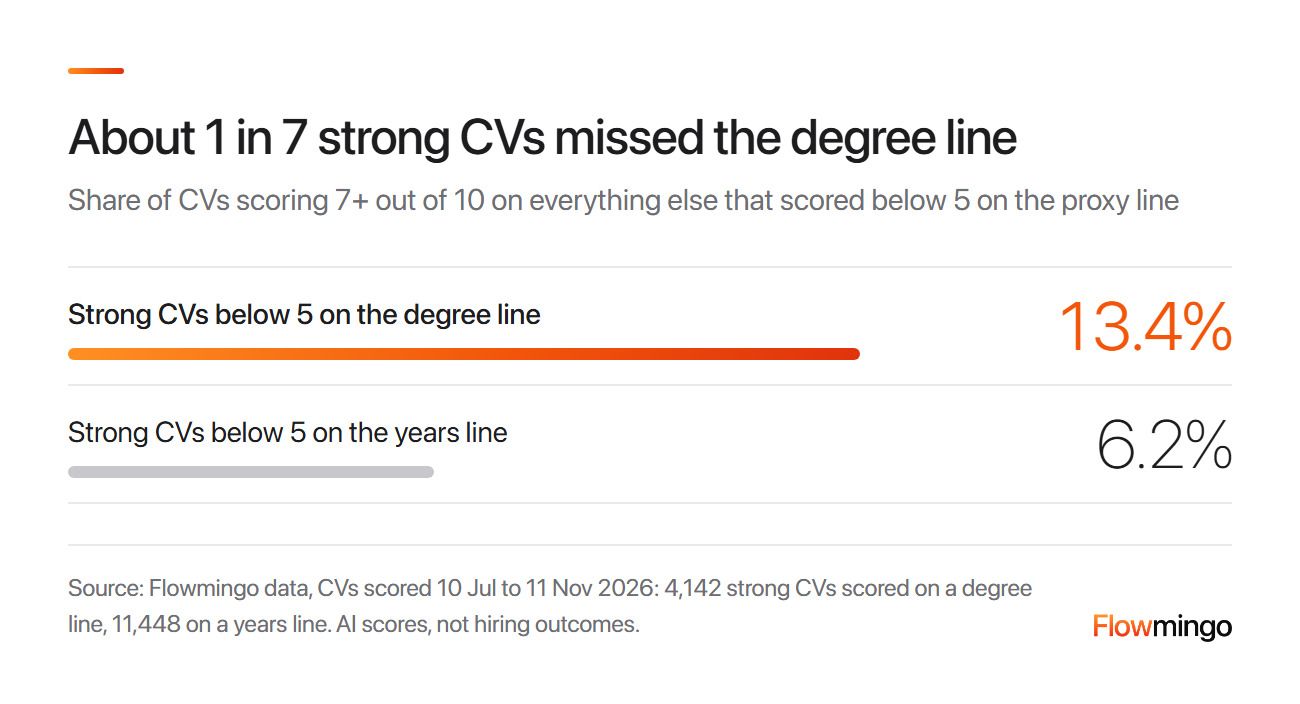
Strong CVs and proxy lines: 13.4% of CVs strong on everything else scored below 5 on the degree line, and 6.2% on the years line.
Flowmingo data · 35,629 CVs scored on a degree line · 89,020 on a years line · CVs scored 10 Jul to 11 Nov 2026
- 13.4% of 4,142 CVs averaging 7 or more on everything else scored below 5 on the degree line.
- 6.2% of 11,448 CVs strong on everything else scored below 5 on the years-of-experience line.
AI CV scores out of 10 against each job's own criteria, not hiring outcomes. A low degree rating can also mean a degree in another field, and it does not show these people would do the job well.
On the degree line, that is about 1 in 7 strong CVs, more than twice the share on the years line. Neither share shows that those people would do the job well, only that a knockout would have stopped you finding out.
On the supervisor role, the fix is to rewrite each proxy as the skill behind it. "Bachelor's degree" becomes "has run a shift or a team and can show a result", and "5 years in logistics" becomes "has planned staff and stock for a shift".
Take CV 37 of the 200 supervisor applicants. She has run a night shift of 12 pickers for 3 years, cut mis-picks on it since taking over, and has no degree. The old lines cut her at a glance, on the degree and on the years, while the new ones put her near the top.
How Flowmingo helps
CV Evaluation drafts criteria from your job description, and you can rewrite each line and set how much it matters.
The AI rates each criterion 0 to 10, with 3 to 5 sentences pointing to what the CV shows, or does not. No CV leaves your list automatically, and you decide who moves forward.
2.1 Should we hide names, photos and schools before the first read?
Yes, where your system allows it, because names, faces and school logos invite the same shortcuts. Our guide to interview bias covers what blind hiring fixes and when it only moves the bias into the interview, and skills based hiring shows how to test the skill itself.
3. Should I reject a strong CV for a 2-year gap or 4 jobs in 5 years?
No. Ask about both in the first conversation, because neither shows whether the person can do this job.
Gap filters are common. In the Hidden Workers survey, 48% of employers that screen with software filtered out middle-skills candidates with a gap of more than 6 months.
Such a rule fires before anyone reads why the gap is there, whether illness, caring for family or a partner's relocation.
Job-hopping is murkier than it looks. In a US field experiment published in 2025, with 3,878 applications across 5 occupations, CVs with frequent moves got about a third fewer callbacks in non-technical jobs (Hollister and colleagues).
For software testers the penalty ran the other way, and very stable CVs paid the price. Pooled across all 5 occupations, the difference could have been chance, so the penalty depends on the job.
That makes a cut for job-hopping a private rule rather than a fact about the person. On r/managers, a finance hiring manager with 2 open roles listed their red flags and asked others whether they were right.
First on the list was a CV where none of the last 2 or 3 jobs lasted more than 1.5 years.
Turn both into questions. For a gap, ask "What were you doing between March 2024 and May 2026, and what did you keep up?" For short jobs, ask "Which of these roles were contracts, and why did you move?"
On the supervisor role, CV 112 shows 4 jobs in 5 years, but 3 of them were peak-season contracts at 1 distribution centre. If tenure still worries you, add a criterion such as "can commit to 12 months" and ask every applicant.
4. My bar for a yes changed halfway through 150 CVs. How do I fix it?
Write the bar before CV 1: 4 to 6 criteria, each with what counts as evidence, agreed with the hiring manager. If CV 80 shows the bar is wrong, change it on paper and rescore what you read.
A bar kept in your head moves with the pile, because the first strong CVs raise it and a run of weak ones lowers it. It also bends toward whoever you already favour, as Uhlmann and Cohen found in 3 experiments published in 2005.
People in those experiments judged an applicant for police chief or, in 1 of the 3, for women's studies professor. They rated a strength as more important to the job when the applicant of the gender they favoured had it.
Rating the police chief criteria before learning the applicant's gender removed the bias, which is the case for writing the bar down before you open CV 1.
Many bars also start life as an old ad. In the Hidden Workers survey, 72% of employers built a new middle-skills posting from the old one or a light edit of it, and only 8% wrote a new job description.
On the supervisor role, the whole bar fits on a 5-line bar card, each line with the evidence that counts and its weight (an illustration, not customer data):
| Criterion | Counts as evidence | Weight |
|---|---|---|
| Has run a shift or a team | Team size, how long, 1 result | Must Have |
| Plans staff and stock for a shift | Rotas, stock counts or a named system | Must Have |
| Safety record | A named safety result or training | Very Important |
| Warehouse system use | Names the system and what they did in it | Important |
| Forklift or similar licence | Named, only where the law requires it | Knockout, asked in the form |
The licence is the only knockout, because the law can require it, and every other line is a weight rather than a gate. If the bar must change midway, note the change and the CV number where it took effect, then rescore what you already read.
Our guide to writing a job description shows how to get from the job to lines like these.
5. Screening CVs at 6pm after a long day: am I rejecting people I'd pass at 9am?
Possibly, and the CV you read just before matters too. Screen in short sittings, shuffle the order, and score each CV against the written bar, not against the one before.
High stakes do not switch off the pull of whoever came before. In admission and hiring interviews studied by Radbruch and Schiprowski, the stronger the previous candidate, the lower the next score, by enough to change who got picked.
CVs show a pull too, of a different kind. In 1 experiment, 72 US employers each rated 40 CVs in turn, scoring from 1 to 10 how interested they were in hiring each person.
A CV that came right after a white man's scored 4% lower than an identical CV that followed a woman's or a minority candidate's. The quality of the previous CV, by contrast, made no difference (Kessler, Low and Shan).
What moved the score was who came before, not how strong their CV was.
Choices also drift as a sitting wears on. In a 2022 field experiment, written up in 2026, Abebe and colleagues ran a business-plan competition for young professionals in Ethiopia and asked senior managers of established Ethiopian firms to judge it.
Each judge watched 12 pairs of video pitches, each pair from a man and a woman, and chose which one to recommend for a cash prize. They were judging pitches, not CVs, and the paper is not yet peer-reviewed.
Judges who got the plain briefing, with no reminder that the competition's organisers were committed to equal opportunity, picked the woman in 48.6% of their first 6 choices, but only 38.4% of their last 6.
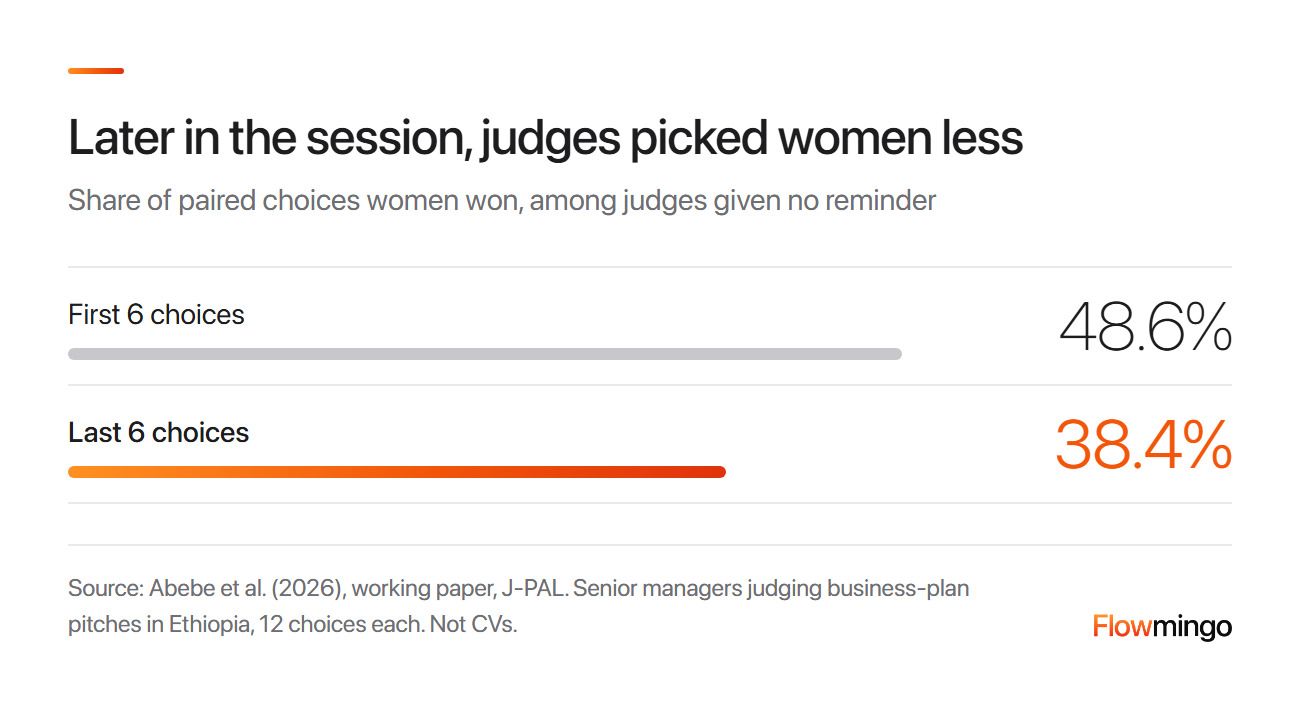
Late in the session: judges given no reminder picked the woman in 48.6% of their first 6 choices and 38.4% of their last 6.
That is a 10-point drop within 1 sitting. The remedy in that experiment was a short reminder: telling judges about the organisers' commitment to equal opportunity fully offset the drop.
Against order and fatigue alike, the fixes cost nothing:
- Screen in sittings of about 40 CVs or 1 hour, then take a break (our rule of thumb, not a study).
- Shuffle the pile instead of reading in arrival order.
- Put the bar card on top, with 1 line: "We hire on these 5 lines, from anyone who shows them."
- Re-score the first 10 CVs at the end of each sitting.
Say you read CV 51 right after 3 CVs from big logistics firms. The bar card asks only whether it shows the 5 lines, so its night-shift result scores the same wherever it sits in the pile.
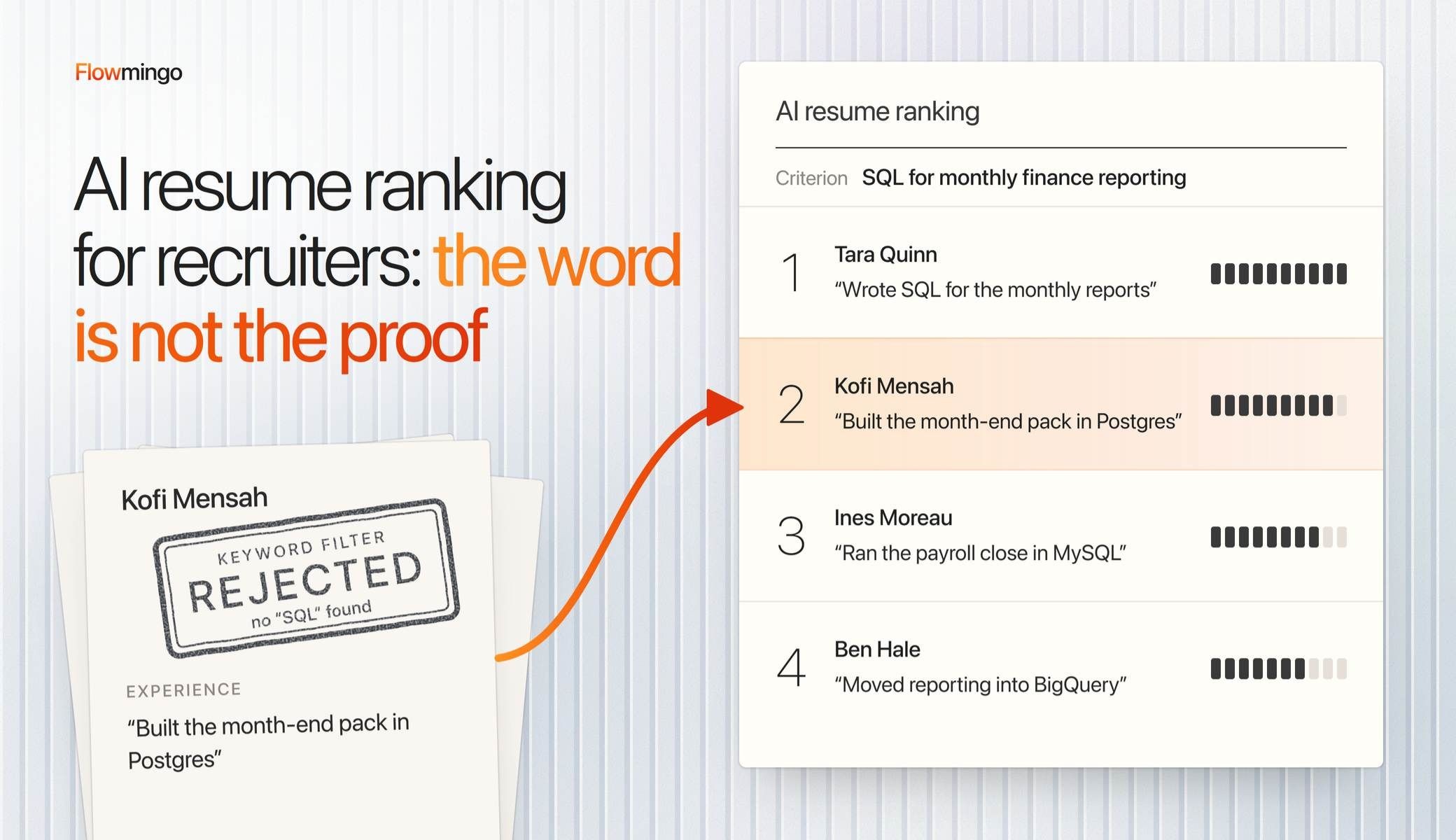
Software has an order effect of its own, worth knowing if an AI tool compares CVs for you. Shown pairs of equally strong CVs, 22 AI models picked the one listed first 63.5% of the time (Rozado), where a fair coin would pick it half the time.
6. With 300 applicants we skim each CV in 6 seconds. Who are we wrongly cutting?
Mostly people with plain CVs, a typo or no photo-ready polish, while polished CVs that prove little get through. That happens because a skim reads the surface, so read the evidence instead.
TheLadders, a US job site, found that recruiters gave a CV an average first look of 6 seconds in 2012, and of 7.4 seconds in a 2018 eye-tracking study (HR Dive). In a glance that short, surface features decide.
Typos are the clearest case. In a 2023 experiment by Sterkens and colleagues, 445 recruiters in Belgium rated graduate CVs and said how likely they were to invite each applicant.
Against an error-free CV, 2 spelling errors cut that stated interview chance by 7.3 points out of 100, and 5 errors cut it by 18.5.
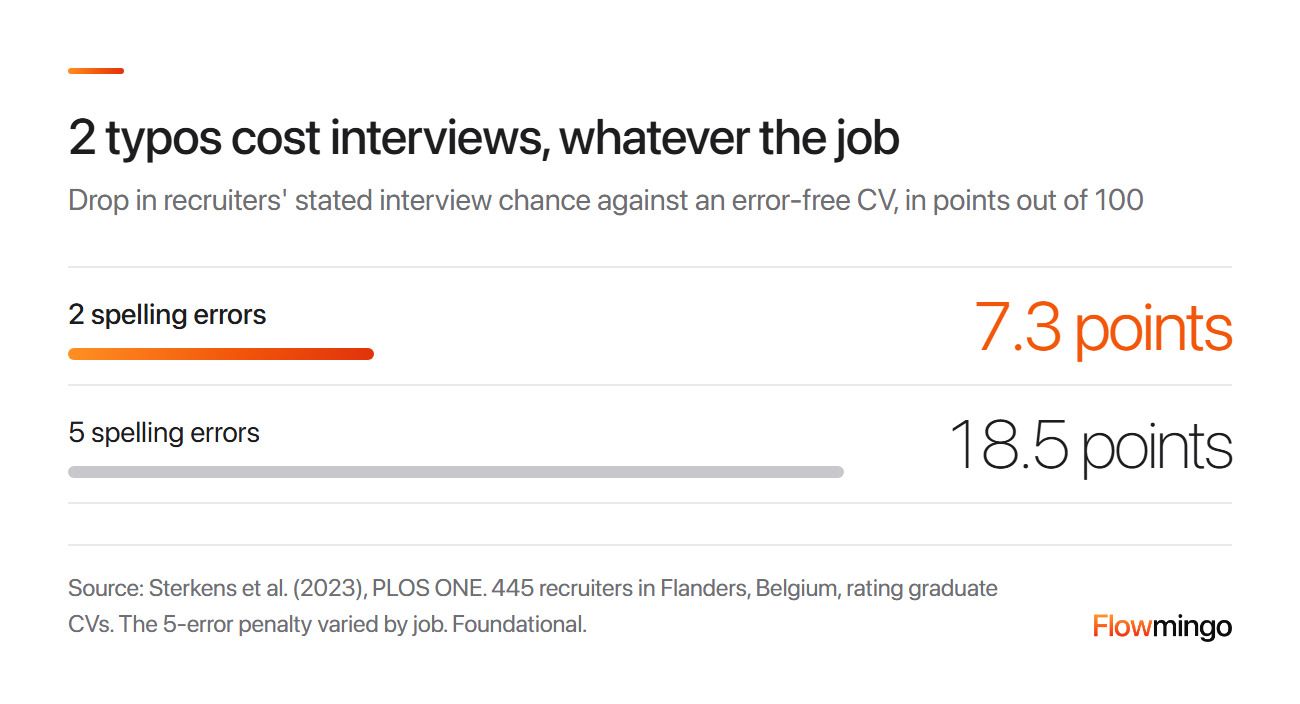
Typo penalty: against an error-free CV, 2 spelling errors cut the interview chance by 7.3 points out of 100 and 5 errors by 18.5 points.
In the chart, the highlighted 2-error penalty was the same across jobs, applicants and recruiters, so 2 typos cost as much in a job with little writing as in one full of it. Only the 5-error penalty shrank, for jobs needing more education.
About half of each penalty came from recruiters assuming the applicant had weaker ability, conscientiousness and people skills.
Photos work the same way. In an Israeli experiment published in 2015, CVs went to real job openings, and attractive men got nearly twice the callbacks of plain-looking men (Ruffle and Shtudiner).
So read the same fields on every CV: the must-haves, the latest role and its scope, and results with a number. Count a typo only where writing is a criterion, and drop the photo field from the application.
On the supervisor role, a misspelled word on CV 88 costs nothing, while the missing team size does.
7. My 2 recruiters screen the same role differently. Which resume screening best practices make them agree?
Give both 1 written bar with named criteria, and have each score the same 5 CVs alone. Talk through every gap of 3 or more points before the real pile.
Different readers see different people in the same CV. In a 2009 study by Cole and colleagues, 244 recruiters reading the same entry-level CVs agreed little on the personality they inferred from them.
Those guesses mostly missed the personality tests the applicants had taken, yet they still shaped how employable each recruiter rated each applicant.
Private rules make it worse, because nobody sees them until they bite. On r/recruiting, a poster learned 6 months into a director search that the recruiter had been auto-declining any CV she thought AI wrote.
Named criteria close much of that gap. In a small 2021 study in Canada, Gawad and colleagues split 10 reviewers into 2 groups of 5, and both groups scored the same 7 residency files.
Each file was a full application to a surgery residency, not a single CV. Reviewers who scored named traits, such as teamwork and leadership, agreed at 0.82, where 1 means perfect agreement.
Those who instead gave each part of the file, such as the CV or the letters, its own overall rating agreed at only 0.55. Calibrating your own 2 screeners takes 5 CVs and 3 steps:
- Pick 5 CVs from across the pile.
- Each reviewer scores them alone on the bar card.
- Where 2 scores sit 3 or more points apart, write a high and a low example for that line.
Say your 2 recruiters score CV 23 a 7 and a 3 on "has run a shift or a team". The first counted a weekend team-lead role, while the second wanted a full-time title. Write down which counts, once, and the ruling holds for all 200 CVs.
Our guide to evaluating candidates consistently runs a longer calibration session.
8. Hiring managers screen CVs with us. Which resume screening best practices belong in our team rules?
Put 8 rules on 1 page, and have every screener agree to them before the role opens.
Shared rules work because personal exceptions add up. In a 2018 study, Hoffman, Kahn and Li followed 15 firms that had brought in a job test.
The more often managers overruled the test, the sooner their hires tended to leave, and a firm of managers who rarely overruled it would keep workers about 15% longer than a firm of frequent overrulers.
The sheet below turns that lesson into 8 rules for screening. Copy it into the role's notes:
- The bar comes first. Write 4 to 6 criteria with their evidence, signed off by the hiring manager and tried on 5 CVs first.
- No proxy cuts. A degree, years, school, gap or short jobs is a question, not a knockout, unless a law or licence requires it.
- Same order, same fields. Shuffle the pile, then read the must-haves, the latest role and its scope, and results with a number.
- Short sittings. Stop after about 40 CVs or 1 hour, and re-score the first 10 at the end.
- No surface cuts. A typo, the layout or a photo counts only where writing or presentation is a criterion.
- A reason for every no. Give each 1 line, tied to a line on the bar card.
- Overrides in writing. Anyone who passes or cuts against the scores writes why, the same day.
- Reply deadlines. Clear screen-outs hear within 3 to 5 days of applying, and everyone gets a yes or no within 2 weeks.
9. We take 2 weeks to reply to applicants. Are faster employers taking our best ones?
Some of them take a job elsewhere before you call, and the rest remember the wait. Turn down clear screen-outs within 3 to 5 days of applying, and give everyone a yes or no within 2 weeks.
Silence is common. The CandE benchmark is a candidate-experience survey that Talent Board founded and Survale, a company that sells candidate-survey software, has run since 2025.
In its 2025 edition, 31% of North American candidates had not heard back 1 to 2+ months after applying.
Our rejection email guide quotes a figure from the edition before, 24% still waiting 2+ months in 2024. The 2 figures count different waits, a month or more against 2 months or more, so they do not contradict each other.
The 2025 figure comes from candidates of 110 employers that chose to take part, so the wider market is likely slower still. In the same edition, 15% of North American candidates said a poor experience meant they would not deal with that employer again.
Meanwhile, applicants move on. On r/humanresources, an HR poster hiring warehouse staff called back 38 hourly applicants and reached 11. Some, they wrote, start at the distribution centre down the road before anyone talks to them.
Flowmingo's own hiring board, where recruiters move each CV from stage to stage, shows the same wait from the recruiter's side.
Flowmingo data · 34,422 CVs · 2,536 hiring projects · 1,094 companies · CVs that arrived 10 Sep to 11 Oct 2026, followed for 30 days
- 2 days was the median wait before a recruiter first moved a CV on the hiring board, when they moved it.
- 34.3% of CVs in projects that used the board moved within 7 days of arriving, and 44.2% within 30 days.
- 42.3% of first moves on the hiring board were a move into the rejected stage.
The board records only stage moves, so a CV read or rejected outside Flowmingo counts as not moved. Only 182 companies used the board.
So even in projects that used the board, about 2 in 3 CVs sat unmoved a week after arriving. When a CV did move, the first move was a rejection about 4 in 10 times.
The fix is to batch the no's, because 1 batch per sitting is faster than 1 reply per CV. On the supervisor role, screen on Tuesday, Thursday and Saturday, and send each sitting's screen-outs the next morning.
That way nobody waits more than 5 days, and the CV-stage template in our rejection email guide covers the wording.
How Flowmingo helps
Send 1 link, and applicants take the AI interview in their own time, so nobody waits for a calendar slot. When an answer is thin or drifts off topic, the AI asks a follow-up before moving on.
In the built-in tracker, you set the stages and move each candidate on a drag-and-drop board.
10. How do I audit my last 100 rejected CVs against resume screening best practices?
Pull your last 100 no's, write the reason behind each, and count 6 things, 1 per mistake. Then fix the 2 biggest counts before the next role opens.
An audit works because each mistake leaves a trace in the rejected pile, such as a "no degree" reason or a 3-week wait, so 1 afternoon is enough to count them.
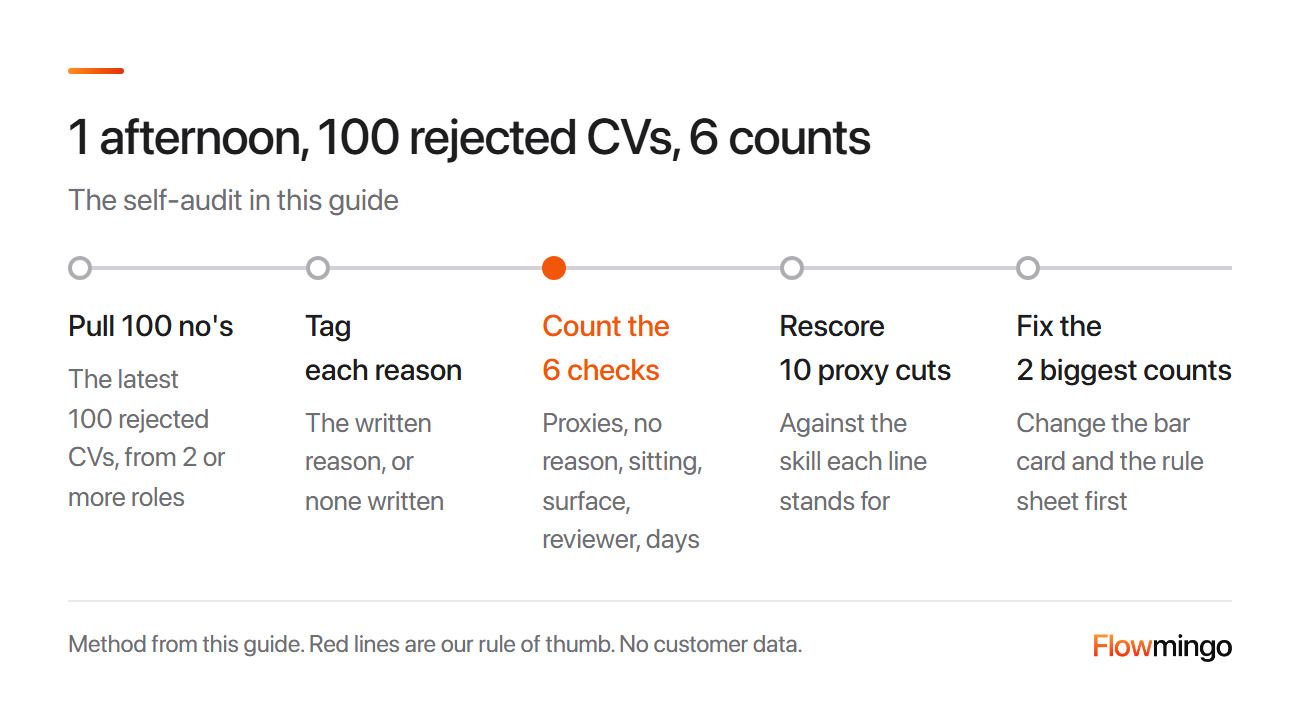
Audit in 5 steps: pull 100 no's, tag each reason, count the 6 checks, rescore 10 proxy cuts, then fix the 2 biggest counts.
Start by pulling 100 no's, the latest 100 rejected CVs from 2 or more roles, and tag each with the reason written at the time, or "none written". Then count the 6 checks: proxies, no reason, sitting, surface, reviewer and days.
Next, rescore 10 of the proxy cuts against the skill each line stands for, which shows whether those cuts lost you anyone strong. Finally, fix the 2 biggest counts, starting with the bar card and the rule sheet.
The red lines in the table below are our rule of thumb, not a study:
| Check | What to count in 100 no's | Red line |
|---|---|---|
| Proxy cuts | No's citing only a degree, years, school, gap or short jobs | More than 5 |
| Missing reasons | No's with no reason tied to a criterion | More than 0 |
| Sitting position | No's in each sitting's last third against its first | 1.5 times as many late |
| Surface cuts | No's for a typo, layout or photo, writing not a criterion | More than 0 |
| Reviewer splits | 10 no's rescored by a second reviewer, gaps of 3+ points | More than 2 of 10 |
| Reply days | Days from applying to the no, for clear screen-outs | More than 5 |
Say 9 of your 100 no's on the supervisor role cite only "no degree". Rescore those 9 on the skill lines, and if 3 come back strong, the degree line becomes a question next time.
If you record applicants' groups lawfully, also check pass rates by group with the 80% rule from our candidate shortlisting guide. It divides each group's pass rate by the highest group's and treats a result under 80% as a sign that 1 group is screened out more.
How Flowmingo helps
Flowmingo is a free AI hiring platform. CV Evaluation scores every CV against criteria you edit and weight, with the evidence next to each score.
So every no can point to a scored line you can check, and no CV leaves your list automatically. CV screening is unlimited on every plan, including Free.
Run your next role on Flowmingo with these resume screening best practices.
11. Sources
Every study, survey, law and thread in this guide links to a source below. Flowmingo figures come from Flowmingo's own platform data.
- Abebe, G., Brooke, S., Gole, T., Quinn, S., & Schwantje, T. (2026). Organisational values, self-image and inclusion: Evidence from a field experiment [Working paper]. J-PAL.
- Cole, M. S., Feild, H. S., Giles, W. F., & Harris, S. G. (2009). Recruiters' inferences of applicant personality based on resume screening: Do paper people have a personality? Journal of Business and Psychology, 24(1), 5-18.
- Fuller, J. B., Raman, M., Sage-Gavin, E., & Hines, K. (2021). Hidden workers: Untapped talent. Harvard Business School Project on Managing the Future of Work and Accenture. Survey fielded January and February 2020.
- Gawad, N., Younan, J., Towaij, C., & Raiche, I. (2021). Comparing 2 approaches for the file review of residency applications. Journal of Graduate Medical Education, 13(2), 240-245.
- Griggs v. Duke Power Co., 401 U.S. 424 (1971). Supreme Court opinion. Legal Information Institute.
- Hoffman, M., Kahn, L. B., & Li, D. (2018). Discretion in hiring. The Quarterly Journal of Economics, 133(2), 765-800.
- Hollister, M., Denier, N., & St-Denis, X. (2025). Do employers care about past mobility? A field experiment examining hiring preferences in technology and non-technology jobs. Sociological Science, 12, 232-255.
- Kessler, J. B., Low, C., & Shan, X. (2026). Lowering the playing field: Discrimination through sequential spillover effects. The Review of Economics and Statistics, 108(2), 504-513. The 4% figure is from the 2022 working paper.
- O'Donnell, R. (2018, November 8). Eye-tracking study shows recruiters look at resumes for 7 seconds. HR Dive.
- Radbruch, J., & Schiprowski, A. (2025). Interview sequences and the formation of subjective assessments. The Review of Economic Studies, 92(2), 1226-1256.
- Reddit, r/humanresources. (2026, October 20). Called 38 hourly applicants back yesterday and reached 11 of them [Online forum post; read via the Arctic Shift archive].
- Reddit, r/managers. (2026, February 12). What are your resume red flags? [Online forum post; read via the Arctic Shift archive].
- Reddit, r/recruiting. (2025, November 23). AI resume [Online forum post; read via the Arctic Shift archive].
- Rozado, D. (2026). Gender and positional biases in LLM-based hiring decisions: Evidence from comparative CV/resume evaluations. PeerJ Computer Science.
- Ruffle, B. J., & Shtudiner, Z. (2015). Are good-looking people more employable? Management Science, 61(8), 1760-1776.
- Sigelman, M., Fuller, J., & Martin, A. (2024). Skills-based hiring: The long road from pronouncements to practice. Burning Glass Institute and Harvard Business School Project on Managing the Future of Work.
- Sterkens, P., Caers, R., De Couck, M., Van Driessche, V., Geamanu, M., & Baert, S. (2023). Costly mistakes: Why and when spelling errors in resumes jeopardise interview chances. PLOS ONE, 18(4), e0283280.
- Survale. (2026, July 21). 2025 candidate experience (CandE) benchmark research: Key statistics. Survale.
- Talent Board & ERE Media. (2024). What sets CandE award winners apart: 2024 candidate experience benchmark research. Talent Board.
- Uhlmann, E. L., & Cohen, G. L. (2005). Constructed criteria: Redefining merit to justify discrimination. Psychological Science, 16(6), 474-480.
- Van Iddekinge, C. H., Arnold, J. D., Frieder, R. E., & Roth, P. L. (2019). A meta-analysis of the criterion-related validity of prehire work experience. Personnel Psychology, 72(4), 571-598.