
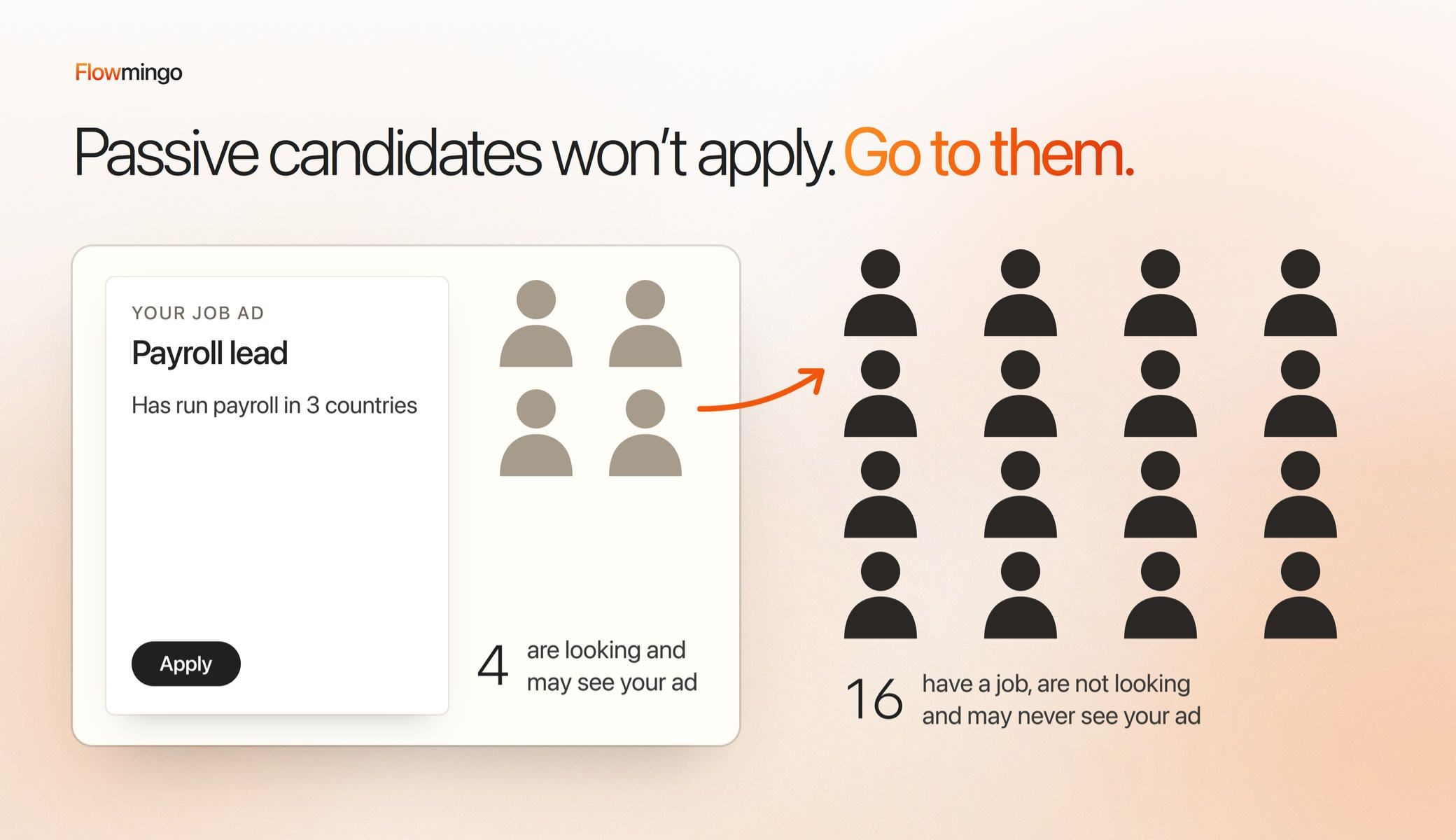
Passive candidates are people who have a job and are not looking for a new one, but would move for the right role. Because they are not applying, recruiters usually reach them through sourcing (searching online profiles), referrals and direct messages rather than job ads.
Recruiters also call them passive job seekers, and you meet them when a job ad brings in plenty of applicants but none who can do the job. The people you want already work somewhere else, so you have to go to them.
Key takeaways
- How many people are passive candidates? Most employed people had not looked for work recently. In a New York Fed survey more than 9 years old, only about 1 in 5 to 1 in 4 employed workers had actively looked in the past 4 weeks.
- Do they get other job offers? Yes. In the same survey, employed people who were not looking received about 1 in 4 of all the job offers in the sample.
- Is sourcing them worth the effort? Often. In the 2025 report from Gem, which makes recruiting software, direct sourcing made 2.47% of applications but 9.94% of hires.
- What must the first message say? Why you picked them, what the role is and the pay. In the EU, it should also say who you are, where you found their details and what their rights are.
1. What are passive candidates in recruitment?
In recruitment, passive candidates are employed people who are not applying anywhere but would talk about the right role. Because they may never see your ad, the first contact is yours to make.
The term covers a range of people. Some quietly ask around their network about openings. Others are happy where they are, but would answer a message that is clearly about them. For example, a payroll manager who likes her team may still reply to a role with a bigger scope.
LinkedIn, the professional network, put numbers on the passive group in a 2013 blog post (LinkedIn Talent Blog). The estimate, now more than 12 years old, gives no method.
LinkedIn placed 75% of the fully employed workforce in the passive group, including the quiet askers it calls "tiptoers". Only about 15% was not open to any new opportunity, so passive does not mean unavailable.
Data with a stated method points the same way. In a 2017 study, now more than 9 years old, the New York Fed, the Federal Reserve Bank of New York, pooled 3 October rounds of its survey.
Those rounds covered about 2,300 employed people. Of those, only about 1 in 5 to 1 in 4 had actively looked for work in the past 4 weeks. Being passive, in other words, is the usual state for someone in work, not the exception.
The opposite term is an active candidate, someone who is applying now, with a job or without one.
2. What does recruiting passive candidates look like on a real role?
On a real role, recruiting passive candidates works like a funnel that starts with names rather than applications, and only interested people enter your process.
Here is 1 role worked through with illustrative numbers.
Say you are hiring a payroll lead who has run payroll in 3 countries. Your job ad brought in 40 applicants, but none of them had done that.
Instead, you search profiles and ask your team for referrals, and between them you find 60 people who fit the must-haves.
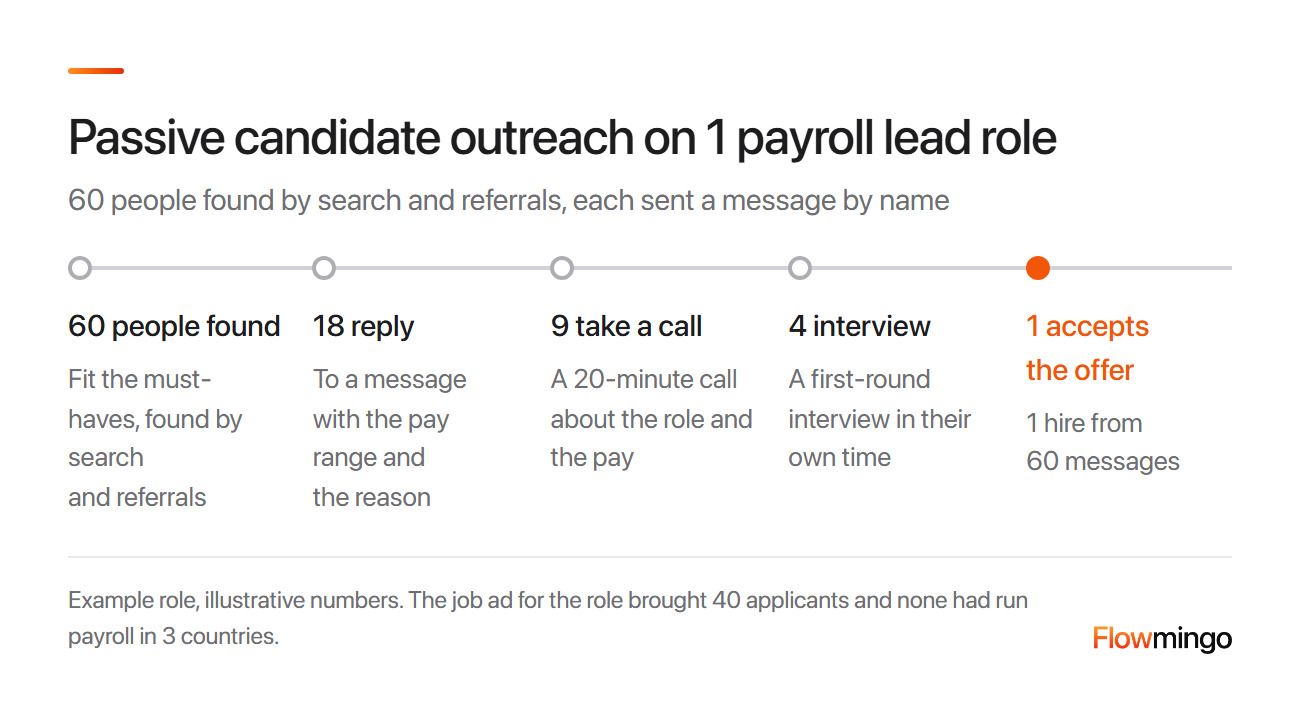
Passive candidate outreach on 1 payroll lead role: 60 people found, 18 reply, 9 take a call, 4 interview and 1 accepts the offer.
You then write to each of the 60 by name, with the pay range and the reason you picked them. Of those 60, 18 reply, and 9 agree to a 20-minute call about the role and the pay.
After the call, 4 take a first-round interview in their own time, and 1 accepts your offer.
That is 1 hire from 60 messages, on a role that the 40 applicants from the ad could not fill. The decision it leads to is about timing: for the next role with few qualified people, you start outreach in week 1 instead of running the ad again.
The biggest drop comes at the first reply, where 60 messages turn into 18 answers, so the first message matters most. Our guide to the recruitment funnel shows how to track each stage.
3. How do you approach passive candidates, step by step?
Treat the first message as the whole pitch, and keep every step after it small. A passive candidate owes you nothing, so each extra form or delay can become a reason to stop replying.
- Write 3 to 5 must-haves before you search. A fact such as "ran payroll in 3 countries" tells you who to message and who to skip.
- Start with referrals and past finalists. In a 2025 report by the recruiting software maker Gem, referrals made 1.64% of applications but 17.09% of hires, so a referral was far more likely than the average application to end in a hire.
- Write to 1 person at a time. Say why you picked them, what the role is and the pay range. Your employer branding, how people see you as a place to work, adds a reason to read on beyond the role.
- Say who you are and where you found them. Under GDPR Article 14, the EU rule for data you did not get from the person, your first message at the latest must say who you are, where you found their details and what their rights are.
- Ask for a small first step, not a CV. LinkedIn's guide warns that passive people most likely have no CV to hand, so offer a short call or a first-round interview they take in their own time.
If someone does not reply, send 1 polite follow-up, then stop. Note each "not now" with a date to write again, because a no today can turn into a yes when their plans change.
3.1 Which mistakes lose a passive candidate?
The costliest mistake is treating a passive candidate like an applicant. A long form, a request for a CV or a week of silence can tell them the move would be hard, and they already have a job.
They also have other options, because other employers approach them too. In the same New York Fed study, employed people who were not looking received about 1 in 4 of all the job offers in the sample.
The same group also received more than half of the unsolicited offers, the ones they had not asked for. That means a slow or generic approach may compete with offers that reached them first.
A copied message sent to 200 people is likely to lose them at the first reply. A hidden salary can do the same, and so can a call booked before you have explained the role.
4. What is the difference between active and passive candidates?
Active candidates are looking and applying now, while passive ones are not, so the first contact usually comes from you. In practice, the role picks the channel: use a job ad when many qualified people exist, and outreach when few do.
Neither active nor passive candidates are better in themselves, because a strong active candidate may simply have lost a job in a layoff. What differs is the effort each gives you.
Active candidates often find you through job ads, so they tend to arrive with a CV and may already be talking to other employers. Passive people are likely to judge you on your first message instead.
The size of each group depends on how a survey counts, which is why this guide's figures differ. Gallup, the polling company, counts more broadly than the New York Fed, because it includes people who are only watching for a job.
In its 2025 World Poll, 50% of employees globally were watching for or actively seeking a new job (Gallup).
The other half were neither watching for nor seeking a new job, so they are unlikely to see your job ad at all.
5. How do you screen passive candidates with Flowmingo?
After the short call or an interested reply, send 1 link instead of an application form, and let each person answer the first-round questions when it suits them. You then review the answers and decide who to meet.
Keep that first round short, and ask only about the 3 to 5 must-haves from step 1 rather than everything a final interview covers.
About 20 minutes of their time is a fair first ask, because a passive candidate at this stage is curious, not yet committed. Anything longer can give them a reason to drop out.
How Flowmingo helps
Paste your job description, and Flowmingo's AI interviewer drafts 1 to 30 questions for you to edit before you share a single link.
Each person takes the interview in their own time, and you get the recording, the transcript and a scored report. Every hiring decision stays with your team.
Sign up free to run the first round with your passive candidates on Flowmingo.
6. Sources
Every study, survey and guideline in this glossary entry links to its source below.
- Dewar, J. (2013, December 20). Recruiting active vs. passive candidates. LinkedIn Talent Blog. LinkedIn
- European Parliament and Council of the European Union. (2016). Regulation (EU) 2016/679, Article 14: Information to be provided where personal data have not been obtained from the data subject. GDPR-Info
- Faberman, R. J., Mueller, A. I., Sahin, A., Schuh, R., & Topa, G. (2017, April 5). How do people find jobs. Liberty Street Economics, Federal Reserve Bank of New York. Liberty Street Economics
- Gallup. (n.d.). Employee retention and attraction indicator. Retrieved 26 October 2026. Gallup
- Gem. (2025). 2025 recruiting benchmarks report. Gem