
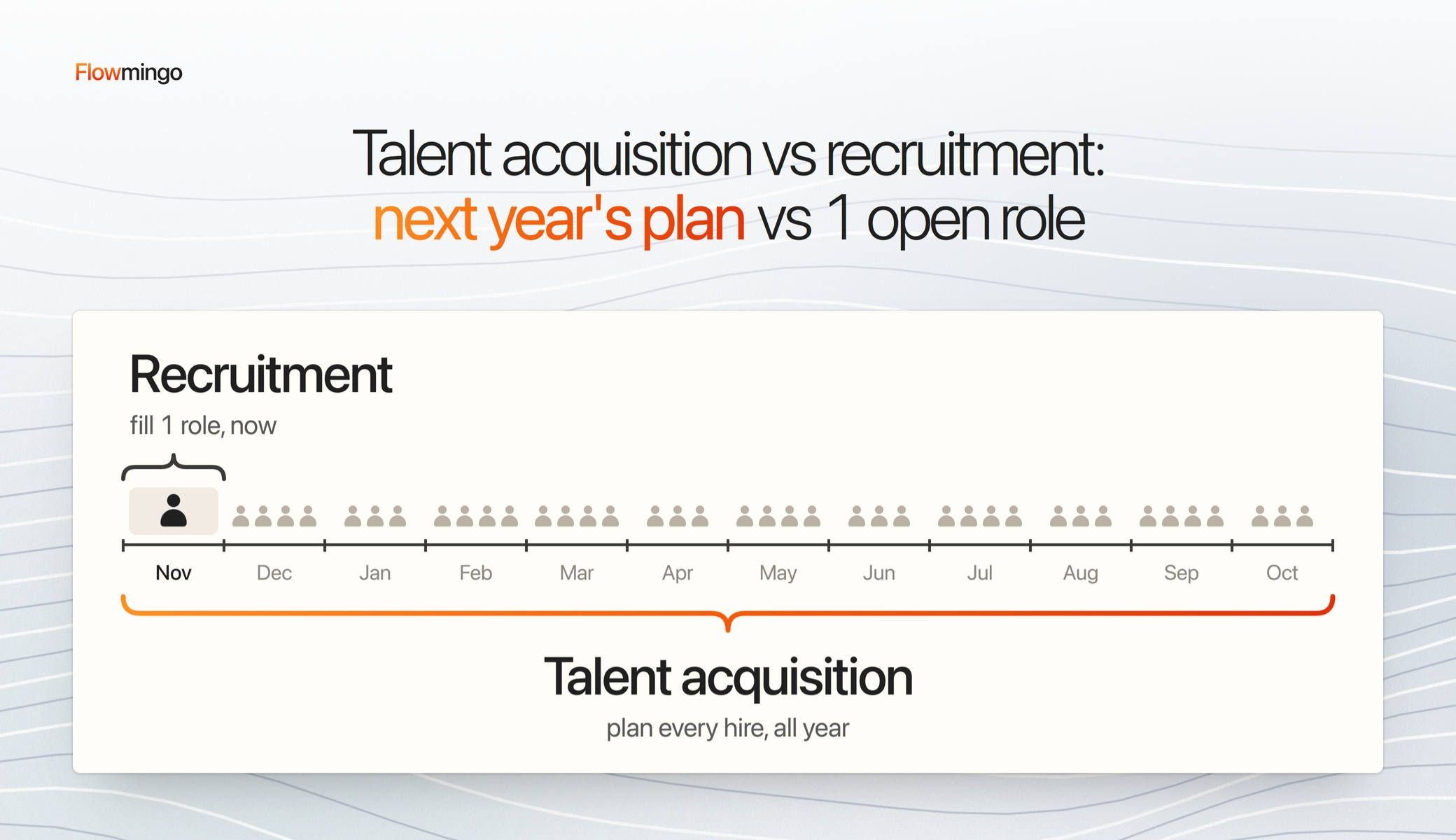
Talent acquisition vs recruitment is the difference between planning the people a business will need next year and filling 1 open role now. Recruitment is the part of talent acquisition that starts when a job opens and ends when it is filled.
If you work in-house, talent acquisition vs recruiting becomes a staffing question when your CEO asks whether to hire a Head of Talent Acquisition or 1 more recruiter. At an agency, you see that title in a client's email signature.
Either way, the title matters less than who owns next year's hiring plan and who fills the roles open now.
Key takeaways
- Which is bigger, talent acquisition or recruitment? Talent acquisition. It holds the hiring plan, the employer brand, the pipeline and recruitment itself, while recruitment works 1 requisition at a time.
- Head of Talent Acquisition or 1 more recruiter? Hire for what is missing. If nobody owns the hiring forecast, the gap is talent acquisition. If the plan exists but roles sit open, the gap is recruiting capacity.
- How is each one measured? Recruitment by time to fill and cost per hire, a median $1,200 for non-executive roles in a 2025 benchmark by the Society for Human Resource Management (SHRM). Talent acquisition by quality of hire and retention.
- Does the long-term work show in the numbers? Referrals do. Ashby, a recruiting software vendor, pooled 54M applications from January 2021 to March 2026. Referred candidates passed the initial screen 52% of the time, against 35% for all candidates.
- Where does a recruitment agency fit? Inside recruitment. The client's talent acquisition team decides which roles go out, and the agency fills them.
1. What is talent acquisition vs recruitment?
Talent acquisition is the ongoing system a company uses to plan, attract and hire the people it needs. Recruitment is the step inside it that fills 1 vacancy, from the job ad to the signed offer.
The line between them is easiest to see in what each one covers. Talent acquisition includes workforce planning with the business, the employer brand, sourcing people before a role opens, referral schemes and internal moves.
Recruitment covers the brief, the advert, screening, interviews and the offer for 1 role. Selection is the choosing part of recruitment, which is why some guides say "recruitment and selection".
For example, a referral scheme is talent acquisition work, while screening the applicants for 1 job is recruitment.
Recruitment vs talent acquisition is a difference of time span and ownership, not of skill. The CIPD, the UK's professional body for HR, measures how often recruitment is tied to a wider talent plan.
In its Resourcing and Talent Planning 2026 survey of 1,014 UK HR professionals, 47% agreed that their recruitment is connected to a wider talent management strategy.
In other words, fewer than half said their recruitment sits inside a wider plan, the part talent acquisition adds.
2. What does talent acquisition vs recruitment look like in practice?
In practice, talent acquisition writes the year's hiring plan and recruitment fills each line of it. The example below follows 1 client's plan down to the 1 role an agency fills.
Take a 300-person logistics client that plans 40 hires in the next 12 months. Its talent acquisition lead starts from the business plan and splits the 40 by channel.
Internal moves and referrals take 16, direct job ads take 18, and 6 niche roles go to 2 agencies. The client will judge that plan later, by quality of hire and retention.
So only 6 of the 40 hires ever reach an agency desk. One of them, a warehouse operations manager, reaches 1 agency recruiter as an open requisition, and that is where recruitment starts.
The recruiter takes the brief and sends a client-ready shortlist of 3 by day 10. The client measures that work differently, by time to fill and cost per hire, which describe 1 vacancy rather than the whole year's plan.
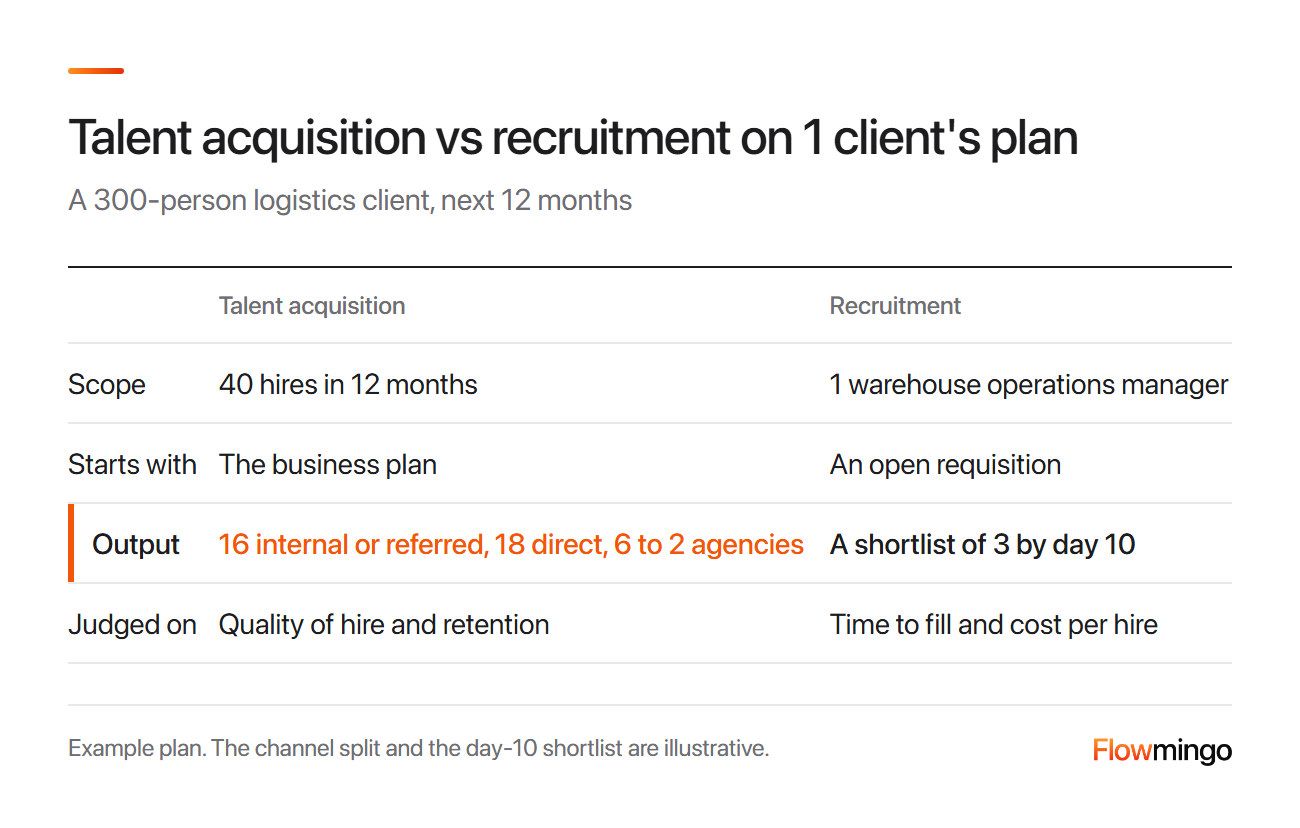
Talent acquisition vs recruitment on 1 client's plan: 40 hires in 12 months, split 16, 18 and 6 by channel. The warehouse operations manager role gets a shortlist of 3 by day 10.
In the example, the year-end review led to 1 decision. Referred hires were the likeliest to still be in post at year end, so the lead moved 4 direct roles to referrals for next year.
Both agencies kept the 6 niche roles, so the change touched only the direct and referral channels.
An in-house team with no agency would fill all 40 itself, and the split would hold: the plan is talent acquisition, and each role it opens is recruitment.
3. How do you build talent acquisition on top of recruitment, step by step?
Start from the recruitment you already run and add the planning around it, 1 habit at a time. Each step below looks further ahead than the next open role.
- Count last year's hires by role and by source. A plan needs a baseline, and few teams have one: in the CIPD's 2026 survey, only 31% of UK employers track time to hire, up from 21% in 2024.
- Forecast next year's hires with each manager. Ask about growth, leavers and new sites, because the forecast shows which roles to source before they open.
- Pick a channel for each kind of role. Referrals earn their place: in Ashby's 2026 benchmark, 52% of referred candidates passed the initial screen, against 35% overall. Ashby sells recruiting software, so read these as vendor figures.
- Keep the runners-up warm. The second and third choices from each search are next year's pipeline, so note why they missed and when to call back.
- Measure the plan as well as each role. Add quality of hire and first-year retention next to time to fill and cost per hire. Our guide to recruiting metrics shows how to set each one up.
3.1 Is talent acquisition just HR?
No. HR covers the whole working life of staff, from pay and performance to exits, and talent acquisition is the HR function that brings people in.
SHRM's research also counts talent acquisition as a separate HR function. In its April 2026 study of 1,908 HR professionals, which compared AI use across HR functions, 27% of organisations use AI in talent acquisition, more than in any other HR area.
The common mistake is a new title without the plan behind it. A recruiter renamed talent acquisition partner who still works only on open requisitions is doing recruitment, so the business still hires in a rush.
4. Is a talent acquisition specialist the same as a recruiter?
The daily work overlaps, but the scope differs. A recruiter fills the roles in front of them, while a talent acquisition specialist also owns part of the plan, such as the forecast, the employer brand or the pipeline.
That scope is what a company weighs when it chooses between a Head of Talent Acquisition and 1 more recruiter. For the recruiter side, SHRM's 2025 benchmark gives a yardstick.
In it, 55% of organisations had dedicated in-house recruiters, each carrying a median 20 requisitions a year. The other 45% had no dedicated recruiter, so whoever owns the plan also fills the roles or uses an agency.
Before adding a recruiter, divide the requisitions you open in a year by that median of 20: a result above your recruiter count points to a capacity gap.
An agency recruitment consultant is a recruiter in this sense, filling roles for many clients at once rather than planning any one client's year. High Tech and High Touch, a 2017 book on headhunting now more than 8 years old, shows how much of that work agencies do.
Its authors, Coverdill and Finlay, write that contingency headhunters, who are paid only when they make a placement, "perform the bulk of the recruiting" in the United States.
If you work at an agency and a client's talent acquisition specialist briefs you, the plan behind the brief matters as much as the role. Ask how many similar hires it holds, because 1 requisition can become repeat orders.
5. How do you handle talent acquisition and recruitment with Flowmingo?
Use Flowmingo for the recruitment part of the work: the first round of screening on each open role, with every result kept on 1 board. The plan, the forecast and the channel mix stay with you.
Before you start, have 2 things ready: the hiring plan from step 2 and 1 job description for each role. Begin with the role that draws the most applicants, because that is where the same questions for everyone matter most.
Keep your own notes on the runners-up from step 4, so that next year's plan starts with names.
How Flowmingo helps
Flowmingo drafts interview questions from your job description, and every applicant you invite takes the AI interview in their own time.
Every completed assessment lands on 1 profile, in 1 board you run your hiring from, and the score can go back to your ATS.
For agencies, client links show names as initials and keep the email, phone and CV with you, so the introduction still runs through your agency.
Sign up free and keep the talent acquisition vs recruitment split clear: you own the plan, and Flowmingo runs the first round.
6. Sources
Every report, study and survey in this guide links to its source below.
- Ashby. (2026, May 7). Recruiting operations benchmarks: Talent trends report. Ashby
- CIPD. (2026). Resourcing and talent planning 2026. Chartered Institute of Personnel and Development. CIPD
- Coverdill, J. E., & Finlay, W. (2017). Introduction. In High tech and high touch: Headhunting, technology, and economic transformation. ILR Press. DOI
- SHRM. (2025). 2025 recruiting benchmarking report. SHRM
- SHRM. (2026, April 8). AI in HR 2026: From hype to measured, human-centered impact. SHRM