
It's Monday, 1,000 applications sit in your queue for 20 openings, and you have 2 recruiters and 5 days to screen candidates at scale.
In 2025, recruiters on Greenhouse, the applicant tracking system, handled 746 applications each over the whole year (North American benchmark). Your 2 recruiters would each face 500 in 1 week, about 2/3 of a year's load, too much for high volume screening by hand.
Reading every CV at 4 minutes would take about 67 hours, against the roughly 60 focused hours your 2 recruiters have, so it is tempting to read the first 100.
Yet the pile is smaller than it looks. Spread over 20 openings, 1,000 applicants is only 50 per hire, about a quarter of the 194 per hire in Greenhouse's Fall 2026 US data, so you cannot afford to lose a strong CV.
So the pile is too big to read and too small to waste. Getting through it depends less on how fast your team reads than on which CVs a person reads at all, and in what order.
Key takeaways
- Can 2 recruiters read 1,000 CVs in a week? No. At 4 minutes a CV, reading them all takes about 67 hours, against the 60 focused hours 2 recruiters have.
- Which knockout questions are safe at volume? Questions on 4 day-1 job facts: work rights, shifts, reaching the site and a needed licence. A person checks any 'no' that may have a religious or disability reason.
- Should the CV score decide who gets declined? Only when a must-have is clearly missing, which is about 1 in 4 CVs in this guide's example.
- How do I know no stage rejects one group more? Check each gate on its own, and review any gate where a group passes at under 80% of the top group's rate.
- How do I catch good applicants the screen threw out? Re-read 60 random declines a week. If none should have passed, the miss rate is very likely 5% or less.
1. With 1,000 applicants and 20 openings, how do 2 recruiters screen candidates at scale this week?
Don't read the pile in the order it arrived. Run everyone through 4 gates instead: lawful knockouts, a CV score in 3 bands, 1 short interview for all who pass, then a ranked review.
That order matters because the pile is too big to read at 4 minutes a CV, yet too small to waste at 50 per hire. Knockouts alone don't fix it, and reading in date order leaves good people unread.
In one r/recruiting thread, after others suggested knockout questions, a recruiter replied "Done all that and still had 900 apps in 48 hours".
Another, on r/Recruitment, works through the first hundred or so by date, plus a set filtered by keyword, and leaves the rest unread. Both describe the same trap, in which the pile outgrows the hours.
Gates get you out because each one asks a single question and has its own pass rate, which you can check by group. A problem then shows up at the gate that causes it.
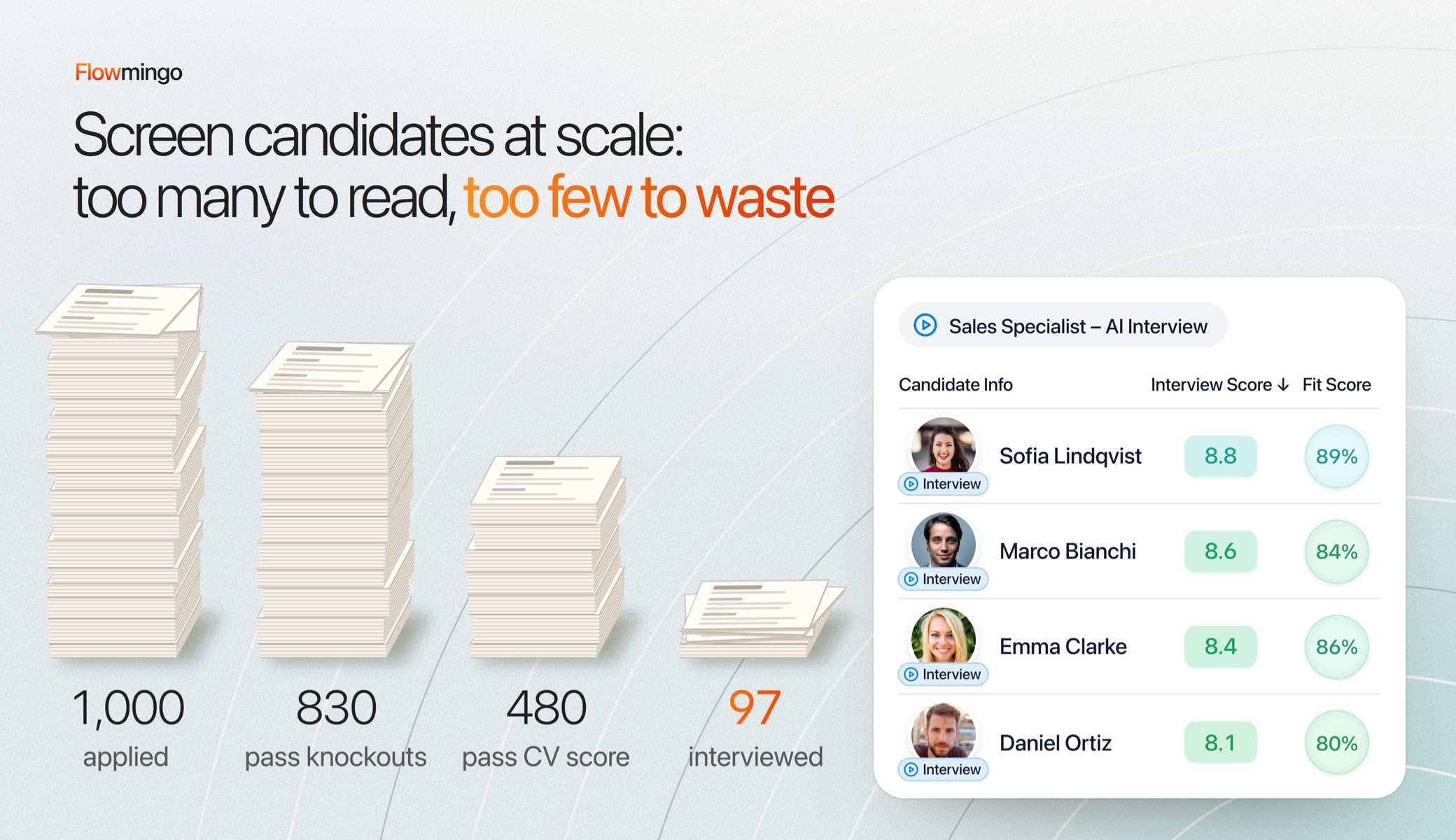
The figure shows the worked example used in every section (illustrative, not customer data).
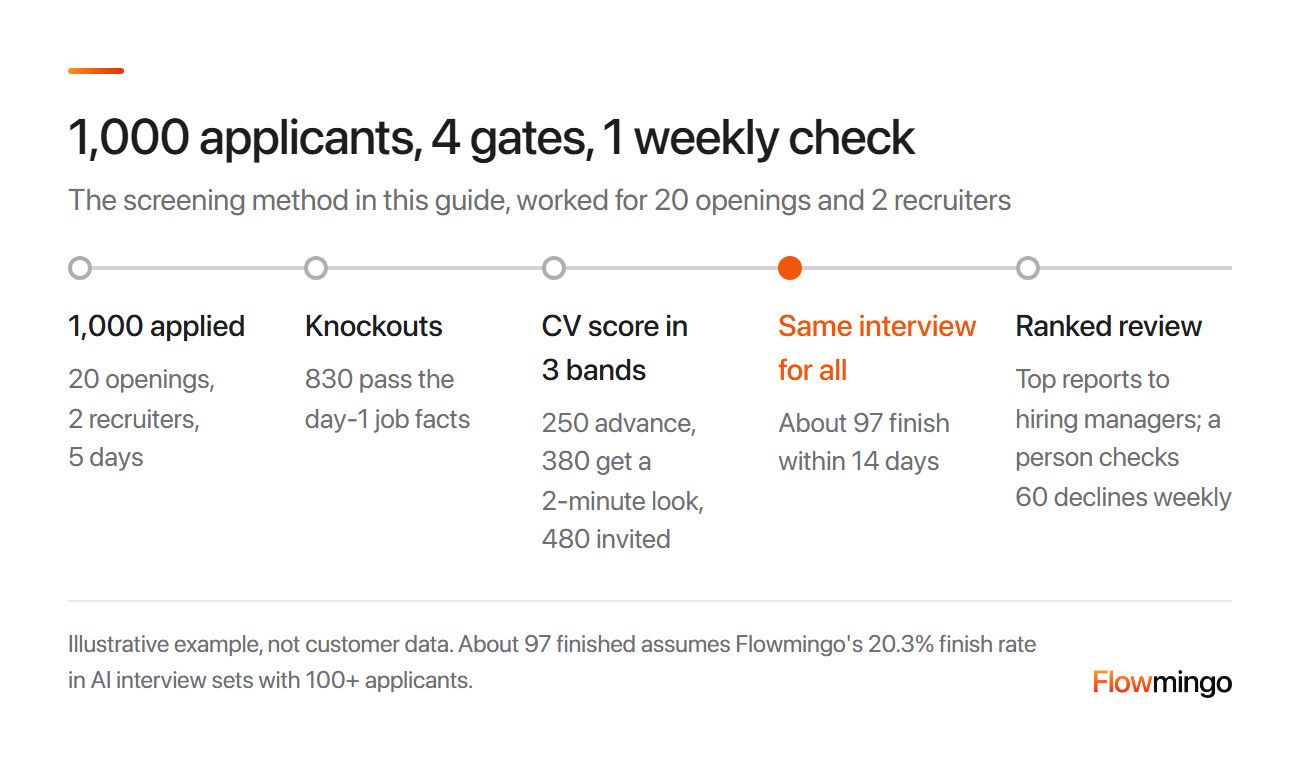
Screening gates: 1,000 applied, 830 pass knockouts, 480 get an invite after the CV bands and about 97 finish within 14 days. Top reports go to hiring managers, and 60 declined CVs get a weekly re-read.
Every gate below works at 1,000 applicants, not only on a small shortlist. For the wider plan, including capacity, drop-out, the law and a weekly scorecard, see our high volume recruiting guide.
2. How many hours would reading all 1,000 CVs take, and how many do 2 recruiters really have?
About 67 hours at 4 minutes a CV, against about 60 focused hours in 5 days. The staged screen in this guide needs about 30.
Add phone screens of 20 minutes for the 200 people your hiring managers want to see, 10 per opening, and the total climbs to 133.3 hours.
The illustrative table, not customer data, sets both against the 60 hours:
| Line | Calculation | Hours |
|---|---|---|
| Hours available | 2 recruiters x 6 hours x 5 days | 60 |
| Read every CV | 1,000 x 4 minutes | 66.7 |
| Phone-screen 200 | 200 x 20 minutes | 66.7 |
| Reading and calls | 133.3 | |
| Set-up | Criteria, knockouts, questions | 4.0 |
| Knockouts | The form sorts the answers | 0 |
| CV human look | 380 x 2 minutes | 12.7 |
| Interview reports | 97 x 5 minutes | 8.1 |
| Weekly audit | 60 x 4 minutes | 4.0 |
| Fairness check | 1 hour a week | 1.0 |
| The staged screen | 29.8 |
The staged screen's biggest line is the human look, a 2-minute read of each of the 380 CVs the score cannot settle (section 5).
Knockouts cost almost no recruiter time, because the form sorts the answers and only the "no" answers routed to a person need a look. This example leaves those minutes out, and every hour in the table is an assumption to swap for your own.
In this example the staged screen yields about 97 scored interviews, short of the 200 your managers want, a gap section 8 shows how to close.
Even with all 200 finished, the report line would rise to 16.7 hours and the total to about 38, still under the 60 available.
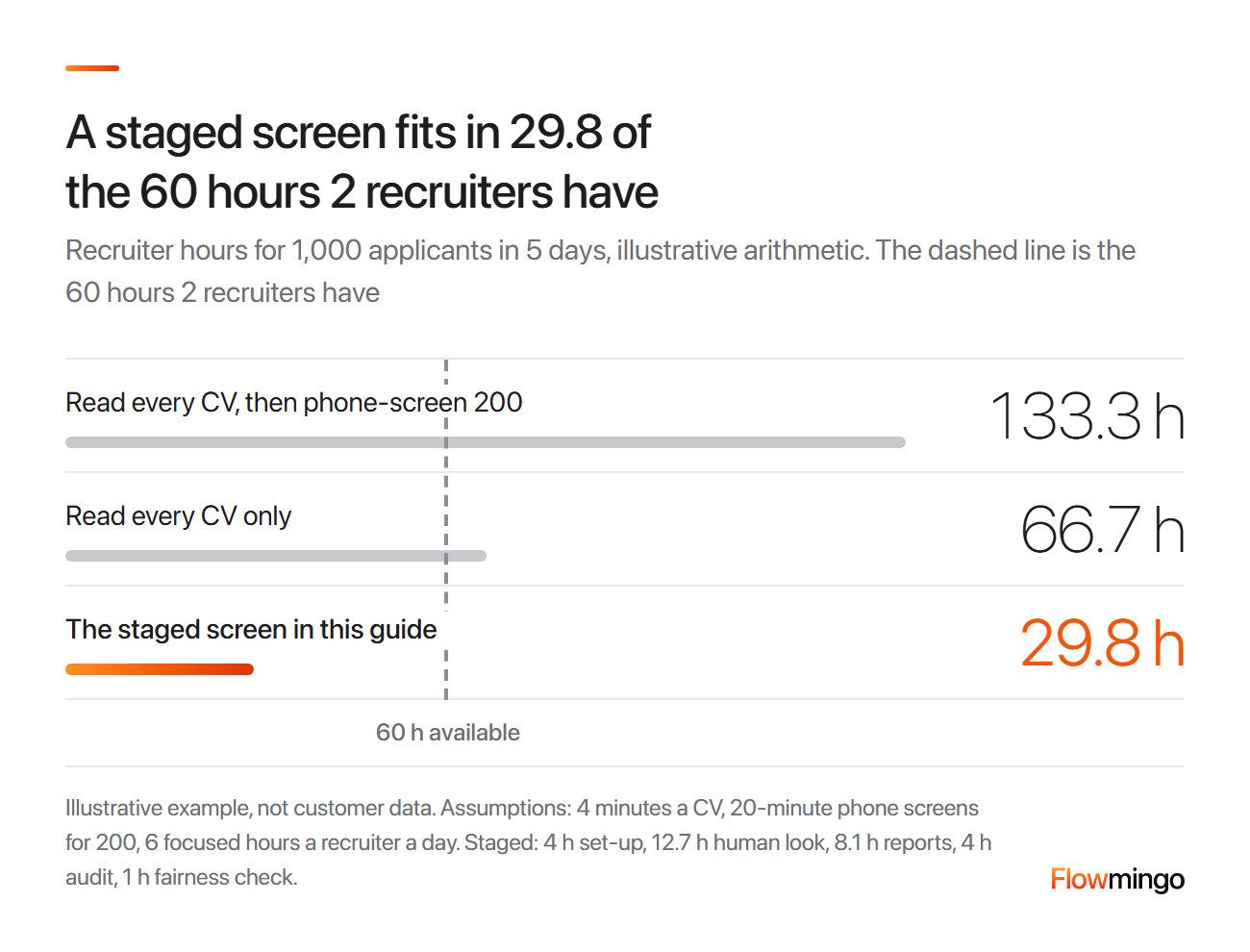
Hours for 1,000 applicants: reading every CV takes 66.7, and adding 200 phone screens 133.3. The staged screen takes 29.8, and the dashed line marks the 60 hours 2 recruiters have in 5 days.
That leaves about 30 of the 60 hours for the work no gate can do: talking to hiring managers, sending replies and checking the knockout "no" answers by hand (where recruiter hours go).
2.1 Should I screen the first 100 applicants and close the ad?
No. Screen in daily batches, because at 50 applicants per hire you cannot spare the rest.
Nor do you need to close the ad to protect your hours, because the flow eases on its own. In Appcast's 2026 benchmark of US job ads, 53.01% of an ad's applications arrived in its first 10 days, and fewer in each 10-day stretch after that.
Pause the ad only when the queue holds more than 5 working days of screening (recruitment funnel).
3. Which knockout questions can I use to screen candidates at scale: work rights, shifts, licence, location?
Knock out only on day-1 job facts asked the same way of everyone: work rights, shifts, reaching the site and a licence the job uses. Send a 'no' with a possible religious or disability reason to a person.
In the US, the work-rights wording already exists. The Justice Department's Immigrant and Employee Rights Section (IER) named 2 appropriate questions in a letter in September 2022.
The letter warns that asking more than those 2 can deter protected workers, such as refugees and asylees, so copy them word for word. This is general information, not legal advice.
Location needs the same care: test the commute, not the postcode. Since 1 January 2026, Illinois has barred using "zip codes as a proxy for protected classes" in AI hiring (Illinois General Assembly).
Copy the wording below, with each knockout's job reason and what each answer triggers:
| Knockout (copy the wording) | Job reason | A 'no' |
|---|---|---|
| "Are you legally authorized to work in the United States?" | IER question 1 | Decline, unless the role can sponsor |
| "Will you now or in the future require sponsorship for employment visa status (e.g., H-1B visa status)?" | IER question 2 | A 'yes': decline if the role cannot sponsor |
| "Do you have the right to work in [country]?" | Where lawful to ask. In Singapore, ask for the NRIC (national ID) number at the offer, or earlier with your reasons stated clearly (TAFEP, the fair-employment body) | Hold if a work pass is possible |
| "This role works [shift pattern]. Can you work it?" | A stated attendance rule | A person checks for a religious reason |
| "Can you get to [site] for the shifts above?" | The commute, not the postcode | Decline |
| "Do you hold a valid [licence] now, or will you by [start date]?" | Only for roles that drive | Decline |
| "Can you lift up to 14 kg (30 lb) through a shift, with or without reasonable accommodation?" | The task, never health | A person talks adjustments |
Never knock out on experience, a degree, a gap, age, a photo, nationality, a postcode or "native speaker".
Knockouts also have a weak spot at volume. A recruiter in the same r/recruiting thread got hundreds of applications despite 6 to 8 knockout questions and warns that bots can answer them. Our candidate fraud guide covers fake applicants.
3.1 Can I auto-reject everyone who says no to weekend shifts?
Ask, but send every 'no' to a person, because a shift swap may solve it.
The caution comes from Groff v DeJoy, a Supreme Court case decided in 2023, about a US Postal Service mail carrier who would not work Sundays for religious reasons.
The Court held that refusing a religious accommodation needs "substantial increased costs" to the business (Supreme Court).
Groff was an employee, not an applicant, so sending an applicant's 'no' to a person is our advice from the case, not its holding. Our pre-screening interview questions guide has the full list.
How Flowmingo helps
Put the knockouts on your Flowmingo job post as pre-screening questions. Each applicant then shows as Qualified or Disqualified, and a 'Pre-screening passed' rule sends the AI interview only to the qualified ones.
Disqualified applicants stay in your list, so a person can open each shift 'no'.
4. Our knockouts and CV score cut hundreds: how do I check no stage rejects one group more?
Run the 4/5 check at every gate: divide each group's pass rate by the rate of the group that passes most. Review any gate whose ratio falls below 4/5, even when the final list looks balanced.
Gaps at different gates can cancel out, as the illustrative table below shows for 500 applicants from each of 2 groups (not customer data):
| Gate | Group A passed | Group B passed | A rate | B rate | Lower ÷ higher |
|---|---|---|---|---|---|
| Knockouts | 380 of 500 | 450 of 500 | 76.0% | 90.0% | 84.4% |
| CV gate (invited) | 180 of 380 | 300 of 450 | 47.4% | 66.7% | 71.1% |
| Interview finished | 50 of 180 | 47 of 300 | 27.8% | 15.7% | 56.4% |
| Bottom line, finished of applied | 50 of 500 | 47 of 500 | 10.0% | 9.4% | 94.0% |
In the last column, the knockouts clear the 80% line at 84.4%, but the CV gate falls to 71.1% against group A, and the interview to 56.4% against group B.
The bottom line still shows 94.0%, because the 2 gaps run in opposite directions:
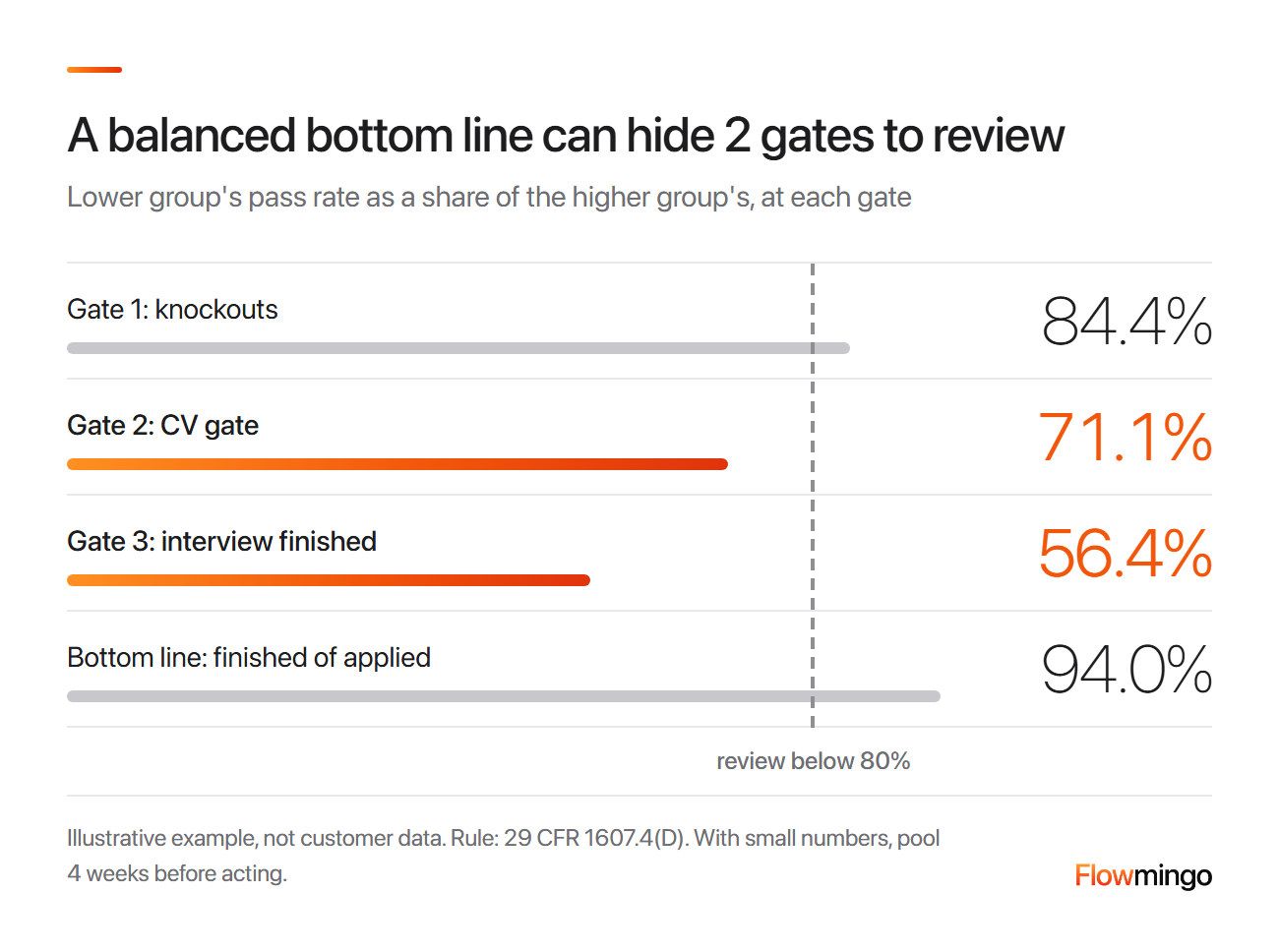
Fairness check by gate, as 4/5 ratios: gate 1 knockouts 84.4%, gate 2 CV gate 71.1% and gate 3 interview finished 56.4%, yet 94.0% on the bottom line. Gates 2 and 3 fall below the dashed review line.
To review a gate under the line, test the knockout, criterion or question behind the gap against the job.
Take group labels from voluntary self-ID answers, and pool 4 weeks of applicants when groups are small, because a handful of people can swing a small group's rate.
The check itself comes from the Uniform Guidelines on Employee Selection Procedures, US federal hiring rules issued in 1978.
Under them, a rate below 4/5 of the top group's generally counts as evidence of adverse impact, the legal term for a selection rate substantially lower for one race, sex or ethnic group than for another (29 CFR 1607.4).
As of 19 November 2026, that rule is still in the eCFR, the government's online text of current federal regulations. That may change in 2027.
On 16 October, the US Equal Employment Opportunity Commission (EEOC) sent the White House, for review, a final rule rescinding the guidelines' interpretive parts, and the EEOC's agenda projects January 2027 as the date it would take effect (Ogletree).
Even then, applicants could still bring disparate-impact claims under Title VII, the main federal job-discrimination law, so keep the 4/5 check as your own monitor either way.
The Supreme Court has already held that a balanced final result does not excuse an unfair step.
In Connecticut v Teal, decided in 1982, Black candidates passed a written test at 54.17% against 79.54% for white candidates, about 68% of the white rate.
Yet in the end a larger share of Black candidates won promotion, 22.9% against 13.5%, and the Court still held that the employer could not defend the test by pointing to that final result.
Software can hide the same gap. A 2026 study by Bommasani and colleagues covered about 4 million applications to 156 employers, all scored by 1 vendor's tool, and earlier analyses of the pooled data had shown minimal adverse impact.
When the researchers ran the 4/5 check job by job instead, 25.87% of applications from Black applicants were for jobs where the tool failed it for their group.
If you hire in New York City, the city's audit rules can cover these gates when an AI or machine-learning tool substantially assists or replaces the decision. Its Department of Consumer and Worker Protection (DCWP) set this out in an FAQ in June 2023.
5. Can AI score 1,000 CVs against our must-haves, and should we decline everything under 5 out of 10?
Yes, AI can score every CV against written, weighted criteria, but not against a flat 5 out of 10. Sort CVs into 3 bands, and decline only when a must-have is clearly missing.
A flat cut-off is risky because a low score can mean the CV never mentions a skill, not that the person lacks it.
The same Uniform Guidelines, which section 4 of this guide introduced, point the same way. They want cut-offs at "normal expectations of acceptable proficiency within the work force" (29 CFR 1607.5).
In plain terms, the line sits at "cannot do the job", not at "not in the top 50".
In the illustrative worked example, the 830 who pass the knockouts fall into 3 bands:
- Advance, 250 of 830: every must-have shows evidence and the score is in the top 30%. Invite the same day.
- Decline, 200 of 830: a must-have is clearly missing, such as a full work history with no bookkeeping role, for an accounts job. Hold these for the audit.
- Human look, 380 of 830: everything else, such as a must-have with no evidence, a thin CV or an unreadable file. A 2-minute look invites 230 and declines 150.
That gives 480 invites, the 250 who advance plus the 230 the human look sends on, and 350 declines held for the weekly audit in section 7.
How the AI scores matters too. Score each CV alone, because 22 AI models in Rozado's 2026 study picked the first of 2 equally qualified CVs 63.5% of the time.
So never ask a chatbot to pick between 2 CVs, or to find the top 50 in a pasted list.
Our platform data gives a second reason to keep the CV cut loose, since the top CV and interview scores usually go to different people:
Flowmingo data · 34,114 candidates · 745 projects · 379 companies · Jul 2025 to Sep 2026
- 19.2% of 532 projects: the top interview score and the top CV score went to the same candidate.
- 54.9% of the 3,684 candidates who later scored 8 or more out of 10 would have been cut by a top-20% CV shortlist, 2,022 people in all.
Both are Flowmingo AI scores, not job performance, and interviewed candidates are a selected group. This shows a different ranking, not which is right.
How Flowmingo helps
CV Evaluation scores every CV 0 to 10 per criterion against your weighted criteria, with 3 to 5 sentences of evidence. A criterion with no evidence in the CV gets a plain flag and counts as 3, not ignored.
6. Every CV reads the same now: how do I rank the hundreds who pass on the same questions?
Give everyone who passes the CV gate the same short interview, scored on written criteria, and rank on that. In a re-analysis of hiring research published in 2022, structured interviews predicted job performance best.
A structured interview is exactly that: the same questions for every applicant, scored against the same written criteria.
In the re-analysis, Sackett and colleagues put structured interviews at 0.42 on a scale from 0 (no link) to 1 (perfect). An unstructured interview scored 0.19, and years of job experience only 0.07.
That is why the interview, not the CV, should do the ranking. For it to rank fairly as you screen candidates at scale, build it the same way for every applicant:
- Ask 5 or 6 questions on the weighted criteria, in about 15 minutes.
- Write the anchors first: what a low, middle and high answer looks like for each question.
- Score every answer before the scorer opens the CV, so the CV cannot sway the score.
For example, ask about an angry customer whose refund is 2 weeks late. A low answer apologises, a middle one promises to chase finance, and a high one gives the customer a date.
6.1 Will good applicants walk away from an async interview?
Some will, so keep the round short and offer a person on request.
The evidence comes from a 2026 field experiment by Avery and colleagues, a working paper not yet peer reviewed, with more than 3,000 applicants.
The researchers randomly assigned them to an asynchronous interview, done in their own time, a live online interview or no interview step.
Against no interview, the asynchronous interview cut the share who carried on by 45 percentage points, and those who left included some of the most qualified applicants. A live online interview cut it by 17 points.
Women were 5.1 points less likely than men to finish, so track finish rates by group, as the interview gate in section 4 does.
Put the length and closing date in the invite's first 2 lines, and send 2 reminders, 2 days in and 2 days before the deadline (invitation templates).
7. How do I check each week that the screen isn't dropping good applicants who word things differently?
Every week, have a person re-read 60 random declines against the same criteria. If none should have advanced, the miss rate is very likely 1 in 20 or less.
The audit answers a risk the section 4 study measured. In that study of 1 vendor's tool at 156 employers, by Bommasani and colleagues, 10% of applicants who sent 4 applications got a rejection from every employer.
That is more than independent decisions would predict, because a shared screen repeats its mistakes for everyone, and so does yours.
The sample size comes from a method in medical statistics called the rule of 3, applied here by analogy. Hanley and Lippman-Hand set it out in 1983, and Newman restated it in 1995.
If none of a random sample should have passed, the miss rate is at most about 3 divided by the sample size, at 95% confidence:
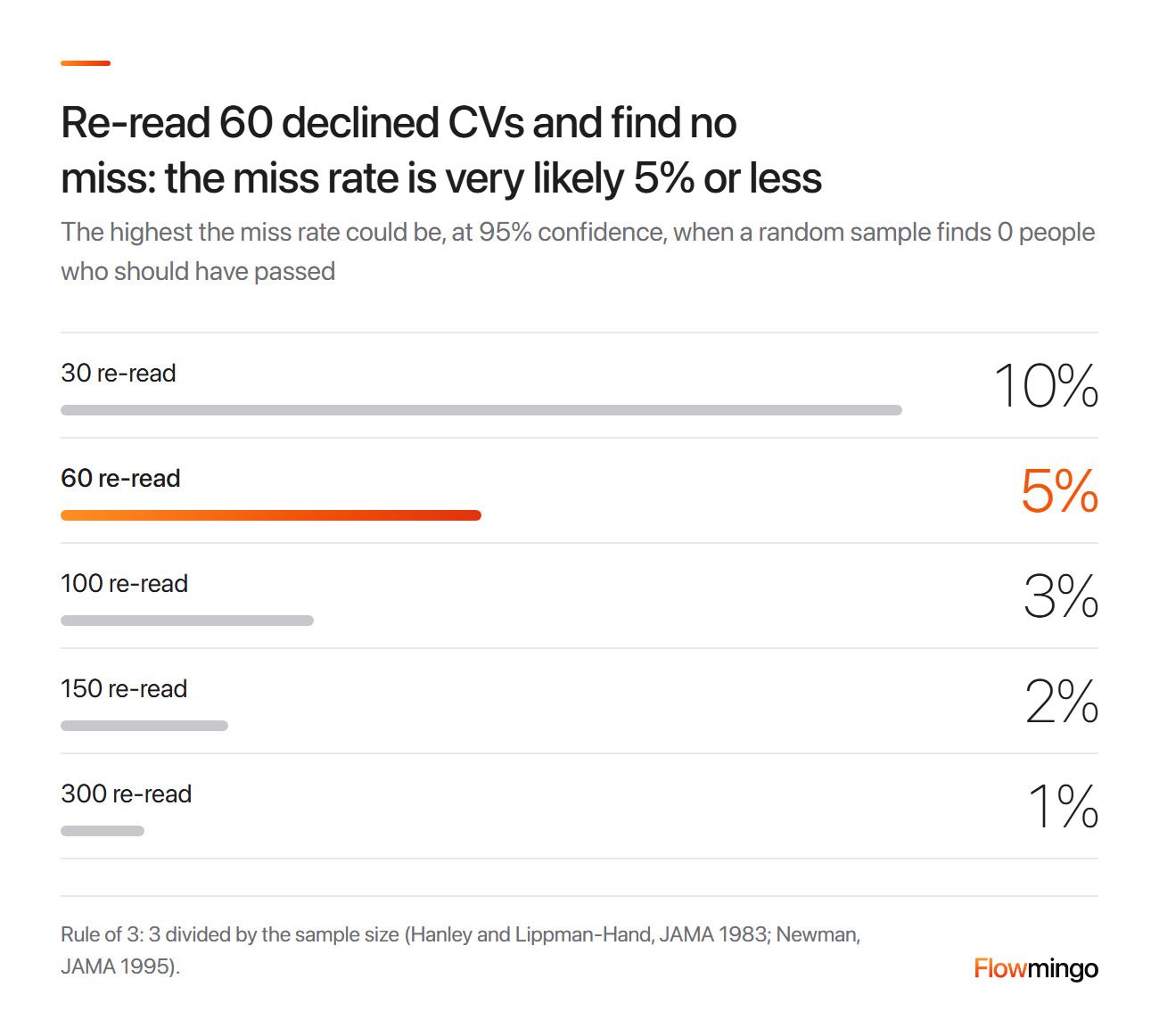
Declined-pile audit: 0 misses caps the miss rate near 10% at 30 re-read, 5% at 60 and 3% at 100. At 150 it is 2%, and at 300 it is 1%.
At 60 re-reads, that cap still allows up to about 17 misses among the 350 weekly declines in the worked example. For a hard-to-fill role, where each miss costs more, re-read 100.
Count someone as a miss if they meet every must-have, or would at least have reached the human look. For example, a café shift lead who handled complaints for 3 years fails a rule seeking "customer service" in a job title (who CV rules cut).
Finding even 1 miss means the criteria need fixing, not a bigger sample. The routine fits in the 4 hours a week that section 2 sets aside for it:
- Every Monday, draw 60 at random from last week's CV declines.
- Re-read each against the written criteria, at about 4 minutes.
- With 0 misses, send the held declines.
- With 1 or more, fix the rule, re-score everyone it declined and invite those who now pass.
- Log the date, role, sample size, misses and rule changed.
8. My hiring managers want 10 per opening: what should each stage pass when we screen candidates at scale?
Work back from the slate, the ranked list your managers see: 10 per opening across 20 openings needs at least 200 finished interviews, about 1,000 invites at 1 in 5. So invite everyone who passes the CV gate the same day, and keep the ad open.
Whether 10 per opening is a lot depends on the benchmark. Ashby, a recruiting software vendor, counts 9.5 applicants interviewed per Customer Support hire in its Recruiter Productivity report, against 11.7 for business roles and 17.6 for technical roles.
In Greenhouse's Fall 2026 US data, of every 1,000 applications, 75 got a screen, 32 a first interview and 5 a hire. That is about 6 first interviews per hire.
The 2 figures count different things: Ashby counts every applicant interviewed per hire on its platform, while Greenhouse counts first interviews, which come after a separate screen, across every US role.
So 10 per opening is normal for support roles on Ashby's measure and generous against Greenhouse's first-interview rate.
The real limit is how many invited applicants finish. On our platform, an interview set is the AI interview, with its questions, that a recruiter builds and invites applicants to. In sets with 100 or more applicants, about 1 in 5 finish:
Flowmingo data · 56,233 recruiter-invited applicants · AI interview sets · 24 Jun to 26 Sep 2026
- 20.3% of applicants invited to sets with 100 or more applicants finished within 14 days (43,106 invited, 114 companies).
Not causal: big and small sets differ in role, company and applicant source. Our other guides' 30.9% within 14 days pools all recruiter-sent invites, 15 Jun to 13 Sep 2026, so do not compare the 2.
In the worked example, the 480 invites give about 97 finished interviews, about 5 per opening, while 200 finished would need about 985 invites.
Even inviting all 830 who pass the knockouts would give only about 168. That means the gap closes with more applicants, not a looser CV gate.
Start with the targets below, then switch to your own rates after 2 weeks:
| Stage | Target pass | Owner | Recruiter minutes | If it drifts |
|---|---|---|---|---|
| Knockout form | 70% to 90% (83%) | Recruiter, manager signs off | Near 0 | Under 70%: check the ad and each knockout |
| CV bands | 50% to 75% invited (58%) | Recruiter | 2 per middle-band CV | Under 50%: criteria too strict |
| Interview | 1 in 5 (97 of 480) | Recruiter | 0 to invite | Falling: check the invite, deadline, reminders and phone use |
| Ranked slate | 10 per opening | Recruiter, then manager | 5 per report | Short: keep the ad open |
| Weekly audit | 0 misses in 60 | Recruiter | 4 per re-read | 1 miss: fix the rule |
| Fairness check | Every gate at 4/5 or more | Recruiter | 60 a week | Below 4/5: review the gate |
9. How fast should we reply at each screening stage, and what does a declined applicant hear?
Invite applicants the day they qualify, and send a hard knockout result within 1 working day. Everyone else hears within 2 weeks of applying, with the stage, the next step and a date.
Silence is common enough that answering at all sets you apart. In Survale's 2025 CandE benchmark, built on more than 66,000 completed candidate surveys, 31% of North American candidates had not heard back 1 to 2+ months after applying.
Those who got feedback on their job fit and status within 1 to 2 weeks were 75% more likely to be "extremely" willing to refer others.
A decline swaps the date for a reason and a door to reapply, and no message carries a score, because a number invites an argument:
- Application, same day: "Thanks for applying for [role]. Software checks your form and scores your CV against our team's must-haves. We re-read a sample of declined CVs weekly, and a person decides who moves on after any interview. You'll hear by [date]."
- Hard knockout 'no', 1 working day: "[Role] needs [requirement], and your form says you don't have it yet, so this application stops here. If that changes, apply again at [link]."
- Possible protected reason, 2 working days: "Thanks for your answer about [shift or task]. A swap or adjustment may work, so reply by [date] with what suits you, or book a call at [link]."
- CV decline, 7 days after applying: "Thanks for applying for [role]. We need [must-have], and your CV doesn't show it, so this application stops here. Other roles are at [link]."
- Interview decline, within 7 days of the decision and 2 weeks of applying: "Thanks for your time on the [role] interview. We assessed [2 or 3 criteria] and chose applicants who showed more [criterion]. Other roles are at [link]."
The interview invite, sent the day an applicant qualifies, needs more lines, because it asks for their time:
"Your next step for [role] is a 15-minute recorded interview, done in your own time by [date 7 days out, time, time zone]. An AI asks the questions and scores your answers, and a person decides who moves on."
"Use a laptop if you can, or a phone with a camera and microphone. Reply to ask for an adjustment or a person instead. You'll hear back by [date]."
These timings differ from our rejection email templates, which send screen-outs in 3 to 5 days and interview declines within 7 days. Holding CV declines for the Monday audit is slower, to catch misses.
A 7-day closing date on the interview loses few people, because most finishers move fast:
Flowmingo data · 100,478 invited applicants · 855 companies · AI interview invites 21 Jul to 18 Oct 2026
- 44.1% of the 17,989 applicants who finished within 30 days (524 companies) were done within 24 hours of the invite.
- 70.1% of those finishers were done within 48 hours, and 96.7% within 7 days.
Finishers only, not a completion rate. Our invitation guide counted only recruiter-sent invites finished within 14 days (15 Jun to 13 Sep 2026): 48.2% within 24 hours, 74.3% within 48 hours and 98.3% within 7 days.
This card adds job-post rule invites, 36.5% of all, whose finishers took longer (median 39.9 hours against 24.7), an association, not a cause.
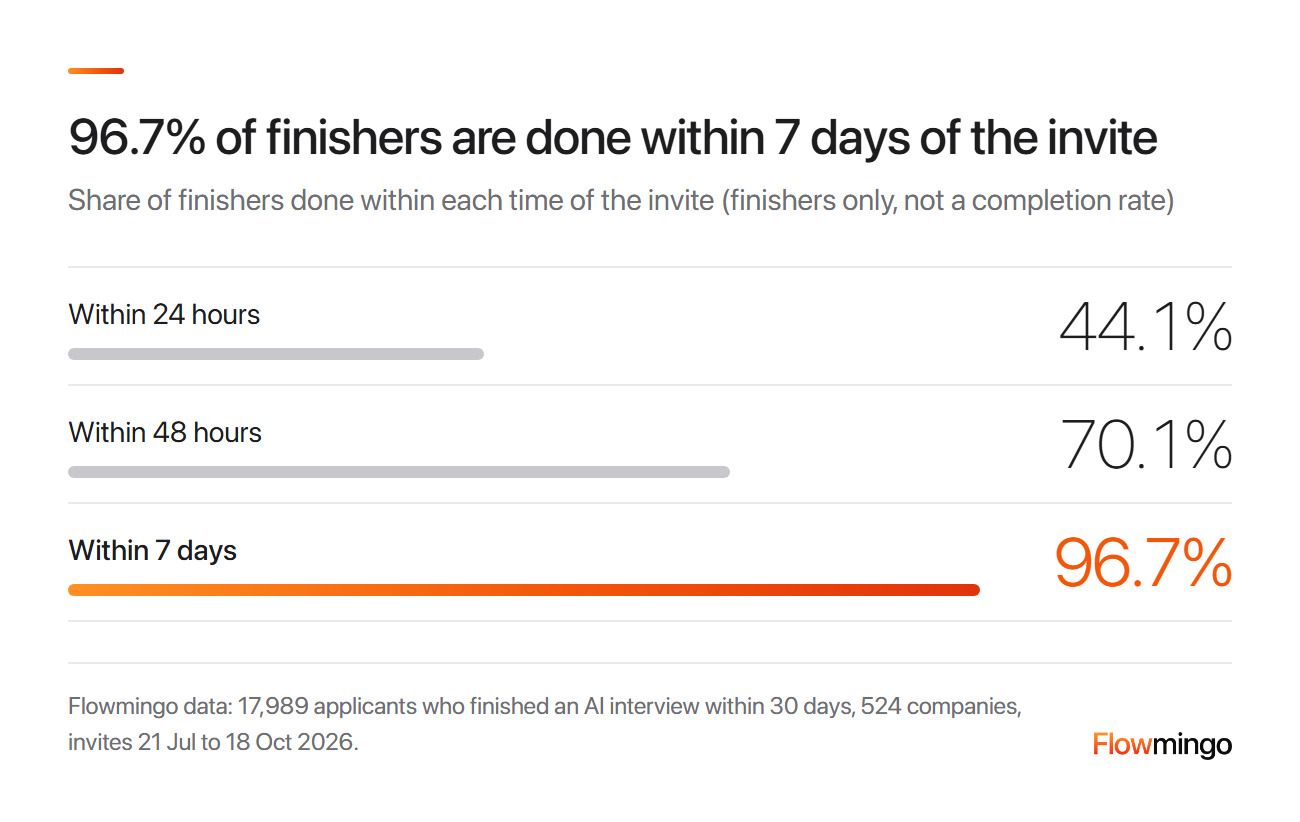
Invite to finish: of 17,989 finishers, 44.1% were done within 24 hours, 70.1% within 48 hours and 96.7% within 7 days.
10. We hire contact-centre agents by the hundred: how do I screen candidates at scale for shifts and language?
Put shift pattern, site and the language of service in the knockouts, then test the job itself in the interview. Keep the round short enough to finish on a phone, and suggest a laptop where applicants have one.
Contact-centre roles add a twist, because a CV says little about who turns up for a 22:00 shift or calms an angry caller. The volumes are large, too: on r/recruiting, a senior recruiter needs 50 onsite customer service reps in a month.
For language, ask whether applicants can hold a full customer conversation in the languages your calls use, rather than asking for a "native speaker".
Under section 19 of the UK Equality Act 2010, "native speaker" can count as indirect discrimination unless it is a proportionate way to meet a job need. That is our reading of the general test, not a ruling.
US guidance allows the job test, on one condition. The EEOC's guidance on questions before a job offer, which dates from 1995, lets you ask applicants to show how they would do the job, if you ask all of them (EEOC).
For example, have each applicant answer a customer whose direct debit failed twice this month.
Phones trail laptops in finish rates, as our AI interview completion rates guide shows, so the invite says a laptop or a phone works, and suggests a laptop.
How Flowmingo helps
Flowmingo is a free AI hiring platform. CV Evaluation scores every CV against your criteria, and the AI Interviewer gives everyone you invite the same questions in their own time.
Flowmingo rejects nobody automatically, and screening is never rate-limited. When 1,000 applicants land on 2 recruiters, use Flowmingo to screen candidates at scale.
11. Sources
Every study, law and forum post in this guide links to a source below. Flowmingo figures come from Flowmingo's own platform data.
- Appcast (2026). 2026 recruitment marketing benchmark report: U.S. version. Appcast.
- Ashby (2026, April 28). Recruiter productivity. Ashby Talent Trends Report.
- Avery, M., Ip, E., Leibbrandt, A., & Vecci, J. (2026). A brave new world of hiring: A natural field experiment on how asynchronous interviews and AI assessment reshape recruitment (CESifo Working Paper No. 12573). CESifo.
- Bommasani, R., Bana, S. H., Creel, K. A., Jurafsky, D., & Liang, P. (2026). Algorithmic monocultures in hiring. Conference paper, FAccT 2026 (arXiv 2605.27371).
- Connecticut v. Teal, 457 U.S. 440 (1982). Supreme Court opinion. Legal Information Institute.
- Greenhouse (2026). The Hire Standard: Greenhouse benchmark report, March 2026, North America. Greenhouse.
- Greenhouse (2026). Hiring trends 2026: Recruiting metrics and benchmarks. Fall 2026 Hire Standard, Greenhouse.
- Groff v. DeJoy, No. 22-174, 600 U.S. ___ (2023). Opinion of the Court. Supreme Court of the United States.
- Hanley, J. A., & Lippman-Hand, A. (1983). If nothing goes wrong, is everything all right? Interpreting zero numerators. JAMA, 249(13), 1743-1745.
- Illinois General Assembly (2024). Public Act 103-0804 (HB 3773), amending the Illinois Human Rights Act, in force 1 January 2026. Illinois General Assembly, via the Internet Archive.
- Newman, T. B. (1995). If almost nothing goes wrong, is almost everything all right? Interpreting small numerators. JAMA, 274(13), 1013.
- NYC Department of Consumer and Worker Protection (2023, June 29). Automated employment decision tools: Frequently asked questions. City of New York.
- Ogletree Deakins (2026, October 21). EEOC sends OIRA final rule rescinding Uniform Guidelines on Employee Selection Procedures. Ogletree Deakins.
- Rozado, D. (2026). Gender and positional biases in LLM-based hiring decisions: Evidence from comparative CV/résumé evaluations. PeerJ Computer Science, 12, e3628.
- Sackett, P. R., Zhang, C., Berry, C. M., & Lievens, F. (2022). Revisiting meta-analytic estimates of validity in personnel selection: Addressing systematic overcorrection for restriction of range. Journal of Applied Psychology, 107(11), 2040-2068.
- Survale (2026, July 21). 2025 candidate experience (CandE) benchmark research: Key statistics. Survale.
- Tripartite Alliance for Fair and Progressive Employment Practices (n.d., read 2026). Preparing job application forms (for employers). TAFEP.
- UK Parliament (2010). Equality Act 2010, section 19: Indirect discrimination. legislation.gov.uk.
- U.S. Code of Federal Regulations (current text). 29 CFR 1607.4, information on impact. Legal Information Institute.
- U.S. Code of Federal Regulations (current text). 29 CFR 1607.5, general standards for validity studies. Legal Information Institute.
- U.S. Department of Justice, Civil Rights Division, Immigrant and Employee Rights Section (2022, September 9). Technical assistance letter on pre-employment work authorization questions. U.S. Department of Justice.
- U.S. Equal Employment Opportunity Commission (1995, October 10). Enforcement guidance: Preemployment disability-related questions and medical examinations. EEOC, via the Internet Archive.
- r/recruiting (2025, May 21). Recruiter thread on handling 900+ applications for 1 job [Online forum post, title paraphrased]. Reddit.
- r/recruiting (2025, July 16). High volume customer service hiring [Online forum post]. Reddit.
- r/Recruitment (2026, September 23). What we look for when a role takes 500 applications and half never get read [Online forum post]. Reddit.