
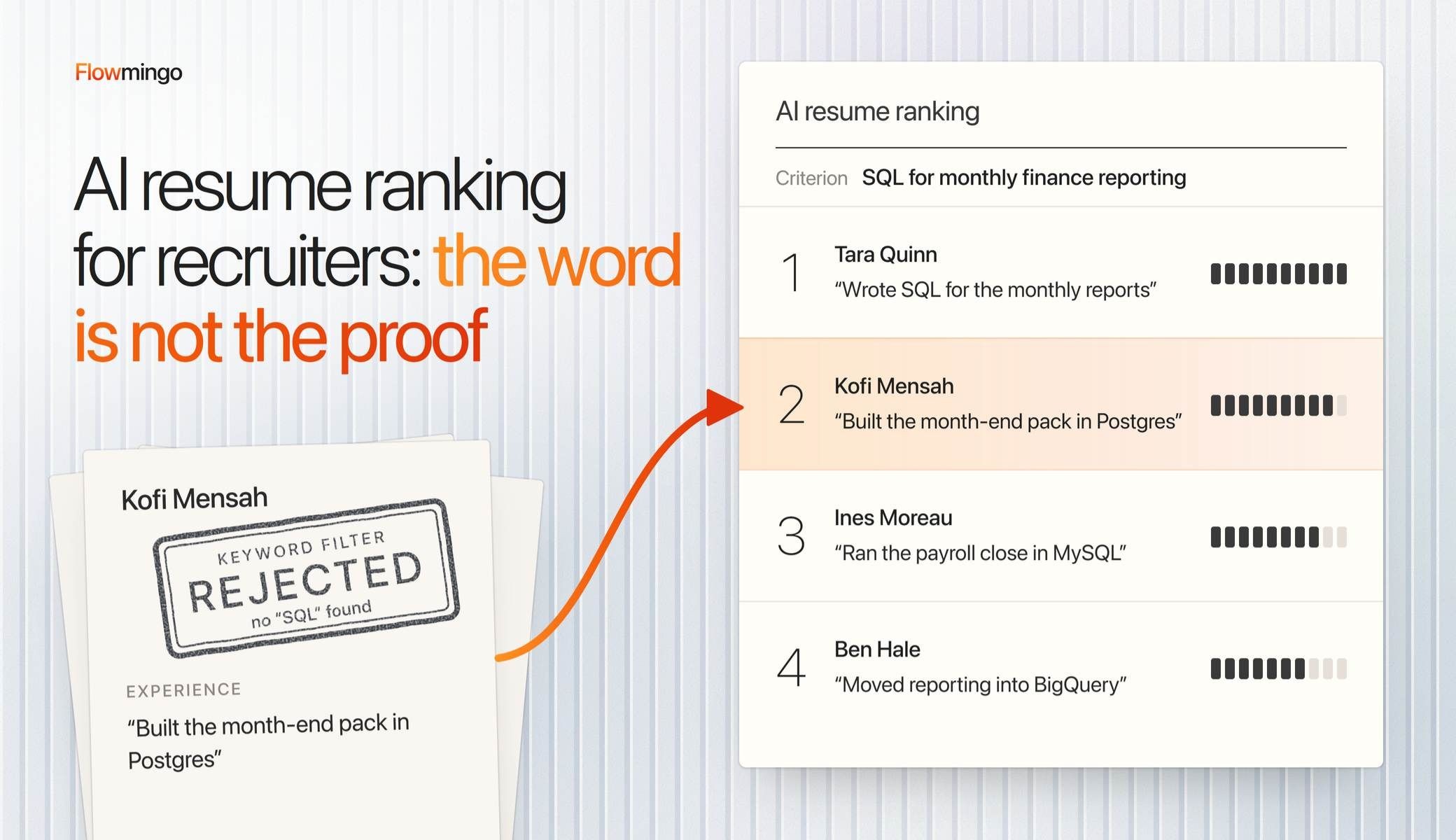
Postgres on the CV, SQL in your filter: same work, different word, and a strong analyst never reaches you. AI resume ranking for recruiters promises to read past mismatches like that one, though it brings risks of its own.
An ATS keyword filter, the rule in your applicant tracking system that searches each CV for the words you chose, does exactly what you set it to do. It checks only whether a word is present.
So it drops people who describe the same work in other words, like the analyst whose CV says Postgres, a database that people query in SQL. It also passes anyone who copies your job ad into their CV.
Both mistakes stay out of sight, because neither shows up in a report. Each strong CV the filter drops is a person you never see, and each thin CV it passes looks, on your screen, like a match.
The second mistake can be counted. Flowmingo, which publishes this guide and scores CVs against each job's own criteria, found that when a CV held a criterion's exact key words, its AI still scored 15.8% of those criteria under 5 out of 10.
The rule worth changing first is the one that lets software remove a person before anyone reads the CV. Keep that power only for hard facts, such as the right to work.
Rank everything else against written criteria with evidence, and test the ranker with reworded and stuffed CVs before you trust its top 20.
Key takeaways
- Why does my ATS keyword filter miss good people? It checks whether a word is present, not whether the work is, so 1 synonym can drop a strong CV.
- Is a CV with all the right keywords a strong CV? Often not. Flowmingo's AI scored 15.8% of criteria under 5 out of 10 even when the CV held the exact words.
- Can hidden white text fool an AI ranker too? Yes, in a new way. ManpowerGroup, the largest US staffing firm, says it finds hidden text in about 10% of the CVs it scans with AI.
- Could an AI ranker copy our past hiring bias? Yes, if it learns from past hires. Amazon's experimental tool, scrapped by early 2017 and revealed by Reuters in 2018, marked down CVs containing the word "women's".
- What should I test before trusting a ranker? Reword 1 strong CV and check it moves 2 places or fewer. In 1 preprint, presentation changes alone (wording, structure, AI polish, layout noise) flipped 29.6% of 1 model's picks.
1. Our keyword filter rejects good people. How does AI resume ranking for recruiters read CVs instead?
A keyword filter checks whether a word appears in the CV. AI ranking that scores criteria reads each CV against each criterion you wrote, rates the evidence and orders everyone by the total.
That difference matters because your criteria describe work, while a filter can only match spelling. Say the job needs renewals on a B2B book, and a filter is set to "renewals".
It drops or buries the CV that says "kept 58 of 60 accounts for a second year", which is the work you asked for in other words. Yet it passes a skills line reading "renewals, churn, NPS, Salesforce" with nothing behind it.
A ranker scoring renewals looks for proof instead, such as a book size or a retention rate. So the CV with 58 of 60 accounts rises, and the bare skills line sinks.
AI ranking comes in 2 kinds, so ask which one a vendor sells. Similarity matching ranks CVs by how close they sit to the job ad, while criterion scoring rates each criterion you wrote and gives a reason for each score.
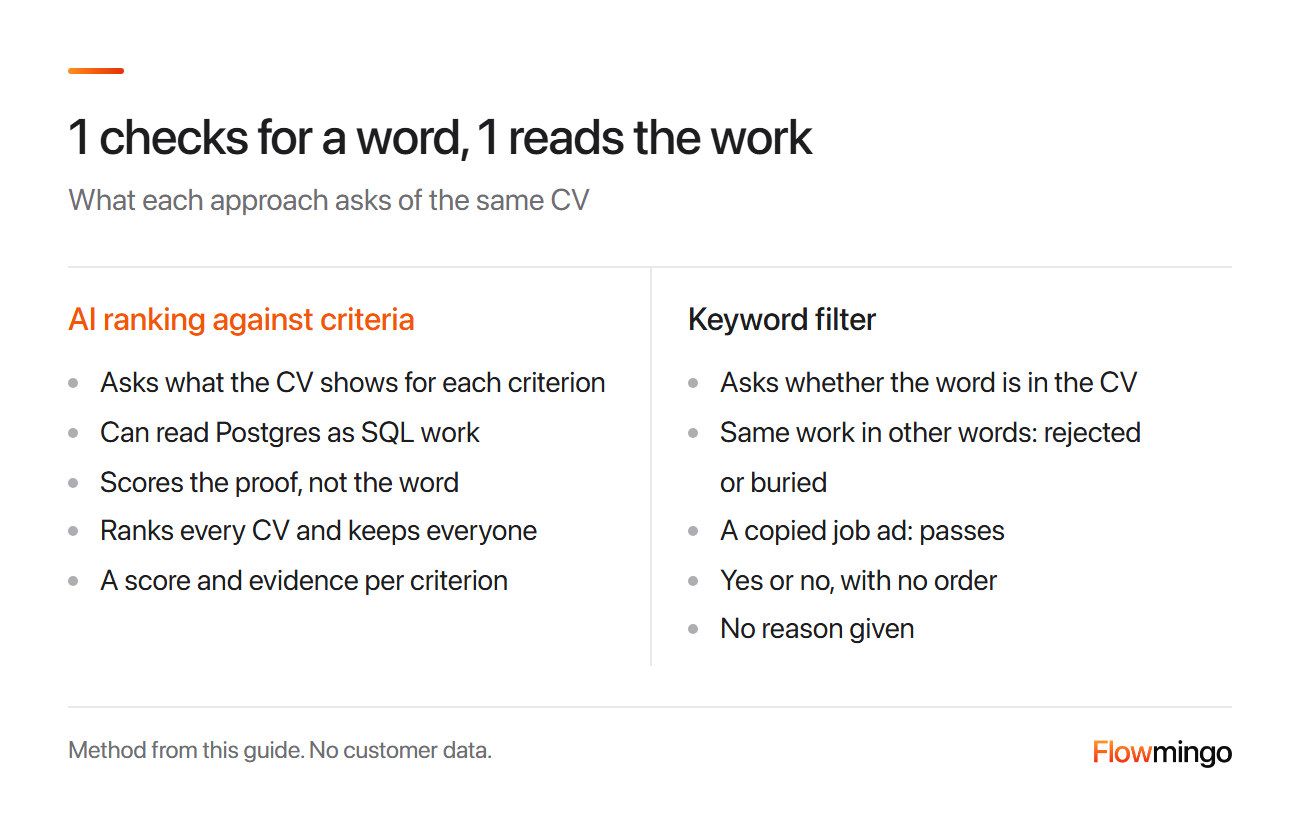
Keyword filter vs AI ranking: the filter checks for a word, and the ranker scores each criterion's evidence and keeps every CV.
In the figure above, AI ranking against criteria asks what the CV shows for each criterion, so it can read Postgres as SQL work. It scores the proof, not the word, ranks every CV and keeps everyone, with a score and evidence per criterion.
The keyword filter on the other side asks only whether the word is in the CV. It rejects or buries the same work written in other words, and it lets a copied job ad pass. What you get back is yes or no, with no order and no reason given.
There is some outside evidence that reading for meaning helps. In a peer-reviewed 2025 test, Resume2Vec, a similarity-matching method, beat a keyword-based ATS on nDCG, a ranking-quality score, in 3 of 5 fields.
Its biggest lead came in mechanical engineering, where its score was 15.85% higher than the ATS's, and the ATS scored slightly higher in the other 2 fields.
The test was small, too: the human ranking both methods were scored against came from 40 students, and each field had only 10 CVs, so test any ranker on your own CVs.
2. How does our ATS keyword filter actually decide which CVs get auto-rejected?
In many ATS setups, knockout questions, the pass-or-fail questions on the application form, do the rejecting, while keyword search does the burying. A CV without your word rarely gets deleted, but it sinks below the hundreds you will actually open.
A knockout question asks something like whether the applicant has the right to work, and the wrong answer can end the application on the spot. The split matters because you fix the 2 in different places: knockouts on the form, and keyword burying in saved searches and status rules.
Filters, the tool behind that burying, are close to universal. In a 2025 survey of 384 recruiters by Jobscan, a vendor that sells CV keyword tools, 99.7% used filters in their ATS. Skills were the first filter for 76.4%, and 55.3% used job titles as a keyword.
Filtering is not the same as rejecting, though. In interviews for Enhancv, another vendor, only 2 recruiters said their systems rejected CVs on content or match scores. Enhancv did not publish how many recruiters it interviewed in all.
Those 2 were the exception. The only filters that every recruiter in those interviews had automated were knockout questions on hard requirements, such as work authorisation.
Some rules do reject on their own, and they are easy to forget once set. One large study shows how common such a rule was more than 5 years ago: Hidden Workers, a 2021 survey of employers by Harvard Business School and Accenture.
In it, 48% of employers that screen with software filtered out middle-skills candidates with a work gap of more than 6 months. The report says their software did it automatically, on the gap alone.
So audit your ATS settings before you change anything, and list every rule that can remove or hide a CV:
- Knockout questions, with the answer that rejects.
- Required keywords, or saved Boolean searches (words joined by AND, OR and NOT) that a recruiter starts from.
- Automatic rejection rules on gaps, location, degree or years of experience.
- Default sorting, such as newest first or a match percentage.
Next to each rule, write the person it removes. For example, "5+ years" removes the analyst with 4 years who ran the reporting alone, and you may never have meant to lose that person.
3. Our ATS rejected a candidate a competitor then hired. How often do keyword filters miss people?
More often than you would guess, by employers' own account. You rarely see it, because a filtered CV leaves no trace in your reports.
The Hidden Workers survey asked 2,275 executives in the US, UK and Germany about their own hiring systems.
Among employers using recruitment software, 88% believed their process at least sometimes vetted out qualified high-skills candidates who did not match the job description exactly. For middle-skills roles, 94% said the same.
These are executives describing their own systems, not a measured rate. Still, those answers suggest that your competitor's hire is a common case, not bad luck.
The cost stays hidden because nobody reviews the rejected pile. You can still measure your own miss rate in an afternoon.
Take 50 CVs your filter rejected or buried on a recent role, and have a recruiter read them against the criteria. Say 4 of the 50 would have earned an interview, a rate of 8%.
If the filter removed 600 people on that role, the same rate means about 48 interviewable people never reached you.
Then note why each of the 4 dropped out: a synonym, a job title, a gap rule or a parsing error, where the ATS misread the file. Our resume parsing guide shows how to check the last one, because a CV the parser garbles fails every keyword test.
4. The job says SQL, the CV says Postgres. Does AI resume ranking for recruiters count it?
A good ranker should, because it reads the work described, not the label on it. Check it on your own CVs, though, because a ranker can also give credit for work the CV never shows.
Synonyms are where filters lose good candidates. Tools have brand names, job titles vary from company to company, and people trained abroad often use other words for the same work.
Say your criterion reads "SQL for monthly finance reporting". One CV says "built the month-end pack in Postgres", and another lists "PostgreSQL" in a skills grid.
A filter on "SQL" as a whole word misses the first, and some tools miss the second too. A ranker reading for meaning should credit both, because both describe SQL work.
So write criteria as outcomes, and name the variants you accept. For example: "Writes SQL for reporting (Postgres, MySQL, T-SQL or BigQuery all count)". The ranker then has a clear bar, and you can spot a credit given on a guess.
Reading for meaning has its own weak spot, because presentation can move an AI ranker even when the facts stay the same. In a 2026 preprint, a study posted before peer review, Chen and Xiao tested exactly that.
They presented 102 test candidates 4 other ways (wordier, restructured, AI-polished, with layout noise) and kept every fact.
Their best-performing setup, a small AI model anyone can download and run, still reversed 29.6% of its picks between 2 candidates across those 4 changes. Another setup reversed 41.4%.
Keyword baselines, the simple word-matching methods they ran for comparison, flipped only 4.0% to 5.2%. But those baselines ranked far worse, so stable is not the same as right.
The authors explain why the keyword methods barely moved. Every reworded CV kept many exact phrases from the scoring rubric, which listed the skills, knowledge and tasks each CV was scored against, so a word-matcher kept finding the same words.
The study also used small models and made-up CVs, so treat it as a warning, not a rate for your tool.
Section 9 turns that warning into a test you can run on your own ranker.
5. Applicants hide the job ad in white text. Does it fool AI resume ranking for recruiters?
White text fools a keyword filter by design, because the filter reads words a person can't see. An AI ranker can resist plain stuffing, but hidden instructions give applicants a new trick.
In the New York Times, ManpowerGroup, the largest staffing firm in the US, said it finds hidden text in about 100,000 CVs a year, roughly 10% of those it scans with AI.
Greenhouse, a hiring platform that processes some 300 million applications a year, estimated that 1% of the CVs it reviewed in the first half of 2025 held such a trick. The 2 figures come from different piles of CVs, and both are company estimates, not audits.
Hidden instructions are the new version of the trick, such as white text telling the AI to rank the CV first. In a preprint by Mu and colleagues, hidden instructions fooled AI screeners over 80% of the time for some tricks.
That was a benchmark test of attacks, not a count of what real applicants do. Visible stuffing, a skills line copying your job ad, is the everyday problem, and the data card below shows how often CVs that held the right words still scored low.
Flowmingo data · 265,097 criterion scores · 65,133 CVs · 25,410 candidates · 1,470 companies · 1-in-4 sample of CVs added 10 Jul to 11 Nov 2026
- 15.8% of 73,582 criterion scores came in under 5 out of 10 although the CV held the criterion's exact key words.
- 54.9% of those 73,582 criterion scores with the exact key words reached 7 or more out of 10.
- 41.3% of 1,258 CVs that held every criterion's key words scored 7 or more overall.
- 17.2% of those 1,258 keyword-complete CVs scored under 5 out of 10 overall.
AI CV scores against each job's own criteria, not hiring outcomes. Key words are the criterion title minus generic words, our rule for what a filter would search. Without CVs from Flowmingo Network, Flowmingo's own candidate pool, 11.5% scored under 5.
The chart below shows how Flowmingo's AI scored those 73,582 criteria. Just over half, 54.9%, reached 7 to 10 out of 10, and 29.3% landed at 5 to 6.9.
The other 15.8% scored under 5: the CV held the skill's key words, but the AI found little shown behind them, and a keyword filter would pass every one of those CVs.
Leave out the Flowmingo Network CVs, as the data card's note does, and the share under 5 is still 11.5%: more than 1 criterion in 10, although the CV held its key words.
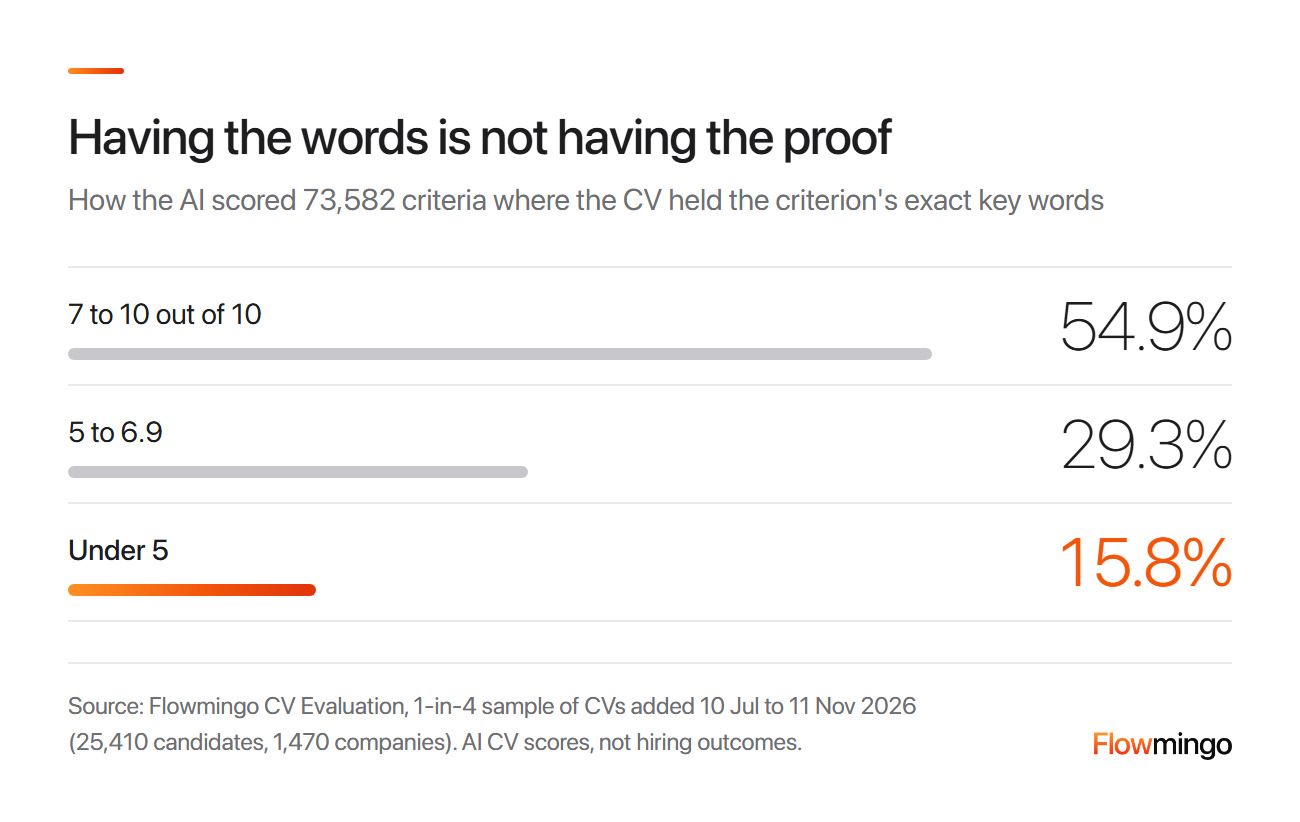
Words vs proof, Flowmingo data: when the CV held a criterion's exact key words, 15.8% of those criteria still scored under 5 out of 10.
So defend against both kinds of stuffing, the hidden and the visible. Convert CVs to plain text before an AI reads them, because hidden text then shows up like any other line.
Then ask the ranker for evidence per criterion, and search the pile for sentences copied from your job ad.
6. Should we keep knockout questions and Boolean search once AI ranks the CVs?
Keep knockout questions for true hard facts, such as the legal right to work, a licence or a shift pattern. Keep Boolean search for sourcing your own database, and stop using it to reject applicants.
A knockout question is cheap and easy to explain, because the candidate answers it. Every one also removes people for good, so each must be a real requirement.
A bad rule can be expensive. In 2023, iTutorGroup paid $365,000 to settle a suit by the EEOC, the US agency that enforces laws against job discrimination.
The EEOC said the company had programmed its tutor application software to reject women aged 55 or older and men aged 60 or older automatically. By the EEOC's account, that rule turned away more than 200 qualified US applicants, and a knockout rule in your ATS can do the same.
Sort every current rule into 3 places:
- Keep as a knockout: right to work, a required licence, shift times, a location you cannot change.
- Move into ranked criteria: years of experience, degree, job titles, tools and industry.
- Delete: gaps in employment, age-linked rules and anything you can't tie to the job.
Boolean search does less harm in your own database, where it adds people to a list rather than removing them, so a missed synonym costs less.
Candidates also game knockouts. A recruiter on Reddit wrote that some "completely lie on the knockout questions", so read a sample of the passes too.
7. Amazon dropped its AI recruiting tool by 2017. Could our ranker learn bias from past hires?
Yes, if it learns from who you hired before, because it copies the pattern along with the skill. A ranker that scores your written criteria avoids that route, but its language model can carry bias of its own.
So the first question for any vendor is whether the ranker learns from your past hiring decisions or only from your written criteria. Whatever the answer, run the name-swap test in section 9 on your own CVs, because either kind of ranker can score a name.
Amazon's experimental tool learned from 10 years of CVs, mostly from men, according to Reuters. Its team built 500 models, and each learned to recognise some 50,000 terms.
The tool penalised CVs containing the word "women's" and downgraded graduates of 2 all-women's colleges. It also favoured verbs more common on male engineers' CVs, such as "executed" and "captured".
Amazon edited those terms out, but the model could still find other ways to sort people. Amazon disbanded the team by early 2017, and Reuters reported the story in 2018.
The lesson outlived the tool: a ranker trained on past hires turns your history into keywords. Journalist Hilke Schellmann heard the same from whistleblowers for her book The Algorithm, published in January 2024 (WIRED interview).
In one case, a screener trained on the CVs of the company's own staff gave extra points for "baseball" and "basketball", and it marked down "softball".
Models that never saw your hires carry bias too. In a peer-reviewed 2025 study, An and colleagues had 5 popular AI models score about 361,000 test CVs with names signalling sex and race.
The models scored women higher and Black men lower than candidates with similar qualifications. At a fixed cut-off, the authors estimate, those gaps could shift the chance of being hired by about 1 to 3 percentage points.
The direction varies from study to study. A 2024 audit of 8 models rated women moderately higher than men (Gaebler and colleagues).
Those models also generally rated Black, Hispanic and Asian applicants moderately higher than White applicants, the opposite direction from An and colleagues' finding for Black men. So test the tool you use, on your own pool.
7.1 Can we tell the AI ranker to show only women, or only under-32s?
Almost never. Filtering on sex or age is unlawful in most places, and "only under-32s" also shuts out everyone 40 and over, whom US law protects. An AI tool does not change that.
iTutorGroup's age rule cost it $365,000, as section 6 shows.
Singapore's Workplace Fairness Act, set to take effect by end-2027, covers hiring, and claims under it can reach S$250,000. The traits it protects include age and sex, according to a fact sheet from MOM, Singapore's Ministry of Manpower.
If you have a diversity goal, widen where you source and check pass rates by group, which keeps the decision on job criteria.
8. The ranker put an irrelevant job title near the top. How do we trace why?
Open the score for each criterion, not the total, and find the 1 criterion that lifted the CV. Then check that the evidence the ranker quotes really sits in the CV.
A total hides its cause. A store manager can outrank analysts for a data role when "stakeholder management" carries the most weight, because store managers write about stakeholders all day.
A ranker that gives only a match percentage leaves you nothing to trace. That is why per-criterion scores with written reasons matter more than any accuracy claim.
Don't take the written reason at face value, though. In a 2023 study of GPT-3.5 and Claude 1.0, both older than today's models, Turpin and colleagues nudged them toward wrong answers with a planted hint, and accuracy fell by up to 36%.
In one version of the hint, every example question in the prompt had A as its right answer. The models' explanations often argued for the hinted answer without naming the hint behind it.
Newer models still leave the hint out. In a 2025 test of reasoning models, which write out step-by-step reasoning before they answer, Anthropic researchers planted similar hints. The reasoning admitted the hint it used only 25% to 39% of the time.
These were general tests, not hiring, but the written reason is still a claim to check against the CV. The figure below traces a wrong rank in 4 steps. The first 2 are the checks this section opened with: find the criterion that lifted the total, then make sure the quoted line is really in the CV.
Then fix the criterion by rewriting a vague one as an outcome you can see. Finally, re-score and compare, and the same CV should now land where you expect.
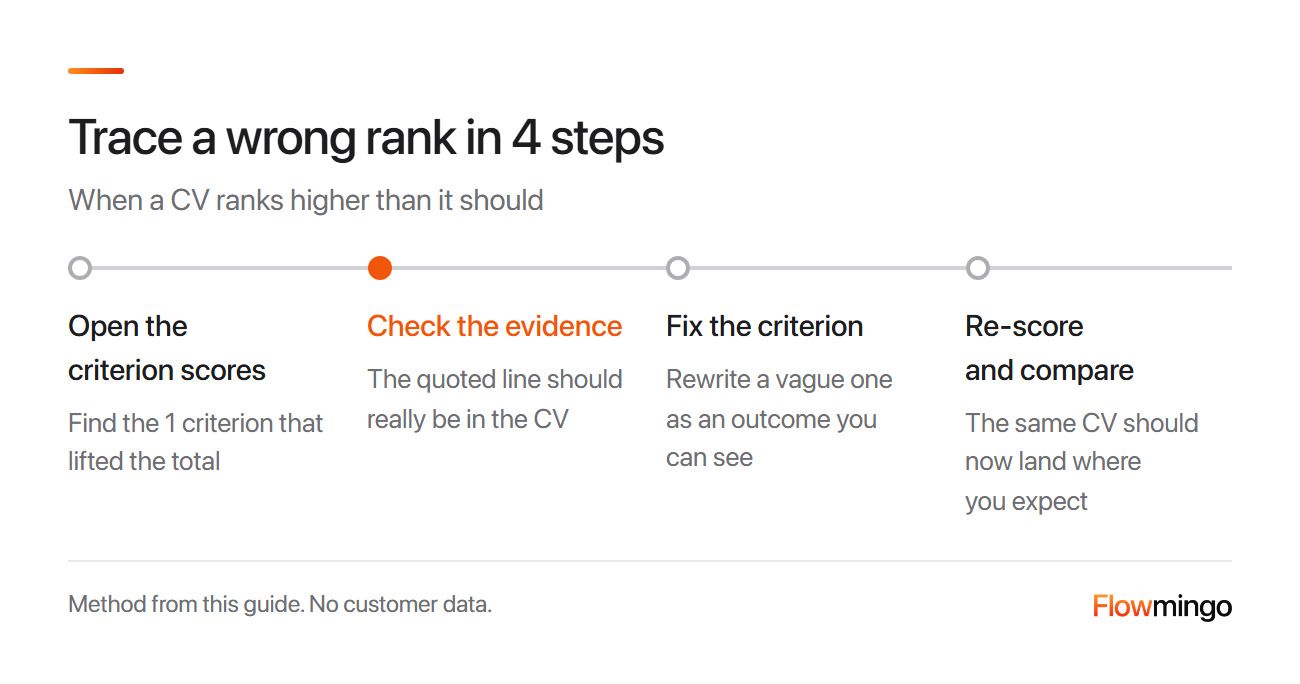
Trace a wrong rank: open the criterion scores, check the evidence, fix the criterion, then re-score and compare.
How Flowmingo helps
CV Evaluation rates each criterion from 0 to 10 on its own, with 3 to 5 sentences on what the CV shows, or does not. A criterion with no evidence is flagged plainly and counts as 3.
You can rename, rewrite, add or remove any criterion, which is how you fix a vague one.
9. How do we test AI resume ranking for recruiters before we trust its top 20?
Run 6 small tests on CVs you already hold, each aimed at a failure this guide has shown. Most need only 5 to 10 CVs.
Our AI CV screening software guide runs a 20-CV pilot that checks accuracy. These tests check something else: whether the rank holds when nothing important changes.
Run the 6 tests in this order, as in the figure below:
- Reworded CV: rewrite 1 strong CV in new words with the same facts. It passes if it moves no more than 2 places.
- Stuffed CV: paste the job ad's skills into a weak CV. It passes if its score rises under 1 point and stays under 5 out of 10.
- Name swap: copy 3 CVs, changing only the name to one signalling another sex or race. Each score gap should stay at 0.5 or less out of 10.
- Order and batch: re-upload the same CVs in reverse order or in 2 batches. It passes if no CV moves more than 2 places.
- Past hire: score 3 recent hires whose CVs would fail your old keyword rule. They should land in your read band, the part of the ranking you will actually read.
- Group pass rates: if you record groups lawfully, divide each group's pass rate by the top group's rate. Every group should come out at 0.8 or more, a line from US federal guidelines explained below.
These pass marks are our rule of thumb, not a standard. The order and name-swap marks match the 20-CV pilot in the AI CV screening software guide.
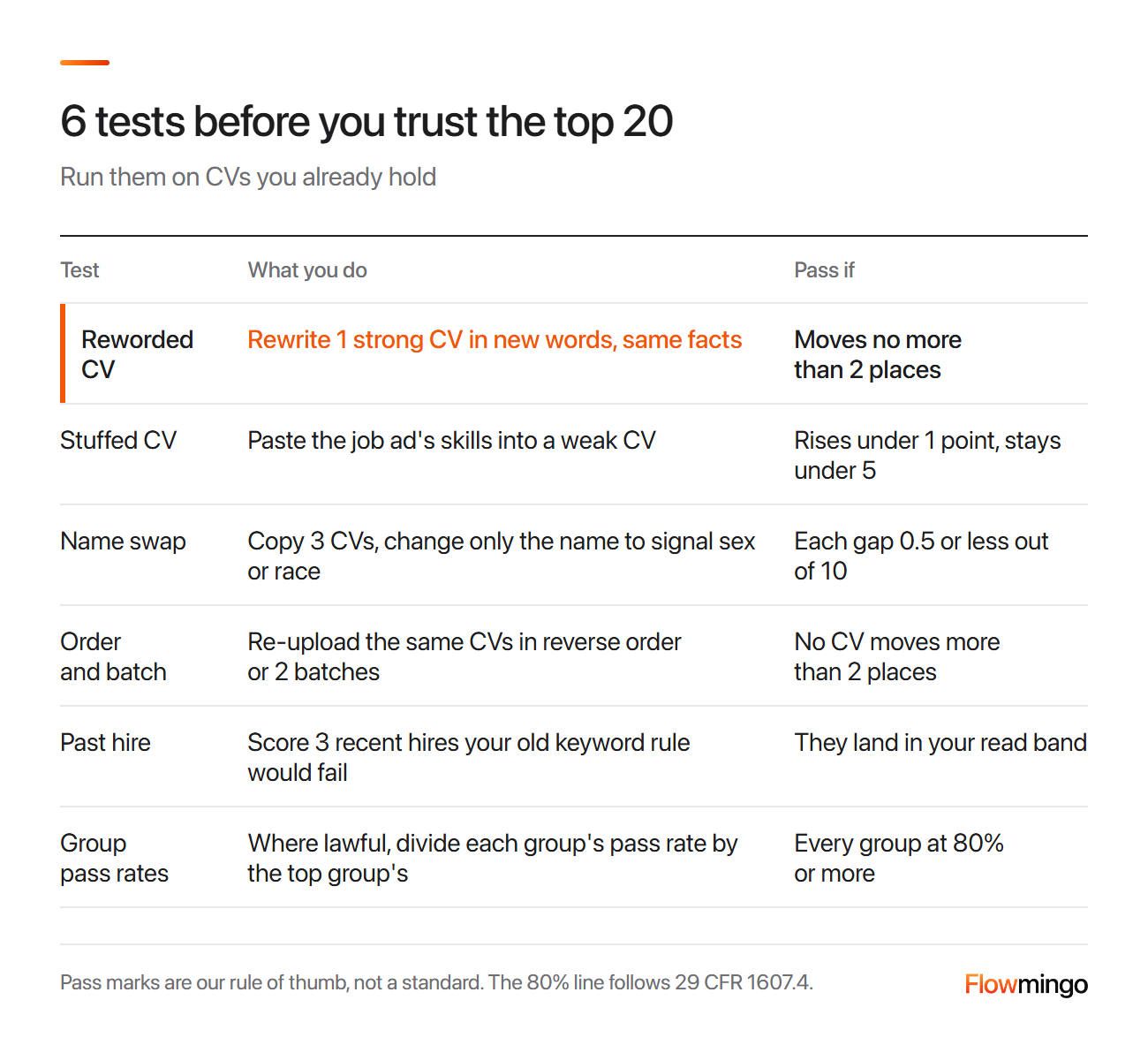
Ranker tests: 6 checks to run on your own CVs, each with what you do and a pass mark, our rule of thumb.
The order test matters because order effects can be large. In a preprint by Yin and colleagues, last revised in 2026 (version 4), 1 model picked the CV in its favoured slot, first or second, 92.8% of the time when the 2 CVs it compared were close in quality.
The 0.8 line for the group pass-rate test is the 80% rule in US federal guidelines adopted in 1978. US federal enforcement agencies generally treat a group passing at under that share of the top group's rate as evidence of adverse impact.
Small groups mislead, though: in a group of 10, 1 person moves the rate by 10 points.
The federal rule behind that line may not last, but the line is still worth using. As of 12 November 2026 the rule is still in the eCFR, the online edition of US federal regulations.
On 16 October 2026, though, the EEOC sent a final rule rescinding the guidelines' interpretive parts to White House review, the law firm Ogletree Deakins reported. The EEOC's agenda lists the rescission as effective in January 2027.
The ratio stays useful as your own monitor because the same kind of ratio runs through New York City's rules for automated hiring tools. Those rules describe their calculations as consistent with that federal section.
The city's Department of Consumer and Worker Protection, which wrote those rules, uses a different rate for a tool that scores rather than selects: each group's share scoring above the median score (DCWP).
10. If we auto-reject every CV under 5 out of 10, have we rebuilt the keyword filter?
Partly, yes: a hard cut-off turns a ranking back into a filter, just a smarter one. Use the score to order your reading, and set how far down to read from your interview hours.
A cut-off feels safe because it sounds objective. But it inherits every error above and removes people unseen, exactly like the filter you are replacing.
Flowmingo data · 105,648 CVs · 50,546 candidates · 1,761 companies · 10 Jul to 24 Sep 2026
- 43.6% of CVs scored under 5 out of 10 against their job's own criteria.
- 51.8% of hiring projects with 20 or more scored CVs had no CV scoring 8 or more.
AI CV scores, not candidate quality or hiring outcomes; not comparable across jobs. Strict criteria or bulk uploads pull scores down.
So an automatic rejection at 5 would have removed 43.6% of those CVs before anyone read them. A bar at 8 would have left more than half of those hiring projects with nobody reaching it at all.
Real cut-offs can be blunt. Hilke Schellmann, the journalist from section 7, found a vendor and a school district agreeing by email to reject anyone under 33% on an AI assessment (WIRED).
The EU treats AI that filters applications as high-risk. Its AI Act, Regulation 2024/1689, lists AI used "to analyse and filter job applications" in Annex III, the Act's list of high-risk uses.
An amending law, Regulation 2026/1744, starts the duties for those high-risk systems on 2 Dec 2027.
Instead of a cut-off, read down the ranking as far as your interview hours allow, and read the band just below where you stop too, because wording and parsing errors hide there.
Our candidate ranking guide shows where to stop with a near-tie, and candidate shortlisting sizes the list from interview hours. For the steps around both, see our CV screening guide.
Note why you stopped where you did. That note answers a candidate who asks, and it shows the ranker did not decide alone.
How Flowmingo helps
Flowmingo is a free AI hiring platform. CV Evaluation drafts criteria from your job description, and you rate each one from Must Have to Good to Have. Every CV then gets a weighted score out of 10, with the evidence written out.
Nobody is filtered out automatically: you filter and sort by score, and every CV stays in your list. It's free with no cap on CVs. We have not commissioned a third-party bias audit, so run the 6 tests above on Flowmingo too.
Then send your shortlist an AI interview they take in their own time, scored on the same criteria. Used that way, AI resume ranking for recruiters ends in a conversation, not a cut. Try Flowmingo free on your next role.
11. Sources
Every study, law and survey in this guide links to a source below; Flowmingo figures come from Flowmingo's own platform data.
- An, J., Huang, D., Lin, C., & Tai, M. (2025). Measuring gender and racial biases in large language models: Intersectional evidence from automated resume evaluation. PNAS Nexus, 4(3), pgaf089.
- Bevara, R. V. K., et al. (2025). Resume2Vec: Transforming applicant tracking systems with intelligent resume embeddings for precise candidate matching. Electronics, 14(4), 794.
- Chen, Q., & Xiao, Y. (2026). Competence-preserving resume perturbations expose presentation sensitivity in LLM screening. arXiv preprint, under peer review.
- Chen, Y., et al. (2025). Reasoning models don't always say what they think. arXiv preprint (Anthropic).
- Dastin, J. (2018). Amazon scraps secret AI recruiting tool that showed bias against women. Reuters.
- EU Artificial Intelligence Act [website] (n.d.). Annex III: High-risk AI systems referred to in Article 6(2). Future of Life Institute, text of Regulation (EU) 2024/1689.
- European Parliament and Council (2026). Regulation (EU) 2026/1744 amending Regulation (EU) 2024/1689, the Digital Omnibus on AI. Official Journal of the European Union.
- Fuller, J. B., Raman, M., Sage-Gavin, E., & Hines, K. (2021). Hidden workers: Untapped talent. Harvard Business School Project on Managing the Future of Work and Accenture.
- Gaebler, J. D., Goel, S., Huq, A., & Tambe, P. (2024). Auditing the use of language models to guide hiring decisions. arXiv preprint.
- Gorelick, E. (2025). Recruiters use AI to scan resumes. Applicants are trying to trick it. The New York Times, via The Star.
- Harrington, C. (2024). AI may not steal your job, but it could stop you getting hired. WIRED, interview with Hilke Schellmann on The Algorithm (Hachette Books, 2024).
- Jobscan (2025). State of the job search 2025. Jobscan.
- Kness, R. (2026). Recruiters reveal ATS doesn't kill your resume, it's overwhelming volume. ClearanceJobs, reporting Enhancv's recruiter interviews.
- Ministry of Manpower, Singapore (2024, November 12). Fact sheet on the Workplace Fairness Bill (first reading). MOM.
- Ministry of Manpower, Singapore (2025). Workplace Fairness (Dispute Resolution) Bill press release. MOM.
- Mu, H., Liu, J., Wan, K., Xing, R., Chen, X., Baldwin, T., & Che, W. (2025). AI security beyond core domains: Resume screening as a case study of adversarial vulnerabilities in specialized LLM applications. arXiv preprint.
- NYC Department of Consumer and Worker Protection (2023). Notice of adoption of final rule: Use of automated employment decisionmaking tools. City of New York.
- Ogletree Deakins (2026, October 21). EEOC sends OIRA final rule rescinding Uniform Guidelines on Employee Selection Procedures. Ogletree Deakins.
- Reddit r/recruiting (2023). Comment on ATS knockout questions. Reddit.
- Turpin, M., Michael, J., Perez, E., & Bowman, S. R. (2023). Language models don't always say what they think: Unfaithful explanations in chain-of-thought prompting. NeurIPS 2023.
- U.S. Equal Employment Opportunity Commission (2023, September 11). iTutorGroup to pay $365,000 to settle EEOC discriminatory hiring suit. EEOC.
- U.S. Code of Federal Regulations (current text). 29 CFR 1607.4, information on impact. eCFR.
- Yin, H., Vardi, S., & Choudhary, V. (2025). Fragile preferences: A deep dive into order effects in large language models. arXiv preprint, first posted 17 June 2025; version 4, 23 July 2026.