
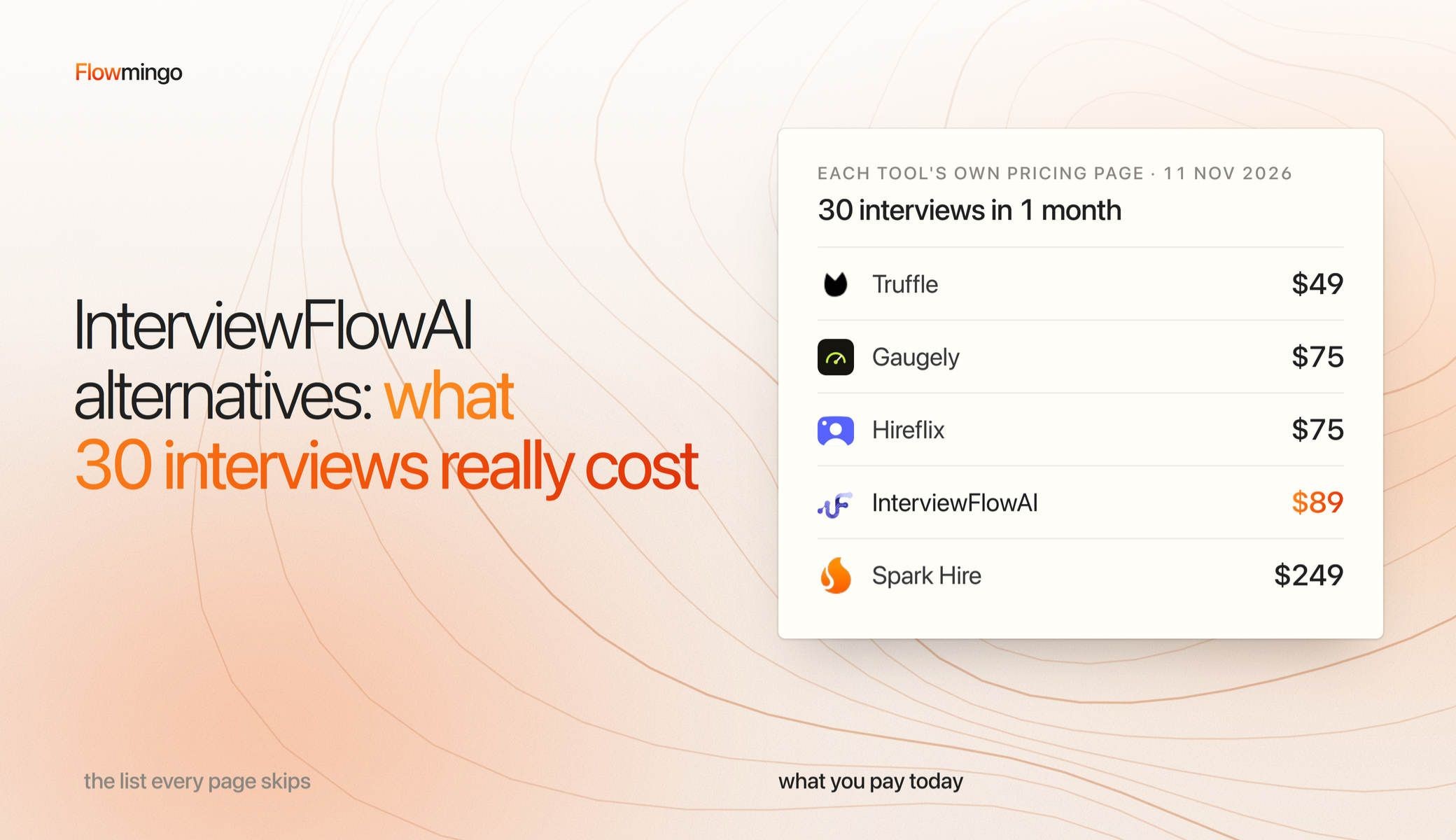
You run first-round screens on InterviewFlowAI, and your renewal is close. So you open the pages that rank for InterviewFlowAI alternatives, and every one that prices the tool quotes the same figure: $0.99 an interview.
That figure is real, but it is probably not what your team pays. The InterviewFlowAI pricing page prints $0.99 on only 2 of its 4 plans, and the cheaper of those 2, Growth, costs $299 a month for 303 interview credits.
A team running 30 interviews a month does better on the entry plan, Pilot, which costs $59 for 20 interviews plus $3 for each extra one. That is $89 in all, or $2.97 an interview, and it is the cheapest route to 30 that the vendor publishes.
None of the ranking pages works out that $89. Of the 8 results Google shows for this search, only a LinkedIn post prices 30 interviews, and it uses the $0.99 rate, which no plan gives at that volume.
This guide prices the alternatives from each vendor's own pricing page, read on 12 November 2026. Its list puts Flowmingo beside 10 rivals. It prices 7 of those entries at 30 interviews a month and, for the other 4, says why 30 interviews have no outright price.
Flowmingo, the company publishing this guide, sells a competing product. That is why its entry sits in the list on the same terms as the rest, with its own real limit printed beside its price.
Your real price turns on 1 number the lists leave out, the interviews you run in a month. Your shortlist turns on 1 distinction they blur: whether a tool runs the interview itself or only records answers.
Key takeaways
- What do the cheapest InterviewFlowAI alternatives cost at 30 interviews a month? Truffle costs $49, Willo $59 for 1 live role, Gaugely Pro $75 billed monthly ($60 billed yearly) and Hireflix $75 billed yearly, against $89 on InterviewFlowAI Pilot.
- Is the 99-cent rate the one we would actually pay? Only from 303 interviews a month. At 30 you pay $2.97 each, and at 100 you pay $2.99 on either plan.
- Which tools on the top lists show a price? The top 2 pages name 11 tools, 4 of them not in this guide's list. Only 5 of the 11 show a price: The Cognitive, Spark Hire, TestGorilla, Metaview and Willo. The other 6 ask for a demo.
- Who writes the lists that rank for this search? Vendors write half of them. Of the 8 results, 4 come from a vendor: 3 rivals selling against InterviewFlowAI, and InterviewFlowAI itself at rank 1.
- Is there an option with no interview cap and no monthly fee? Yes, Flowmingo's Free plan, and entry 1 prints its real limit: it keeps the latest 300 videos for 30 days.
1. Our InterviewFlowAI renewal is close: which InterviewFlowAI alternatives do we price first?
Price these InterviewFlowAI alternatives in the order below, which ranks them by what 30 interviews a month cost on each vendor's own page. The first 7 price that volume outright, and the last 4 say why they do not.
Each entry answers the same 4 questions: who it suits, what it does, what it cost on the day we read its pricing page, and where it falls short. Flowmingo comes first only because that cost order puts its $0 plan at the top.
Most of the 10 rivals come from the 2 top-ranked pages, InterviewFlowAI's own alternatives hub and The Cognitive's list. Between them, those 2 pages name 11 tools, and 7 of those 11 have an entry below.
The other 3 rivals, Truffle, Gaugely and Hireflix, are our additions, and each prices 30 interviews on its own page.
The 4 named tools left out, Alex by Apriora, HeyMilo, Humanly and Sapia.ai, showed no figure on 12 November 2026. Sections 4 and 7 look at all 11 named tools, so they cover those 4 too.
Our Flowmingo vs InterviewFlowAI page compares those 2 products directly, and our comparison hub covers other vendors.
1. Flowmingo
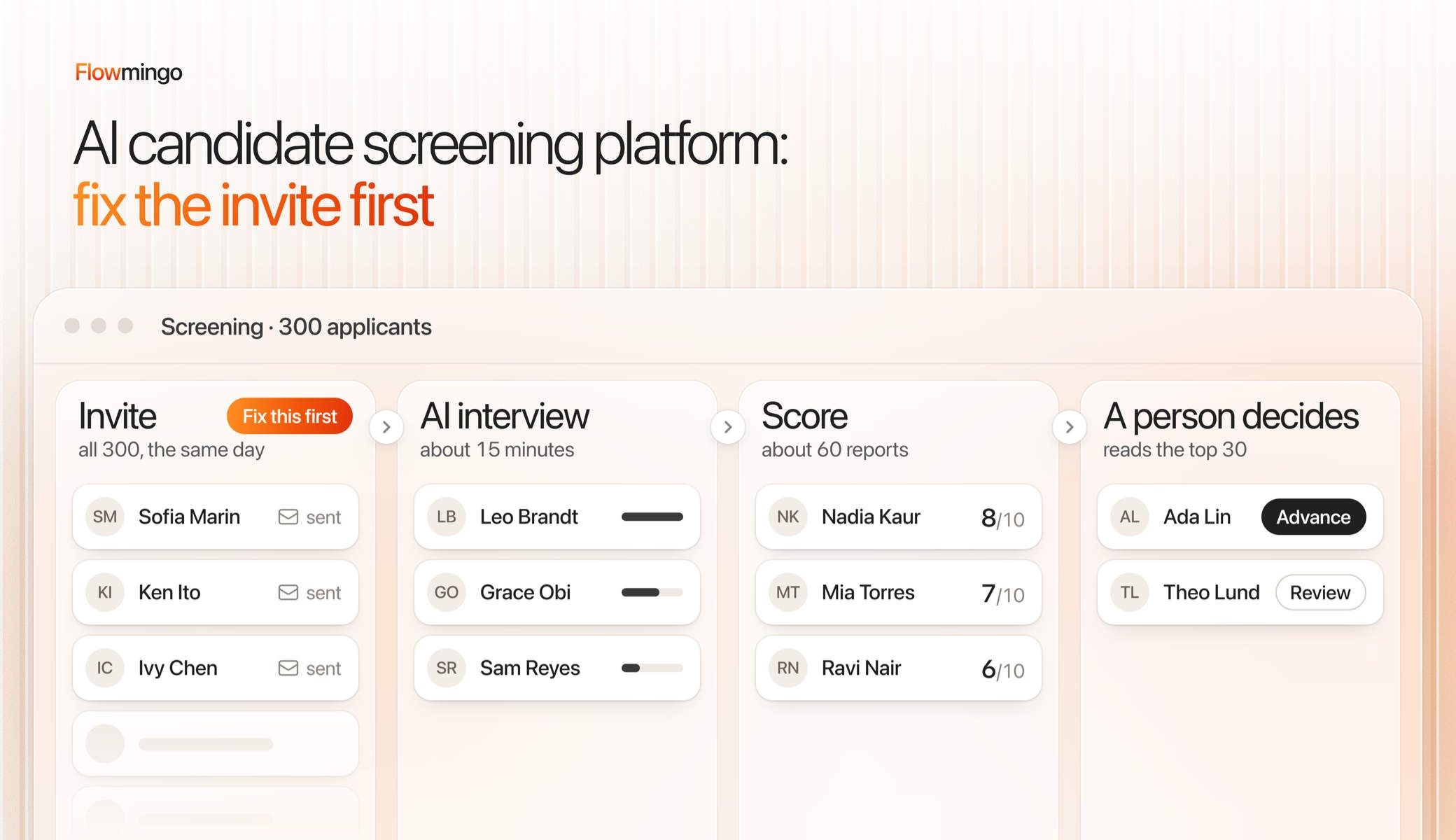
Best for a team that wants the interview run for it, with no cap and no monthly fee. What it does: you send each applicant an AI interview to take in their own time, and get back a recording, a transcript and a score.
Price: Free is $0 with no interview cap, so 30 interviews a month cost $0. Paid plans start at $42 a month billed yearly (its pricing page, read 12 November 2026).
Real limit: Free keeps the latest 300 videos for 30 days, though the scores and transcripts stay on every plan. It also caps an interview at 20 minutes and allows 3 report downloads in total.
Free sessions carry Flowmingo's brand beside yours, and candidates may see optional offers from us. Sponsoring an interview, which means paying Flowmingo $0.49 when the candidate starts it, removes both the brand and the offers.
Sponsoring is optional, so 30 interviews a month still cost $0, or $14.70 if you sponsor all 30.
2. Truffle
Best for 1 or 2 roles a month screened on recorded answers. What it does: collects one-way video answers, which candidates record on their own, and scores resumes and assessments from the same credits.
Price: Starter costs $49 a month, billed monthly only, for 200 credits. A completed interview uses 5, so 30 interviews use 150 credits and cost $49 (its pricing page, read 12 November 2026).
Real limit: Starter is a hard cap with no rollover, so in a busy month screening stops until you upgrade.
3. Willo
Best for hiring in bursts and paying only in the months you hire. What it does: one-way video, audio and written questions, with email and SMS invites and scorecards.
Price: Lite costs £49 a month for each live role, so you pay only for the roles you use that month, with no contract. In US dollars the page shows $59, so 30 interviews on 1 role cost $59 (its pricing page, read 12 November 2026).
Real limit: Lite stops at 5 live roles and 150 assessed candidates per role. For AI summaries and ATS connections, its page points to Enterprise, from £2,999 a year.
4. Gaugely
Best for a conversation rather than a recording, at a low published rate. What it does: runs voice and video AI interviews and ranks the scorecards.
Price: Free covers about 12 interviews a month. Pro is $75 a month billed monthly ($60 billed yearly) for a 1,000-minute pool, about 100 interviews, so 30 cost $75 (its pricing page, read 12 November 2026).
Real limit: Gaugely's counts assume about 10 minutes an interview, so longer interviews drain the minute pool faster.
5. Hireflix
Best for a company under 50 people that wants no volume cap. What it does: one-way video interviews, with unlimited responses, positions and seats.
Price: a company under 50 employees pays $75 a month billed yearly, so 30 interviews cost $75. From 50 to 250 employees the price is $150 (its pricing page, read 12 November 2026).
Real limit: that rate needs a yearly commitment and follows your headcount, not your volume, so a company that reaches 50 staff pays double for the same 30 interviews.
6. Spark Hire
Best for many open roles and many interviewers. What it does: live and one-way video interviews, with AI transcripts, summaries and scores.
Price: video interviews cost $249 a month billed annually, with unlimited jobs and users, or $299 month to month for 5 jobs and 5 users. So 30 cost $249 or $299 (its pricing page, read 12 November 2026).
Real limit: only the annual plan lets you download interviews, which matters on the day you leave.
7. The Cognitive
Best for a live, two-way AI interview rather than a recording. What it does: runs AI video interviews and returns a recording and a scorecard per role.
Price: Starter is $99 a month for 15 live interviews and Growth $299 for 50. So 30 interviews need Growth at $299 (its pricing page, read 12 November 2026).
Real limit: each interview uses 20 minutes of credits, and unused plan credits expire every month.
8. TestGorilla
Best for roles decided on provable skills before any interview. What it does: skills tests and recorded video questions, with AI interviews on its higher plan.
Price: Core starts at $215 a month per account, billed annually, without AI interviews. Plus adds them, from $520 a month billed annually, at 2 credits per candidate (its pricing page, read 12 November 2026).
Real limit: the page does not show how many credits a plan buys, so 30 interviews have no outright price.
9. Metaview
Best for improving the interviews your team runs, with an AI screener beside them. What it does: takes notes on live calls, and its Screening agent runs a voice interview scored on your rubric.
Price: the note-taker is free for 25 calls a month, and Pro costs $60 a month per user for unlimited calls (its pricing page, read 12 November 2026).
Real limit: we found no rate for the Screening agent on that page, so 30 interviews need a quote.
10. BrightHire
Best for AI screening and live-interview notes from 1 vendor. What it does: BrightHire Screen is, in its words, "an AI interviewer that runs structured screening interviews".
Price: on 12 November 2026 we found no price on its pricing page. Screen is "priced by interview volume" behind a demo request.
Real limit: you cannot cost 30 interviews until a quote arrives.
11. HireVue
Best for a large employer buying AI interviews, video interviews and assessments together. What it does: its AI Interviewer asks questions and follow-ups "in a natural two-way conversation".
Price: we found no price on its pricing page on 12 November 2026, only an FAQ and a demo request.
Real limit: HireVue sells on quotes only, which is why our HireVue pricing post works from public contracts instead.
2. What does InterviewFlowAI cost at the volume we actually interview?
InterviewFlowAI sells 4 plans, and the plan you pick decides what each interview costs. Pilot, the entry plan, is $59 a month for 20 interview credits, which is $2.95 an interview.
The pricing page prices the larger plans in the same credits. Growth is $299 a month for 303 credits, or $250 billed yearly, and Scale is $499 for 505 credits, or $416.60 billed yearly.
| Plan | A month | Interview credits | Price of 1 interview |
|---|---|---|---|
| Pilot | $59 | 20 | $2.95 |
| Growth | $299, or $250 billed yearly | 303 | $0.99, or $0.83 |
| Scale | $499, or $416.60 billed yearly | 505 | $0.99, or $0.83 |
| Enterprise | Custom | Unlimited | Not published |
Credits pay for more than interviews, which matters when you budget. An assessment costs 0.5 credits, an AI role play 2 and the notetaker 1 a meeting, so each of those drains the same pool your interviews draw on.
Extra interviews cost $3 each on Pilot and $0.99 on Growth and Scale. Unused credits roll into the next month only on those 2 larger plans, so on Pilot a quiet month is money gone.
That rollover matters on a seasonal pipeline, because a quiet February pays for a busy March.
Say you interview 30 people in November. On Pilot you pay $59 plus 10 extras at $3, which is $89, or $2.97 an interview.
On Growth you pay $299 for those same 30, or $9.97 each. The plan is not expensive for what it holds; it is simply sized for a team running 10 times your volume.
3. Why does every list of InterviewFlowAI alternatives print the same $0.99?
Because they quote the rate from the top of the pricing page without naming the plan it belongs to. The 99-cent rate applies to Growth and Scale billed monthly, and both plans bill for roughly 10 to 17 times the volume a small team runs.
Reney, a rival vendor whose comparison page ranks third, puts it plainly: "InterviewFlowAI offers AI interviews at $0.99 per interview with unlimited job postings."
RightMatch, another rival, repeats the figure at rank 7, and a LinkedIn post at rank 8 builds a whole section on it.
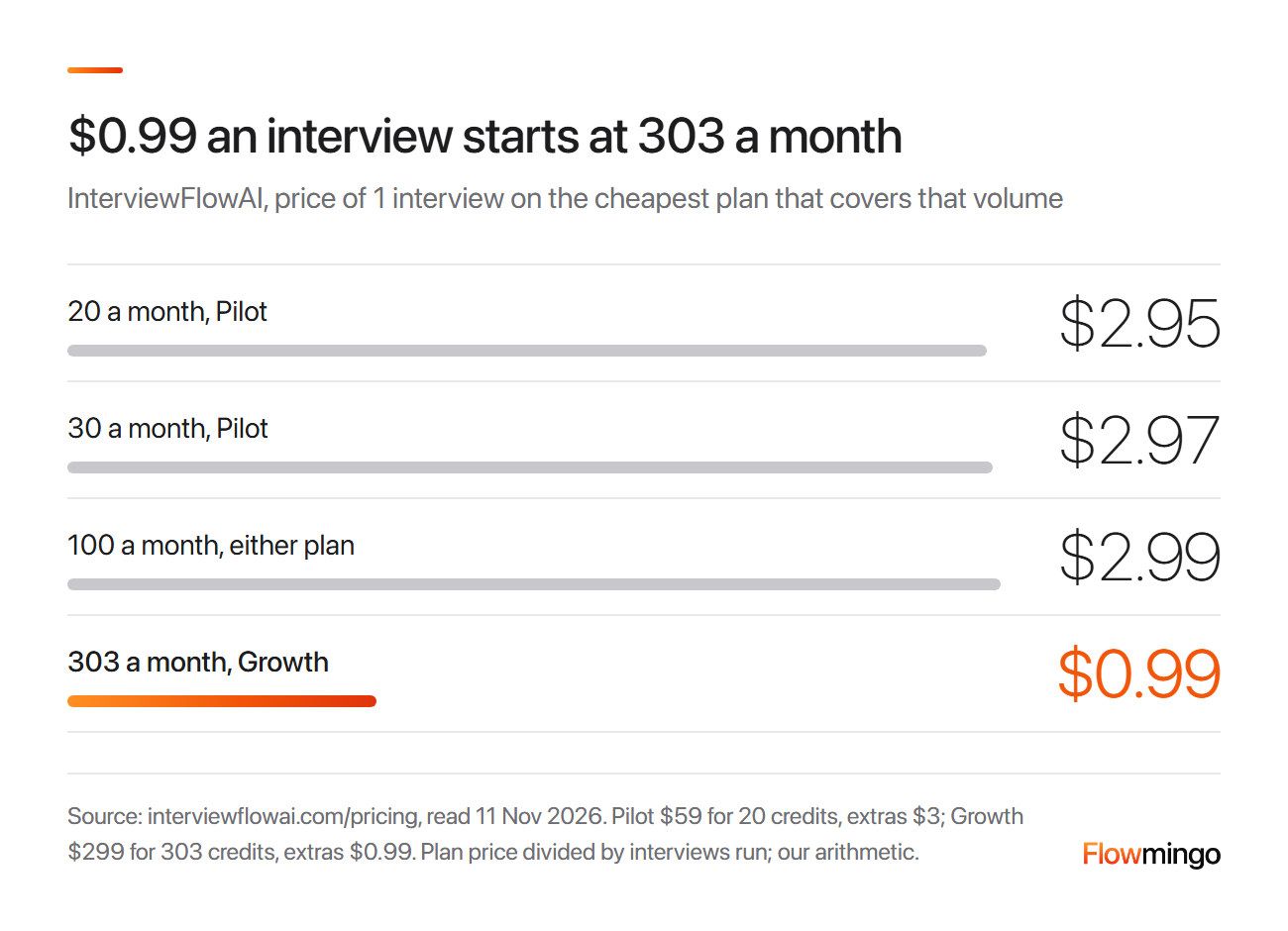
InterviewFlowAI price per interview: $2.95 at 20 a month on Pilot and $2.97 at 30. It reaches $2.99 at 100 on either plan, and $0.99 at 303 on Growth.
That LinkedIn post sets its own volume at 30 interviews a month, then prints "~$29.70" for InterviewFlowAI against "$1,500+" for the average competitor. The first figure is 30 interviews at $0.99, a rate no published plan gives at 30.
The crossover between the 2 plans is worth knowing before a sales call. Pilot costs $59 plus $3 for every interview above 20, so at 100 interviews it comes to $299, exactly the price of Growth.
So below 100 a month the entry plan wins, and above 100 Growth does. Even then, Growth's price per interview falls from $2.99 toward $0.99 only as you approach its full 303 credits, so a team below that volume never pays the advertised rate.
4. Which InterviewFlowAI alternatives publish a price we can read today?
Only 5 of the 11 tools the top 2 ranking pages name publish a price: The Cognitive, Spark Hire, TestGorilla, Metaview and Willo. Those 11 include the 4 that section 1 leaves out.
Of those 5, just The Cognitive, Spark Hire and Willo price 30 interviews outright. That leaves Flowmingo and our 3 additions, Truffle, Gaugely and Hireflix, as the other 4 entries in section 1 with a price for 30.
The table below gives what each vendor's pricing page showed on 12 November 2026, including the 6 with no figure.
| Tool | Its own pricing page on 12 Nov 2026 |
|---|---|
| The Cognitive | AI Interview plans from $99 a month for 15 live interviews |
| Spark Hire | Video interviews from $249 a month, billed annually |
| TestGorilla | Assessments from $215 a month per account; sourcing seats $74 |
| Metaview | Notes free for 25 calls a month, then $60 per user; sourcing $100 or $300 |
| Willo | Lite £49 per live role a month; Enterprise from £2,999 a year |
| HireVue | No figure found; an FAQ and a demo request |
| BrightHire | No figure found; priced by volume or company size |
| Alex by Apriora | Redirects to a 30-minute demo booking |
| HeyMilo | Redirects to a demo booking |
| Humanly | No pricing page; its site books a demo |
| Sapia.ai | A per-hire model, rate on request |
The sourcing prices in the TestGorilla and Metaview rows are for a separate product that searches for candidates to contact, so they price no interviews.
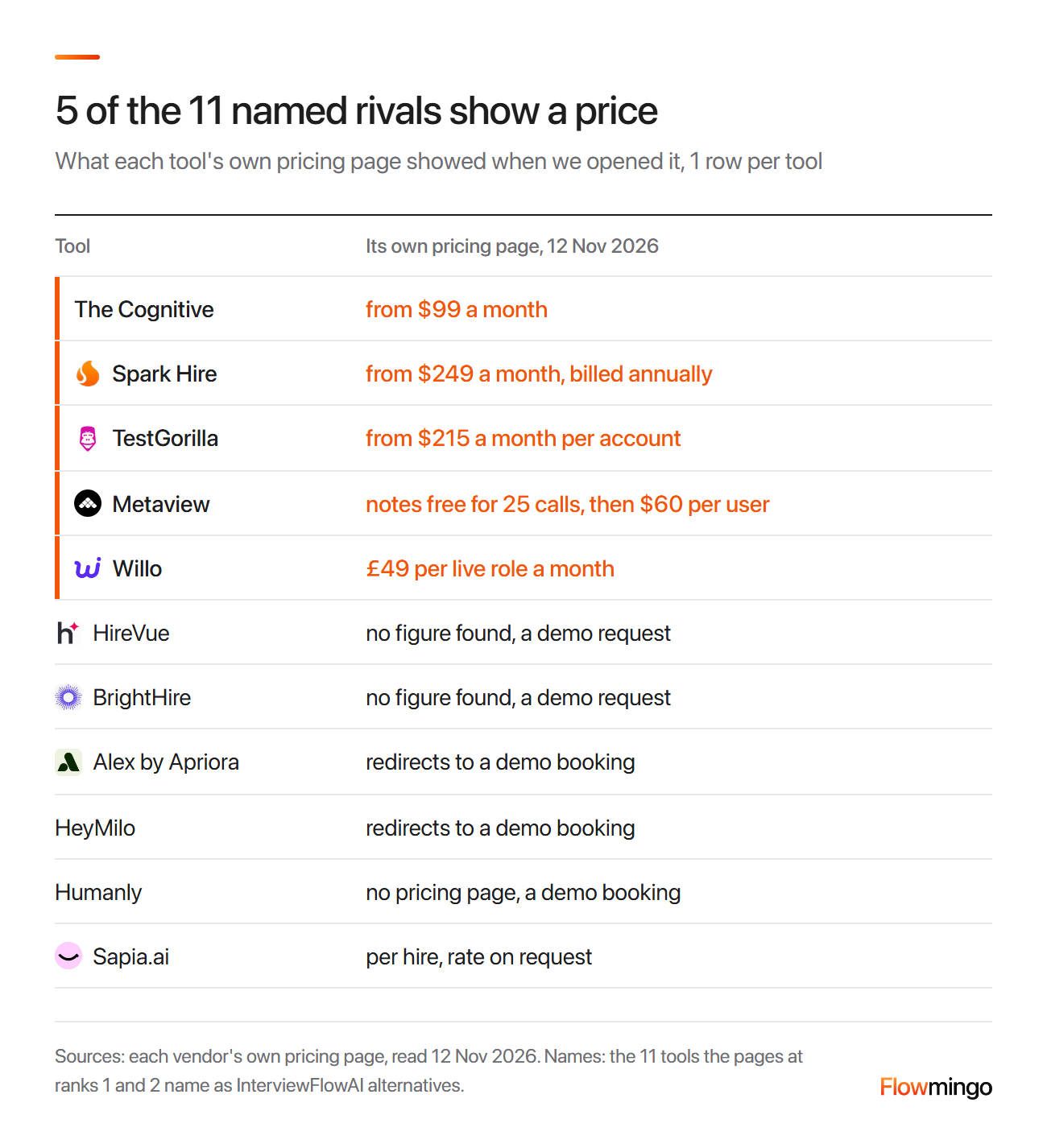
Published price check, 12 Nov 2026: The Cognitive $99, Spark Hire $249, TestGorilla $215, Metaview $60, Willo £49. The other 6 ask for a call.
A missing price is not a reason to drop a vendor, but it is a reason to put it in a later round, because a quote takes weeks and your renewal does not wait.
Ask the ones without a figure for a rate at your own volume, in writing. A vendor that will not price 30 interviews a month is telling you something.
Sapia.ai, for instance, is open about the shape of its deal rather than the size. It charges per hire, and says it is "designed to best serve companies that hire more than 500 people per year".
Read the date beside every figure, too, because a vendor can change a plan, a cap or a billing basis between your shortlist and your renewal.
When you check a page yourself, let it finish loading and open every tab. Spark Hire's video prices sit behind a product tab, and a plan card that loads late can hide a figure from a quick look.
Because a late card can hide a figure that way, each "no price" line in this guide was checked twice: on the page as it loaded, and in its source code, the raw text the page is built from.
5. What do 30 interviews a month cost on each tool?
Between $49 and $299 among the 6 rivals that price it outright. Part of that gap is what each tool does, which section 7 sorts out, and part is whether a plan sells you a pool you will use or one sized for a much bigger team.
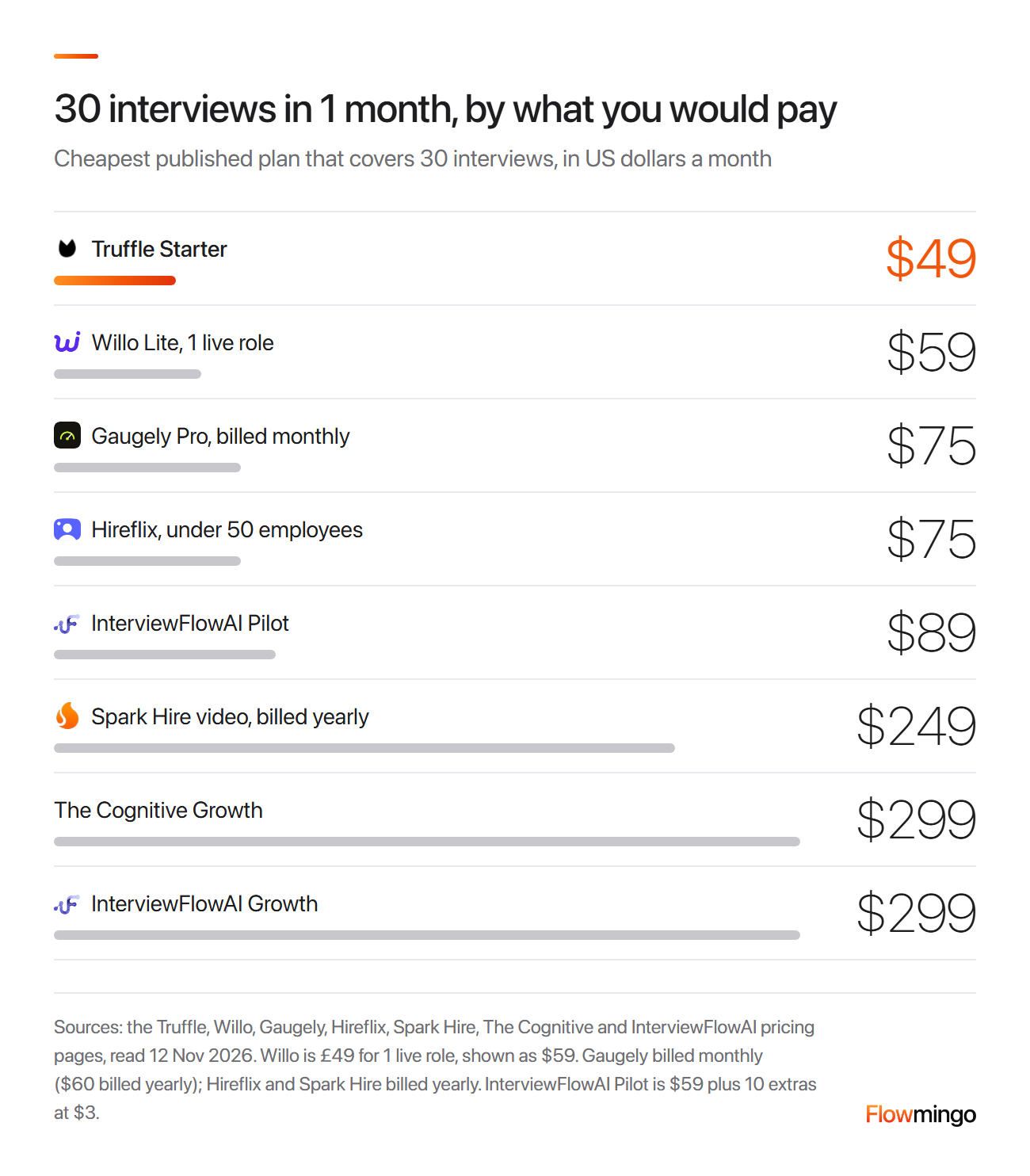
Cost of 30 interviews in 1 month: Truffle $49, Willo $59, Gaugely Pro $75 billed monthly, Hireflix $75 billed yearly, InterviewFlowAI Pilot $89. Spark Hire $249, The Cognitive $299, InterviewFlowAI Growth $299.
Truffle is the cheapest rival at this volume, and 30 one-way interviews use only 150 of the 200 credits in its $49 Starter pool. It also charges only for an interview a candidate finishes, so a no-show costs nothing.
Gaugely Pro covers about 100 interviews from its 1,000-minute pool, so 30 fit easily. Hireflix charges by company size, which means its figure does not move with the 30.
The Cognitive sits at the other end for a small team. Its Starter plan at $99 covers 15 live interviews, so 30 means Growth at $299, the same monthly bill as InterviewFlowAI Growth.
Willo bills per live role rather than per interview, so the chart shows 1 role at $59. That price holds whether 3 people answer or 150 do.
So the comparison turns on how your interviews are spread, not just how many there are. A team with 1 heavy role gets the most from Willo, while a team that spreads 30 interviews over 3 roles pays $177, more than Gaugely or Hireflix at $75.
6. Are there free InterviewFlowAI alternatives for a small hiring team?
Yes, and the useful difference is whether the free option ends at a volume or at a date. Gaugely's $0 plan gives a 120-minute pool a month, roughly 12 interviews, while Truffle's 7-day trial gives 30 credits.
Those 30 credits buy 6 completed one-way interviews, because a finished interview costs 5. That is enough to judge the product but not enough to screen a role.
InterviewFlowAI runs a 7-day trial on an eligible business email, with 10 credits. Those pay for 10 interviews at most, so a role with 40 applicants runs out of credits after 10 candidates, however many days are left. Like Truffle's, this trial shows you the tool but cannot screen a whole role.
Count your monthly applicants before you rely on any capped plan. For example, 1 role drawing 40 applicants uses more than 3 months of Gaugely's free pool if every applicant interviews.
Start a short trial on a role that already has applicants waiting. Then the week measures the tool rather than your pipeline, because you see real completion rates instead of a demo.
Flowmingo's Free plan, entry 1 in section 1, has no interview cap and no end date. Its limits sit in that entry, printed the same way as every rival's.
7. Which of these tools run the interview, and which only sit in on ours?
The top 2 ranking pages name 11 tools between them, including the 4 that section 1 leaves out. Of those 11, 6 run the conversation themselves with no recruiter present, though TestGorilla does so only on its Plus plan.
BrightHire and Metaview make it 8, because each also sells an AI screener beside its notes on your calls. Sapia.ai runs a text chat instead, and Spark Hire and Willo collect recorded answers.
The lists blur those differences by filing every kind under one heading. The Cognitive's list, for example, says Metaview "records and summarizes interviews your team conducts".
Yet Metaview's own Screening page sells a voice agent that candidates talk to whenever it suits them, which is why the table below files it as both an AI screener and a note-taker.
| What it does | Tools | What you get back |
|---|---|---|
| Runs the conversation | The Cognitive, Alex by Apriora, HeyMilo, Humanly, HireVue, TestGorilla on Plus, plus Gaugely (our addition) | A scored interview, with no recruiter in the room |
| Both: an AI screener and notes on your calls | BrightHire, Metaview | A scored first round, then notes on the human interviews |
| Collects recorded answers | Spark Hire, Willo, plus Truffle and Hireflix (our additions) | A video per question, some with a transcript and score |
| Scores a text chat | Sapia.ai | A scored chat interview |
Rows 1 and 2 are where a buyer replacing InterviewFlowAI should look, and row 3 if recorded answers are enough. In row 2, check that the quote covers the screening agent, because notes alone replace nothing here.
The same blur explains the Reddit thread at rank 6. Its question is about a "real time AI interview assistant", and its answers name desktop apps a job seeker runs during their own interview.
Those apps sit on the opposite side of the table from you. Because Google files them under the same words, a list of InterviewFlowAI alternatives can hand you a tool built for the candidate you are screening.
So decide which row you need before you take a demo, and judge every list against it.
8. Who wrote the pages that rank for this search?
Vendors wrote half of them, so treat any price on these lists as a claim to check on the vendor's own pricing page. Of the 8 results, 4 belong to a vendor: 3 rivals selling against InterviewFlowAI, and rank 1, InterviewFlowAI's own alternatives hub.
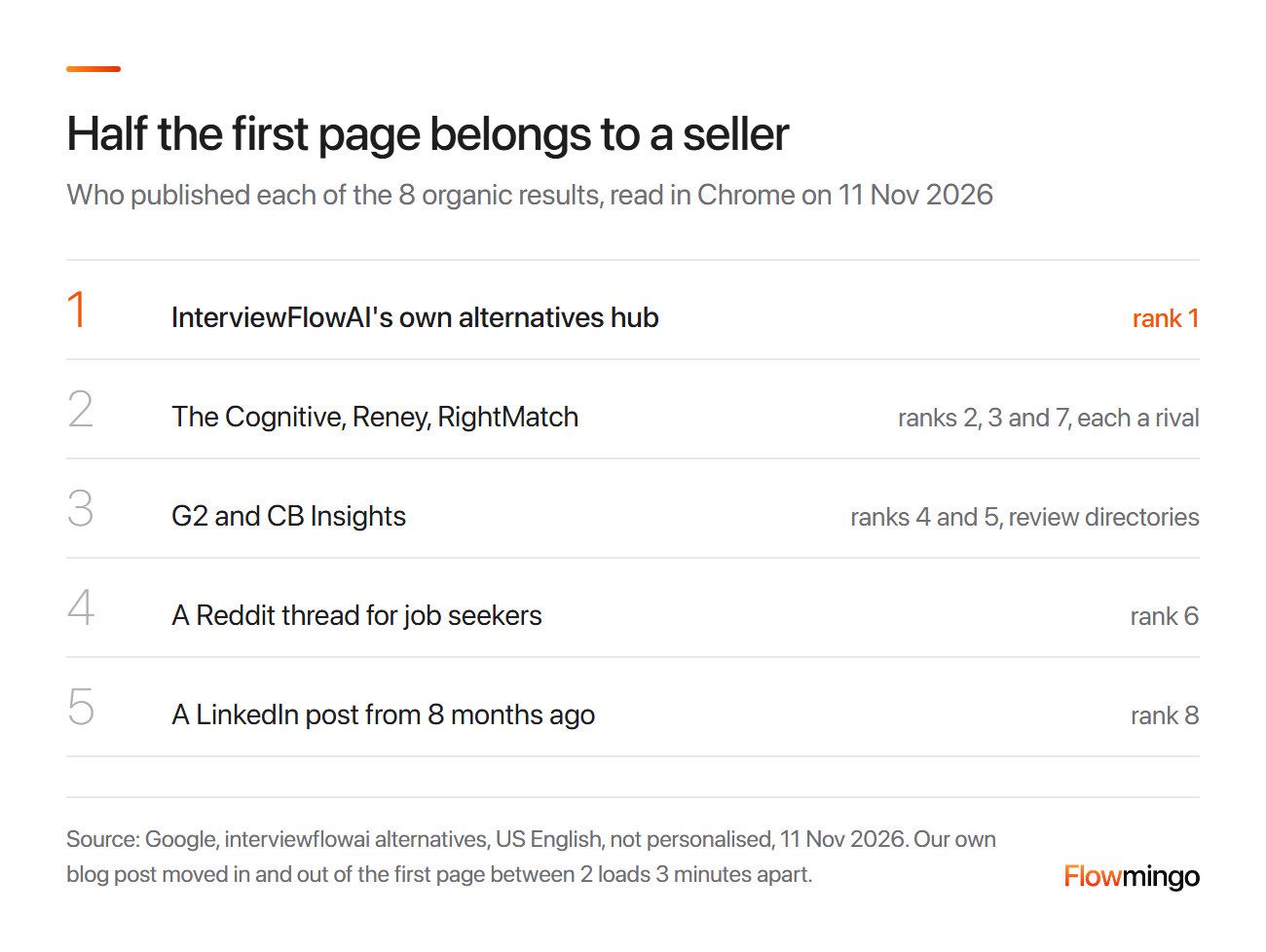
Who published the top 8: 1 page is InterviewFlowAI's own and 3 belong to rivals. The rest are 2 review directories, 1 Reddit thread and 1 LinkedIn post.
The Cognitive names 7 alternatives, ranks itself first and then prices only itself. Its page says every claim comes from each vendor's public documentation "as of August 2026".
Reney and RightMatch each compare InterviewFlowAI with a single rival: themselves.
None of that makes them wrong, and this guide, from a vendor too, is in the same position. It does mean that half the results for InterviewFlowAI alternatives on that first page come from someone with a product to sell.
Age is the other thing to check, because an old post can keep a figure the vendor's own page no longer shows. The LinkedIn post at rank 8 dates from March 2026, 8 months before this guide. It gives $1,300 a year for Vervoe, a platform it compares that this guide does not list.
Vervoe showed no plan figure on its own pricing page on 12 November 2026, so check any figure like that with the vendor before it goes into your budget.
The 2 review directories, G2 and CB Insights, can widen a shortlist. Their search snippets, the only part this guide quotes, name tools but give no price for any of them.
One snippet names CodeSignal, Braintrust AIR and Paylocity, none of them in this guide's list, and the other names Metaview, Willo and Spark Hire.
9. How do we move off InterviewFlowAI without losing our interview records?
Export first, then switch, whichever of the InterviewFlowAI alternatives you choose. Import and export sits on Growth and above, at $299 a month against Pilot's $59, so a Pilot customer has 1 upgrade to budget for before anything else.
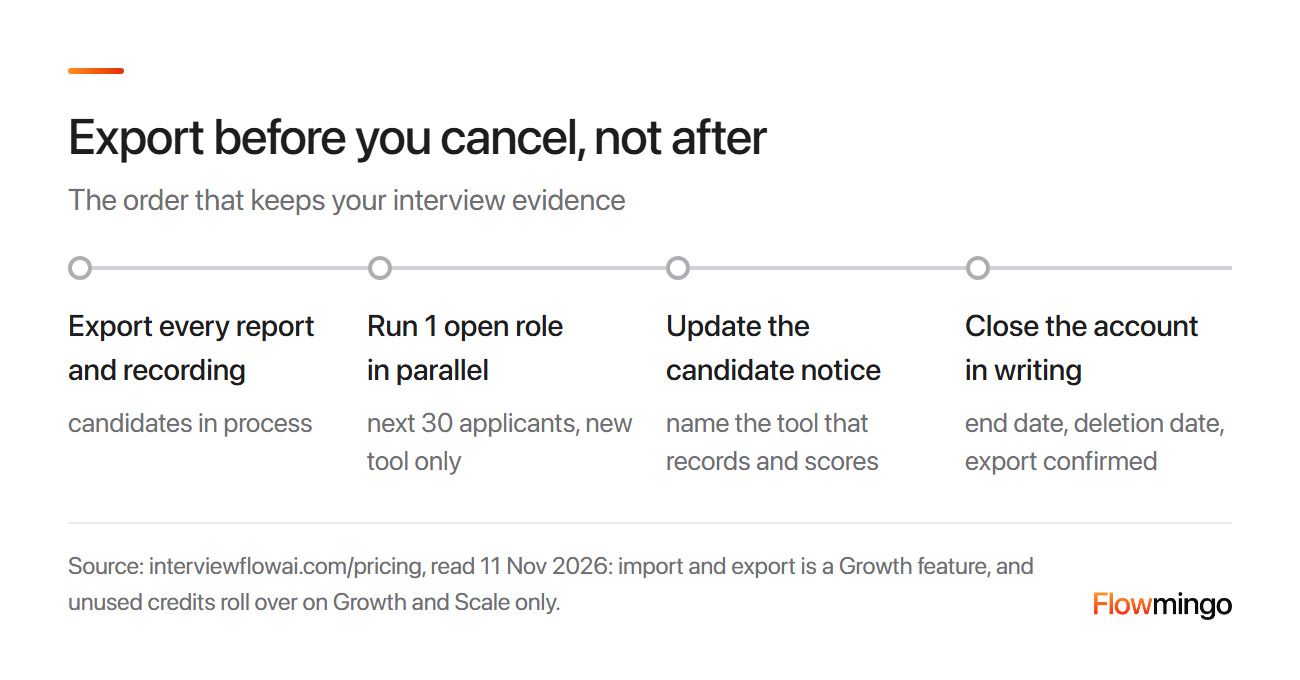
Switch plan: export every report and recording, then run 1 open role on the new tool. Update your candidate notice, and close the old account in writing.
The order matters, because a cancelled plan can take your evidence with it. Do not count on the new tool importing your old recordings, either: ask each vendor in writing whether it can, before you cancel anything.
9.1 What do we pull out before anything is cancelled?
Take the candidate reports, the recordings and the transcripts for every role still running, then the finished roles from the past year. Start with candidates mid-process, because those are the records a hiring manager asks for this week.
9.2 What do we ask the vendor in writing?
Ask for the end date, the deletion date and written confirmation that your export is complete. Ask who owns the recordings and the scores, and put the same question to every tool you shortlist.
Give a reply date 2 weeks before your renewal, so a slow answer still leaves you time to move.
9.3 How do we test the new tool before we cancel the old one?
While you wait for those answers, send the next 30 applicants for 1 open role through the new tool only, and let the old tool keep every other role. Compare completion rate and time to shortlist with the old tool's last 30 on that role.
Our micro1 alternatives post, written for teams leaving micro1's AI interviewer, runs the same parallel test.
Update your candidate notice, the text that tells applicants how you assess them, before that role opens. Name the tool that records and scores each interview, and tell applicants how to reach a person instead.
10. When is InterviewFlowAI still the right tool for our hiring?
Stay if you run more than 300 interviews a month. That is where the published rate becomes real and the plan stops being oversized.
Between 100 and 300 a month, Growth is still the cheaper InterviewFlowAI plan, at $299 for up to 303 interviews. That is $1.99 an interview at 150 and $1.20 at 250, so set it against each rival's price at your own volume.
Even 2 rival vendors praise its price. The Cognitive writes on its own list: "Stay with InterviewFlowAI if you want a cheap screening layer with a price on the website."
Reney adds that it "is hard to beat on price" when you already have the candidates. InterviewFlowAI's plans also count interview credits rather than recruiter seats, so adding a hiring manager costs nothing.
Watch 2 limits if you stay, because both sit above the entry plan. Cheat detection arrives on Scale at $499 a month, and ATS integrations start on Growth, so a Pilot customer gets neither.
Move if your volume sits under 100 a month, where the published rate never arrives. At 30 interviews a month, 4 of the 6 rivals in section 1 that price that volume outright cost less than Pilot's $89, and Spark Hire and The Cognitive cost more.
10.1 Other lists worth reading
Flowmingo appears in 2 third-party lists that compare tools like these. Read them beside this one, because we wrote neither.
- Work Insiders, free AI interviewing software: tools with a free tier that does not expire, the shortest route to a parallel test.
- Work Insiders, AI screening tools compared: the widest sweep of the category we have found.
How Flowmingo helps
Whichever tools you shortlist, run the parallel role in section 9 on a plan whose price you can read today. Flowmingo's are public: Free at $0, Starter $42, Growth $84 and Scale $339 a month billed yearly, and you can cancel at any time.
The AI interview is 1 piece of Flowmingo. Screening questions, tests, CV scoring and a tracker come with the same Free plan, inside the limits in entry 1 above.
You can test all of it on Flowmingo, beside the other InterviewFlowAI alternatives on your shortlist.
11. Sources
Every price, date and quotation above links to the page we read it on, and every vendor figure was re-read on 12 November 2026. Prices per interview are our own arithmetic: each plan's monthly price divided by the interviews it covers at the volume named in the text.
- Alex. (2026). Schedule a 30-minute demo. Reached from apriora.ai/pricing. Retrieved November 12, 2026.
- BrightHire. (2026). Pricing. Retrieved November 12, 2026.
- CB Insights. (2026). Top InterviewFlowAI alternatives, competitors. Search snippet only. Retrieved November 11, 2026.
- G2. (2026). Top 10 InterviewFlowAI alternatives and competitors. Search snippet only. Retrieved November 11, 2026.
- Gaugely. (2026). AI interview software pricing. Retrieved November 12, 2026.
- HeyMilo. (2026). Book a demo. Reached from heymilo.ai/pricing. Retrieved November 12, 2026.
- Hireflix. (2026). Pricing. Retrieved November 12, 2026.
- HireVue. (2026). AI interviewer. Retrieved November 12, 2026.
- HireVue. (2026). Pricing. Retrieved November 12, 2026.
- Humanly. (2026). Pricing. Retrieved November 12, 2026.
- InterviewFlowAI. (2026). AI interview software alternatives. Retrieved November 11, 2026.
- InterviewFlowAI. (2026). Pricing. Retrieved November 12, 2026.
- Metaview. (2026). AI screening agent. Retrieved November 12, 2026.
- Metaview. (2026). Pricing. Sourcing and Notetaker tabs. Retrieved November 12, 2026.
- Munjal, M. (2026, March). Best AI interview platforms 2026: pricing comparison. LinkedIn.
- Reddit. (2026). Which is the best tool for real time AI interview assistant. r/recruiting. Retrieved November 11, 2026.
- Reney. (2026). Reney vs InterviewFlowAI. Retrieved November 11, 2026.
- RightMatch AI. (2026). InterviewFlowAI alternatives and competitors. Retrieved November 11, 2026.
- Sapia.ai. (2026). Pricing. Retrieved November 12, 2026.
- Spark Hire. (2026). Pricing. Video interview tab. Retrieved November 12, 2026.
- TestGorilla. (2026). Pricing. Retrieved November 12, 2026.
- The Cognitive. (2026, October 10). InterviewFlowAI alternatives: 7 recruiting options for 2026. Retrieved November 11, 2026.
- The Cognitive. (2026). AI recruiting pricing. Retrieved November 12, 2026.
- Truffle. (2026). Pricing. Retrieved November 12, 2026.
- Vervoe. (2026). Pricing. Retrieved November 12, 2026.
- Willo. (2026). Pricing. Retrieved November 12, 2026.
- Work Insiders. (2026). Free AI interviewing software. Retrieved November 12, 2026.
- Work Insiders. (2026). AI screening tools compared. Retrieved November 12, 2026.