
On this page
- The short answer
- Pricing
- The AI interview
- What your applicants experience
- What comes back after each interview
- Integrations and workflow
- Scoring and data
- Which should you choose?
- Moving from InterviewAgent.ai
Reference
The short answer
InterviewAgent.ai conducts the first-round screen. Recruiters configure questions and competencies, candidates speak with the AI, and the resulting shortlist links interview evidence to scores. Its role is more substantial than recording preset answers or transcribing a human meeting[3].
Flowmingo also conducts the interview and returns evidence. Applicants answer spoken questions on video, with follow-ups and a scored report. Recruiters review the recording, transcript and criterion reasons in the hiring project. Free includes unlimited interviews, projects and team members.
Start with the format and the working team you need. InterviewAgent.ai offers multiple response formats and a paid, tiered workflow. Flowmingo makes an ongoing video-interview process available without a software subscription. Compare the resulting evidence and practical handoffs before choosing; adaptive questions alone do not distinguish these products[2,3].
2 more differences worth knowing
A paid allowance or unlimited free interviews
InterviewAgent.ai plans have monthly interview and seat allowances. Flowmingo Free has no interview cap or end date, so a larger applicant pool does not require buying more interview capacity[2].
See the detailCompare the input format and the review output
InterviewAgent.ai supports voice, video and writing. Flowmingo centers spoken questions with video answers. Both return scored evidence; test which format reveals the skills your role requires[2,9].
See the detail
Pricing: what each one costs you
InterviewAgent.ai has paid volume tiers. Flowmingo keeps AI interviews unlimited.
The prices below were checked on 4 October 2026. Annual figures are monthly equivalents with the full year paid upfront. They are separate purchase terms from monthly billing. Flowmingo publishes Free, Starter and Growth, with the interview allowance unchanged across them[2].
| What | InterviewAgent.ai |  |
|---|---|---|
| Starter | US$149/month; 100 interviews; 2 seats[2] | $0with unlimited AI interviews, team members and hiring projects |
| Growth | US$399/month; 500 interviews; 5 seats[2] | Free $0; Starter US$49/month; Growth US$99/month. AI interviews stay unlimited |
| Scale | US$999/month; 2,000 interviews; 15 seats[2] | Interview and team-member allowances remain unlimited |
| Enterprise | US$1,998/month; 4,000 interviews; 30 seats[2] | Confirm any enterprise access requirement separately |
| Annual billing | Starter/Growth/Scale/Enterprise: US$74/199/499/999 monthly equivalents[2] | Published monthly paid plans; Free has no subscription charge |
| Annual payment | US$888/2,388/5,988/11,988 upfront, respectively[2] | Free US$0; paid features are optional |
Choose a tier using both applicants and reviewers. A recruiting team may fit an interview allowance but still need more people to review candidates. Count recruiters, hiring managers and any recurring panel members before comparing costs. Ask whether a shared reviewer needs a paid seat and whether access can be restricted. Flowmingo includes unlimited team members, with Owner, Admin and Member roles.
A subscription divided by its full allowance is a capacity calculation, not an overage quote. If you use only part of a plan, the subscription remains the relevant cost. A seasonal campaign also needs enough capacity in its busiest month. Do not divide an annual interview estimate by 12 and assume unused monthly allowance carries forward. Confirm the treatment of abandoned interviews, retries and additional usage before inviting a large cohort.
At 500 or 2,000 interviews in a month, start with the corresponding published tier, then check seats and required features. At 10,000, the listed tiers do not establish a price. Request written terms instead of multiplying smaller packages or assuming unlimited capacity. Flowmingo Free provides a useful baseline for the interview charge, but reviewer time, implementation and any optional paid features still belong in the total cost.
Budget for the workflow you will actually use. If you need recordings downloaded, different candidate branding or longer video retention, compare Flowmingo paid benefits as well as Free. If you already have an ATS, include the effort of connecting it and validating the transferred records. A lower interview charge helps only if the resulting process gives the team usable evidence.
Flowmingo's plans: Free is $0 with unlimited AI interviews. Starter ($49 a month) and Growth ($99 a month) add your brand on what you share, downloads, longer assessments and longer-kept interview videos. See pricing.
How these numbers were worked out
- USD prices and allowances are from the current pricing page, checked on 4 October 2026[2].
- Annual totals are the stated upfront payments, not monthly cancelable subscriptions.
- No allowance stacking, rollover, overage rate, refund entitlement or 10,000-interview quote is inferred.
- Flowmingo figures use its published plans. Software fees do not measure total recruiting cost.
The AI interview: both follow up, but the response format matters
InterviewAgent.ai describes a structured conversation with follow-ups inside a common role framework. Flowmingo also asks follow-ups to applicant answers. The useful comparison is whether the conversation produces relevant evidence, rather than whether either tool has an AI question generator[4].

| What | InterviewAgent.ai | |
|---|---|---|
| Role setup | Recruiter selects questions, competencies and rubric weights[3] | 1-30 questions drafted from the job description; edit the questions and criteria before inviting |
| Follow-ups | Additional questions within a structured interview flow[4] | Response-based follow-ups during the AI interview |
| Voice screening | Dedicated voice-screening workflow advertised[10] | AI speaks questions; the applicant answers on video |
| Video screening | Conversational video with scored transcripts and highlights[9] | The AI asks aloud and follows up; the applicant records video answers in their own time |
| Technical assessment | Probes knowledge and reasoning; does not execute code[1] | Role-specific interview questions; practical tests are a separate assessment |
| Interview duration | Confirm the permitted duration for the selected workflow | Set the whole interview up to 60 minutes, depending on your plan |
Use a question that needs a concrete example. For customer support, ask how the applicant handled a difficult customer with incomplete information. A useful follow-up should clarify the action taken, the constraint and the result. Compare whether each interview gathers that evidence without repeatedly asking the same question or supplying the answer. This checks the conversation rather than the polish of a prepared demonstration.
Keep the assessment standard consistent when formats differ. Voice can reveal how someone explains a decision; writing gives them a different opportunity to organize the answer. If your role depends on phone communication, do not treat a written response as equivalent evidence without considering the job. For both tools, decide which competencies belong in the first round and which need a later work sample.
The configured rubric also needs to match the questions. If a hiring manager values escalation judgment, ensure candidates have a chance to explain when they sought help. Review at least one incomplete and one strong answer before expanding the interview. A detailed scorecard cannot repair a conversation that never asked for the relevant evidence.
What your applicants experience
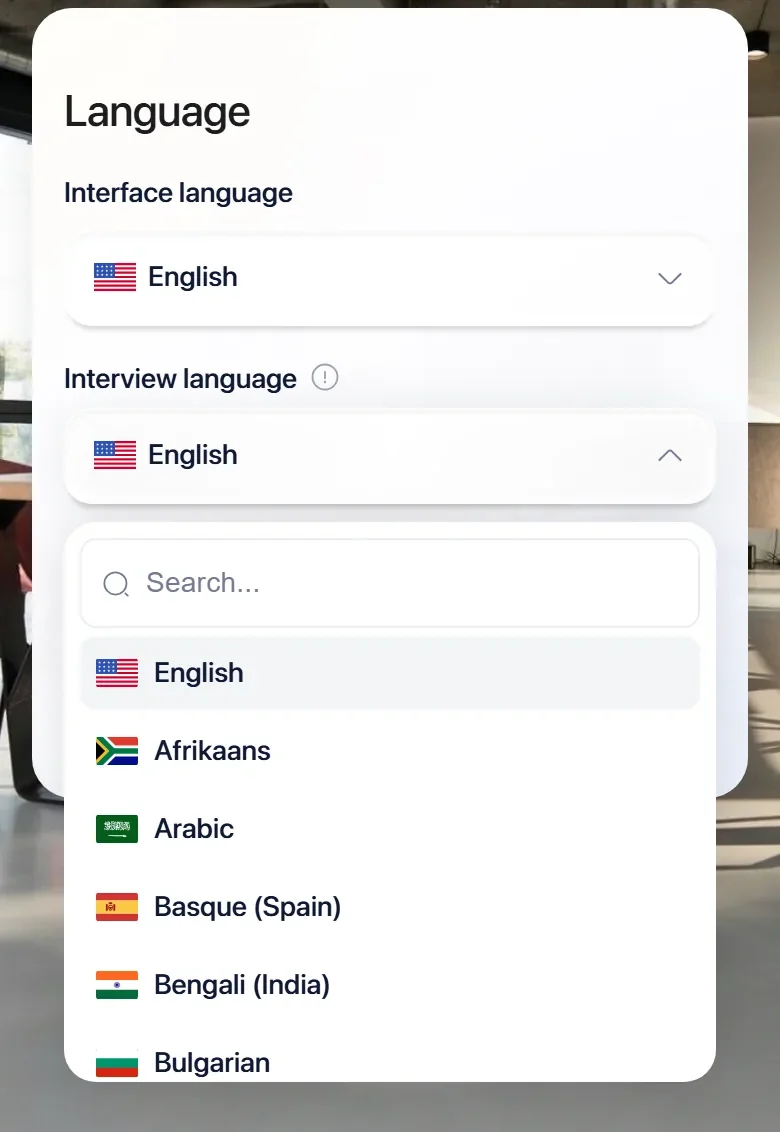
InterviewAgent.ai says candidates choose a suitable time and receive AI disclosure and consent information before participating. Flowmingo applicants also complete the interview independently through a browser. Compare the whole journey from invitation to completion, including what happens when the applicant cannot use the expected format[5].
A public sample is useful for understanding the idea, but it cannot establish completion quality. Before inviting applicants, run a real, authorized test with the vendor. Check how the invitation explains the purpose, how the candidate starts, what device access is needed and how the experience ends. Keep any simulated candidate names or scores separate from measured product results.
Include the least convenient realistic situation in the pilot: an older phone, a weak connection, a quiet speaker or an interrupted answer. Record what the applicant can recover without restarting and what help the recruiter receives. Neither a responsive marketing page nor a language claim establishes that recovery works in your hiring context. Flowmingo publishes 60+ interview languages; test the specific allowed language with the actual job questions.
Give applicants a clear next step. Decide who answers technical questions, how requests for an alternative process are handled and when a person reviews the outcome. The recruiting team still owns those communications. This matters when an automated first round removes the informal opportunity to ask a recruiter what happens next.
| What | InterviewAgent.ai | |
|---|---|---|
| Timing | Candidate completes the interview at a suitable time[5] | Applicant interviews in their own time |
| Video experience | AI-led video conversation with follow-ups[9] | A phone or laptop browser, with a camera and microphone check before the interview |
| Languages | Confirm required languages; no supported count established in this review | 60+ spoken interview languages; applicants choose from the languages you allow |
| AI disclosure | Disclosure and consent before the interview[3] | AI-led interview with a camera and microphone check |
| Alternative process | Privacy policy directs candidates to the employer for a human alternative[6] | Employer should provide an appropriate alternative outside the AI interview |
| Public demonstration | Sample-data simulation in the browser, not a real candidate interview[6] | Evaluate the actual interview preview and public sample report |
What comes back after each interview
InterviewAgent.ai documents criterion-based scoring with transcript evidence. Its product overview also describes recorded answers and recruiter score overrides. Flowmingo exposes criterion reasons, question-level evidence and the recording. Neither product should be presented as the only one that explains an AI score[1,8].
| What | InterviewAgent.ai | |
|---|---|---|
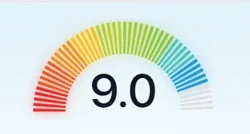
| Scoring framework | Anchored 1-5 criterion scores based on answer content[8] | 0-10 per criterion with a written reason; overall score uses the importance you set |
| Evidence connection | Score linked to the supporting transcript passage[8] | Video recording and transcript, with the answer available alongside its evaluation |
| Recorded answer | Voice/video recording kept with the candidate transcript[1] | Video answers remain available within plan retention terms |
| Reviewer control | Recruiter can override a score[1] | Recruiter reviews evidence and can add team ratings and notes |
| Candidate comparison | Ranked shortlist and comparison on common criteria[8] | Scores, written reasons, strengths, gaps, recommendation and cohort percentile band |
| Summary format | Scored transcript and highlighted video moments[9] | Criterion reasons, strengths, gaps and recommendation |


 Overall score
Open a score you disagree with. Follow it back to the answer and check whether the stated reason reflects what the candidate actually said. Then give the same evidence to a second reviewer. The useful result is a defensible discussion about the competency, not automatic agreement with an attractive number. Preserve the distinction between an AI score, a human rating and the final decision.
Different scoring scales cannot be compared by their face value. Converting a 1-5 score into 0-10 does not make the underlying rubrics identical. Instead, define the evidence for weak, acceptable and strong performance before the pilot. Compare whether each report lets reviewers place the answer against those definitions and recognize missing evidence.
Time the review task, not only report generation. Ask a hiring manager to explain why they would advance one applicant and hold another. Track whether they can find the relevant answer, understand the criterion and share the decision with a colleague. A shorter summary can be useful, but it should not remove the context needed to question the recommendation.
Integrations and workflow
| What | InterviewAgent.ai | |
|---|---|---|
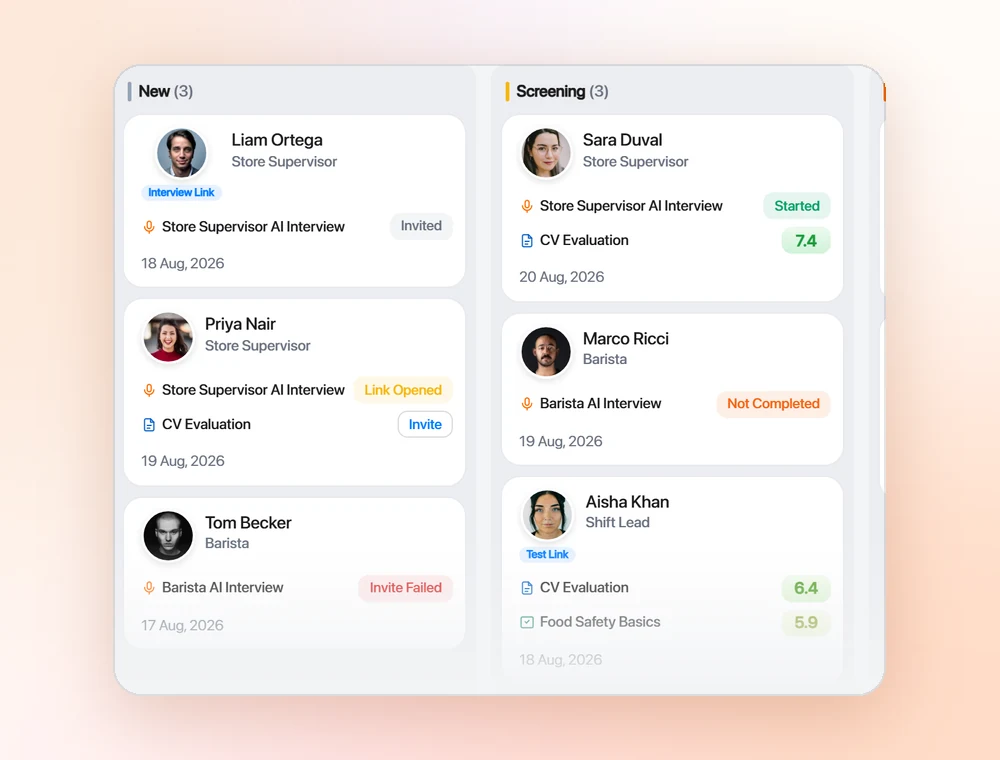
| Hiring record | Interview, transcript, scores and recruiter notes on one candidate record[1] | Built-in hiring stages, applicant records, notes and team ratings on every plan |
| ATS export | Growth and above[2] | Custom data connections through the API and webhooks |
| ATS and HRIS integration | Scale and above; verify the required connector[2] | REST API, webhooks and MCP for custom integrations on every plan |
| Status handoff | Features page describes candidate-status transfer to the ATS[4] | Configure the required events in the custom connection |
| Team access | Plan-based recruiter seats[2] | Unlimited team members, with Owner, Admin and Member roles |
| Enterprise access | Enterprise lists SSO/SAML[2] | Confirm any specific SSO or access requirement |
| Related assessments | Positions HireAgent for sourcing and SkillJudge for tests[4] | CV evaluation and separate assessments alongside the interview |
Export and integration are different buying requirements. A downloadable or transferred record may be enough for a small hiring team. An established ATS workflow may need automatic invitations, completion updates and a report attached to the correct application. Specify which events must move in each direction before comparing subscription levels or implementation effort.
For InterviewAgent.ai, request the exact supported connector and field mapping. For Flowmingo, plan the work needed to implement a custom API or webhook connection. A published integration mechanism does not mean that your ATS is already connected. Test a controlled applicant with a duplicate email or multiple applications so records stay attached to the right role.
Review access with the people who will actually use it. A hiring manager may need evidence for one role without seeing the whole candidate database. Check invitation, permissions, report access and account removal. Include this task in the pilot rather than discovering a seat or permissions problem when the first shortlist is ready.
Scoring, oversight and candidate data
Compare decision controls and the evidence behind trust claims
InterviewAgent.ai publishes consent and human-review policies, alongside audit-support material. Those statements need to be read at their stated scope. Its compliance guide distinguishes providing scoring data from conducting an independent audit for an employer. This comparison has not verified an independent vendor audit or certification[7].
Request the actual document your procurement decision needs. An audit-support feature, a published privacy policy and an independent certification establish different things. Ask who produced any audit, what product and period it covers, and whether its scope matches the configuration you will use. Do not turn either vendor’s marketing language into a guarantee about your own hiring process.
Before a pilot, agree who can read recordings, how long evidence needs to remain available and how a candidate request reaches the right person. Then walk through the procedure using test data. A retention setting has little practical value if the hiring team cannot explain what it affects or how an exported copy is handled.
Keep review substantive. Ask reviewers to document the evidence that influenced their decision, including when it differs from the AI recommendation. Both products leave the final choice with the recruiter. That control is most useful when the team can inspect an answer and correct its interpretation, rather than approving a ranked list without opening the reports.
| What | InterviewAgent.ai | |
|---|---|---|
| Final decision | Published policy says no automatic hiring or rejection[3] | Recruiters review the evidence and decide who moves forward |
| Evaluation inputs | FAQ says appearance, accent and personality are not scored[5] | Review the configured criteria and the reasons returned for each answer |
| Audit support | Provides structured scoring information to support a separate independent audit[7] | Confirm the evidence required for your assessment process |
| Security statements | FAQ describes encryption and restricted access[5] | Request current certification evidence. A published DPA is a data contract, not a certification |
| Retention | Privacy policy describes customer-configured retention[6] | Recording retention and download features depend on plan |
| Candidate requests | Policy describes withdrawal and requests through the inviting employer[6] | Published Data Processing Agreement and Privacy Policy; confirm retention and deletion requirements |
Which should you choose?
| If you are | Pick | Why |
|---|---|---|
| You want ongoing interviewing without a subscription | Flowmingo | Free includes unlimited AI interviews, projects and team members. |
| You need a voice or written first round | InterviewAgent.ai | Evaluate those advertised formats against the role requirements[2]. |
| Your hiring volume changes sharply each month | Flowmingo | The free interview allowance does not need to be resized for a campaign. |
| You want to inspect transcript-linked score overrides | InterviewAgent.ai | Its product overview specifically describes that reviewer control[1]. |
| Your team needs enterprise SSO | InterviewAgent.ai | Its Enterprise plan lists SSO/SAML; validate configuration and scope[2]. |
| You need an included hiring tracker | Flowmingo | Review interviews and move applicants through hiring stages in the same free workspace. |
| You need a working connection to an existing ATS | Either | Validate the specific connector or custom implementation using a complete candidate record. |
| You are selecting on assessment quality | Either | Run a common role and rubric. This comparison contains no measured accuracy benchmark. |
Moving from InterviewAgent.ai: test one role first
If you already use InterviewAgent.ai, preserve the working parts of your process while testing Flowmingo on one role. If both are new, use the same pilot brief. Agree on the evidence and review tasks before judging either report.
- Define one role and a common standardWrite the competencies, example questions and evidence for a strong answer. Configure each interview around that standard, without assuming the tools use identical score scales.
- Run the real candidate journeyUse authorized test participants, the intended language and an ordinary device. Check consent, question clarity, interruptions and the completion message. Keep the public sample separate from this test.
- Review evidence and complete the handoffAsk two reviewers to explain their choices from the answers. Test report access, the hiring stage and any ATS transfer. Record missing evidence and manual steps, not just impressions.
- Confirm capacity and access before expandingObtain written InterviewAgent.ai terms for expected usage and seats. Compare Flowmingo’s optional paid features against the same requirements. Keep existing reports accessible during the transition.
Pilot it on 1 role this week. Unlimited AI interviews in 60+ languages, for $0.
Start Hiring FreeThe full comparison, point by point
For the procurement checklist: all 37 points, with a source on each. Open a group.
Price and plan limits6 points
| What | InterviewAgent.ai | |
|---|---|---|
| Starter | US$149/month; 100 interviews; 2 seats[2] | $0 with unlimited AI interviews, team members and hiring projects |
| Growth | US$399/month; 500 interviews; 5 seats[2] | Free $0; Starter US$49/month; Growth US$99/month. AI interviews stay unlimited |
| Scale | US$999/month; 2,000 interviews; 15 seats[2] | Interview and team-member allowances remain unlimited |
| Enterprise | US$1,998/month; 4,000 interviews; 30 seats[2] | Confirm any enterprise access requirement separately |
| Annual billing | Starter/Growth/Scale/Enterprise: US$74/199/499/999 monthly equivalents[2] | Published monthly paid plans; Free has no subscription charge |
| Annual payment | US$888/2,388/5,988/11,988 upfront, respectively[2] | Free US$0; paid features are optional |
The interview6 points
| What | InterviewAgent.ai | |
|---|---|---|
| Role setup | Recruiter selects questions, competencies and rubric weights[3] | 1-30 questions drafted from the job description; edit the questions and criteria before inviting |
| Follow-ups | Additional questions within a structured interview flow[4] | Response-based follow-ups during the AI interview |
| Voice screening | Dedicated voice-screening workflow advertised[10] | AI speaks questions; the applicant answers on video |
| Video screening | Conversational video with scored transcripts and highlights[9] | The AI asks aloud and follows up; the applicant records video answers in their own time |
| Technical assessment | Probes knowledge and reasoning; does not execute code[1] | Role-specific interview questions; practical tests are a separate assessment |
| Interview duration | Confirm the permitted duration for the selected workflow | Set the whole interview up to 60 minutes, depending on your plan |
Candidate experience6 points
| What | InterviewAgent.ai | |
|---|---|---|
| Timing | Candidate completes the interview at a suitable time[5] | Applicant interviews in their own time |
| Video experience | AI-led video conversation with follow-ups[9] | A phone or laptop browser, with a camera and microphone check before the interview |
| Languages | Confirm required languages; no supported count established in this review | 60+ spoken interview languages; applicants choose from the languages you allow |
| AI disclosure | Disclosure and consent before the interview[3] | AI-led interview with a camera and microphone check |
| Alternative process | Privacy policy directs candidates to the employer for a human alternative[6] | Employer should provide an appropriate alternative outside the AI interview |
| Public demonstration | Sample-data simulation in the browser, not a real candidate interview[6] | Evaluate the actual interview preview and public sample report |
Reports and evaluation6 points
| What | InterviewAgent.ai | |
|---|---|---|
| Scoring framework | Anchored 1-5 criterion scores based on answer content[8] | 0-10 per criterion with a written reason; overall score uses the importance you set |
| Evidence connection | Score linked to the supporting transcript passage[8] | Video recording and transcript, with the answer available alongside its evaluation |
| Recorded answer | Voice/video recording kept with the candidate transcript[1] | Video answers remain available within plan retention terms |
| Reviewer control | Recruiter can override a score[1] | Recruiter reviews evidence and can add team ratings and notes |
| Candidate comparison | Ranked shortlist and comparison on common criteria[8] | Scores, written reasons, strengths, gaps, recommendation and cohort percentile band |
| Summary format | Scored transcript and highlighted video moments[9] | Criterion reasons, strengths, gaps and recommendation |
Integrations and team7 points
| What | InterviewAgent.ai | |
|---|---|---|
| Hiring record | Interview, transcript, scores and recruiter notes on one candidate record[1] | Built-in hiring stages, applicant records, notes and team ratings on every plan |
| ATS export | Growth and above[2] | Custom data connections through the API and webhooks |
| ATS and HRIS integration | Scale and above; verify the required connector[2] | REST API, webhooks and MCP for custom integrations on every plan |
| Status handoff | Features page describes candidate-status transfer to the ATS[4] | Configure the required events in the custom connection |
| Team access | Plan-based recruiter seats[2] | Unlimited team members, with Owner, Admin and Member roles |
| Enterprise access | Enterprise lists SSO/SAML[2] | Confirm any specific SSO or access requirement |
| Related assessments | Positions HireAgent for sourcing and SkillJudge for tests[4] | CV evaluation and separate assessments alongside the interview |
Oversight and candidate data6 points
| What | InterviewAgent.ai | |
|---|---|---|
| Final decision | Published policy says no automatic hiring or rejection[3] | Recruiters review the evidence and decide who moves forward |
| Evaluation inputs | FAQ says appearance, accent and personality are not scored[5] | Review the configured criteria and the reasons returned for each answer |
| Audit support | Provides structured scoring information to support a separate independent audit[7] | Confirm the evidence required for your assessment process |
| Security statements | FAQ describes encryption and restricted access[5] | Request current certification evidence. A published DPA is a data contract, not a certification |
| Retention | Privacy policy describes customer-configured retention[6] | Recording retention and download features depend on plan |
| Candidate requests | Policy describes withdrawal and requests through the inviting employer[6] | Published Data Processing Agreement and Privacy Policy; confirm retention and deletion requirements |
Questions buyers ask
Is InterviewAgent.ai the same product as Interviewer.AI?
No. This page evaluates InterviewAgent.ai at interviewagent.ai. Interviewer.AI has its own separate Flowmingo comparison page; the similar names do not make their features or prices interchangeable.
Can the public InterviewAgent.ai demo replace a product trial?
No. Its privacy policy describes a browser simulation using sample data, not a real interview. It can explain the workflow, but a real authorized test is needed to assess conversation quality and report behavior[6].
Does InterviewAgent.ai include code execution?
Its product overview distinguishes technical questioning from executing code. The AI can probe knowledge and reasoning; evaluate a separate practical assessment when the role requires coding evidence[1].
Do these comparisons prove one tool scores candidates more accurately?
No. This review compares documented capabilities and commercial access. It includes no common candidate benchmark, independently verified scoring-accuracy result or guaranteed hiring outcome.
Sources and method
This comparison was updated on 4 Oct 2026. Competitor claims link to InterviewAgent.ai's own pages or a named third party; ratings carry their own checked dates. Flowmingo facts come from our pricing, the AI Interviewer page, a sample report, our Data Processing Agreement and our Privacy Policy. Spotted something out of date? Tell us below and we fix it.
All 10 sources
- 1 InterviewAgent.ai: product overview and detailed product questions. interviewagent.ai
- 2 InterviewAgent.ai: current pricing, annual totals and plan inclusions. interviewagent.ai
- 3 InterviewAgent.ai: role setup, interviewing and recruiter review. interviewagent.ai
- 4 InterviewAgent.ai: features and ATS workflow. interviewagent.ai
- 5 InterviewAgent.ai: candidate experience, scoring and data FAQ. interviewagent.ai
- 6 InterviewAgent.ai: privacy policy and public demo disclosure. interviewagent.ai
- 7 InterviewAgent.ai: audit support and employer responsibilities. interviewagent.ai
- 8 InterviewAgent.ai: interview scoring and scorecard evidence. interviewagent.ai
- 9 InterviewAgent.ai: conversational video interviewing. interviewagent.ai
- 10 InterviewAgent.ai: phone screening workflow. interviewagent.ai
What changed, and when
- Added the InterviewAgent.ai comparison using current first-party product, pricing and policy sources. Distinguished sample demonstrations from live interviews and audit support from independent verification.