
On this page
- The short answer
- Pricing
- The AI interview
- What your applicants experience
- What comes back after each interview
- Integrations and workflow
- Scoring and data
- Which should you choose?
- Moving from Ribbon
Reference
The short answer
Ribbon is no longer accurately described as only a voice-screening tool. Its current product explicitly offers voice and video interviews, custom questions and scoring criteria. The wider workflow includes outreach, an ATS integration directory and read-only access for compatible AI tools[1,3,5].
Flowmingo includes the interview and hiring workspace without a subscription. Recruiters configure questions and criteria, invite applicants and review evidence together. Free includes unlimited interviews, projects and team members. Paid plans add capabilities such as branding, downloads, longer assessments and longer recording retention.
The key comparison is the operating package. Ribbon's published plans combine interview allowances with seats and active-role limits. Flowmingo does not meter its core AI interview volume. Compare the actual channels, ATS handoff and evidence requirements before deciding whether a Ribbon bundle or Flowmingo's included workflow better fits the team[2].
2 more differences worth knowing
Published allowances shape the Ribbon plan
Ribbon lists interview, seat and active-role limits for its paid tiers. Flowmingo includes unlimited core interviews, projects and team members. A team can outgrow a seat limit before its interview allowance[2].
See the detailWhatsApp is an invitation route in both workflows
Ribbon's WhatsApp page explicitly describes invitations and reminders that link to an interview. Flowmingo also supports WhatsApp invitations for enabled eligible paid organizations, with messaging credits[4].
See the detail
Pricing: what each one costs you
Use Ribbon's billing period, allowances and overage together.
The reviewed pricing page displays annual billing: Growth US$499/month, Business US$999/month and Scale US$1,999/month. These are monthly equivalents under annual billing, not verified month-to-month prices. A seven-day trial is advertised; it is not an ongoing free plan[2].
| What | Ribbon |  |
|---|---|---|
| Growth, annual billing | US$499/month; 100 interviews, 2 seats, 2 active roles[2] | Free: unlimited interviews, team members and projects |
| Business, annual billing | US$999/month; 400 interviews, 5 seats, 5 active roles[2] | Starter: US$49/month; core volume remains unlimited |
| Scale, annual billing | US$1,999/month; 1,000 interviews, 10 seats, 10 active roles[2] | Growth: US$99/month; core volume remains unlimited |
| Published overage | US$4 / US$3 / US$2.50 per interview respectively[2] | No core AI interview overage |
| Enterprise | Custom terms; confirm unlimited scope and extras[2] | Confirm any requirements beyond published plans |
| Trial | Seven days advertised[2] | Ongoing Free plan |
Compare the annual commitment before the apparent monthly amount. Multiplying the displayed annual-billing equivalents by twelve gives US$5,988 for Growth, US$11,988 for Business and US$23,988 for Scale, before additional usage or other charges. These calculations describe the advertised billing basis, not a negotiated quote or a confirmed cancellation policy. Request month-to-month terms separately if the hiring campaign is temporary.
A 500-interview month illustrates why allowance and overage belong together. On the published Growth allowance and rate, 400 additional interviews would add US$1,600 to the monthly equivalent; Business would add US$300 for 100 additional interviews. These are illustrative calculations, assuming every interview is chargeable under the displayed rules. Confirm how retries, partial sessions and monthly resets actually work before budgeting.
Check roles and reviewers as well as volume. A team with eight hiring managers and only a few hundred interviews may need a different tier from a two-person team running one large campaign. Clarify whether hiring-manager or client access consumes a seat and what makes a role active. Do not assume that archiving and reopening roles bypasses the commercial limit.
Flowmingo's free interview volume removes that usage calculation for the core AI interviewer, but evidence and presentation requirements still matter. Free keeps the latest 300 interview videos for 30 days while results, scores and transcripts remain available. Longer retention, downloads or branded sharing can justify a paid plan. Compare the complete requirement rather than treating an interview allowance as the entire purchase.
Flowmingo's plans: Free is $0 with unlimited AI interviews. Starter ($49 a month) and Growth ($99 a month) add your brand on what you share, downloads, longer assessments and longer-kept interview videos. See pricing.
How these numbers were worked out
- First-party pricing checked on 4 October 2026; the displayed annual-billing option is used.
- Annual totals equal the displayed monthly equivalent multiplied by twelve.
- The 500-interview examples apply the displayed allowance and overage; actual billing rules need confirmation.
- No old flat per-interview price or calculator default replaces current plan terms.
The AI interview: structured conversations with configurable criteria
Ribbon lets teams set questions and scoring rubrics, then asks follow-ups when an answer needs more detail. Flowmingo also combines configured criteria with spoken follow-ups. Compare the quality of the evidence and the review experience rather than assuming either product is a fixed questionnaire[1].

| What | Ribbon | |
|---|---|---|
| Questions | Custom questions for the role[1] | Generate and edit questions from a job description |
| Rubric | Role-specific criteria[1] | Criterion ratings with configurable importance |
| Follow-ups | Probe answers that need more detail[1] | Follow-ups during the spoken interview |
| Formats | Voice and video options[1] | Standard asynchronous browser AI interview |
| Technical work | Demonstrate any required executable exercise | Technical Tests support executable coding questions |
| Decision | Scored review for the hiring team[1] | Recruiter reviews evidence and decides |
Use an answer that is plausible but incomplete. For a shift-supervisor role, an applicant may say they reorganized the team without explaining why. A useful follow-up should establish the constraints, choice and result. Review whether the interviewer elicits that evidence without suggesting the preferred response, then check whether the scoring explanation reflects what was actually said.
Agree the meaning of each criterion before comparing scores. Communication might mean explaining a safety issue clearly, rather than sounding confident or using polished language. A role-specific rubric should reward the behavior needed on the job. If different managers mean different things by the same label, an automated score can conceal disagreement rather than resolve it.
Do not transfer capabilities across interview formats without checking them. A voice-only configuration may produce a different evidence record from video, and an executable technical exercise is different from explaining a programming concept. Ask for the complete experience required by the role, including the final report. Flowmingo's Technical Tests should be evaluated on that same practical standard.
What your applicants experience
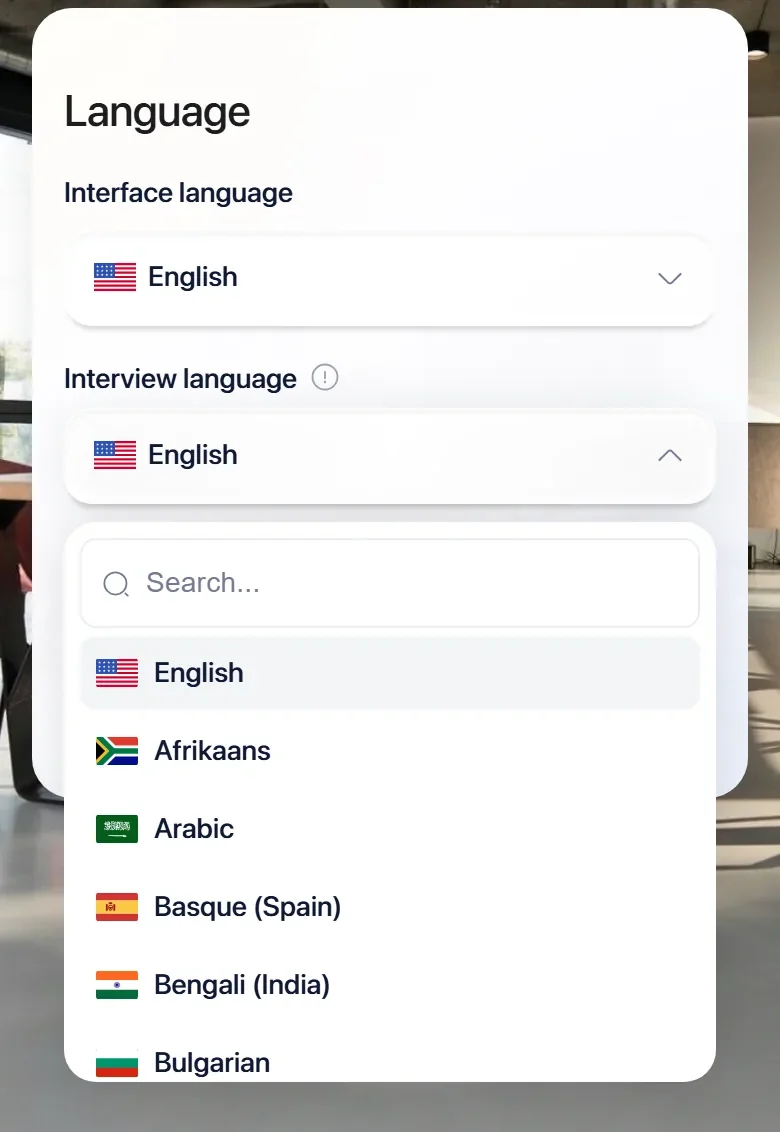
Ribbon offers browser-based voice and video interviews and advertises more than ten languages. Its WhatsApp product delivers invitations and links; the interview runs in Ribbon. Flowmingo's WhatsApp invitation likewise opens the browser interview, subject to paid eligibility, organization enablement and messaging credits[1,4].
Evaluate outreach as a sequence, not a list of channels. A candidate should understand which role the message concerns, why they received it and what happens after they open the link. Check that reminders stop when the interview is complete and that multiple channels do not create confusing duplicate requests. Confirm messaging charges and eligibility separately from interview allowance.
For a voice option, test whether the candidate can complete the assessment in the environment they are likely to use. For a video option, inspect device checks and support when the camera or microphone fails. Do not assume every applicant prefers the same format. Gather feedback from a representative pilot and provide a clear route for someone who needs another process.
Compare the language used in the question, the answer and the report. A supported language count does not establish quality for a specialized role or local vocabulary. Have a reviewer inspect a real transcript and scoring explanation in the target language. Keep language availability, candidate comfort and assessment relevance as separate pilot observations.
| What | Ribbon | |
|---|---|---|
| Timing | Candidate completes on their own schedule[1] | Candidate completes independently |
| Device | Modern phone or computer browser[1] | Browser interview with camera and microphone check |
| Interview language | 10+ advertised; verify the selected language[1] | 60+ spoken interview languages |
| Outreach | Email, SMS and separately described WhatsApp workflow[4] | Email and eligible paid WhatsApp invitations |
| WhatsApp purpose | Invitation, reminder and progress tracking[4] | Invitation linking to the browser interview |
| Branding | White-label options in published plans[2] | Plan-dependent company branding |
What comes back after each interview
Ribbon's current interviewer page places the recording, transcript, summary and scorecard together. Flowmingo also pairs the assessment with recorded evidence and written reasons. The useful distinction is whether reviewers can understand and challenge the recommendation quickly in their actual workflow[1].
| What | Ribbon | |
|---|---|---|
| Evidence | Recording and transcript together[1] | Recording and transcript alongside scores |
| Summary | Interview summary and recommendation[1] | Strengths, gaps and recommendation |
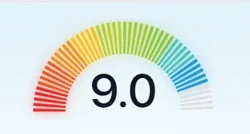
| Scoring | Custom role rubric[1] | 0-10 criterion ratings and importance-weighted overall score |
| Client handoff | Evaluate the required staffing report workflow[7] | Report links; paid branded sharing and downloads |
| ATS access | Validate the selected connector's result mapping[3] | API/webhooks; confirm required fields and permissions |
| Human review | Scored review supports the team | Recruiter retains the decision |


 Overall score
Test the report with the hiring manager who will use it. Ask them to identify the strongest evidence for one requirement and the main unresolved question. A score alone is insufficient if they cannot find the answer behind it. Measure the effort required to reach that evidence using their actual permissions, especially when a staffing agency shares the result with a client.
A summary should preserve uncertainty. If an applicant never gave a concrete example, the report should not turn a confident assertion into demonstrated experience. Review a sample containing incomplete answers and compare the written reasons. This is more informative than comparing two polished sample reports with uniformly strong candidates.
For agency submissions, define what the client receives and what remains internal. A recruiter may need access to the full recording while the client needs a concise evidence summary. Confirm link expiration, branding and download permissions. Keep the assessment version associated with the submission so later rubric changes do not create confusion about an earlier recommendation.
Integrations and workflow
| What | Ribbon | |
|---|---|---|
| ATS connections | Published directory of named integrations[3] | API, webhooks and MCP; confirm native availability |
| Mapping | Advanced mapping appears in higher-tier scope[2] | Scope custom event and field mapping |
| Outreach timeline | WhatsApp activity alongside email and SMS[4] | Candidate invitations and hiring-project workflow |
| MCP | Read-only ATS lookup through compatible clients[5] | MCP available; compare tool scope and permissions |
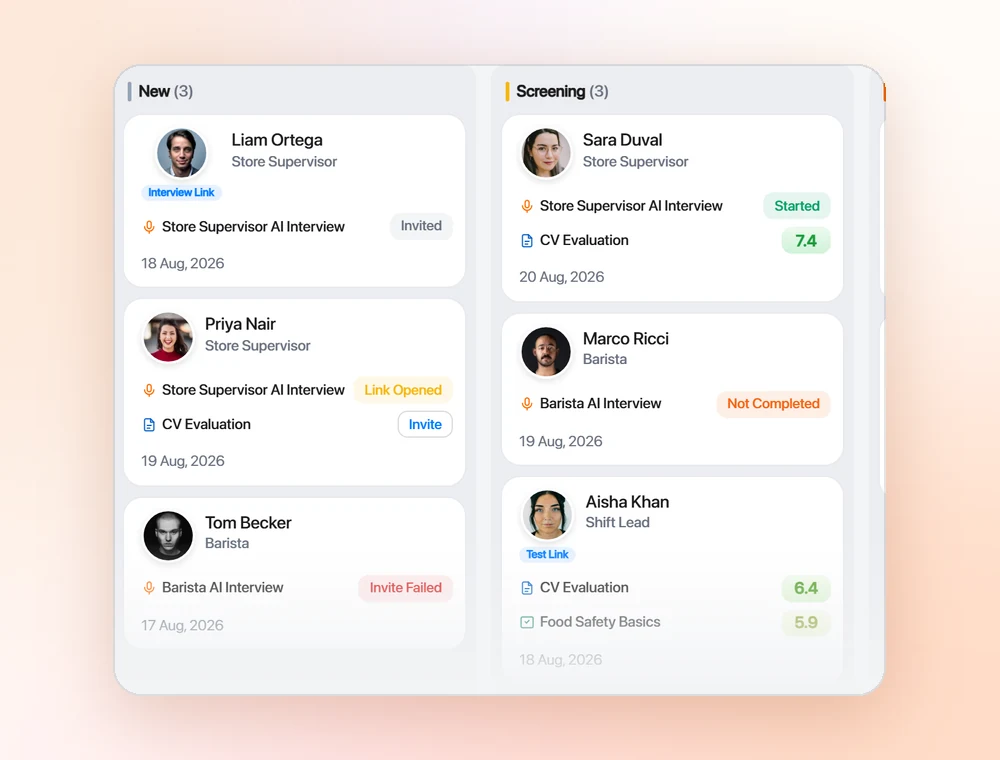
| Hiring record | Connected ATS and Ribbon candidate workflow[3] | Included applicant tracking and stages |
| Enterprise access | Custom scope includes SAML and sub-teams[2] | Confirm organization-specific access requirements |
Demonstrate the integration for the actual ATS. A directory entry does not establish that every score, attachment or stage update is supported. Test an applicant with two open applications and a completed interview for only one role. Confirm where the report lands, whether the hiring manager can open it and how the team resolves a failed update[3].
Ribbon's MCP page describes read-only access. That can help a compatible AI assistant answer questions about jobs and applications, but it does not authorize the assistant to move candidates or issue offers. Flowmingo also provides MCP, so compare the available tools and access boundaries instead of treating the protocol itself as a unique advantage[5].
For a small team, the included Flowmingo tracker may cover the workflow without a separate ATS connection. For an established staffing operation, preserving existing records and submission practices may matter more. Decide which system owns the candidate stage and which stores the assessment. That prevents conflicting updates when both interfaces are used during a pilot.
Scoring, oversight and candidate data
Review actual trust evidence and configured access
Ribbon publishes an audit page and offers access to its report. The page's broad fairness language should not be treated as proof that every configuration is bias-free. Request the current report and security scope relevant to the interview deployment, then review the employer's own rubric and process[6].
An audit should answer a concrete procurement question. Check the product version, assessment scope, date and population covered. Do not turn a marketing headline into an independent conclusion about fairness. Use the documentation to identify what is already supported and what the employer still needs to validate for its own roles.
Review access across the interview platform, ATS and any connected AI client. Read-only access still exposes candidate information, so limit it to an appropriate audience. Confirm how recordings, transcripts and reports are retained or deleted in each system. Include shared client links in that inventory rather than treating the original workspace as the only copy.
| What | Ribbon | |
|---|---|---|
| Audit evidence | Report access offered through Ribbon[6] | Request evidence relevant to the configured assessment |
| Scoring review | Inspect questions, rubric and supporting answers[1] | Inspect criteria, reasons and recorded evidence |
| MCP boundary | Read-only ATS tools described[5] | Review granted tools and permissions |
| Retention | Confirm interview and exported-record terms | Plan-dependent video window; results remain |
| Access control | Plan-specific team and enterprise options[2] | Workspace roles and sharing permissions |
| Decision | Define employer review before progression | Recruiter makes hiring decisions |
Which should you choose?
| If you are | Pick | Why |
|---|---|---|
| You need a published paid package with outreach and ATS scope | Ribbon | Ribbon lists tier allowances and bundled capabilities; verify the exact workflow[2]. |
| You need unlimited interviews without a subscription | Flowmingo | Core AI interviews are unlimited on Free. |
| You require a browser voice-only interview option | Ribbon | Ribbon explicitly offers voice and video formats[1]. |
| You need many reviewers across a few roles | Flowmingo | Unlimited team members avoid a core reviewer-seat limit. |
| You need WhatsApp invitations | Either | Both have invitation workflows; compare eligibility, delivery and charges[4]. |
| You need an included hiring tracker | Flowmingo | Projects and applicant stages are included on Free. |
| You need AI-assisted ATS lookup | Either | Both offer MCP; compare actual read tools and permissions[5]. |
| You need defensible assessment evidence | Either | Inspect the same sample answers and the explanation behind each score. |
Moving from Ribbon: test one role first
Pilot a single role with its real outreach and ATS handoff. Keep the billing period and expected interview count explicit so the commercial comparison matches the tested workflow.
- Choose the role and evidence standardAgree the questions, required criteria and expected interview length. Include an answer that needs clarification and one with incomplete evidence.
- Test invitations and completionRun the intended email, SMS or WhatsApp journey. Check device setup, reminders, completion status and the candidate's next-step message.
- Review the report and integrationOpen results as a hiring manager and, if relevant, a client. Check permissions, the correct application record and failed-event handling.
- Calculate the actual plan requirementInclude seats, active roles, usage, overage and retention. Compare the annual commitment with the same period and evidence requirements in Flowmingo.
Pilot it on 1 role this week. Unlimited AI interviews in 60+ languages, for $0.
Start Hiring FreeThe full comparison, point by point
For the procurement checklist: all 36 points, with a source on each. Open a group.
Price and plan limits6 points
| What | Ribbon | |
|---|---|---|
| Growth, annual billing | US$499/month; 100 interviews, 2 seats, 2 active roles[2] | Free: unlimited interviews, team members and projects |
| Business, annual billing | US$999/month; 400 interviews, 5 seats, 5 active roles[2] | Starter: US$49/month; core volume remains unlimited |
| Scale, annual billing | US$1,999/month; 1,000 interviews, 10 seats, 10 active roles[2] | Growth: US$99/month; core volume remains unlimited |
| Published overage | US$4 / US$3 / US$2.50 per interview respectively[2] | No core AI interview overage |
| Enterprise | Custom terms; confirm unlimited scope and extras[2] | Confirm any requirements beyond published plans |
| Trial | Seven days advertised[2] | Ongoing Free plan |
The interview6 points
| What | Ribbon | |
|---|---|---|
| Questions | Custom questions for the role[1] | Generate and edit questions from a job description |
| Rubric | Role-specific criteria[1] | Criterion ratings with configurable importance |
| Follow-ups | Probe answers that need more detail[1] | Follow-ups during the spoken interview |
| Formats | Voice and video options[1] | Standard asynchronous browser AI interview |
| Technical work | Demonstrate any required executable exercise | Technical Tests support executable coding questions |
| Decision | Scored review for the hiring team[1] | Recruiter reviews evidence and decides |
Candidate experience6 points
| What | Ribbon | |
|---|---|---|
| Timing | Candidate completes on their own schedule[1] | Candidate completes independently |
| Device | Modern phone or computer browser[1] | Browser interview with camera and microphone check |
| Interview language | 10+ advertised; verify the selected language[1] | 60+ spoken interview languages |
| Outreach | Email, SMS and separately described WhatsApp workflow[4] | Email and eligible paid WhatsApp invitations |
| WhatsApp purpose | Invitation, reminder and progress tracking[4] | Invitation linking to the browser interview |
| Branding | White-label options in published plans[2] | Plan-dependent company branding |
Reports and evaluation6 points
| What | Ribbon | |
|---|---|---|
| Evidence | Recording and transcript together[1] | Recording and transcript alongside scores |
| Summary | Interview summary and recommendation[1] | Strengths, gaps and recommendation |
| Scoring | Custom role rubric[1] | 0-10 criterion ratings and importance-weighted overall score |
| Client handoff | Evaluate the required staffing report workflow[7] | Report links; paid branded sharing and downloads |
| ATS access | Validate the selected connector's result mapping[3] | API/webhooks; confirm required fields and permissions |
| Human review | Scored review supports the team | Recruiter retains the decision |
Integrations and team6 points
| What | Ribbon | |
|---|---|---|
| ATS connections | Published directory of named integrations[3] | API, webhooks and MCP; confirm native availability |
| Mapping | Advanced mapping appears in higher-tier scope[2] | Scope custom event and field mapping |
| Outreach timeline | WhatsApp activity alongside email and SMS[4] | Candidate invitations and hiring-project workflow |
| MCP | Read-only ATS lookup through compatible clients[5] | MCP available; compare tool scope and permissions |
| Hiring record | Connected ATS and Ribbon candidate workflow[3] | Included applicant tracking and stages |
| Enterprise access | Custom scope includes SAML and sub-teams[2] | Confirm organization-specific access requirements |
Oversight and candidate data6 points
| What | Ribbon | |
|---|---|---|
| Audit evidence | Report access offered through Ribbon[6] | Request evidence relevant to the configured assessment |
| Scoring review | Inspect questions, rubric and supporting answers[1] | Inspect criteria, reasons and recorded evidence |
| MCP boundary | Read-only ATS tools described[5] | Review granted tools and permissions |
| Retention | Confirm interview and exported-record terms | Plan-dependent video window; results remain |
| Access control | Plan-specific team and enterprise options[2] | Workspace roles and sharing permissions |
| Decision | Define employer review before progression | Recruiter makes hiring decisions |
Questions buyers ask
Is Ribbon only a voice interviewer?
No. The current product and pricing pages explicitly include voice and video interviews[1,2].
Does Ribbon conduct the interview inside WhatsApp?
Its WhatsApp page says the channel delivers an invitation and link; the structured interview runs in Ribbon[4].
Are the displayed Ribbon prices monthly subscriptions?
The reviewed page displays monthly equivalents billed annually. Obtain month-to-month terms separately; this comparison does not infer them from the annual amounts[2].
Can Ribbon MCP change ATS records?
Its current MCP page describes read-only access and explicitly excludes changes to jobs, candidate stages and offers[5].
Sources and method
This comparison was updated on 4 Oct 2026. Competitor claims link to Ribbon's own pages or a named third party; ratings carry their own checked dates. Flowmingo facts come from our pricing, the AI Interviewer page, a sample report, our Data Processing Agreement and our Privacy Policy. Spotted something out of date? Tell us below and we fix it.
All 7 sources
- 1 Ribbon: current AI Interviewer. ribbon.ai
- 2 Ribbon: plan prices and allowances. ribbon.ai
- 3 Ribbon: ATS integration directory. ribbon.ai
- 4 Ribbon: WhatsApp invitation workflow. ribbon.ai
- 5 Ribbon: read-only MCP capabilities. ribbon.ai
- 6 Ribbon: audit information and report request. ribbon.ai
- 7 Ribbon: staffing screening workflow. ribbon.ai
What changed, and when
- Added a sourced comparison of the current product, commercial terms, interview experience, review evidence and workflow fit. Vendor statements are distinguished from hands-on validation.